


Is there an Octopus energy battery storage tariff?
Published: 2026-10-07 01:01:19
Updated: 2026-10-06 18:02:16
Octopus Flux and Intelligent Octopus Flux are domestic battery storage tariffs that price import and export by time of day, not a free battery.

Octopus energy battery storage tariff?
Understand octopus energy battery storage tariff in the UK, with clear explanations, examples, and practical next steps.
Is there an Octopus energy battery storage tariff?
Octopus Flux and Intelligent Octopus Flux are the products that match an Octopus energy battery storage tariff search. They are domestic import and export supply tariffs for homes that can shift electricity with a battery. They are not a grant, a battery purchase scheme, or an installation carried out by the supplier. Flux prices the electricity you buy and, where an export arrangement is in place, the electricity you send out, across off-peak, day and peak windows. Intelligent Octopus Flux is the related smart tariff. Octopus can schedule a compatible battery if you grant access, rather than the household only setting the times.
The battery stays your equipment, normally bought and installed outside the energy contract as residential solar battery storage. A standard storage tariff should not be read as including a free or discounted battery, or as Octopus fitting the hardware, unless a specific offer that is open today says otherwise. Availability depends on postcode, meter type and kit compatibility, so an old rate card is not a live offer. This guide describes product shape only. It is not pinned to a rate-card date, and it does not quote unit rates, standing charges or savings.
How Flux differs from other Octopus products
Flux-style products are built around solar and storage. On standard Octopus Flux, the household or the inverter app is expected to follow the published windows. Intelligent Octopus Flux adds supplier scheduling only where Octopus has an integration and you allow control. A battery that is widely installed in the UK is not automatically on that list. If it is not listed, the smart product may be closed even though a manual time-of-use product is still possible. Octopus has commonly published Flux as three bands: a short overnight off-peak window, a daytime band, and an early-evening peak. In public descriptions those bands have often been discussed as roughly 02:00 to 05:00, the rest of the day, and 16:00 to 19:00. Treat that only as a picture of the product shape. Clock times, regional variants and any export rules have to be read on the live Octopus Flux and Intelligent Octopus Flux pages before an inverter schedule is set. Do not copy times from a forum post. Agile Octopus is a separate import product that follows wholesale prices in half-hourly slots. Outgoing Fixed and Outgoing Agile are the fixed-rate and half-hourly versions of Outgoing Octopus. One pays export at a rate set by that product. The other links export to half-hourly wholesale prices. Neither is a home-battery tariff in the Flux sense, though some households pair an import tariff with one of them and run the battery themselves. Intelligent Octopus Go is an electric-vehicle tariff built around a charging window for a compatible car, not around a home battery as the main asset. Eligibility, who may control the asset, and whether storage use is permitted are not the same across these products. Do not assume Flux can be stacked with Outgoing Fixed or Outgoing Agile. The live terms say which export arrangement applies. Export payments for small-scale generation in Great Britain commonly sit under the Smart Export Guarantee. Confirm the current arrangement against Ofgem's Smart Export Guarantee guidance and the Octopus page for the product you are actually offered. Rates, standing charges, exit fees and any export caps are set by the supplier and can change by date and region. They are not fixed by a national battery-tariff rule.
Overview
Northern Ireland supply is a separate market from Great Britain. A Great Britain product page should not be assumed to apply there, including Flux, Outgoing Fixed, Outgoing Agile and Intelligent Octopus Go.
Who a storage tariff actually suits
This suits owner-occupiers, and some private tenants, in Great Britain who already have a home battery or are about to install one, usually with solar, and who can live with a smart meter and prices that move through the day. A battery can still be worth it without solar in some homes, but the tariff maths is different. A meter that records the relevant import and export intervals is normally required before time-of-use settlement and export payments can work as the product intends. Without that meter, joining may be delayed or refused even if the battery is already on the wall.
It is a weak fit if you want a flat rate, cannot have a smart meter fitted, or do not want a third party controlling the battery. A very small battery, or one kept only for backup, may not move enough energy to justify a peak-priced window. Renters who cannot change the supply contract or the electrical installation are generally outside the practical audience, even if the landlord has solar on the roof.
Business, factory and farm sites follow a different contracting path. Half-hourly industrial supplies and large behind-the-meter batteries are not domestic Flux-style products. Commercial battery storage, industrial battery storage and grid-scale battery energy storage systems use different metering, contracts and network studies. Do not infer a business tariff from a domestic storage page.
What has to be true on site before it helps
In practice the tariff only helps if the battery can move energy in the windows that product prices. Charging from the grid on cheaper import and discharging in expensive periods works when usable capacity covers evening use, round-trip losses are acceptable, and the home is not forced to import at peak because the battery is already empty. Usable capacity sits below the nameplate figure, and a stored kilowatt-hour is not a full kilowatt-hour returned to the house or the grid.
Winter solar often cannot refill a battery every day, so a schedule copied from a summer bill can fail in January. An export limit, inverter settings, or an existing solar inverter can cap charge and discharge rates even when the tariff shape looks favourable. Connecting generation and storage to the local distribution network is a separate job from the supply switch. In Great Britain that connection is typically handled under G98 or G99, depending on capacity and what the distribution network operator requires. The tariff does not grant that connection, and an installer notification is not the same as completing the Octopus switch or setting up import and export MPANs.
On a manual time-of-use tariff, charge and discharge times live in the inverter or battery app and need updating if the published windows change. On an intelligent tariff, those local schedules can fight the supplier's commands if both stay active. Export income also depends on an accepted export arrangement, often under the Smart Export Guarantee, and on the meter recording export rather than the app only showing generation.
Why the bill may not match the app
Clamp direction, export metering and hybrid inverter mode are common reasons a bill disagrees with the monitoring app. The app can show healthy solar generation while the supplier sees little export, or the battery can charge from the grid when you believed it was solar-only. Backup gateways and islanding modes are separate from tariff optimisation. They can disable the grid charge or discharge path the tariff assumes is available.
Compatibility is not static. Firmware, internet uptime, and sometimes an approved installer account can all be required before smart control works. Daily full cycling to chase a peak export window may be allowed by the tariff and still be a poor idea under the battery warranty. Read the cycle and throughput terms before you treat arbitrage as free money. Losses, export caps and product rules can remove the gap that a simple overnight-versus-peak comparison suggests.
Before you switch, get these checks agreed rather than assumed. If the site survey is still open, you can book a free survey to confirm the kit and connection path.
What to check before you switch
A smart meter that can record the import and export intervals the product uses is normally part of joining, not an optional extra. The tariff still does not include the battery. You buy and install the hardware yourself, or you already own it. If the property is in Northern Ireland, do not treat a Great Britain Octopus page as your offer. Warranty cycling is a separate constraint from the tariff. A schedule that looks attractive on a unit-rate comparison can still be the wrong way to run the pack.
Do not reuse a forum saving or an old pence-per-kilowatt-hour figure as your expected bill. Live import and export rates, standing charges and window times have to come from Octopus's current pages for your region, including the Flux, Intelligent Octopus Flux, Outgoing Fixed, Outgoing Agile and, if you are comparing a car tariff, Intelligent Octopus Go pages. Cross-check the export arrangement with Ofgem's Smart Export Guarantee guidance. This article does not estimate hardware cost, annual savings or payback, because those depend on your import, solar generation, usable capacity and the tariff that is actually open to you. A separate guide on how to calculate the payback covers the method without fixing a rate.
Download a stretch of your own use if the meter or inverter allows it, and note how much of your demand sits in the evening. Ask the installer what charge and discharge rate remains after any export limit, G98 or G99 constraint, or hybrid-inverter setting. Then compare a Flux-style product, an intelligent product only if your kit is listed, and a simpler import tariff paired with Outgoing Fixed or Outgoing Agile, using those live prices. If the battery is mainly for power cuts, check whether it can work during a power cut before you treat a peak-priced storage tariff as the right tool.
Plan, Compare & Buy Renewable Energy Solutions
AI does the thinking.
You get the perfect solar match.
Use RoboMo™ to assess your property, compare available technologies and connect with trusted UK installers, suppliers and manufacturers.
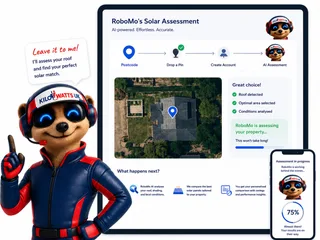
Simply enter your postcode, drop a pin on your roof, create your free account and let RoboMo™ analyse your property to find the best solar panels for your home.

You don't have to think
RoboMo™'s AI analyses your roof and does all the hard work.

Accurate & tailored
AI-powered assessment based on your roof, location, and conditions.

Best options, maximum savings
Compare top solar panels for the best performance and value.

Simple, fast & effortless
Provide a few details, sit back and watch your results unfold.
STEP 1
Choose Home, Business or Industrial
Enter your postcode to start your assessment.
STEP 2

Drop a pin on your roof
STEP 3

Create your free account
STEP 4

Sit back and watch RoboMo™ work
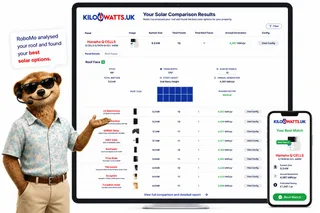
RoboMo™ analyses your roof and builds your personalised solar comparison.

Step 1
Enter your postcode
Start designing your wind energy system in seconds.
Are you an installer, distributor or renewable energy business?
Kilowatts UK is expanding the Flower Turbines partner network across the UK.
Become A Flower Turbines PartnerKilowatts UK is an authorised representative
Flower Turbines
Compact vertical-axis turbines built for real UK sites, not just open farmland.
They start in light wind, sit in a small footprint, and are bird-safe by design. Cluster them as a bouquet and the group performs better together than the same turbines standing alone. Enter your postcode for a location-based generation estimate. Figures use area weather data and will differ if buildings, trees or hills sit in the way.
Starts in light UK wind
Built to generate in typical UK wind, not only open farmland.
Small rooftop or ground footprint
Compact towers for roofs, yards and tight sites.
Bird-safe slow rotation
Slow vertical-axis spin, bird-safe by design.
Bouquet clusters raise output
Grouped turbines outperform the same units standing alone.
STEP 2

Choose a location
STEP 3

Place your cluster
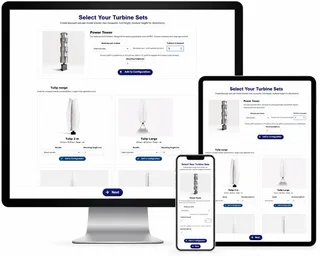
Tap the map where you want the turbine cluster to go.
STEP 4

Instant generation forecasts
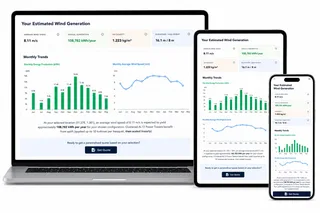
Compare different turbine layouts and see annual generation forecasts instantly.
STEP 5

No commitment required
Explore different configurations before deciding whether to request a quotation.
Related articles


FAQ
Need Help? RoboMo's Got Answers
Is there an Octopus energy battery storage tariff?
Octopus Flux and Intelligent Octopus Flux are the domestic products that match a search for an Octopus energy battery storage tariff. They are import and export supply tariffs for homes that can shift electricity with a battery, not a grant, a battery purchase scheme, or an installation by the supplier. Flux prices the electricity you buy and, where an export arrangement is in place, the electricity you send out, across off-peak, day and peak windows. Intelligent Octopus Flux is the related smart tariff, where Octopus can schedule a compatible battery if you grant access. Availability depends on postcode, meter type and kit compatibility, so an old rate card is not a live offer.
Does an Octopus storage tariff include a free or discounted battery?
No. The battery stays your equipment and is normally bought and installed outside the energy contract. A standard storage tariff should not be read as including a free or discounted battery, or as Octopus fitting the hardware, unless a specific offer that is open today says otherwise. You still need suitable kit, a connection that the network accepts, and a meter that can record the intervals the product uses.
How does Octopus Flux differ from Intelligent Octopus Flux?
On standard Octopus Flux, the household or the inverter app is expected to follow the published windows. Intelligent Octopus Flux adds supplier scheduling only where Octopus has an integration and you allow control. A battery that is widely installed in the UK is not automatically on that list. If it is not listed, the smart product may be closed even though a manual time-of-use product is still possible. Check the live product pages for your region before you set a schedule.
Can I use Outgoing Octopus, Agile or Intelligent Octopus Go instead of Flux?
Outgoing Fixed and Outgoing Agile are export products, not home-battery tariffs in the Flux sense, though some households pair an import tariff with one of them and run the battery themselves. Agile Octopus is a separate import product that follows wholesale prices in half-hourly slots. Intelligent Octopus Go is built around a charging window for a compatible electric vehicle, not around a home battery as the main asset. Do not assume Flux can be stacked with Outgoing Fixed or Outgoing Agile. The live terms say which export arrangement applies.
Who is an Octopus battery storage tariff suitable for?
It suits owner-occupiers, and some private tenants, in Great Britain who already have a home battery or are about to install one, usually with solar, and who can live with a smart meter and prices that move through the day. A battery can still be useful without solar in some homes, but the tariff maths is different. It is a weak fit if you want a flat rate, cannot have a smart meter fitted, do not want a third party controlling the battery, or have a very small pack kept only for backup. Business, factory and farm sites follow a different contracting path and should not infer a tariff from a domestic storage page.
What has to be in place before a storage tariff actually helps?
The tariff only helps if the battery can move energy in the windows that product prices. Usable capacity sits below the nameplate figure, round-trip losses apply, and winter solar often cannot refill a battery every day. An export limit, inverter settings, or an existing solar inverter can cap charge and discharge rates. Connecting generation and storage is a separate job from the supply switch, typically under G98 or G99 in Great Britain depending on capacity and what the distribution network operator requires. The tariff does not grant that connection.
Why might my bill not match the battery or solar app?
Clamp direction, export metering and hybrid inverter mode are common reasons a bill disagrees with the monitoring app. The app can show healthy solar generation while the supplier sees little export, or the battery can charge from the grid when you believed it was solar-only. Backup gateways and islanding modes can also disable the grid charge or discharge path the tariff assumes is available. Export income depends on an accepted export arrangement, often under the Smart Export Guarantee, and on the meter recording export rather than the app only showing generation.
What should I check before switching to Flux or Intelligent Octopus Flux?
Confirm the exact battery and inverter are on the live list for that product, and that import and export MPANs and the meter can settle the intervals used. If Octopus is meant to control the battery, switch off local schedules so they do not fight the supplier's commands. Check that backup or island mode will not block charge and discharge, and read warranty cycle limits before daily cycling for bill savings. Take live import and export rates, standing charges and window times from Octopus's current pages for your region, and do not reuse a forum saving or an old unit rate. Northern Ireland supply is a separate market, so a Great Britain product page should not be assumed to apply there.