


Home battery storage in Kent
Published: 2026-10-06 02:47:08
Updated: 2026-10-05 19:47:45
There is no single Kent payback for home battery storage. Compare usable evening energy, tariffs, UK Power Networks and a lawful place to site it.
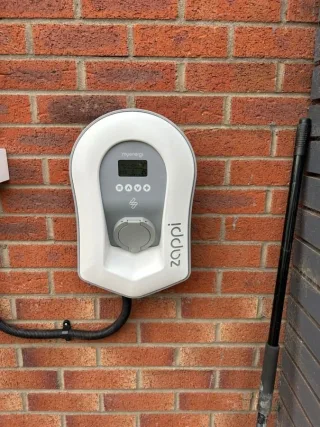
Home battery storage in Kent
Home battery storage in Kent from Kilowatts.uk in Broadstairs. Costs, roofs, planning and what to do next then compare a local system.
Home battery storage in Kent
Whether that is a sound buy depends on the after-dark load, the import and export tariffs, usable capacity after losses, the installed cost of the actual coupling method, a lawful place to put the battery, and the grid connection that will be accepted. There is no single Kent payback, no county export rate, and no verified county grant to put into a spreadsheet.
A practical start is half-hourly smart-meter data, the inverter already on the wall, and a written choice between a self-consumption battery and a system designed to keep selected circuits on in a power cut. Those are different jobs. Most domestic systems are not whole-house backup, and they are not a route off the grid.
What usable evening energy actually is
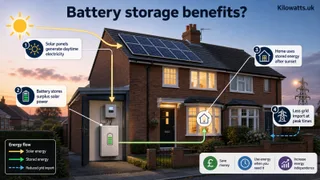
A domestic battery is an electrical store, most often lithium-ion, charged from the photovoltaic array and sometimes from the grid on a time-of-use import tariff. Its measured effect is higher self-consumption: a larger share of on-site generation is used in the home. The nameplate kilowatt-hour figure is not the energy you can rely on after dark.
Depth-of-discharge limits set by the manufacturer reduce the usable share of that nameplate. Conversion losses between the battery and the circuits you care about reduce it again. A cloudy day may leave the store only partly charged by evening. Manufacturer round-trip efficiency claims are often in a high band, but they are product claims, not a Kent average, and they do not include every loss in the wider system.
The right comparison is usable evening energy against the load that actually occurs after generation falls away. Ordinary lighting, a fridge and electronics are a modest draw. Electric heating and hot water can dwarf the store. A normal domestic battery covers hours of ordinary load, not days of winter heating, and it does not make the household independent of the grid. The arithmetic should be run on your meter data. The figures that follow are assumed, so the method is visible. They are not a survey, not a product rating, and not a Kent average. Assume a datasheet usable capacity of 10 kilowatt-hours after the stated depth of discharge, then allow about a tenth for conversion losses, leaving about 9 kilowatt-hours that can be delivered. At a steady 0.4 kilowatt of ordinary evening load, that store covers a long evening and into the next morning. Add a 3 kilowatt heater or immersion and the same store is gone in roughly three hours. The installer should replace every assumed figure with the datasheet and your half-hourly use before a size is treated as suitable.
Self-consumption and the Smart Export Guarantee
The Smart Export Guarantee is a Great Britain scheme. Ofgem publishes the framework, and larger licensed suppliers must offer a tariff for eligible exported renewable electricity. The rate, the metering rules and how a battery affects measured export are set by the supplier under those rules. They are not set by the county, and a battery does not itself create a payment. Check the current Ofgem SEG guidance and the supplier’s current terms, rather than an older blog summary or a neighbour’s rate.
Storing midday generation and using it in the evening can be rational when avoided import is worth more than the export rate on that household’s tariffs. The same choice usually reduces export volume, so export income can fall even while the overall bill improves. That comparison only works with the actual import and export prices. A national average, or a rate quoted for another region, is not evidence for a Kent bill.
A smart meter does not by itself make every SEG tariff available. Electricity imported from the grid and later exported is not the same thing as renewable generation. Supplier terms commonly refuse SEG payment on that grid-charged export, and some require metering that keeps it separate from solar export. Confirm that before anyone assumes overnight charging will earn an export income. Where the tariff requires MCS, the certificate should cover the equipment being relied on, not an older solar-only install that no longer matches the system.
G98, G99 and G100 with UK Power Networks
Choosing a battery brand is separate from connecting it. Most Kent premises are in UK Power Networks’ South Eastern licence area. Newer estates are sometimes on an independent distribution network operator, in which case that company’s process applies. Solar and storage still go through notification or application, and sometimes an export limit. Constraints in parts of the South East can slow an offer or cap how much may leave the property. A battery changes when electricity is exported. It does not remove a connection limit or guarantee a payment.
Installers and DNO offers use three labels, and the quote should say which one it assumes. G98 is the engineering recommendation used for many small, fully type-tested connections, commonly discussed around 16 amps per phase, where the route is notification rather than a full application before connection. G99 is the recommendation used when the equipment is larger, is not on that notification route, or otherwise needs an application before it is commissioned. G100 is the recommendation for a customer export-limitation scheme, used when export must be capped below what the inverters could otherwise send out. A setting in an app is not the same thing as a G100 scheme the network operator has accepted.
What should be checked early is the existing inverter model, any export limit already agreed, whether the new kit changes the inverter arrangement, and whether the combined equipment still sits on the route the quote names. An existing solar connection, even one already notified, does not automatically authorise a later battery. A hybrid swap is assessed on the new inverter. An AC-coupled battery can add a second device that is capable of export. Exact treatment depends on the proposed equipment and on current UK Power Networks guidance for notification and application. It should be confirmed on the job, not guessed from a postcode.
Where a battery can sit on a Kent property
Kent’s solar resource is in the better part of Great Britain, but yield still depends on orientation, pitch, shading and system size, not on the county name. Housing is just as varied: dense terraces, newer estates, and rural or estuarine properties. Cable route, consumer-unit condition and a lawful place for the battery often move the quote more than the district name.
Coastal and estuarine districts, including parts of Thanet, Sheppey, the Medway and Thames estuary, and Romney Marsh, raise ordinary siting issues. Salt air matters for outdoor equipment. Flood risk matters for anything mounted low. A waterproof cabinet is not the same as a manufacturer environmental rating, and a basement or outbuilding is not suitable until temperature, ventilation, fire separation and flood level have been checked. On marsh and estuary sites, ask which flood level was used before any low-mounted plant is accepted.
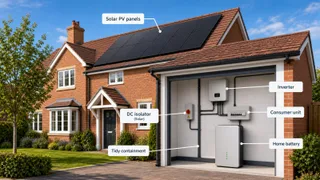
Conservation areas and listed buildings rarely block an internal battery by themselves. External enclosures, and any work to a listed building, can need consent. That is a question for the specific property and the local planning authority, not a county-wide rule. For fire safety, the quote should name the specification being applied. For dwellings that is commonly PAS 63100, alongside BS 7671 for the electrical installation. Location rules are design constraints: clearance, separation from habitable rooms and escape routes, ventilation, and avoidance of spaces that overheat. The edition being worked to should be named, not assumed.
What moves the installed cost
There is no stable published price for home battery storage in Kent, and a national online figure or a neighbour’s quote is not your number. The same nameplate capacity can be a very different job once the electrical work is specified. Compare written scopes, not headline kilowatt-hours.
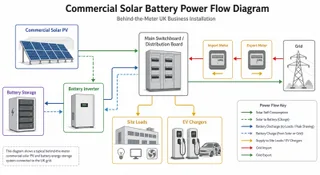
The largest swings are usually the coupling method and the electrical upgrades. A battery fitted with a new array can share inverter choice, metering and the connection proposal. A retrofit often means a hybrid inverter change, or an AC-coupled battery beside the existing solar inverter, and those routes are not interchangeable on price. A consumer-unit upgrade, earthing work, a long cable route, poor access, an outdoor enclosure, or a backup gateway with a dedicated circuit board can each add labour that a product-only price leaves out. Scaffold and roof work belong to the array, but they still affect a combined quote.
VAT is a line on the invoice, not a county average. In Great Britain, HMRC’s energy-saving materials rules have zero-rated qualifying installations of solar panels and of battery storage in residential accommodation. From February 2024 that treatment was extended to battery storage installed on its own, within a relief period set to run to 31 March 2027 unless the rules change. A supply-only purchase, a non-residential job, or a later rule change can be treated differently. Read the VAT line on the quote against current HMRC guidance, and do not treat a zero rate as guaranteed for every Kent job.
New solar, retrofit and backup that is designed
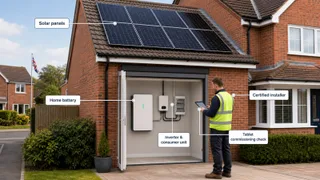
A battery fitted with a new array is usually simpler to design, because inverter choice, metering and the connection proposal can be made together. A retrofit should state whether the solar inverter is being replaced or reworked, or whether storage is being added beside it, and what happens to monitoring and any existing warranties. Until that is written down, the figure is not comparable with a new-build package. Many hybrid systems shut down with the grid unless a backup gateway and a backed-up circuit are designed in. A sentence such as “the house will run in a power cut” should not appear unless the circuits, the changeover equipment and the limits of that island mode are listed. Runtime is unknown until the backed-up load and the usable capacity are specified. Most systems are not whole-house backup. Equipment that must stay on for safety or medical reasons should not be assumed to be covered. Commissioning should leave you with evidence of the UK Power Networks notification or application, or the equivalent from an independent network operator, an electrical installation certificate, and access to monitoring. If a tariff or a notification route you are relying on requires MCS, that certificate should match the finished system. Failed communications and degradation are otherwise invisible until the bills change.
Who it suits and who should pause
Storage is most relevant for a Kent household with solar, or a firm plan to install it, that uses electricity outside generating hours. Evening peaks, shift patterns and a time-of-use import tariff can strengthen the case, provided the extra cycling is accepted and any grid-charged energy is not assumed to earn export income. A specified backup circuit can also be a sound reason, if the electrical design includes it and you accept that the rest of the house may still go dark.
It is a weak fit where there is little solar, very low electricity use, no space that meets the fire and ventilation specification named on the quote, or a connection upgrade the household does not want to pay for. Renters and many leaseholders cannot commission the work without the building owner. It is also a poor fit if the goal is to heat the house through an outage or to leave the grid. Usable capacity on a normal domestic battery is the wrong scale for that job.
Cycle life and warranty length are product-specific. They are often discussed around a ten-year or cycle limit, and both need to be read on the datasheet rather than assumed for the county. A warranty is not a prediction of bill savings.
Grants, outages and grid-charged export
There is no verified Kent battery grant to build into the decision. If a scheme is mentioned, ask which body pays it, who is eligible, whether it applies to storage, solar, or both, and where that is published. Do not treat a national headline, or a scheme aimed at a different technology, as a discount on this quote. Eligibility and amounts change, and an installer-mentioned payment is not confirmed until the paying body says so.
In a power cut, a standard grid-tied hybrid system is expected to shut down with the network unless backup has been designed. Designed backup keeps selected circuits on, for a runtime set by usable capacity and those loads, and it still leaves other circuits off. It is not the same as an off-grid system, and it will not carry whole-house electric heating through a long outage. If backup matters, it has to be a line in the design, not a hope attached to a self-consumption battery. Read how a battery behaves in a power cut before treating shutdown as a fault.
Energy that was imported from the grid and later exported should not be assumed to be paid under the Smart Export Guarantee. SEG is for eligible renewable export. Ofgem’s framework and the supplier’s terms decide what is metered and what is paid, and grid-charged export commonly falls outside payment. Using stored solar in the evening can still reduce the bill when avoided import is worth more than the export you forgo. That is a tariff comparison, not a county rule.
What to gather before you compare quotes
Before you compare installers, gather the evidence that actually changes the design. A nameplate size chosen because it is popular in the South East will not match a home that uses very little after dark, or one whose connection is already export-limited. Ask for a written split between ordinary self-consumption and any backup function, the coupling method, and the siting assumptions in plain language.
The quote should also name the connection route in the language the network operator uses, and the fire-safety specification being applied. Outdoor plant should be justified by the manufacturer’s rating, not only by a cabinet that looks weatherproof. On estuary and marsh sites, the flood level used for the design should be stated before low-mounted plant is accepted.
The next useful step is a site-specific design that states the coupling method, the connection route, the siting standard, what is backed up, the VAT treatment, and what is deliberately left out. If those items are missing, the quotes are not yet comparable.
Plan, Compare & Buy Renewable Energy Solutions
AI does the thinking.
You get the perfect solar match.
Use RoboMo™ to assess your property, compare available technologies and connect with trusted UK installers, suppliers and manufacturers.
Simply enter your postcode, drop a pin on your roof, create your free account and let RoboMo™ analyse your property to find the best solar panels for your home.

You don't have to think
RoboMo™'s AI analyses your roof and does all the hard work.

Accurate & tailored
AI-powered assessment based on your roof, location, and conditions.

Best options, maximum savings
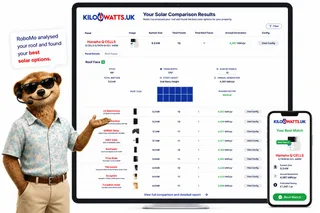
Compare top solar panels for the best performance and value.

Simple, fast & effortless
Provide a few details, sit back and watch your results unfold.
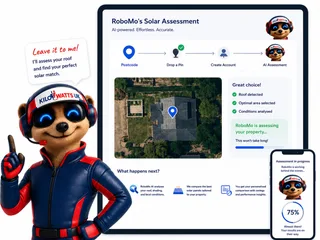
STEP 1
Choose Home, Business or Industrial
Enter your postcode to start your assessment.
STEP 2

Drop a pin on your roof
STEP 3

Create your free account
STEP 4

Sit back and watch RoboMo™ work
RoboMo™ analyses your roof and builds your personalised solar comparison.

Step 1
Enter your postcode
Start designing your wind energy system in seconds.
Are you an installer, distributor or renewable energy business?
Kilowatts UK is expanding the Flower Turbines partner network across the UK.
Become A Flower Turbines PartnerKilowatts UK is an authorised representative
Flower Turbines
Compact vertical-axis turbines built for real UK sites, not just open farmland.
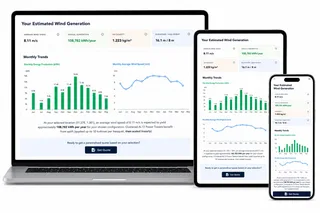
They start in light wind, sit in a small footprint, and are bird-safe by design. Cluster them as a bouquet and the group performs better together than the same turbines standing alone. Enter your postcode for a location-based generation estimate. Figures use area weather data and will differ if buildings, trees or hills sit in the way.
Starts in light UK wind
Built to generate in typical UK wind, not only open farmland.
Small rooftop or ground footprint
Compact towers for roofs, yards and tight sites.
Bird-safe slow rotation
Slow vertical-axis spin, bird-safe by design.
Bouquet clusters raise output
Grouped turbines outperform the same units standing alone.
STEP 2

Choose a location
STEP 3

Place your cluster
Tap the map where you want the turbine cluster to go.
STEP 4

Instant generation forecasts
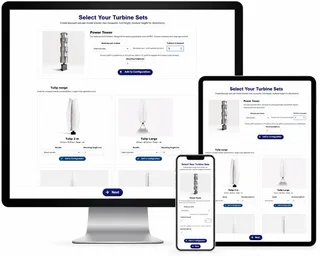
Compare different turbine layouts and see annual generation forecasts instantly.
STEP 5

No commitment required
Explore different configurations before deciding whether to request a quotation.
Related articles
FAQ
Need Help? RoboMo's Got Answers
Is a home battery worth it in Kent if I already have solar?
It can be, if a meaningful share of your electricity is used after the array has stopped generating. The battery does not increase what the roof produces; it stores electricity so more generation is used on site rather than exported. Whether it is a sound buy depends on your after-dark load, import and export tariffs, usable capacity after losses, the installed cost of the coupling method, a lawful place to put the battery, and the grid connection that will be accepted. There is no single Kent payback and no county export rate to put into a spreadsheet.
How much evening energy can a domestic battery actually supply?
The nameplate kilowatt-hour figure is not the energy you can rely on after dark. Depth-of-discharge limits and conversion losses both reduce usable capacity, and a cloudy day may leave the store only partly charged. Ordinary lighting, a fridge and electronics are a modest draw, while electric heating and hot water can empty a normal domestic battery in a few hours. The installer should replace any assumed figures with the datasheet and your half-hourly meter data before a size is treated as suitable.
Does a home battery increase Smart Export Guarantee payments?
No. The Smart Export Guarantee is a Great Britain scheme under which larger licensed suppliers must offer a tariff for eligible exported renewable electricity. Storing midday generation for evening use can reduce export volume, so export income may fall even if the overall bill improves. A battery does not itself create a payment, and electricity imported from the grid and later exported is commonly not treated as renewable generation for SEG. Check current Ofgem guidance and your supplier’s terms, including any MCS requirement, before assuming overnight charging will earn export income.
Do I need G98, G99 or G100 approval from UK Power Networks?
Most Kent premises are in UK Power Networks’ South Eastern licence area, though some newer estates are on an independent network operator. G98 is often the notification route for small, fully type-tested connections; G99 is used when an application is needed before commissioning; G100 is an accepted export-limitation scheme, not merely a setting in an app. An existing solar connection does not automatically authorise a later battery, and a hybrid swap or AC-coupled unit can change how the connection is assessed. Confirm the route on the quote against current network guidance rather than guessing from a postcode.
Where can a battery be installed on a Kent property?
Cable route, consumer-unit condition and a lawful location often matter more than the district name. Coastal and estuarine sites can raise salt-air and flood issues, and a waterproof cabinet is not the same as a manufacturer environmental rating. Conservation areas and listed buildings rarely block an internal battery by themselves, but external enclosures and work to a listed building can need consent from the local planning authority. For fire safety, the quote should name the specification being applied, commonly PAS 63100 for dwellings alongside BS 7671 for the electrical installation.
Will a home battery keep the house running in a power cut?
Most domestic systems shut down with the grid and are not whole-house backup or a route off the grid. A designed backup circuit needs a gateway, a listed set of circuits, and a clear statement of what stays off. Runtime is unknown until the backed-up load and the usable capacity are specified. Equipment that must stay on for safety or medical reasons should not be assumed to be covered.
Are there grants or a standard price for home battery storage in Kent?
There is no verified Kent battery grant to build into the decision. If a scheme is mentioned, ask which body pays it, who is eligible, and whether it applies to storage, solar, or both. There is also no stable published price for the county: coupling method, consumer-unit work, cable runs, enclosures and backup equipment can change the job more than the nameplate capacity. VAT treatment should be read from the quote against current HMRC guidance, not assumed for every installation.
Who is a home battery a poor fit for?
It is a weak fit where there is little solar, very low electricity use, no space that meets the fire and ventilation specification on the quote, or a connection upgrade you do not want to pay for. Renters and many leaseholders cannot commission the work without the building owner. It is also a poor fit if the aim is to heat the house through an outage or to leave the grid, because usable capacity on a normal domestic battery is the wrong scale for that job. Warranties and cycle life are product-specific and should be read on the datasheet, not treated as a prediction of bill savings.