Founder & Renewable Energy Author, kilowatts.uk


Founder & Renewable Energy Author, kilowatts.uk
Article
On 27 October 2026, Morlais reported that HydroWing had contracted Anglesey company Ecodetect to monitor a planned 30MW tidal-stream project.
How morlais ai wildlife monitoring work, typical output, costs and limits, and whether they have a future for UK homes, balconies and businesses.
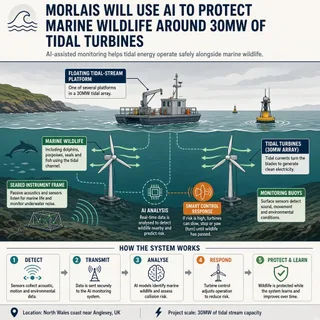
Morlais does not yet have AI protecting marine wildlife around operating turbines. On 27 October 2026, Morlais reported that HydroWing had contracted Anglesey company Ecodetect to monitor a planned 30MW tidal-stream project in the Morlais zone off North Wales. The plan is cameras and sonar feeding software that classifies seals, dolphins, fish and diving seabirds, and rejects seaweed, algae and debris, with results sent so operators can start mitigation. No devices were deployed when the contract was announced, and no detection accuracy has been published. A first device is scheduled for 2027, with 18 machines of 1.67MW targeted for 2030 if construction, finance and deployment hold. That is the direct status of the story. A monitoring contract on a future array is not a completed survey, a collision-risk model, or evidence that software already keeps animals clear of a turning rotor. The points that can be checked from the reported contract news, and the points that cannot, sit in a short set of facts.
This article does not reproduce the primary Morlais, HydroWing or Ecodetect notice, so it cannot attach that document or quote a checked passage from it. The sensor and mitigation points below are the substance reported with that contract news, not a transcription of a numbered clause. Anyone who needs the exact wording should read that notice itself. A summary is not a substitute for the source text.
The useful question is narrower than whether AI will watch dolphins. It is whether species-level detection in fast, murky water could later support adaptive operation, instead of relying only on conservative assumptions made before the machines exist. Nothing in the reported announcement shows that this has already happened.
The dates still depend on construction, financing and putting hardware in the sea. A contract signed before deployment can shape how the first device is instrumented. It cannot, by itself, bring the array forward, vary a consent, or prove that later devices will be allowed on easier terms.
In practice, treat three documents as different things even when they arrive in the same news cycle. The commercial contract says who will supply monitoring. The marine consent says what may be built and under what environmental conditions. The performance evidence, which does not yet exist in public, would say whether the classifier works in this channel. Mixing those three is the mistake that turns a supplier appointment into a claim of protection.
Boat surveys and seasonal counts tell planners which animals use a stretch of sea. They are less able to show what those animals do in the minutes when a rotor is turning in a strong tide. If behaviour near the device is uncertain, conditions can stay cautious, and expansion of an array can be slower than the engineering programme. Tidal-stream machines take energy from moving water in a channel, not from waves at the surface. Animals that matter include marine mammals, fish and birds that dive through the same water the rotor occupies.
Deployment in the Morlais zone is not authorised by a monitoring contract. In Welsh inshore waters, marine licences are determined by Natural Resources Wales under the Marine and Coastal Access Act 2009 regime. Habitats duties can also apply where European protected species such as harbour porpoise or bottlenose dolphin may be disturbed, and seals have separate protection. Parts of the sea around Anglesey are designated for harbour porpoise. This article does not map the array footprint onto a named site boundary, and it does not reproduce a marine licence, a European protected species licence, or any condition that names cameras, sonar or curtailment. Those documents, not the October 2026 contract note, set what the project is allowed to do.
Operating UK tidal-stream sites show why the evidence gap is familiar, and also why it does not travel as a template. MeyGen’s machines in the Inner Sound of the Pentland Firth, and Nova Innovation’s machines in Bluemull Sound, Shetland, have been discussed publicly in terms of monitoring animals around devices that actually rotate. Both sit under Scottish consenting, not Natural Resources Wales. That comparison only shows a shared problem: pre-construction surveys cannot fully describe behaviour beside a rotor that does not yet exist. It does not show that those projects use this camera-sonar-software chain, and it does not move a Welsh marine licence. Continuous monitoring is attractive because tides run on a timetable and the same channel is used again and again. A system that only samples a few calm days can miss the combination of current, visibility and animal movement that matters. It can also miss the ordinary clutter of a Welsh tidal site: weed, algae, bubbles and debris that look, to a naive detector, a little like an animal.
The announced design uses two sensor types because neither is reliable in every tidal condition. Cameras need light and reasonably clear water. Sonar can still return a target when the water is turbid, but bubbles, turbulence and hard debris can create returns that are not animals. Ecodetect’s role, as described, is to classify what those sensors see and to reject seaweed, algae and debris.
In practice the chain has more steps than a camera and a model. A detection has to be formed, classified, sent ashore or to an operator station, judged against a rule, and only then turned into a turbine action and a record someone can audit later. If any link is weak, “real time” does not by itself protect wildlife or keep generation orderly.
Mounting matters as much as the algorithm. Surface gear has to survive waves and vessel traffic. Seabed gear has to survive current, scour and biofouling. A lens or transducer that silts up will fail quietly unless someone maintains it and unless the failure itself raises an alarm. Software trained in clearer water, or on a different seabed, should not be assumed to transfer without site testing. The announcement does not describe training data, update cycles, or who checks classifications when the tide is running hard.
The headline task is classification: tell a dolphin, seal, fish or diving bird from weed and rubbish. That is harder than it sounds in a tide race. A curling frond can mimic a fin for a frame or two. A dense patch of bubbles can look like a school of fish on sonar. A diving bird is in the rotor zone only briefly, so a missed frame is a missed animal, not a slightly late label.
Two errors point in opposite directions, and both matter. Calling weed a dolphin can push operators to slow or stop a machine without a conservation benefit. Calling a dolphin weed can leave the animal unremarked in the record the consent was meant to protect. Fish and diving seabirds add further classes that can overlap in size and movement with debris.
No detection accuracy, false-positive rate or false-negative rate has been published for this contract. Until those figures exist, from this site or from an independent check, the seaweed-versus-dolphin claim is a design aim. It is not a demonstrated performance. A correct label would still not be a collision-risk result, because distance, relative speed and avoidance would remain unmeasured.
The announcement says results will be transmitted so operators can initiate environmental mitigation. It does not say what that action is. It does not say whether a turbine would stop automatically, whether a person must approve a slowdown, or how long an alert remains valid after the animal has left the frame. An alert with no rule is a notification. Mitigation is a defined change in how the machine runs, plus a reason that can be explained afterwards.
The following is not announced policy and should not be read as HydroWing or Ecodetect procedure. It is the minimum a written rule still has to contain before anyone could claim that an alert protects wildlife. Communications delay, a cluttered control screen, or an unclear duty holder can all break the chain between a correct classification and a useful response.
Excessive false alerts are a generation problem as well as a nuisance. If every weed event curtails a 1.67MW device, output falls without a matching benefit for wildlife. Missed detections do the opposite harm: the log looks quiet while animals were present. Either failure can damage confidence with Natural Resources Wales and with anyone later asked to rely on the record. That is why the handoff from software to a named rule needs to be written down before the first device is in the water, not inferred from a press note after the event.
Environmental uncertainty is one reason marine projects carry conservative assumptions. If later evidence showed that animals reliably avoid rotors, or that they only enter a defined zone in certain tidal states, operators and regulators could discuss tighter, evidence-based rules. That is the hopeful reading of automated monitoring. It is not what the October 2026 announcement has delivered. The other reading is just as plausible. If alerts are frequent and unverified, turbines could be curtailed more often than a pre-construction assessment assumed. If animals are missed, the monitoring record could not be used to relax anything, and might weaken trust in the method. Detecting an animal still does not calculate collision risk. Risk needs distance, relative speed, rotor state and avoidance, which are separate measurements from a species label.
Anyone treating this as a shortcut through consent should slow down. A monitor can supply evidence. It does not replace the marine licence, habitats duties, the collision analysis, or the construction programme. Scottish monitoring practice at operating sites is context, not a precedent that Natural Resources Wales must follow.
Morlais is a Welsh tidal-stream zone off North Wales, and HydroWing’s plan, as reported with the monitoring news, is 18 devices rated at 1.67MW, about 30MW in total, with completion targeted for 2030. The first device is scheduled for 2027. Both the project and the monitoring supplier are tied to Anglesey, so this is a local consenting and instrumentation story rather than a generic claim about AI at sea.
Rated megawatts are not annual energy. How much a tidal array produces depends on the resource, availability, and any time the machines are held back for environmental or technical reasons. No yield, capacity factor or wildlife-curtailment figure is available from the announcement, and none should be inferred from 18 times 1.67MW. Monitoring cost is similarly unpublished. Inventing a payback, a grant or a curtailment-hour total from the nameplate rating would mislead anyone comparing this project with other generation.
The 2030 array remains dependent on building, financing and putting machines in the water. Instrumentation planned now can make the first device more informative. It cannot prove that later devices will be consented on easier terms, and it cannot be used as if the zone’s marine licence had already been varied.
Regulators and operators will want errors in both directions, not a single accuracy slogan. A confusion matrix, showing how often each real class is labelled as each predicted class, is the straightforward way to show whether dolphins are separated from weed, and whether diving birds are confused with debris. Independent checks matter because the supplier of the software should not be the only reviewer of its own alerts.
Site conditions belong in that evidence. Turbidity, bubbles, current, biofouling and low visibility can all degrade cameras and sonar. A trial in clearer water, or a bench test on stored clips, would not answer how the system behaves on a spring tide off Anglesey. Maintenance of lenses and transducers is part of performance. A sensor that fails quietly can manufacture a false-quiet consent record, which is worse than an obvious outage.
Until those results exist, classification performance is unknown, time from alert to a turbine response is unknown, and lost generation from false alerts is unknown. The practical request to Ecodetect and HydroWing is therefore specific. Ask for verified species-detection results from this site, including both false animal calls and missed animals. Ask for the written rule that follows an alert, including who may slow or stop a machine, how long the alert stays valid, and who signs the environmental record. Ask which of those points, if any, are already required by the marine licence rather than offered only as a project intention.
Other UK tidal channels share the consenting tension: animals use energetic water, and surveys taken before a rotor exists cannot fully describe encounter risk. A method that combines cameras, sonar, a maintained communications path and a written mitigation rule could be relevant beyond Morlais. That does not make this contract a template, and it does not mean MeyGen or the Shetland arrays have already validated this classifier.
Each channel has its own water clarity, noise, weed and protected species. A model tuned to one Anglesey deployment can fail somewhere else if the seabed, bubble climate or animal mix differs. Scottish marine licensing and Welsh marine licensing are also different decision systems, even when the engineering looks similar. Export of the method needs the missing pieces: checked error rates, a defined human or automatic response, a default if communications fail, and a collision analysis that sits beside classification rather than being replaced by it.
This is not a product for a home, a balcony, a farm or a factory, and it does not change a rooftop solar decision, a battery size or a heat pump survey. It matters to people following Welsh tidal power and to businesses watching how marine generation is evidenced. The next useful public step is not another claim that AI can tell a dolphin from seaweed. It is site data, once devices and sensors are actually in the water, showing whether that distinction holds often enough to guide operation without creating new blind spots.
Solar comparison
Enter your postcode to assess your roof, compare solar options and connect with trusted UK installers.
Choose home, business or industrial, then enter your postcode. RoboMo maps the roof and ranks panel brands by fit.
1. Postcode Start the assessment for your property.
2. Pin the roof Mark the array on the map.
3. Compare RoboMo™ builds your options.

Battery ROI tool
Enter the day rate, off-peak rate and export rate. The calculator ranks batteries in the Kilowatts shop over 10 years. Home batteries also suit offices and small commercial sites.
Reading

Combining rooftop solar and a VAWT is a UK design question, not a ready-made bundle. Check hub-height wind, structure, consent and the DNO connection.
Read article
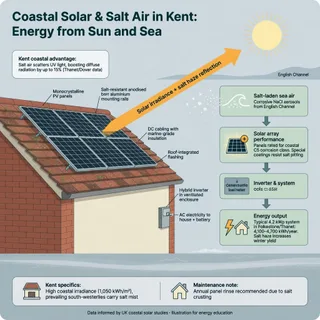
Coastal solar in Kent still generates in salt air. Specify rails, hooks and bolts for the real exposure on a Thanet, Dover or Folkestone roof.
Read article
Flower Turbines for Kent coastal rooftops are a niche choice, not a default upgrade. Check hub wind, salt air, roof loads and planning before you buy.
Read article
Flower Turbines vs a small HAWT on an urban UK site turns on hub-height wind, not the brochure. Check loads, planning, noise and connection before you buy.
Read article
Write for Kilowatts.uk
Write it here under your own name. Sign in, put a profile up, and start a guide. Pay only if you want more links from your articles out to your own site.
Create a Kilowatts.uk account, or sign in if you already have one.
Put your name, photo and experience on a public author page.
Write a guide or a blog. Free authors can put one followed link to their own site in articles each month.
FAQ
Live help
Talk to RoboMo™ and get instant answers.
Live chat