


Imperial's Hydrogen-Organic Flow Battery Wins a US Patent - Could Organic Dye Store Grid Energy?
Published: 2026-11-24 06:55:38
Updated: 2026-11-23 22:56:20
See how Imperial’s hydrogen–organic flow battery uses a dissolved compound to store energy and what UK grid pilots still need to prove about efficiency.
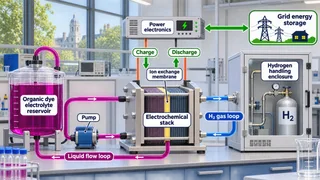
Imperial-linked hydrogen–organic flow battery receives US patent
A dissolved organic compound can work alongside hydrogen to store electricity. A laboratory cell demonstrated the reversible reaction, and US patent 12,785,128 was granted on 3 November 2026 for a specific hydrogen–organic flow battery design. The grant lists IP2IPO Innovations Limited as the assignee. Whether the technology could serve the UK grid depends on how much power a complete system can deliver, how long it can sustain that output, how much electricity it returns and what it costs to run. US patent grant reproduced by Justia · 2020 laboratory study
The grant names Anthony Kucernak and Javier Rubio-Garcia as inventors. Both co-authored the related Imperial College London study, published in 2020. The patent defines the scope of the US claims. The paper reports how the laboratory cell performed. To check for corresponding UK rights, search the relevant registers using UK application number GB1819459.7. US patent grant reproduced by Justia · UK Intellectual Property Office patent search
How hydrogen and the organic liquid store energy
The cell pairs a hydrogen gas circuit with a circulating liquid electrolyte containing an organic compound. During discharge, hydrogen is oxidised at the negative electrode. Electrons flow through the external circuit, supplying power, and the dissolved compound accepts them at the positive electrode. Charging reverses the reactions and regenerates hydrogen for the next discharge. US patent grant reproduced by Justia
The laboratory study used a modified benzoquinone. The term ‘organic dye’ tells you little about how the compound stores energy. Under the cell’s operating conditions, it can repeatedly accept and release electrons. The patent claims specify features of the active molecule. How the electrolyte is handled, replaced and disposed of depends on the formulation used in a complete system. US patent grant reproduced by Justia · 2020 laboratory study
What the lab result tells us about efficiency and service life
The 2020 study reported cell-level energy efficiency above 60% at a current density of 100 mA/cm² over about 200 charge and discharge cycles. Current density is the electric current per unit of electrode area. The researchers added water every 40–60 cycles to replace what evaporated. If you’re assessing a pilot system, ask how it manages water loss and how often it needs servicing. 2020 laboratory study
A site assessment needs two figures: continuous output in kilowatts (kW) and usable energy in kilowatt-hours (kWh). Together, they tell you how long the system can sustain the required output. Ask for usable energy measured at your proposed discharge rate and for data from longer tests showing how much capacity the battery retains under a similar duty cycle. Commercial service life remains uncertain after about 200 laboratory cycles.
Ask for a full charge and discharge test with both measurements taken at the same AC connection point. AC-to-AC round-trip efficiency is the share of the electricity used for charging that the system returns on discharge. Check whether the measurement includes power conversion, pumps, controls and hydrogen-handling equipment, and how the supplier accounts for standby consumption. Compare costs using the same scope for each quote, including the cell stack, liquid circuit, hydrogen equipment, electrical connection and maintenance. A typical UK installed price remains unknown from the laboratory study.
Where hydrogen–organic flow storage could fit in the UK
A factory, farm or grid site with space for the equipment and a recurring need for sustained discharge could be a candidate for a future pilot. For a home or flat, the immediate choice is among commercially available batteries.
Overview
When planning a workplace pilot, check where hydrogen could accumulate after a leak and how staff would reach the equipment for inspections and servicing. Pressure-system duties depend on the equipment and operating conditions. Ask the supplier how the system detects and manages hydrogen entering the liquid circuit or liquid entering the gas side. Confirm who maintains each part. HSE guidance on dangerous substances and explosive atmospheres · HSE guidance on pressure systems · US patent grant reproduced by Justia
What to compare before choosing battery storage
For solar self-consumption, compare the surplus on a typical day with demand after sunset. For backup during a power cut, identify the circuits you want to keep running and give installers their combined running load and any significant start-up loads. Give each installer the same consumption data, backup requirements and installation scope so you can compare usable capacity and continuous output directly. If you’re planning rooftop solar as well, use the same consumption data to compare home solar installations.
For a commercial pilot, give suppliers the same load profile and ask for measured AC output, usable energy, round-trip efficiency and capacity retention under a comparable duty cycle. Agree in advance where to take those measurements and which auxiliary loads to include. If the site also plans to generate electricity, use that load profile to assess pairing storage with solar.
Solar comparison
Compare solar for your property
Enter your postcode to assess your roof, compare solar options and get quotes from UK installers.
- Free postcode start
- Home, business and industrial
- RoboMo™ maps your roof
See which panels fit your roof
Choose home, business or industrial, then enter your postcode. RoboMo maps the roof and ranks panel brands by fit.
1. Postcode Start the assessment for your property.
2. Pin the roof Mark the array on the map.
3. Compare RoboMo™ builds your options.

Battery ROI tool
See what a battery saves on your bill
Enter the day rate, off-peak rate and export rate. The calculator ranks batteries in the Kilowatts shop over 10 years. Home batteries also suit offices and small commercial sites.
Reading
Sources and further reading
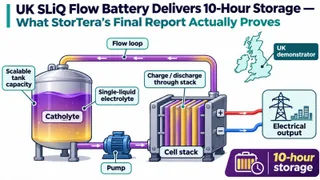
StorTera’s UK SLiQ flow battery trial reports a 10-hour discharge. See which power and efficiency figures buyers still need before sizing a system.
Read article
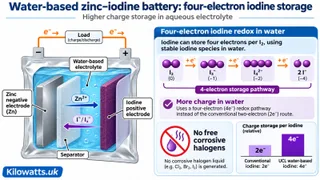
See how UCL's four-electron zinc–iodine battery delivered 1.1 Ah in a water-based pouch cell and what remains unknown for UK home storage.
Read article
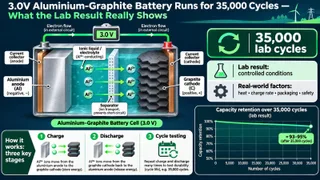
See why 3.0 V is the charge cut-off, how aluminium-graphite battery capacity fell over 35,000 lab cycles and what UK storage buyers still need to know.
Read article
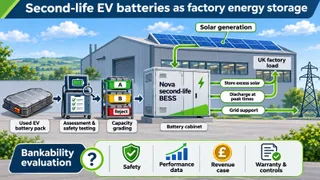
Assess Moment Energy’s 500 kWh Nova second-life EV battery for UK commercial sites. See how usable capacity, warranties and grid limits affect finance.
Read article


Mo's Solar Mission
Mo's Mission Nominations
Garlinge Primary School and Nursery
Garlinge Primary School and Nursery is a foundation primary school on Westfield Road in Margate, Kent, for children aged 3 to 11. It is m...
St Luke's Church of England Primary SchoolSt Luke's Church of England Primary School is a voluntary controlled Church of England primary school on Jubilee Road in Formby, Merseysi...
Comberbach Nursery and Primary SchoolComberbach Nursery and Primary School is a primary academy on Mather Drive in the village of Comberbach, near Northwich in Cheshire, for...
Locations
Solar installation near you
Write for Kilowatts.uk
Got a trade and something worth saying?
Write it here under your own name. Sign in, put a profile up, and start a guide. Pay only if you want more links from your articles out to your own site.
Register
Create a Kilowatts.uk account, or sign in if you already have one.
Author profile
Put your name, photo and experience on a public author page.
Start creating
Write a guide or a blog. Free authors can put one followed link to their own site in articles each month.
FAQ
Need Help? RoboMo's Got Answers
Can an organic dye really store electricity in a flow battery?
In the laboratory cell, a dissolved compound based on benzoquinone stored energy through a reversible chemical reaction with hydrogen. The compound accepts electrons as the battery supplies power and releases them during charging, which also regenerates the hydrogen.
Does the US patent mean I can buy this battery for my home in the UK?
The US patent covers a specific battery design. The article describes a laboratory demonstration and identifies no UK home model or installed price. If you need storage now, compare commercially available home batteries against your solar and backup needs.
How efficient was the battery, and what do we know about its lifespan?
The study reported energy efficiency above 60% at cell level over about 200 charge and discharge cycles under the reported test conditions. A complete system would also use electricity for equipment such as pumps, power converters and hydrogen controls. Commercial service life remains uncertain, and the researchers periodically topped up water lost to evaporation.
Could this technology help store electricity for the UK grid?
A factory, farm or grid site with space for the equipment and a regular need for several hours of power could be a candidate for a future pilot. Its suitability would depend on how much power it can deliver, how long it can sustain that output and how much electricity it returns. Site operators would also need to assess installation and maintenance costs.
What should a business check before hosting a hydrogen–organic battery pilot?
Use your half-hourly meter data to define how much power you need and for how long. Ask the supplier for a measured charge and discharge test at the same AC connection point, including electricity used by pumps, controls and hydrogen equipment. Check where leaked hydrogen could collect, how leaks are detected and who will service each part of the system.
How do I choose a home battery for rooftop solar?
Compare the solar electricity you typically export during the day with the electricity you use after sunset. Use those figures to compare usable capacity in kilowatt-hours. Check continuous output in kilowatts against the appliances you expect to run at the same time.
Will a home battery keep my appliances running during a power cut?
That depends on whether the quoted system is configured to provide backup and which circuits it can supply. Tell the installer which appliances you want to keep running, including any with a high start-up draw. Ask how long the battery can support those loads and what charge level that estimate assumes.
Live help
Need help right now?
Talk to RoboMo™ and get instant answers.