


Solar Panel Angle UK: Why Roof Pitch Is a Trade-Off
Published: 2026-09-25 12:15:49
Updated: 2026-10-06 12:33:25
The midwinter sun sits around 47 degrees lower than in midsummer. Here's what that means for UK roof pitch, tilt and when your solar power actually arrives.

The Angle The Sun Arrives At: Why There Is No Perfect Solar Panel Tilt
If you have searched for the "best angle for solar panels in the UK", you were probably hoping for one number. There isn't one — and once you understand why, the question improves. The midday sun sits roughly 47 degrees lower in midwinter than it does in midsummer, so any fixed roof is aimed correctly for only part of the year. A shallow pitch favours the high summer sun. A steeper pitch catches more of the low winter sun. Across a full year the two end up surprisingly close on total generation; what really changes is the shape of the year — when those kilowatt-hours arrive. This companion piece to our ten-second episode unpacks that trade in plain UK terms: what tilt does, what it doesn't do, why winter units are worth more than summer ones, and what you can sensibly control given that tilt is locked in on installation day.
"No. Midwinter sun sits roughly forty-seven degrees lower. Tilt compromises."
Why there is no single perfect panel angle
A solar panel produces most when light arrives closest to perpendicular to the glass. Light that strikes obliquely — raking across the surface at a glancing angle, the way a low amber winter sun does — delivers less energy per square metre of panel and reflects more of it away. That is the whole of the tilt question in one sentence.
The complication is that the sun does not hold still. Over a year, the midday sun in Britain swings through roughly 47 degrees of altitude between the winter and summer solstices. A fixed panel cannot follow it. Whatever tilt you install, the array is ideally aimed for a couple of moments in the year and approximately aimed for all the rest. That is not a flaw in the technology; it is geometry. Anyone offering you a single "optimum" figure without asking a single question about your household is quoting a textbook, not designing a system.
The useful reframing is this: tilt is not a performance dial you turn up. It is a compromise you choose deliberately, and the honest version of the conversation names the compromise out loud.
What the 47-degree seasonal swing does to a fixed array
Picture the same slate roof through two days. In December, the sun climbs a short, low arc across the southern sky, chimney shadows crawl a long way over the slates, and the light meets the panel faces at a shallow angle for the whole of its brief appearance. In June, the sun draws a much higher, much longer arc, arriving far closer to square-on and staying up for many more hours.
Two separate things are happening. First, day length: there is simply more time to generate in summer. Second, angle of incidence: the same panel converts light more effectively when the sun is high relative to its tilt. Those two effects compound, which is why British solar output is naturally seasonal regardless of how well a system is designed.
It is worth clearing up a common misreading of that seasonality. Summer wins on quantity of light, not on ideal operating conditions. Solar panels are actually more efficient in cold weather than in hot weather — a crisp, bright winter day is excellent panel weather; there is just far less of it. Similarly, UK homes still generate useful solar power on overcast days, because panels respond to diffuse light as well as direct beams. Britain's grey skies are less of an obstacle than the low winter sun angle and the short winter day.
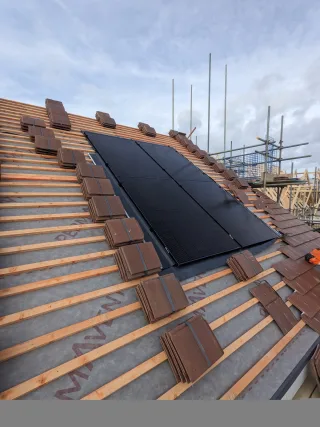
Shallow versus steep: the same year, a different shape
Overlay two annual generation curves on the same roof — one for a shallow pitch, one for a steeper pitch — and the picture becomes intuitive. The shallow profile spikes higher through high summer, because it is better aligned with a sun that is nearly overhead. The steeper profile is flatter across the year but holds up noticeably better through the dark months, because it presents a squarer face to a low December sun and, incidentally, sheds rain, snow and surface dirt a little more readily.
The part that surprises people is what happens to the totals. Across a full British year, the two curves end up remarkably close. Neither tilt "wins" in kilowatt-hours; they redistribute them. Steep borrows from summer to pay winter. Shallow does the reverse. If your only metric is an annual generation figure on a quote, most sensible pitches will look broadly similar, and you will have learned almost nothing about how the system will behave in your house. That is why we treat tilt as a question of seasonal shape rather than seasonal size. Knowledge beats marketing here: a design that names the shape of your year is more useful than one that quotes a single headline number.
Why winter kilowatt-hours are worth more than summer ones
If annual totals are close, the deciding factor is timing — and timing has a value, because a unit you generate and use yourself displaces a unit you would otherwise have bought.
In midsummer, a British home frequently generates more than it can immediately consume. The surplus goes to a battery if you have one, and then to the grid. In midwinter, the opposite is true: household demand is at its highest — lighting, heating pumps, cooking, hot water, EV charging — while generation is at its lowest. Almost every winter unit you produce is consumed on the spot, offsetting electricity you would have imported at whatever your tariff charges.
So the practical question is not "which pitch generates more?" but "when does this household actually use power?" A home that is occupied and drawing load through winter days benefits from a profile that holds December better. A home that is empty on weekdays, or built around summer loads and generous export arrangements, may care less. Neither answer is universally right; only one of them is right for your house.
Tilt is fixed at installation — so control what you can
The blunt operational point from the episode deserves repeating: tilt is fixed at installation. Unlike a tariff, a battery charging schedule or an EV charger timer, roof pitch is not something you revisit later. On most British homes the pitch is already decided by the roof itself, built long before anyone thought about solar, and changing it is not a realistic retrofit.
That has two consequences. First, the design conversation matters more than most people expect, because it is the only moment the geometry is genuinely open. Second, on a standard pitched roof, tilt is often not the variable at all — the roof is what it is, and the real design levers are elsewhere: which roof faces you use, how the array is split across those faces, string and inverter arrangement so that shading on one section does not drag another down, and whether battery storage is sized to move summer surplus into evening use.
Where tilt genuinely is a live choice — flat roofs, ground-mounted arrays, outbuildings and some extensions — it should be chosen against your consumption pattern, not against a generic optimum. On a flat roof there are additional constraints worth understanding, because a steeper mounting angle needs more spacing between rows to avoid self-shading, which affects how much capacity fits in the available area.
A practical checklist before you commit to a pitch
Work through these before signing anything. They are the questions that separate a designed system from a quoted one.
- When is your house actually occupied? Weekday daytime occupancy shifts value strongly towards winter generation and self-consumption. 2. What are your winter loads? Heat pumps, electric hot water, home working and EV charging all concentrate demand in the months when generation is scarce. 3. Is tilt genuinely a choice here? On a fixed pitched roof, the answer is usually no. Ask directly rather than being sold an "optimised angle" on a roof that cannot be changed. 4. Ask for seasonal shape, not just an annual total. A monthly generation profile tells you far more than a single yearly figure, and makes shallow-versus-steep visible. 5. Check the shading survey covers winter. Low winter sun casts long shadows from chimneys, dormers, neighbouring roofs and trees that simply do not exist in June. A summer-only shading assessment flatters the design. 6. Consider roof faces together. Splitting an array across two orientations can broaden the daily generation window even when it slightly reduces the peak. 7. Match storage to the profile. Battery capacity that makes sense for a summer-heavy shallow array may be sized differently from one supporting a flatter, steeper profile. 8. Confirm what is fixed and what is adjustable later. Tariffs, schedules and battery settings can be revised. Pitch, orientation and roof penetrations cannot.
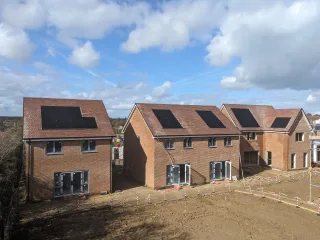
Questions people ask next
Does orientation matter more than tilt? For most UK pitched roofs, which way the roof faces sets the daily shape of generation, while tilt adjusts the seasonal shape. They interact, so a good design considers both together rather than optimising one in isolation.
Should I add tilt frames to a pitched roof to improve the angle? It is rarely proportionate. Tilt frames add wind loading, visual bulk, fixings and cost for a change in output that is usually modest, given how close annual totals sit across sensible pitches. On flat roofs, mounting angle is a genuine and necessary design decision.
Do trackers that follow the sun solve this? Trackers exist and they do address the geometry directly, but they introduce moving parts, maintenance and mounting requirements that seldom suit a domestic British roof. Fixed arrays remain the pragmatic choice for homes. Will a steeper pitch help with snow and dirt? A steeper surface tends to shed water and debris more readily, which is a small maintenance benefit rather than a headline performance argument. Is a shallow roof a reason not to install solar? No. Both profiles produce a useful year. The pitch you have shapes the design; it rarely decides whether solar is worthwhile. If you want to see how different design choices compare side by side before you commit, that is exactly what a proper comparison exercise is for.
Video transcript
Mo: So there's one perfect panel angle? RoboMo: No. Midwinter sun sits roughly forty-seven degrees lower. Tilt compromises.
Mo: So which tilt actually wins? RoboMo: Neither. Shallow peaks in summer. Steep holds December. Annual totals stay close.
Mo: Then how do I choose a pitch? RoboMo: By when you use power. Winter units offset costly imports. Tilt is fixed at installation. Mo: So there's one perfect panel angle? RoboMo: No. Midwinter sun sits roughly forty-seven degrees lower. Tilt compromises. / Mo: So which tilt actually wins? RoboMo: Neither. Shallow peaks in summer. Steep holds December. Annual totals stay close. / Mo: Then how do I choose a pitch? RoboMo: By when you use power. Winter units offset costly imports. Tilt is fixed at installation.
Wrapping up
There is no perfect solar panel angle, and that is genuinely good news — it means you are not chasing a number you cannot reach on a roof you cannot change. The sun swings roughly 47 degrees in altitude between midwinter and midsummer, so every fixed array is a compromise. Shallow pitches peak higher in summer; steeper pitches hold December better; annual totals stay close. What differs is when the power arrives, and winter units are the ones that displace the electricity you would otherwise be buying at your worst prices. Judge a design by its seasonal shape, by how honestly it models winter shading, and by how well it matches your household's actual pattern of use. Tilt is fixed on installation day. The thinking that goes into it shouldn't be.
Next step
If you'd like to see how your own roof's pitch, orientation and winter shading shape the year, a survey is the sensible next step — no pressure, just the numbers for your house. You can read more about how residential installations are designed, compare approaches side by side, or book a time to talk it through.
Plan, Compare & Buy Renewable Energy Solutions
AI does the thinking.
You get the perfect solar match.
Use RoboMo™ to assess your property, compare available technologies and connect with trusted UK installers, suppliers and manufacturers.
Simply enter your postcode, drop a pin on your roof, create your free account and let RoboMo™ analyse your property to find the best solar panels for your home.

You don't have to think
RoboMo™'s AI analyses your roof and does all the hard work.

Accurate & tailored
AI-powered assessment based on your roof, location, and conditions.

Best options, maximum savings
Compare top solar panels for the best performance and value.

Simple, fast & effortless
Provide a few details, sit back and watch your results unfold.

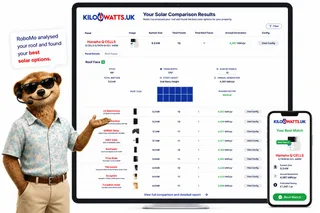
STEP 1
Choose Home, Business or Industrial
Enter your postcode to start your assessment.
STEP 2

Drop a pin on your roof
STEP 3

Create your free account
STEP 4

Sit back and watch RoboMo™ work
RoboMo™ analyses your roof and builds your personalised solar comparison.

Kilowatts UK is an authorised representative
Flower Turbines
Compact vertical-axis turbines built for real UK sites, not just open farmland.
They start in light wind, sit in a small footprint, and are bird-safe by design. Cluster them as a bouquet and the group performs better together than the same turbines standing alone. Enter your postcode for a location-based generation estimate. Figures use area weather data and will differ if buildings, trees or hills sit in the way.
Starts in light UK wind
Built to generate in typical UK wind, not only open farmland.
Small rooftop or ground footprint
Compact towers for roofs, yards and tight sites.
Bird-safe slow rotation
Slow vertical-axis spin, bird-safe by design.
Bouquet clusters raise output
Grouped turbines outperform the same units standing alone.

Step 1
Enter your postcode
Start designing your wind energy system in seconds.

STEP 2

Choose a location
STEP 3

Place your cluster
Tap the map where you want the turbine cluster to go.
STEP 4

Instant generation forecasts
Compare different turbine layouts and see annual generation forecasts instantly.
STEP 5

No commitment required
Explore different configurations before deciding whether to request a quotation.
FAQ
Need Help? RoboMo's Got Answers
What is Solar Panel Angle UK: Why Roof Pitch Is a Trade-Off about?
If you have searched for the "best angle for solar panels in the UK", you were probably hoping for one number. There isn't one — and once you understand why, the question improves. The midday sun sits roughly 47 degrees lower in midwinter than it does in midsummer, so any fixed roof is aimed correctly for only part of
Who is this video for?
UK homeowners comparing the options discussed in Solar Panel Angle UK: Why Roof Pitch Is a Trade-Off.