


UK SLiQ Flow Battery Delivers 10-Hour Storage - What StorTera's Final Report Actually Proves
Published: 2026-11-23 17:01:26
Updated: 2026-11-23 09:02:15
StorTera’s UK SLiQ flow battery trial reports a 10-hour discharge. See which power and efficiency figures buyers still need before sizing a system.
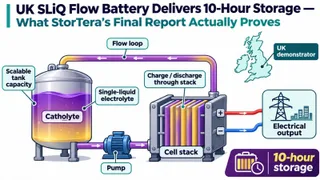
StorTera reports a 10-hour SLiQ discharge. What did the UK trial demonstrate?
StorTera reports that its SLiQ flow battery discharged for 10 hours. The company’s August 2025 project report, hosted on GOV.UK, gives that duration in the executive summary (p. 6) and conclusion (p. 33). Table 1 (pp. 17–18) records about 10 hours of charging and separately confirms discharge to the grid. It gives no duration for the grid discharge. The published results leave two questions for buyers. How much power did the demonstrator sustain over the reported 10 hours, and how much usable AC energy did it deliver? StorTera final report
StorTera’s report documents charging, discharge to the grid and response to remote commands. The company identifies third-party verification and validation as a next step towards commercial deployment. StorTera final report, executive summary and Table 1
What the three headline figures measure
Discharge duration, coulombic efficiency and self-discharge measure different aspects of performance. For a site assessment, establish how long the battery can supply the required power, how much energy it returns after charging and what it loses while idle. StorTera final report, Table 1 and conclusion
Overview
Energy depends on voltage as well as charge, so an amp-hour ratio cannot tell you how many kWh the site gets back. To estimate bill savings, use AC energy measurements from charging and discharging. Check whether they include pumps, controls and other auxiliary loads. The reported self-discharge figure covers 4.5 hours. To estimate losses over a weekend or longer, ask for measurements that reflect the expected standby conditions. StorTera final report, Table 1
What power did the demonstrator deliver?
The reported 10-hour figure leaves the sustained power in kW unclear. The GOV.UK programme listing describes a proposed 200 kW / 1.6 MWh installation at Midlothian Innovation Centre. If the full 1.6 MWh were usable at a steady 200 kW, it would last eight hours. Establishing the actual test output requires a measured discharge trace. GOV.UK Phase 2 project listing
For a factory looking to cover an overnight shift, compare the battery’s discharge trace with the factory’s demand profile for the same period. Ask for sustained AC power in kW and usable AC energy in kWh at the same metering point, together with the state-of-charge limits used in the test. Total kWh shows how much energy the battery supplied over the run. The kW trace shows whether it could meet demand throughout the shift, including peaks. Use both measures when sizing a site battery.
How the single-liquid lithium–sulphur design works
SLiQ uses a liquid electrolyte called the catholyte. A pump circulates it from a tank through the battery cells and back. Charging changes the chemical state of the catholyte. The reverse reaction supplies power during discharge. A power conversion system connects the battery to the AC network. The catholyte can also be stored separately from the cells. StorTera final report
When assessing a site layout, allow space for the tank, pipework and containment, as well as access to service the pumps and electrical equipment. Ask how pump and control loads are metered during operation and standby, especially if you’re comparing SLiQ with a system that reports efficiency at its AC terminals.
What remote control did the trial demonstrate?
StorTera demonstrated that remote commands could start charging or discharging and change power and current. At a business with on-site solar, an energy management system could use those controls to charge the battery with surplus generation and schedule discharge for when the site needs the power. StorTera final report, Table 1
For a site installation, check who can issue commands and how the local controller enforces the agreed import and export limits. During commissioning, ask the supplier to show what happens if communications drop while the battery is charging or discharging. The operator should be able to see the command, the measured response and any alarm.
What the trial means for UK homes, balconies and businesses
StorTera describes the SLiQ demonstrator as an alpha prototype. Commercial buyers still need a warranted service life, an installed price for their site and independently verified AC-to-AC efficiency for a commercial SLiQ system. The £5,019,402 in the GOV.UK listing is Phase 2 project funding. A site quote would need to cover the equipment, electrical integration and civil works. StorTera final report, route to commercialisation · GOV.UK Phase 2 project listing
The report gives no domestic installation specification. If you’re considering rooftop or balcony solar, start by checking how much surplus generation you could use to charge a battery and how much electricity you use after solar output falls. If you need backup during an outage, ask which circuits the quoted system can supply, what load it can sustain and how long it can run at that load. If you’re planning a rooftop installation, you can also compare residential solar options.
For a factory, farm or renewable generator, use half-hourly demand and generation data to work out when the battery needs to discharge and how much time it has to recharge. A shorter-duration battery may meet the same requirement if most demand falls within a few hours. Check the tariff, site import and export limits and available space before requesting a costed design for commercial energy storage. For SLiQ, ask for independently verified discharge data at the intended power, measured auxiliary consumption, a maintenance schedule and written warranty terms.
Solar comparison
Compare solar for your property
Enter your postcode to assess your roof, compare solar options and get quotes from UK installers.
- Free postcode start
- Home, business and industrial
- RoboMo™ maps your roof
See which panels fit your roof
Choose home, business or industrial, then enter your postcode. RoboMo maps the roof and ranks panel brands by fit.
1. Postcode Start the assessment for your property.
2. Pin the roof Mark the array on the map.
3. Compare RoboMo™ builds your options.

Battery ROI tool
See what a battery saves on your bill
Enter the day rate, off-peak rate and export rate. The calculator ranks batteries in the Kilowatts shop over 10 years. Home batteries also suit offices and small commercial sites.
Reading
Sources and further reading
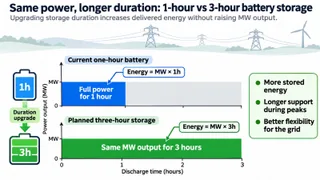
See why Econergy is weighing three-hour upgrades for four UK batteries totalling 106 MW, and when longer discharge could pay for the retrofit.
Read article
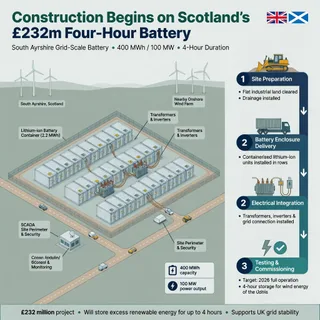
Construction has started on the 350MW Kilmarnock South battery after CIP's investment decision. Four hours is intraday balancing, not a windless week.
Read article
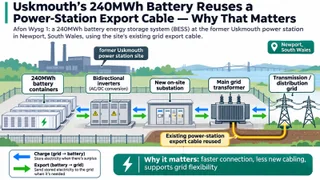
Practical UK guide on Uskmouth's 240MWh Battery Reuses a Power-Station Export Cable - Why That Matters.
Read article
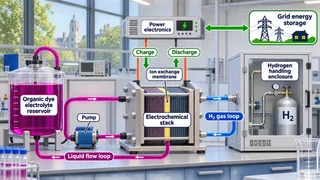
See how Imperial’s hydrogen–organic flow battery uses a dissolved compound to store energy and what UK grid pilots still need to prove about efficiency.
Read article


Mo's Solar Mission
Mo's Mission Nominations
Garlinge Primary School and Nursery
Garlinge Primary School and Nursery is a foundation primary school on Westfield Road in Margate, Kent, for children aged 3 to 11. It is m...
St Luke's Church of England Primary SchoolSt Luke's Church of England Primary School is a voluntary controlled Church of England primary school on Jubilee Road in Formby, Merseysi...
Comberbach Nursery and Primary SchoolComberbach Nursery and Primary School is a primary academy on Mather Drive in the village of Comberbach, near Northwich in Cheshire, for...
Locations
Solar installation near you
Write for Kilowatts.uk
Got a trade and something worth saying?
Write it here under your own name. Sign in, put a profile up, and start a guide. Pay only if you want more links from your articles out to your own site.
Register
Create a Kilowatts.uk account, or sign in if you already have one.
Author profile
Put your name, photo and experience on a public author page.
Start creating
Write a guide or a blog. Free authors can put one followed link to their own site in articles each month.
FAQ
Need Help? RoboMo's Got Answers
What did StorTera’s SLiQ trial demonstrate?
StorTera’s final report records charging, discharge to the grid and response to remote commands. The executive summary and conclusion report a 10-hour discharge. Table 1 confirms grid discharge but gives no duration for that test, so buyers still need a measured trace to see how much power the battery sustained and how much usable energy it delivered.
Does a 10-hour discharge mean the battery can supply 200 kW for 10 hours?
The report gives no sustained power figure for the reported 10-hour discharge. The proposed installation was rated at 200 kW and 1.6 MWh, which would give eight hours at 200 kW if all 1.6 MWh were usable. Ask for a time-stamped AC discharge trace showing power in kW and total energy delivered in kWh at the same meter.
Does 91% coulombic efficiency mean I get back 91% of the electricity I put in?
The 91% figure measures how much electrical charge was recovered on the DC side, in amp-hours. To estimate electricity use or savings, ask for AC-to-AC round-trip efficiency measured in kWh. Check whether the measurement includes losses from the power converter and electricity used by pumps and controls.
What does the reported 0.02% self-discharge tell me about leaving the battery idle?
The figure measures charge lost over 4.5 hours in a test without flushing. If you expect the battery to sit idle over a weekend, ask for measurements over a comparable period. Check separately how much electricity the equipment uses in standby.
Is SLiQ an option for UK homes with rooftop or balcony solar?
StorTera describes the demonstrator as an alpha prototype, and the report gives no domestic installation specification. If you’re sizing a home battery, estimate how much surplus solar electricity you could store and how much you typically use after solar output falls. If you need power during an outage, ask which circuits the quoted system can supply and how long it can sustain your expected load.
Can a business use the trial results to size a battery for an overnight shift?
Use half-hourly demand and generation data to identify how much power your site needs, how long it needs it and when the battery can recharge. Compare that profile with a verified discharge trace, checking both sustained power in kW and usable energy in kWh. If you plan to use remote dispatch, ask the supplier to demonstrate how the controller handles site import and export limits and what happens if communications drop.
What should I ask for before buying a commercial SLiQ system?
Request independently verified discharge and AC-to-AC efficiency data at your intended operating power, along with a maintenance schedule and written warranty terms. Ask for a site-specific installed quote covering the equipment, electrical integration and civil works. The published £5,019,402 figure refers to Phase 2 project funding.
Live help
Need help right now?
Talk to RoboMo™ and get instant answers.