


Uskmouth's 240MWh Battery Reuses a Power-Station Export Cable - Why That Matters
Published: 2026-11-23 19:28:43
Updated: 2026-11-23 11:29:31
Practical UK guide on Uskmouth's 240MWh Battery Reuses a Power-Station Export Cable - Why That Matters.
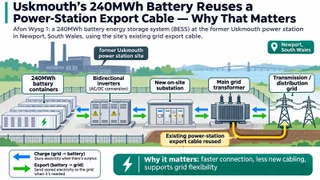
Why Uskmouth’s 240 MWh battery reuses a power-station export cable
Afon Wysg 1 (AW1), the 240 MWh battery storage project at the former Uskmouth power station in Newport, reused around two-thirds of the station’s export cable. Developer Ampeak Energy says this reduced the amount of new high-voltage cable the project needed, saving construction time and cost. The project still needed some new high-voltage cabling and a new on-site substation. Ampeak’s 11 November 2026 construction update
An environmental screening report in Newport City Council’s planning records shows that the project was designed to connect by underground cable to the existing National Grid 132 kV substation. The cable route was still to be confirmed when the report was written. Environmental screening report in Newport’s planning records
At another former power station, engineers would check the condition of the cable’s insulation and joints, its electrical rating and whether its route suits the new layout. They would also check the protection settings and how much power the connection can import for charging and export during discharge. Those checks help determine which equipment can stay and what needs replacing.
What happens between installation and commercial operation?
Ampeak’s 11 November update reported that Jones Bros Civil Engineering UK had installed all 55 battery units, 36 inverters and the main grid transformer. The inverters convert between the batteries’ direct current and the grid’s alternating current. The transformer adjusts the voltage so power can flow between the plant and the grid. Battery supplier e-STORAGE was assigned to carry out commissioning.
At first energisation, the grid supplies power to the plant’s electrical equipment. During charge and discharge commissioning, the team checks how the batteries, inverters and controls work together. Typical checks include whether the plant follows power commands, whether meters record flows correctly in both directions and whether protection operates as designed. Commercial operation begins when the plant enters service.
Ampeak’s 12 November 2026 business update gave two targets: first energisation later that month and full commercial operation in the first quarter of 2027.
What 120 MW and 240 MWh mean at Uskmouth
AW1 is rated at 120 MW of power and 240 MWh of energy. Power measures how quickly the battery can deliver electricity. Energy measures how much it can deliver over time. Dividing 240 MWh by 120 MW gives a nominal discharge time of two hours at rated power. How much energy reaches the grid depends on the starting charge, the battery’s usable operating range, conversion losses and where the energy rating is measured. Ampeak’s published AW1 rating
The initial AW1 installation has 240 MWh of capacity. Ampeak is developing a proposed expansion to 480 MWh, which would extend the nominal discharge time to four hours at the same 120 MW power rating. Afon Wysg 2 is a separate battery project at the same energy park. Uskmouth Sustainable Energy Park project overview
How dispatch depends on a battery’s available energy
Dispatch means instructing a battery to charge or discharge. The plant’s controls account for its state of charge, the power its inverters can supply and the limits at its grid connection. A battery may be able to deliver the requested power for a short period and need to recharge before it can sustain that output for longer. On a smaller scale, smart energy controls can help homes and businesses decide when to charge or discharge a battery.
In Great Britain’s Balancing Mechanism, the National Energy System Operator (NESO) can use information about the energy available from limited-duration assets to inform dispatch decisions. Ampeak’s installation announcement leaves open which services AW1 will provide and how it will receive dispatch instructions. NESO’s explanation of dispatch for limited-duration assets
What Uskmouth can tell homes and businesses about battery sizing
Size a battery around the job it needs to do. To use more rooftop solar after sunset, compare how much electricity your panels export during the day with how much you use later. If your business wants to cut peak grid demand, use half-hourly meter data to see how far demand rises above your target and how long it stays there. The highest demand above the target helps determine the inverter output you need in kW. The total energy used above the target over that period helps determine usable battery capacity in kWh.
A small solar array may produce too little surplus on a regular basis to make use of a large battery. If you’re retrofitting a battery, ask the installer whether the existing solar inverter can work with the proposed system and whether the consumer unit or distribution board and the site’s grid connection can accommodate it. If you need backup power, check which circuits the battery can supply during a power cut and how much power it can deliver in backup mode.
Bring recent consumption data to the installer, along with generation and export readings if you have solar. Ask for a quote that gives the battery’s usable capacity, continuous output and expected charging and discharging losses. Use those figures to compare how much solar energy each design could shift into the evening or how long it could help keep grid demand below your target. If your business is considering rooftop solar alongside storage, you can also compare commercial solar systems.
Solar comparison
Compare solar for your property
Enter your postcode to assess your roof, compare solar options and get quotes from UK installers.
- Free postcode start
- Home, business and industrial
- RoboMo™ maps your roof
See which panels fit your roof
Choose home, business or industrial, then enter your postcode. RoboMo maps the roof and ranks panel brands by fit.
1. Postcode Start the assessment for your property.
2. Pin the roof Mark the array on the map.
3. Compare RoboMo™ builds your options.

Battery ROI tool
See what a battery saves on your bill
Enter the day rate, off-peak rate and export rate. The calculator ranks batteries in the Kilowatts shop over 10 years. Home batteries also suit offices and small commercial sites.
Reading
Sources and further reading
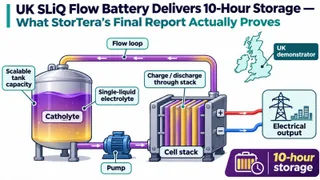
StorTera’s UK SLiQ flow battery trial reports a 10-hour discharge. See which power and efficiency figures buyers still need before sizing a system.
Read article

See what the first CETO buoy deployment tested and why the 80 kW wave energy trial’s grid export and servicing data matter for UK wave power.
Read article
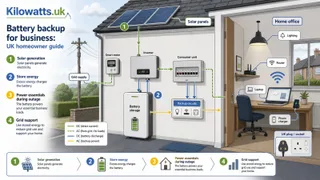
Can a home battery work during a power cut in the UK? A home battery can work during a power cut in the UK, but only if it has the right setup.
Read article
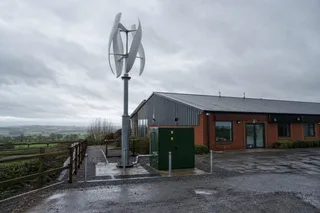
Discover what Flower Turbines' UK Power Networks approval means for small wind buyers in the UK, and how it affects their projects.
Read article


Mo's Solar Mission
Mo's Mission Nominations
Garlinge Primary School and Nursery
Garlinge Primary School and Nursery is a foundation primary school on Westfield Road in Margate, Kent, for children aged 3 to 11. It is m...
St Luke's Church of England Primary SchoolSt Luke's Church of England Primary School is a voluntary controlled Church of England primary school on Jubilee Road in Formby, Merseysi...
Comberbach Nursery and Primary SchoolComberbach Nursery and Primary School is a primary academy on Mather Drive in the village of Comberbach, near Northwich in Cheshire, for...
Locations
Solar installation near you
Write for Kilowatts.uk
Got a trade and something worth saying?
Write it here under your own name. Sign in, put a profile up, and start a guide. Pay only if you want more links from your articles out to your own site.
Register
Create a Kilowatts.uk account, or sign in if you already have one.
Author profile
Put your name, photo and experience on a public author page.
Start creating
Write a guide or a blog. Free authors can put one followed link to their own site in articles each month.
FAQ
Need Help? RoboMo's Got Answers
Why did the Uskmouth battery reuse the power station’s export cable?
The project reused around two-thirds of the former power station’s export cable. Developer Ampeak Energy says this reduced the amount of new high-voltage cable it needed and saved construction time and cost. The project still needed some new cabling and a new on-site substation.
Can a battery charge and discharge through the same grid cable?
Yes. Electricity can flow through the same cable in either direction, subject to the connection’s import and export limits. Engineers also check the cable’s condition and rating, along with the protection and metering for both directions.
What do 120 MW and 240 MWh mean for the Uskmouth battery?
The 120 MW rating measures how quickly the battery can deliver electricity, while 240 MWh measures how much energy it can deliver over time. Dividing 240 MWh by 120 MW gives a nominal discharge time of two hours at full power. The energy that actually reaches the grid depends on factors including the starting charge, usable capacity and conversion losses.
What happens after a grid-scale battery is installed?
At first energisation, the grid supplies power to the plant’s electrical equipment. The commissioning team then tests charging and discharging, including whether the controls follow instructions, the meters record flows in both directions and the protection system responds as designed. Commercial operation begins when the plant enters service.
How do I choose a battery size for my home solar panels?
Compare how much surplus solar electricity you typically export during the day with how much electricity you use after sunset. Check readings across seasons, as the surplus available to charge the battery varies throughout the year. Ask installers to quote usable capacity in kWh, continuous output in kW and expected charging and discharging losses so you can compare systems.
Can I add a battery to my existing solar panels?
Often, yes. Ask the installer whether the proposed battery can work with your existing solar inverter and whether your consumer unit and grid connection can accommodate the system. Share recent consumption, generation and export readings so the installer can size it around your actual usage.
Will a home battery keep my appliances running in a power cut?
Only if the system is designed and installed to provide backup power. Ask which circuits it can supply and how much power it can deliver in backup mode. How long it lasts depends on the charge available when the power goes out and how much electricity those circuits draw.
Live help
Need help right now?
Talk to RoboMo™ and get instant answers.