Founder & Renewable Energy Author, kilowatts.uk


Founder & Renewable Energy Author, kilowatts.uk
Article
UK home solar needs a usable roof, daytime use and a network that can take the inverter. A reported loan is not a grant, nor a battery or heat pump.
How home solar work, typical output, costs and limits, and whether they have a future for UK homes, balconies and businesses.
Home solar is worth a serious look when the property has a usable, largely unshaded roof or a suitable ground site, you use a meaningful share of electricity while the array is generating, and the electrical installation and local network can accept the design. It is a weaker buy if the roof is heavily shaded, near the end of its life, or the house is empty in daylight and you have no reasoned plan for storage or shifted loads. A battery and a heat pump are different products. A reported cheap loan does not make all three suitable, and it is not a grant.
The decision turns on generation you can actually use or export, the condition of the roof and consumer unit, and whether connection rules allow the inverter you are being sold. Surplus can be stored only if a battery is specified for a clear reason, and it can be exported only if the connection and a current tariff allow it. Most grid-tied systems will not run the house through a power cut unless a separate backup arrangement has been designed and approved.
Treat finance, commissioning and warranties as three different relationships. You may repay a lender, be commissioned by an installer, and have to claim on a manufacturer if a panel, inverter or battery fails. A sales quote is not permission to connect, and a headline interest rate does not repair a poor roof.
Installers usually express annual generation as kilowatt-hours per kilowatt-peak. For a largely unshaded array with a reasonable orientation, UK design tools commonly land in a broad band of about 800 to 1,100 kWh per kWp a year. South-facing roofs in sunnier southern locations tend toward the upper part of that band. Shade, a steep east or west aspect, a strong northerly tilt, or a more northerly postcode can sit below it. A very clear south-coast roof can sit at the top. That band is a sense-check only. It is not a quote, not a certification guarantee and not a prediction of bill savings. A separate note on how much panels generate does not replace the model for your roof.
The figure that matters is the survey model for your roof, with the shade scene and orientation stated. A useful output names the kilowatt-peak, the inverter size, any export limit, the modelled annual kilowatt-hours, and the assumed split between self-use and export. It should also say what occupancy pattern sits behind that split. A design that assumes someone is home all day will overstate self-use if the house is empty on weekdays.
There is no national self-use percentage that applies to your house. Self-use rises when people are in during daylight, when appliances, an electric vehicle or a hot-water diverter can run while the array is generating, or when a battery is sized for a stated evening load. It falls when generation is large relative to daytime demand. Export can still have value, but only under a tariff you have actually accepted. Import unit rates and export rates move independently. Winter heating demand in a typical UK home is not met by solar alone, even if a heat pump is added later.
Buyers meet several different frameworks, and none of them is a substitute for the others. Microgeneration Certification Scheme (MCS) certification is the quality and product route most households will be pointed to if they want a Smart Export Guarantee tariff or a mainstream consumer-protection path. Check that the installer and the products are currently listed, and check the official MCS page for what that listing does and does not cover. A logo on a brochure is not the same check. A short guide to what MCS certification means is background only, not the official listing.
In Great Britain, the Smart Export Guarantee is the Ofgem framework under which larger licensed suppliers must offer an export tariff for eligible small-scale low-carbon generation. The rate is a commercial offer, not a fixed historic feed-in payment. Metering, certification and eligibility should be read on the current Ofgem and supplier pages before you count export income. Northern Ireland is not on that scheme. Connection there is arranged with the Northern Ireland network operator, and export treatment has to be confirmed locally rather than copied from a Great Britain quote.
Connection in Great Britain is usually discussed under ENA engineering recommendations G98 and G99, through the distribution network operator for the postcode. Smaller type-tested systems are often notified under G98. A figure of 16 amps per phase, about 3.68 kW on a single-phase supply, is the ceiling people commonly meet in that conversation. Larger inverters, batteries that change the connection, or sites the network cannot accept under the simple route usually need a G99 application before connection. Confirm the current ENA document and the operator’s form. UK Power Networks, Northern Powergrid, National Grid Electricity Distribution, Scottish and Southern Electricity Networks, SP Energy Networks and, in Northern Ireland, NIE Networks are different organisations. The right one is the one that covers the property. Planning and building rules are separate again. Many householder roof arrays in England are handled as permitted development if the published conditions are met. Listed buildings, flats, shared roofs, conservation constraints and ground arrays often need a specific check. Scotland, Wales and Northern Ireland do not use the English rules. Electrical safety, roof loading and notification under building regulations, or the devolved equivalent, still apply. A competent-person route can deal with some electrical notification. It does not decide planning, and it does not authorise export. Read the current official page for the nation and the building-control route before you treat a salesperson’s “no permission needed” line as settled. An overview of planning permission for panels should send you back to that official page, not replace it. An offer of credit, if one exists, does not notify the network, does not create an export tariff and does not prove the heat pump’s extra load is acceptable. If the inverter, the battery or the export limit changes after the application, the network operator may treat it as a different proposal.
Secondary reports have described a warm-homes-style loan under which households might be offered free or cheap borrowing for solar panels, batteries and heat pumps. This article has not verified a dated government publication that sets the interest rate, fees, legal status, start date, nation coverage or tenure rules. Until you have read that official page for the nation where the property sits, it is not safe to assume the loan is interest-free, fee-free, open to landlords, or large enough for a full install.
It is also unknown, from those headlines alone, whether solar, a battery and a heat pump can be funded separately, or whether credit checks, income tests and tenure rules apply. Owner-occupiers, private landlords and social landlords are often treated differently in housing schemes. That split is not confirmed here. A loan is not a grant. You may still repay capital, and early-repayment rules can matter if you move or refinance.
Do not size the array from a reported loan amount, and do not treat an old grant name as if it were this scheme. Businesses, factories and farms sit outside the household framing of those reports unless an official page explicitly includes them. If you rent, or you own a flat with a shared roof, permission and who benefits from the bill saving can block a sensible project even when the technology would work. Those tenure questions stay unknown until the rules are published.
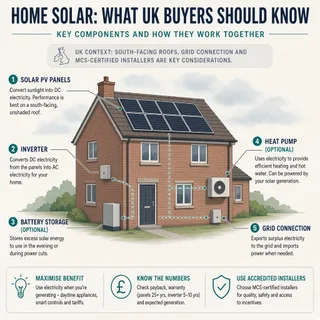
Panels produce direct current. An inverter converts that to alternating current the house can use. In practice, output is highest around the middle of the day and in the brighter months. A south-east to south-west roof usually does better than a heavily shaded or north-facing one, but pitch, local horizon and nearby trees matter as much as compass bearing. Which way panels should face is a survey input, not a guarantee. Satellite panel counts miss winter shade from chimneys, dormers and neighbouring extensions. That shade is often worse because the sun is lower.
Solar does not remove the electricity bill. Night use, winter heating and standing charges remain. Whether solar still works in winter is a different question from whether it covers the heating bill. A household that is out all day may export much of the annual generation unless demand is shifted, or a battery is specified against a measured evening load. Generation and bill impact belong in the site-specific model, not in a generic promise attached to a loan.
Most domestic solar-plus-battery systems are grid-tied. They are designed to operate with the network, not as an off-grid supply. Protection settings required for connection are there so the inverter disconnects when the network is out. That is why backup has to be designed, not assumed.
A battery is most relevant where evening use is high compared with daytime generation, or where you have a reasoned plan to charge from a cheaper off-peak period and the round-trip losses still leave you better off. It is not justified merely because panels are on the roof. How a home battery works should be read against your own evening load, not a finance brochure. Usable capacity, cycle life and what the warranty actually counts as a cycle are product-specific. They should come from the datasheet, not from a finance brochure. Location matters too. Ventilation and fire-safety arrangements required by the manufacturer and current building guidance rule out some lofts, cupboards and garages. A heat pump is a heating decision. It moves heat from outside air, or from the ground in some designs, into the home for space heating and often hot water. Suitability depends on heat loss, the emitters, hot-water demand, outdoor-unit noise and airflow, and whether the supply can support the extra load. Quoting a unit from floor area alone is a common failure. A house that still loses heat too quickly will disappoint whatever the loan rate. Running cost versus a boiler cannot be stated without a heat-loss calculation and a tariff you can actually get.
Combining all three can make sense after three separate surveys. It is a weaker plan if the only reason to add a battery or a heat pump is that a headline listed them beside the panels. A looped electricity supply, a full consumer unit, or a network limit can change the electrical job even when the roof looks ideal.
A useful survey is more than a panel count on a satellite image. The installer should look at structure and remaining roof life, shading across the year, cable routes, inverter location, metering, and spare ways and condition at the consumer unit. If the covering is near the end of its life, renewing it before the array is often the better sequence. Taking panels off a failing roof later is a cost the first quote may never show.
Battery location needs the clearance, ventilation and fire arrangements in the manufacturer’s instructions and in current building guidance. Heat-pump design needs a heat-loss calculation, a place for the outdoor unit that respects noise and airflow, and a check that radiators or underfloor circuits can deliver heat at the design flow temperature. Those are heating facts. They are not solved by adding more panels.
Grid connection is its own workstream. The quote should say whether the proposal is expected to be a G98 notification or a G99 application, whether an export limit is likely, and who submits the paperwork. Product standards and installer competence sit alongside that. Do not treat the deposit invoice as consent to connect. If the design changes after the network response, ask whether the approval still covers it.
Reviews can show patterns in workmanship, snagging and communication. They do not prove that a loan scheme is open, who administers it, or which products it will fund. They also do not prove that a highly rated firm is right for your roof, your network operator, or a heat pump. A company can be excellent at straightforward roof arrays and weak on constrained supplies or heating design.
Warranty length is not the same as guaranteed output. Read the panel product warranty, any performance warranty, the inverter warranty and the battery warranty as separate documents. Ask who you call if the installer stops trading, which consumer code applies, and whether an insurance-backed guarantee is actually in force. Ask what is excluded, whether monitoring is included, and whether roof leaks caused by the installation are covered. Workmanship cover and manufacturer cover fail in different ways.
A long list of star ratings is a weaker signal than a design pack that shows shading, string or optimiser layout, inverter size, any export limit, and expected self-use in plain language. If the pack will not state those assumptions, you cannot judge the reviewer’s “savings” against your own occupancy.
Exported electricity is paid only if you are allowed to export and you accept a current tariff. In Great Britain that conversation usually starts with the Smart Export Guarantee. Suppliers set their own rates and conditions. Some require a specific meter arrangement, a minimum export volume, or MCS certification. None of those commercial terms should be copied from a neighbour’s bill or from a feed-in tariff that closed to new applicants years ago.
Check the supplier offer that would actually apply to you, and check Ofgem’s current description of the scheme rather than a blog summary. Northern Ireland does not use the Smart Export Guarantee. If a quote adds a fixed export income for the next decade, ask which tariff, which eligibility rule and which expiry date sit behind the number. If those cannot be named, the income is an illustration, not an offer.
Self-use is often worth more per kilowatt-hour than export, because it offsets imported electricity you would otherwise buy. That gap is not fixed. It depends on your import tariff, any time-of-use rate, and the export price on the day you sign. A battery can move some export into the evening, but round-trip losses and the capital cost have to be part of the same comparison.
This article does not state a price. A national figure would be a false quote. What you pay depends on array size, roof access and scaffold, mounting and any need for bird protection, cable routes, whether the consumer unit and bonding need work, inverter choice, and whether a battery or heat pump is added as a separate scope. Ground mounting, listed-building constraints, a DNO study and reinforcement can move the job further. Tax treatment of domestic energy equipment has changed before. It should appear on the quote, not be assumed from an older article.
Ask for the design and the price to itemise equipment, labour, scaffold, electrical upgrades, commissioning, monitoring and warranties. Compare two quotes on kilowatt-peak, expected annual kilowatt-hours, shade allowance and what is excluded, not on the monthly repayment alone. You can compare home solar options on those design points rather than on a headline repayment. A low borrowing rate on an oversized or heavily shaded system can still be poor value. A cheap loan, if one is later confirmed, changes how you might pay. It does not change the roof’s yield.
If the price depends on a particular network outcome, the contract should say what happens if the operator requires an export limit, a smaller inverter or a paid study. That is a common place for disputes after the deposit has been paid.
A standard grid-tied home solar system switches off in a power cut. That is intentional. The inverter must not energise a dead network while engineers may be working on it. A battery on the same grid-tied design does not, by itself, keep the lights on. Whether a battery runs in a power cut depends on a separate backup specification, not on the word hybrid. Backup exists only if the specification includes an approved islanding or backup arrangement, the right switchgear, and a defined set of circuits that will run.
If riding through outages matters, it has to be written into the design before you sign, including which loads are backed up and which are not. Whole-house backup is a different electrical job from backing up a few lights and a router. It can affect inverter choice, battery location and the connection application. Do not infer it from the word hybrid on a datasheet.
Off-grid design is another category again. It needs enough generation and storage for winter, a different approach to safety, and a clear-eyed view of what you will do without. Very few ordinary UK rooftop quotes are that design. If a seller says the house will run as normal in a power cut, ask them to mark the backup circuits on a drawing and to state the approval route.
Home solar is a weaker fit where the roof is heavily shaded for much of the year, structurally unsound, or unlikely to last as long as the array. It is also weaker where almost all generation would be exported, the export tariff is poor or unavailable, and you have no other reason to proceed. Solar alone will not cover winter heat demand in a typical UK home. Adding a heat pump without a heat-loss calculation does not close that gap.
A loan, if a scheme later opens on published terms, would only help households that meet those rules and can afford the repayments. It is not a substitute for a grant you do not have to repay. It is not a reason to proceed where the survey fails. Shared roofs, leasehold restrictions and rental properties can make a technically sound array a bad project because the person who pays is not the person who saves.
If the only evidence in favour is a star rating, a satellite layout and a repayment that looks smaller than your current bill, pause. The bill comparison is only meaningful when standing charges, import rates, export rates, occupancy and winter use are in the same calculation.
Start with twelve months of electricity use if you have it, ideally half-hourly, plus a note of when the house is occupied. That tells an installer whether solar, storage, or neither, is the first conversation. For heating, ask for a heat-loss calculation before comparing a heat pump with the boiler you have. For any loan, wait for the official page and read interest, fees, early-repayment rules, nation coverage and required installer standards yourself. If you want that checked on the property, book a free energy survey rather than sizing from a headline.
Keep the survey output, the connection confirmation and the warranty documents together. If the installed inverter or battery differs from the one that was notified, ask the installer and the network operator whether the approval still holds before you treat the job as finished.
Solar comparison
Enter your postcode to assess your roof, compare solar options and connect with trusted UK installers.
Choose home, business or industrial, then enter your postcode. RoboMo maps the roof and ranks panel brands by fit.
1. Postcode Start the assessment for your property.
2. Pin the roof Mark the array on the map.
3. Compare RoboMo™ builds your options.

Battery ROI tool
Enter the day rate, off-peak rate and export rate. The calculator ranks batteries in the Kilowatts shop over 10 years. Home batteries also suit offices and small commercial sites.
Reading
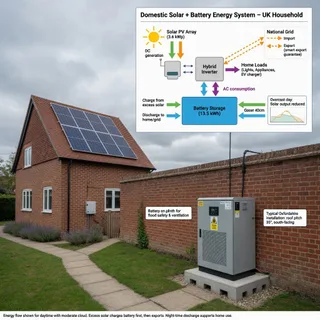
Battery storage in Stanford in the Vale is worth it only if load, tariff and the SSEN connection let you move surplus or cheaper power to a later hour.
Read article

Worth depends on your roof, daytime use and the export tariff you can get. This page sets out how to judge a 2026 UK install.
Read article
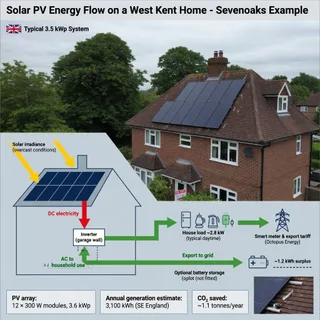
Solar panel installation in Sevenoaks is a roof, shade and planning job under UK Power Networks, not a town price.
Read article

An EV is a large, flexible electrical load. Here's how UK home charging changes solar self-consumption, sizing decisions and long-term system value.
Read article
Write for Kilowatts.uk
Write it here under your own name. Sign in, put a profile up, and start a guide. Pay only if you want more links from your articles out to your own site.
Create a Kilowatts.uk account, or sign in if you already have one.
Put your name, photo and experience on a public author page.
Write a guide or a blog. Free authors can put one followed link to their own site in articles each month.
FAQ
Live help
Talk to RoboMo™ and get instant answers.
Live chat