


What is an 800W solar panel and how efficient is it?
Published: 2026-06-29 11:15:35
Updated: 2026-07-18 08:13:03
Understand 800w solar panel in the UK, with clear explanations, examples, and practical next steps.
What is an 800W solar panel?
An 800W solar panel is either a single solar PV module rated at 800 watts peak, or, more commonly for UK homes, a small 800W solar array made from two panels of around 400W each. In both cases, 800W is the peak power rating under laboratory conditions. It does not mean the panel will produce 800W continuously throughout the day.
The rating may be shown as 800W, 800Wp, or 0.8kWp. Wp means watts peak. This is measured under Standard Test Conditions, usually based on 1,000W of sunlight per square metre, a cell temperature of 25°C, and a standard light spectrum. Real UK roofs rarely match those conditions for long because sunlight changes by season, cloud cover, time of day, roof angle, shading, and panel temperature.
For most homeowners, the practical point is simple: an 800W solar PV system is small. It can reduce some daytime electricity import, especially background loads, but it is not normally large enough to power a whole UK home or make a property energy independent.
- If you are comparing solar panel options, focus on:
- the system size in kWp
- the panel dimensions and efficiency
- the likely annual generation in kWh
- the roof space required
- the inverter or microinverter setup
- whether the installation is compliant for UK grid connection
An 800W system can be a useful renewable energy upgrade in the right situation, but the headline wattage alone does not tell you whether it is suitable.
Is an 800W solar panel one panel or two panels?
In the UK domestic solar market, “800W solar panel” often means an 800W system rather than one physical panel. Many home solar installations use individual panels in the 400W to 470W range, so an 800W setup is often two modules connected together.
A true single 800W module is less common on UK homes. Very high-wattage modules are usually physically large and are more often aimed at commercial roofs, ground-mounted systems, agricultural buildings, or large flat roofs. They can be difficult to handle on smaller domestic roofs and may need careful checks for clamping zones, wind loading, rail spans, and roof access.
Two smaller panels are often easier to fit on a UK house because the installer has more layout flexibility around:
- chimneys
- roof windows
- vents
- dormers
- valleys
- ridges and roof edges
- aerials and satellite dishes
Panel dimensions matter as much as the headline wattage. A physically large 800W panel is not automatically better than two smaller 400W panels if it is awkward to mount, partially shaded, or too close to roof edges. As a rough guide, a domestic 800W setup using two modern 400W panels may need around 3.5m² to 4.0m² of clear roof area. The exact figure depends on the panel model, its solar panel efficiency, the mounting system, and the spacing required for safe installation.
How much electricity can an 800W solar system generate in the UK?
An 800W solar system is 0.8kWp. In the UK, a practical planning range for solar PV generation is often around 700kWh to 1,000kWh per kWp per year, depending on the roof and location. For a well-sited 0.8kWp system, that can mean roughly 600kWh to 800kWh per year.
A lower output is more likely if the roof is shaded, faces far from south, has an unsuitable pitch, or is in a less favourable location. A higher output is more likely on an unshaded south-facing or near-south-facing roof with a sensible pitch, particularly in sunnier parts of the UK.
A simple way to estimate annual generation is to multiply the system size by the expected yield:
- 0.8kWp × 750kWh/kWp/year = about 600kWh per year
- 0.8kWp × 900kWh/kWp/year = about 720kWh per year
- 0.8kWp × 1,000kWh/kWp/year = about 800kWh per year
You can read more about UK solar generation ranges here: how much electricity do solar panels generate in the UK? For context, a system generating 700kWh a year averages about 1.9kWh per day across the year. That does not mean it produces 1.9kWh every day. A bright summer day may produce several times more than a dull winter day. For a small two-panel system, local shading can matter more than regional location. If a chimney shadow crosses one panel for part of the day, the impact can be noticeable because there are only one or two modules in the array.
What does 800W mean in everyday use?
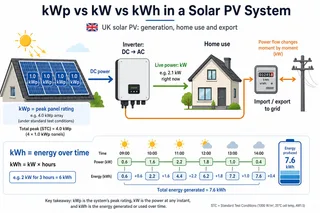
An 800W rating is a power rating, not an amount of electricity. Power is measured in watts or kilowatts. Energy is measured in kilowatt-hours.
If an 800W solar system ran at full output for one hour, it would generate 0.8kWh of electricity. In real UK conditions, it will rarely run at full output continuously. Output rises and falls through the day as sunlight changes.
- A practical example:
- at 800W for 1 hour, the system generates 0.8kWh
- at 400W for 2 hours, it also generates 0.8kWh
- at 100W for 8 hours, it also generates 0.8kWh
- a fridge or freezer cycling on and off
- broadband router and home networking equipment
- a laptop and monitor
- low-energy lighting
- ventilation or small circulation pumps
- some standby loads
- Kettles often draw much more than 800W.
- Ovens and hobs are much larger loads.
- Electric showers are far beyond the scale of an 800W array.
- EV chargers draw far more power than an 800W system can provide.
- Washing machines can draw high power when heating water.
- Heat pumps cannot be powered by an 800W solar system alone.
On a clear spring or summer day, an 800W system may produce useful power for several hours around the middle of the day. On a dark winter day, it may only produce a small amount. Cloud, rain, low sun angle, dirt, shade, and hot panel temperatures all reduce output. In everyday use, an 800W solar system may help cover small daytime loads such as: It will not reliably run high-demand appliances by itself. That does not make an 800W system pointless. It means expectations need to match the system size. Used well, a small solar array can reduce imported electricity during daylight, especially in a home with daytime occupancy or predictable background demand.
Is 800W enough for a UK home?
For a typical UK home, 800W is usually too small to cover most annual electricity use. Ofgem’s typical domestic consumption values are often used as a benchmark for household energy use, and a medium-use home is commonly around 2,700kWh of electricity per year. A well-sited 800W solar array producing around 600kWh to 800kWh per year could offset a useful share of that figure, but only when generation and household demand overlap.
Timing is crucial. Solar PV generates in daylight. Many households use a lot of electricity in the morning and evening, when solar output may be lower. If the property is empty during the day, more solar electricity may be exported to the grid. If someone works from home, runs appliances during daylight, uses an immersion diverter, or has a battery, self-consumption may improve.
- An 800W setup may be suitable for:
- modest daytime load reduction
- a garage, workshop, or outbuilding
- a small flat roof or restricted roof area
- a low-consumption property
- a trial or space-limited renewable energy project
- some off-grid uses, such as cabins, boats, caravans, and sheds
Off-grid systems need different design considerations from grid-tied home solar. They may require batteries, charge controllers, suitable inverters, fuses, isolators, and careful load calculations. An 800W system is usually not the best size if the aim is to maximise roof generation, support an electric vehicle, or make a meaningful contribution to a heat pump’s annual electricity demand. Where roof space and budget allow, many UK homes consider larger residential solar panel systems because fixed costs such as design, scaffolding, electrical work, certification, testing, and paperwork are spread across more panels.
What affects the real output of an 800W solar panel?
The real output of an 800W solar panel or 800W solar array is highly site-specific. On a small solar PV system, minor design issues can have a large percentage impact because there are only one or two modules.
- Key factors include:
- Roof direction: South-facing roofs usually give the highest annual solar generation in the UK. East-facing roofs produce more in the morning, while west-facing roofs produce more in the afternoon and early evening.
- Roof pitch: Around 30° to 40° is often close to ideal for annual UK output, although many other pitches can still work.
- Shading: Chimneys, trees, aerials, dormers, roof windows, and neighbouring buildings can reduce generation. Winter shading can be worse because the sun is lower.
- Inverter choice: A small inverter may clip peak output, while microinverters or optimisers may help where shading is unavoidable.
- Panel temperature: Solar panels usually produce less power as they get hotter, even in bright sunshine.
- Panel efficiency: A higher-efficiency panel can achieve more rated power in a smaller area, which may matter on limited roof space.
- Dirt and debris: Heavy soiling, bird mess, moss, and leaf build-up can reduce output.
- Roof condition: Installing panels on a roof that may soon need repair can create avoidable cost and disruption.
- Cable and electrical design: Poor cable routing or unsuitable components can reduce performance and create safety risks.
On flat roofs, the design also needs to account for mounting frames, ballast or fixings, wind loading, and row spacing. Panels placed too close together can shade each other when the sun is low, reducing the output of the whole system. For small systems, a good shading assessment is especially important. A roof that looks clear at midday in June may still be shaded in the morning, afternoon, or winter months. With only two panels, losing one panel to shade for part of the day can materially reduce annual generation.
What should installers check before fitting an 800W system?
A small solar array still needs proper design. It is not just a matter of placing a panel on a roof and connecting a cable. The same principles of safe solar PV installation apply whether the system is 0.8kWp or much larger.
- Before fitting an 800W system, a competent installer should check:
- Panel layout: Whether one large module or two smaller modules fit safely and sensibly on the roof.
- Roof structure: Whether the roof can accept the added load and mounting system.
- Clamping zones: Panels must be fixed within manufacturer-approved clamp positions to avoid warranty and structural issues.
- Wind loading: Roof edges, ridges, exposed locations, and large-format modules need careful uplift assessment.
- Roof covering: Slate, concrete tile, clay tile, metal sheet, felt, single-ply, and other flat roof coverings need appropriate fixings and weatherproofing.
- Cable routing: DC cables should be clipped, protected from sharp edges, kept away from standing water, and routed to reduce overheating and damage risks.
- Inverter location: The inverter or microinverter setup should be accessible, ventilated, and suitable for the environment.
- Isolation and labelling: Solar PV systems need suitable isolators, warning labels, and safe shutdown arrangements.
- Electrical protection: Earthing, RCDs, circuit protection, cable sizing, and consumer unit compatibility should be checked.
- Monitoring: Basic monitoring can help the homeowner spot faults or underperformance.
- Future upgrades: Battery compatibility and potential system expansion should be considered before equipment is chosen.
Bird protection can also be worth considering where pigeons are common. It adds cost, but it can help prevent nesting under panels and reduce future maintenance issues. A common mistake is choosing the highest-wattage module without checking whether it is practical to install. On a real UK roof, panel size, roof access, mounting rail spans, shading, obstruction layout, and compliance often decide the best option.
Are 800W plug-in and balcony solar kits suitable in the UK?
Some people searching for an 800W solar panel are looking at plug-in solar kits or balcony-style solar systems. These products may look simple, but UK electrical safety and grid requirements still matter. A product being sold online does not automatically mean it is suitable or compliant for connection to a UK property.
Solar PV connected to home wiring normally needs correct grid notification or approval. Installations up to 3.68kW per phase are commonly handled under G98 after installation if compliant equipment is used. Larger systems generally need G99 approval before connection. An 800W system is below 3.68kW, but it can still need proper notification to the Distribution Network Operator.
A qualified electrician should check:
- earthing arrangements
- circuit protection
- RCD suitability
- isolation
- labelling
- cable sizing
- inverter compliance
- how the system connects to the property
- whether the existing consumer unit is suitable
Back-feeding a socket circuit can be unsafe if the circuit is not designed and protected for that purpose. The risk is not just performance loss; it can include electric shock, overheating, nuisance tripping, invalidated warranties, or issues with insurers. MCS certification is often needed for Smart Export Guarantee eligibility. It may also matter for insurers, lenders, warranties, and future property paperwork. Building Regulations and planning rules can also apply, especially for flats, listed buildings, conservation areas, leasehold properties, and unusual roof or balcony placements. If you are considering a plug-in or balcony solar product, check UK compliance before buying. The safest route is to have the design reviewed by a competent electrician or solar installer rather than relying only on the kit description.
How does an 800W system compare with a larger solar system?
An 800W solar system can be useful, but it is small by whole-home standards. It may suit restricted roof space, a garage, a workshop, a low daytime base load, or a modest renewable energy project. It is less suitable when the aim is to cover a large share of household electricity use.
A larger system can often have a lower cost per kWp because the fixed parts of the job are spread across more panels. Scaffolding, design, testing, commissioning, paperwork, and installer time do not reduce in direct proportion when the solar array is very small.
For example, if a home has enough unshaded roof space for several panels, a 3kWp to 4kWp system may make more sense than stopping at 0.8kWp. The larger system is likely to generate more electricity across the year and may work better with a solar battery, immersion diverter, EV charging strategy, or other load-shifting measures. The right answer still depends on the property and the household’s usage pattern.
- The best system size depends on:
- available roof area
- annual electricity consumption
- daytime electricity demand
- shading
- orientation and pitch
- budget
- export arrangements
- battery plans
- future loads such as an EV or heat pump
- whether the roof is suitable for long-term installation
A household that uses most electricity at night may benefit less from extra solar unless it can shift loads into daylight hours or store surplus generation. A household with daytime occupancy, home working, or flexible appliance use may make better use of solar power as it is generated.
Common misconceptions about 800W solar panels
A lot of confusion comes from mixing up watts, kilowatt-hours, panel size, and solar panel efficiency. These are related, but they are not the same thing.
Higher wattage is always better
Fit, efficiency, warranty, shading behaviour, wind loading, and installer support also matter.800W means 800 units of electricity
It does not. Watts measure power. Electricity generation and use are measured in kWh.A bigger panel always means better value
Not always. If a large module is hard to mount or more affected by shade, two smaller panels may be more practical.Solar panels do not work in cloudy UK weather
They do generate in diffuse daylight, but output is lower than in direct sun.The panel rating is what you will get all day
No. The Wp rating is measured under controlled test conditions. Real output changes throughout the day and year.Any 800W kit can be plugged into a wall socket
Safe UK connection depends on electrical protection, inverter compliance, isolation, earthing, and grid notification.An 800W panel is twice as efficient as a 400W panel
Not necessarily. It may simply be larger. Two 400W panels can have similar efficiency to one 800W panel.An 800W system can make a home independent from the grid
It will offset some electricity use, but it is too small for most homes to rely on alone.
The safest way to judge an 800W product is to look beyond the headline rating. Check the panel area, module dimensions, efficiency, inverter rating, mounting method, certification, warranty, monitoring, and whether the proposed installation is compliant for your property.
The practical answer
An 800W solar panel or 800W solar array is a small 0.8kWp PV system. In the UK, it might generate roughly 600kWh to 800kWh per year on a suitable site, although shading, roof direction, pitch, local weather, and installation quality can move the result up or down.
Its efficiency is usually similar to other modern solar panels, often around 20% to 23%. The fact it says 800W does not make it unusually efficient. The rating tells you the maximum peak output under Standard Test Conditions, not the power you will receive all day.
For most UK homes, 800W can be useful for reducing some daytime electricity import, particularly small background loads. It is not a full-house solar solution and will not reliably support large appliances, EV charging, or heat pump demand on its own. The best choice depends on whether you mean one large module, two smaller panels, a roof-mounted system, a plug-in kit, a balcony-style system, or an off-grid setup. For a safe and worthwhile installation, practical design, roof suitability, solar panel efficiency, electrical compliance, and grid notification matter just as much as the wattage.
Ready to compare your options?
Get tailored comparisons and connect with trusted installers in under a minute.
Plan, Compare & Buy Renewable Energy Solutions
AI does the thinking.
You get the perfect solar match.
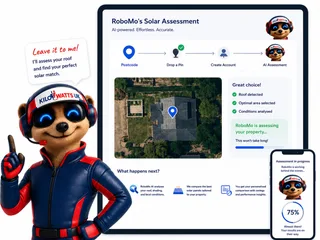
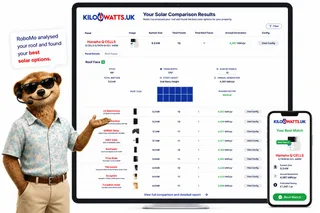
Use RoboMo™ to assess your property, compare available technologies and connect with trusted UK installers, suppliers and manufacturers.
Simply enter your postcode, drop a pin on your roof, create your free account and let RoboMo™ analyse your property to find the best solar panels for your home.

You don't have to think
RoboMo™'s AI analyses your roof and does all the hard work.

Accurate & tailored
AI-powered assessment based on your roof, location, and conditions.

Best options, maximum savings
Compare top solar panels for the best performance and value.

Simple, fast & effortless
Provide a few details, sit back and watch your results unfold.
STEP 1
Choose Home, Business or Industrial
Enter your postcode to start your assessment.
STEP 2
Drop a pin on your roof
STEP 3

Create your free account
STEP 4

Sit back and watch RoboMo™ work
RoboMo™ analyses your roof and builds your personalised solar comparison.

Step 1
Enter your postcode
Start designing your wind energy system in seconds.
Are you an installer, distributor or renewable energy business?
Kilowatts UK is expanding the Flower Turbines partner network across the UK.
Become A Flower Turbines PartnerKilowatts UK is an authorised representative
Flower Turbines
Compact vertical-axis turbines built for real UK sites, not just open farmland.
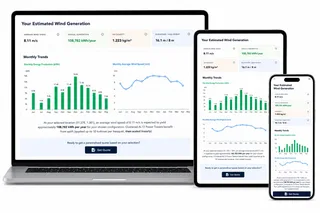
They start in light wind, sit in a small footprint, and are bird-safe by design. Cluster them as a bouquet and the group performs better together than the same turbines standing alone. Enter your postcode for a location-based generation estimate. Figures use area weather data and will differ if buildings, trees or hills sit in the way.
Starts in light UK wind
Built to generate in typical UK wind, not only open farmland.
Small rooftop or ground footprint
Compact towers for roofs, yards and tight sites.
Bird-safe slow rotation
Slow vertical-axis spin, bird-safe by design.
Bouquet clusters raise output
Grouped turbines outperform the same units standing alone.

STEP 2

Choose a location
STEP 3
Place your cluster
Tap the map where you want the turbine cluster to go.
STEP 4

Instant generation forecasts
Compare different turbine layouts and see annual generation forecasts instantly.
STEP 5

No commitment required
Explore different configurations before deciding whether to request a quotation.
Related articles
Mo's Mission Nominations
FAQ
Need Help? RoboMo's Got Answers
What is an 800W solar panel?
An 800W solar panel is a solar PV product or system with a peak output rating of 800 watts under laboratory test conditions. For UK homes, this often means a small 0.8kWp solar array made from two panels of around 400W each, rather than one single large panel. The 800W figure does not mean it will produce 800W all day; real output changes with sunlight, season, shading, roof angle, temperature, and weather.
Is an 800W solar panel one panel or two panels?
It can be either, but in the UK domestic market an “800W solar panel” often refers to an 800W system made from two smaller modules. True single 800W modules are usually physically large and are more common on commercial roofs, ground-mounted systems, agricultural buildings, or large flat roofs. For many homes, two smaller panels are easier to fit around chimneys, roof windows, vents, dormers, and roof edges.
What does 800W or 800Wp mean?
800W, 800Wp, and 0.8kWp all refer to the peak power rating of the solar panel or array. Wp means watts peak, which is measured under Standard Test Conditions, normally based on 1,000W of sunlight per square metre and a cell temperature of 25°C. UK roofs rarely match those conditions for long, so the actual output will usually be lower than 800W and will vary throughout the day.
How efficient is an 800W solar panel?
Most modern solar panels are roughly 20% to 23% efficient, with some premium models slightly higher. An 800W panel is not automatically more efficient than a 400W panel; it may simply be larger or use more cells. If an 800W array is made from two 400W panels that are each around 21% efficient, the combined array is still around 21% efficient across the larger surface area.
How much electricity can an 800W solar system generate in the UK?
An 800W solar system is 0.8kWp. In the UK, a well-sited system of this size might generate roughly 600kWh to 800kWh per year, although the exact figure depends on location, roof direction, pitch, shading, and installation quality. Output will be much higher on bright summer days than on dull winter days, so annual generation is a better planning figure than daily output.
Is 800W enough to power a UK home?
For most UK homes, 800W is not enough to power the whole property or cover most annual electricity use. It can still reduce daytime grid import by helping to supply small background loads such as a fridge, router, laptop, lighting, or standby consumption. It will not reliably run high-demand appliances such as kettles, ovens, electric showers, EV chargers, or heat pumps by itself.
What can an 800W solar panel run?
An 800W solar system can help run smaller daytime loads when there is enough sunlight, such as a broadband router, fridge or freezer cycling on and off, laptop, monitor, low-energy lighting, or small pumps. It is better to think of it as reducing import from the grid rather than directly powering one appliance all the time. If the appliance demand is higher than the solar output at that moment, the extra electricity will still come from the grid or a battery if one is installed.
How much roof space does an 800W solar system need?
A typical domestic 800W setup using two modern 400W panels may need around 3.5m² to 4.0m² of clear roof area. The exact space depends on the panel model, dimensions, mounting system, spacing requirements, roof access, and whether the panels need to be kept away from roof edges or obstructions. A single 800W module may need similar total area but can be harder to position on smaller or more complex roofs.
What affects the output of an 800W solar panel?
The main factors are roof direction, roof pitch, shading, local weather, panel temperature, inverter choice, panel efficiency, dirt, and installation quality. South-facing roofs usually give the strongest annual output in the UK, while east-facing and west-facing roofs can still work but produce power at different times of day. Shading is especially important on a small system because shade on one of only one or two panels can have a noticeable impact on total generation.
Is an 800W solar system worth it?
An 800W system can be worthwhile where roof space is limited, daytime electricity use is steady, or the aim is to reduce small background loads. However, if a home has enough suitable roof space, a larger system may offer better value per kWp because fixed costs such as scaffolding, design, electrical work, testing, certification, and paperwork are spread across more panels. The best choice depends on roof suitability, budget, electricity use, export arrangements, and whether you plan to add a battery, EV charger, or heat pump later.
Can I connect an 800W solar kit to a plug socket?
You should not assume an 800W plug-in or balcony solar kit is safe or compliant just because it is sold online. UK electrical safety, inverter compliance, circuit protection, earthing, isolation, labelling, and grid notification still matter. Back-feeding a socket circuit can be unsafe if the circuit has not been designed and protected for that purpose, so a qualified electrician or competent solar installer should check the design before connection.
Does an 800W solar system need grid notification in the UK?
Yes, grid-connected solar PV normally needs the correct notification or approval process with the Distribution Network Operator. Systems up to 3.68kW per phase are commonly handled under G98 if compliant equipment is used, while larger systems generally need G99 approval before connection. An 800W system is below 3.68kW, but it can still require proper notification and compliant installation.
Do I need MCS certification for an 800W solar system?
MCS certification is often needed if you want to access Smart Export Guarantee payments for exported electricity. It may also matter for warranties, insurers, mortgage lenders, property records, and future resale paperwork. Even for a small 800W system, using a competent installer and compliant equipment can help avoid problems with safety, grid connection, and documentation.
Can an 800W solar panel charge a battery?
Yes, an 800W solar system can charge a battery if the system is designed with compatible equipment, but the charging rate and total stored energy will be limited by the small array size and available sunlight. A battery may improve self-consumption by storing surplus daytime generation for evening use, but the economics need careful checking because the cost of battery equipment can be high compared with the output of a small 0.8kWp solar array.
Is one large 800W panel better than two 400W panels?
Not necessarily. One large 800W panel may look simpler, but it can be harder to handle, mount, and position on a typical UK roof. Two 400W panels often give more layout flexibility around obstructions and may be easier to install safely within approved clamping zones. The better option depends on panel dimensions, efficiency, shading, wind loading, mounting requirements, warranty conditions, and roof layout.
Will an 800W solar panel produce electricity on cloudy days?
Yes, solar panels can generate electricity in cloudy UK weather because they can use diffuse daylight as well as direct sunlight. However, output will be lower than in bright sun and may be very low on dark winter days. The 800W rating is a peak test rating, not a guarantee of output in normal weather.
Can an 800W solar system run an EV charger or heat pump?
An 800W solar system is far too small to run an EV charger or heat pump on its own. EV chargers typically draw several kilowatts, and heat pumps can have significant electricity demand across the year, especially in colder weather when solar generation is lower. An 800W array may offset a small amount of their annual electricity use, but it should not be treated as a dedicated power source for either technology.
What should an installer check before fitting an 800W solar system?
A competent installer should check the roof condition, structure, panel layout, clamping zones, wind loading, shading, cable routes, inverter choice, isolation, labelling, earthing, RCD suitability, circuit protection, and consumer unit compatibility. They should also consider whether the system can be monitored, whether bird protection is needed, and whether future upgrades such as extra panels or battery storage are likely. A small solar system still needs proper design and safe installation.