


When Vertical Wind Turbines Make Sense for UK Homes
Published: 2026-08-09 14:32:48
Updated: 2026-08-14 10:54:35
They need clean wind at the rotor, a safe mounting position, planning acceptability, suitable grid connection arrangements.
Vertical wind turbines in the UK: the short answer
Vertical wind turbines can work for UK homes, but only on a minority of sites. They need clean wind at the rotor, a safe mounting position, planning acceptability, suitable grid connection arrangements, and realistic expectations on output and maintenance. In sheltered streets, low gardens, and most rooftop positions, turbulence usually makes small wind a poor investment compared with solar panels, battery storage, or efficiency improvements.
A vertical axis wind turbine is not automatically better because it accepts wind from different directions or looks compact. The deciding factor is still the wind resource at the proposed height, on that exact property. A turbine that spins in gusts may still produce very little useful annual electricity.
The best candidates are exposed rural, coastal, hilltop, farm, or smallholding sites with space for a properly engineered mast. The weakest candidates are dense urban homes, enclosed suburban gardens, and properties where the only mounting option is the house roof.
What a vertical wind turbine actually is
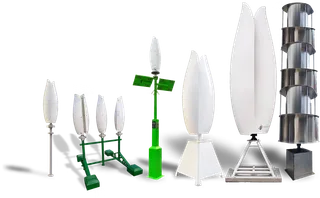
A vertical wind turbine, often called a vertical axis wind turbine or VAWT, has a rotor that turns around a vertical shaft. Common designs include curved-blade, straight-blade, and helical forms. Unlike a traditional horizontal axis turbine, it does not need to yaw into the wind in the same way.
That can help where wind direction changes, but it does not remove the need for strong, smooth airflow. Small turbines perform poorly in turbulent air because gusts and swirling flow reduce output and increase stress on bearings, fixings, blades, brakes, and electrical components.
A domestic system normally uses power electronics before feeding household loads, charging a battery, exporting to the grid, or operating as part of an off-grid supply. The exact design depends on the turbine, controller, inverter, battery arrangement, metering, isolation, and whether other generation such as solar panels is already installed.
When vertical wind turbines make sense for UK homes
A vertical wind turbine is most likely to make sense where the property has open exposure and enough space to put the rotor into cleaner wind. Rural homes, farms, smallholdings, exposed coastal properties, and hilltop plots are more plausible than terraced streets or enclosed suburban gardens.
The turbine also needs to match the household’s energy use. Wind can complement winter demand because windy periods may occur when solar output is lower, but generation is still variable. A good design looks at when electricity is used, whether surplus can be stored, whether export will be paid, and whether maintenance access is realistic.
Treat any proposal cautiously if it relies on product images, rated power, or broad claims about “urban wind” without explaining the actual wind conditions at the rotor. The useful question is not whether the turbine can spin, but whether it can generate enough usable kWh over time to justify the installation. For a wider overview of domestic options, see residential wind power.
Clear airflow
Fewer nearby buildings, trees, ridges, fences, and roof obstructions means less turbulence.Matched demand
The system should fit real electricity use, export arrangements, and any battery strategy.Sensible access
Bearings, fixings, brakes, blades, electrical parts, and safety equipment may need inspection.Exposed location
Open ground, coastal exposure, hilltop positions, or rural plots give the turbine a better chance.Practical mounting
A properly designed freestanding mast is often more credible than attaching a turbine to a house.
Why rooftop and urban wind turbines are difficult
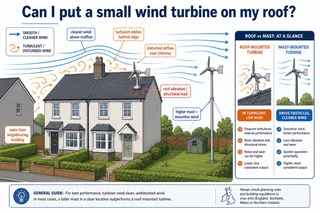
Rooftop wind turbines are appealing because the roof is already high, but they are rarely simple. Buildings create disturbed airflow around ridges, parapets, chimneys, dormers, roof valleys, and neighbouring houses. A turbine mounted in that air may rotate visibly while still producing limited useful energy.
There is also a structural issue. A wind turbine creates vibration, dynamic loading, moving-part risk, and noise transmission in a way that solar panels do not. A roof that can accept solar mounting is not automatically suitable for a turbine, because the loads, fixings, waterproofing risks, and maintenance needs are different.
Urban wind can work in some specialist commercial or architectural projects, but domestic installations need evidence rather than assumptions. In built-up areas, an installer should be able to explain mounting height, turbulence, safe shutdown, noise risk, access, neighbour impact, and the grid connection route before recommending equipment. If the only possible position is roof-mounted, read more about whether you can put a turbine on your roof before assuming it is viable.
Vertical wind versus horizontal wind, solar, and batteries
Vertical turbines are often promoted as quieter, compact, and better in changing wind direction. Those advantages can matter, but they do not automatically make them the best domestic energy option. Horizontal axis turbines are often more efficient in clean wind. Solar panels are usually easier to assess for many UK homes because roof area, orientation, shading, and inverter design can be reviewed with more confidence. A battery is different. It does not generate electricity, but it can shift solar generation, wind output, or off-peak tariff charging into periods when the home needs power. If the main goal is lower grid import rather than generating specifically from wind, the better answer may be solar, a battery, insulation, controls, or tariff optimisation.
| Option | Best suited to | Main limitation to check early |
|---|---|---|
| Vertical wind turbine | Exposed sites with variable wind direction and suitable mounting space | Turbulence, planning sensitivity, realistic output, and maintenance access |
| Horizontal wind turbine | Open rural or coastal sites with clean prevailing wind | Mast height, visual impact, moving parts, and grid connection |
| Rooftop solar panels | Many homes with usable roof space and limited shading | Roof condition, orientation, shading, and inverter design |
| Battery storage | Homes wanting to use more generated or off-peak electricity on site | Usable capacity, charge rate, tariff fit, and installation location |
| Energy efficiency upgrades | Homes with high heat loss or avoidable demand | Fabric condition, ventilation, heating controls, and user behaviour |
Overview
This is why a proper home energy design starts with the site and the load profile, not with the product. A windy-looking garden may be a poor turbine site, while an ordinary pitched roof may be excellent for solar. Equally, an exposed rural property with poor solar roof space may be a stronger wind candidate than the average house.
Planning permission and UK local constraints
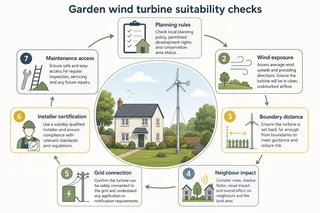
Domestic wind turbines can be sensitive in planning because they are visible, moving structures that may create noise or affect neighbours. Rules depend on the UK nation, local planning authority, property type, turbine size, mounting method, distance from boundaries, previous renewable installations, and whether the site is in a protected area. The safest starting point is to check with the local planning authority or the relevant devolved planning guidance before ordering equipment. Planning Portal guidance is commonly used in England, while Wales, Scotland, and Northern Ireland have their own planning systems and local interpretation. Permitted development rights for domestic wind are tightly conditional, and many proposals still need explicit planning permission. For more detail, see this guide to micro wind permitted development. Listed buildings, conservation areas, national parks, National Landscapes, protected views, aviation constraints, ecological sensitivities, and proximity to neighbours can all change the answer. Even a small turbine may raise questions about visual impact, noise, shadow movement, safety clearances, and cumulative impact where other equipment is already installed.
| UK area | Practical planning point | What to check before buying |
|---|---|---|
| England | Some domestic wind proposals may be considered under permitted development only if strict conditions are met | Planning Portal guidance, local planning authority position, protected area status, turbine type, height, and siting |
| Wales | Planning rules and local policy may differ from England | Local authority guidance, site constraints, landscape sensitivity, and neighbour impact |
| Scotland | Domestic renewable planning is handled within the Scottish planning system | Local authority advice, conservation constraints, height, noise, and visual impact |
| Northern Ireland | Planning rules are separate from Great Britain | Local planning guidance, permitted development conditions, location restrictions, and grid connection implications |
Overview
Planning is separate from electrical approval. A turbine can be acceptable in planning terms but still need the correct Distribution Network Operator process before connection. It may also be electrically possible but unacceptable in planning. Both checks should happen early.
Grid connection, DNO process, export, and batteries
A grid-connected vertical wind turbine needs compatible electrical equipment and a safe connection to the home’s installation and local electricity network. The design should make clear whether the turbine supplies household loads, charges a battery, exports surplus electricity, or operates as a standalone off-grid system.
For UK homes, installers normally consider the Energy Networks Association connection processes used by Distribution Network Operators. Smaller generation may fall under G98 arrangements in some cases, while larger systems, multiple generators, or more complex export arrangements may require G99. Where export is limited by equipment, G100 export limitation may also be relevant. The correct route depends on the inverter arrangement, total generation, export level, and existing systems such as solar PV.
Export payments are not automatic just because a turbine produces electricity. The Smart Export Guarantee is administered by licensed suppliers, with eligibility, metering, and evidence requirements set by the supplier within the Ofgem framework. Some suppliers may require suitable certification, compatible export metering, and proof that the installation meets their terms. Check this before assuming any export income. A battery can improve self-consumption, but it does not fix a poor wind site. Battery sizing needs to reflect usable capacity, charge and discharge rates, household demand, export limits, and whether the same battery is also being used for solar or tariff charging. A battery that is too small may spill surplus energy, while an oversized battery may add cost and complexity without being used effectively.
Costs, savings, and payback should be treated carefully
Small wind economics are highly site-specific. The main financial driver is not the turbine’s brochure rating. It is the amount of usable electricity generated at the actual hub height after turbulence, downtime, electrical losses, battery losses, curtailment, export limits, and maintenance are considered.
It is difficult to give a reliable installed cost without a site design because the turbine is only one part of the project. A quote may need to include foundations, mast work, structural checks, cabling, trenching, inverter or controller equipment, isolation, battery integration, consumer unit work, DNO paperwork, planning support, lifting access, commissioning, and maintenance provision.
Treat headline payback claims cautiously unless they are tied to a site-specific output estimate. A credible proposal should separate estimated annual generation, self-consumption, export, maintenance, expected component life, and assumptions about electricity prices. If the estimate does not explain wind speed, mounting height, exposure, and turbulence, it is not enough for an investment decision.
Understanding generation, capacity factor, and output claims
A turbine’s rated kW is its power rating under specified conditions. It does not tell you how many kWh it will generate across a year. Annual generation depends on how often the wind reaches useful speeds, how smooth the airflow is, how high the turbine is mounted, and how much energy can be used, stored, or exported. Capacity factor is a useful concept because it compares actual energy production with the energy a turbine would produce if it ran at full rated output all the time. Small domestic turbines on turbulent sites can perform very differently from the impression created by rated power alone. This is why two turbines with the same rating can deliver very different results. A cautious assessment should model a range of outcomes rather than one optimistic figure. The examples below are deliberately non-numerical because a reliable estimate requires local wind evidence, mounting details, and the equipment power curve.
| Site outcome | What it usually means | Financial implication |
|---|---|---|
| Poor wind site | Sheltered location, low mounting height, turbulent airflow, or frequent obstructions | Output is unlikely to justify the project except for specialist off-grid reasons |
| Moderate wind site | Some exposure but affected by nearby buildings, trees, or planning-limited height | Careful modelling is needed and alternatives may still be better value |
| Strong wind site | Open exposure, suitable mast height, clean airflow, and practical maintenance access | Wind may be worth comparing seriously against solar, batteries, or a combined system |
Overview
Where an installer provides projected kWh, ask what wind data was used, how the mounting height was chosen, what power curve was applied, and whether losses have been deducted. If the forecast assumes ideal conditions that do not exist on the property, the payback calculation will be misleading.
What an installer should check before recommending one
A good installer will not start by promising that a particular vertical turbine is right for the property. They should first assess the wind resource, physical site, electrical system, planning context, and the homeowner’s aims. Many domestic wind enquiries fail at this stage because the site is too sheltered or the mounting option is not acceptable.
The survey should cover mechanical, electrical, and practical details. A freestanding mast may require ground assessment, foundations, access, safe working space, and appropriate clearances. A building-mounted proposal needs particular care around vibration, structure, waterproofing, noise transmission, and long-term maintenance.
Electrical checks should include cable routes, isolation, earthing considerations, consumer unit suitability, inverter or controller compatibility, battery integration, export metering, existing solar, and the DNO connection route. If the installer cannot explain these points clearly, the proposal is not ready.
DNO process
The design should state whether G98, G99, or export limitation considerations apply.Wind evidence
The installer should explain what wind data has been used for the exact mounting position.Planning route
The installer should identify likely planning risks before equipment is ordered.Mounting method
The proposal should justify whether the turbine is freestanding or building-mounted.Maintenance plan
Access, inspection intervals, safe shutdown, and component replacement should be addressed.Turbulence assessment
Nearby roofs, trees, fences, boundaries, and slopes should be considered.
Common mistakes to avoid
The most common mistake is buying a turbine before proving the site. A small turbine on a poor wind site may rotate frequently but generate little useful electricity. Movement is not the same as energy production, and a visible spin in gusty weather does not prove strong annual output.
Another mistake is comparing rated power across products without understanding the conditions behind that rating. Wind turbine output is highly sensitive to wind speed, and real domestic mounting heights can be far below ideal test conditions. It is also easy to overlook losses through electronics, battery charging, export limits, curtailment, and downtime.
Homeowners should also avoid assuming that a vertical turbine is maintenance-free. Any generator with moving parts needs a sensible inspection plan. Bearings, fixings, brakes, blades, electrical connections, mast components, and safety systems all need to remain reliable in harsh weather, especially on exposed coastal or upland sites.
Mounting too low
A neat garden installation may sit in turbulent air and underperform badly.Ignoring planning
Ordering equipment before checking local rules can create delay or wasted cost.Forgetting maintenance
Moving parts need access, inspection, and safe isolation over time.Treating a roof like a mast
Building-mounted wind introduces vibration, noise, waterproofing, and structural questions.Buying from brochure figures
Rated power and attractive images do not prove annual kWh on your site.
How vertical wind works with solar, batteries, heat pumps, and EVs
Wind can be a useful partner for solar in the right location because it may produce more during unsettled or winter weather. That does not mean wind automatically makes a home self-sufficient. The result depends on generation timing, household demand, storage, export, and the flexibility of other loads. If you are weighing up a hybrid design, this guide explains how to combine solar and wind.
For homes with a heat pump, winter electricity use may be higher, so a good wind resource could help if output coincides with demand. The heat pump’s controls, weather compensation, hot water schedule, and household comfort settings all affect how much locally generated electricity is useful on site.
Electric vehicles and immersion diverters can also absorb surplus generation, but only if the timing works. A car that is away during windy daytime periods cannot use that electricity directly unless a battery or export arrangement captures the value. The best combined systems are designed as one electrical strategy rather than as separate add-ons. If solar is already installed, the installer needs to understand existing inverter capacity, export limits, metering, DNO approval, battery settings, and consumer unit arrangements before adding wind. Retrofitting without checking these details can create delays or require redesign.
Certification, standards, and consumer protection checks
Homeowners should ask what certification, product evidence, and workmanship standards apply to the proposed system. MCS certification can be relevant because some export tariff routes and consumer protection expectations may depend on recognised installation and product standards. The exact requirement depends on the supplier, technology, equipment, and installation route, so check it before relying on export income.
It is also important to understand warranties and responsibilities. A turbine project can involve a manufacturer, installer, electrician, structural specialist, planning adviser, and network operator. The homeowner should know who is responsible for performance estimates, structural design, electrical compliance, commissioning, maintenance, and fault response.
Ask for clear written documents before paying a deposit. These should include the proposed location, mounting method, electrical schematic, estimated generation assumptions, planning position, DNO route, maintenance requirements, warranty terms, and exclusions. A vague quote for “supply and fit” is not enough for a moving generator connected to a home.
When a vertical wind turbine is probably not suitable
A vertical wind turbine is probably not suitable if the property is surrounded by taller buildings, mature trees, high fences, nearby ridgelines, or complex roof shapes that create turbulence. In these cases, the turbine may spin but still produce too little useful electricity.
It is also a weak option where planning sensitivity is high, neighbour distances are tight, or the only realistic location is attached to the house. Noise perception, vibration, visual impact, and maintenance access can become disproportionate problems on constrained domestic plots.
If the main aim is reducing bills, other measures may offer a clearer route. Solar panels, battery storage, insulation, heating controls, draught reduction, hot water timing, and tariff optimisation are often easier to assess and maintain for ordinary homes. Wind should compete against those options on evidence, not on novelty. If solar looks like the stronger route, you can compare home solar options before committing to a turbine.
Practical questions homeowners usually ask
Many homeowners ask whether vertical wind turbines work on roofs. The practical answer is that rooftop mounting is usually difficult because roof-level airflow is turbulent and the structure must handle vibration, dynamic loading, noise transmission, and waterproofing risk. It is not enough for the roof to be strong enough for solar panels.
Homeowners also ask whether a small turbine needs planning permission. The answer depends on location, size, mounting, UK nation, property type, and local constraints. Do not assume permitted development applies. Check the local planning route before ordering equipment.
Generation is another common question. A turbine’s annual kWh depends far more on actual wind conditions than on the rated kW printed on the product sheet. A site-specific estimate should explain wind data, mounting height, power curve assumptions, losses, and how much energy will be used on site or exported. Export payments can be possible, but they are not automatic. The Smart Export Guarantee involves supplier-specific eligibility, metering, and evidence requirements within the Ofgem framework. Confirm the supplier’s conditions, any certification expectations, and the metering arrangement before including export income in a payback calculation.
Next steps for UK homeowners considering a vertical wind turbine
Start with evidence rather than equipment. Look at site exposure, proposed mounting height, nearby obstructions, planning sensitivity, electrical capacity, existing generation, likely self-consumption, and maintenance access. If those fundamentals are weak, compare solar, battery storage, efficiency improvements, heating controls, or tariff optimisation before committing to wind.
A sensible next step is to request a site-specific assessment, not a generic quote. The installer should explain why wind is suitable for your property, where the turbine will be mounted, what permissions may be needed, what DNO process applies, how output has been estimated, and how the system will be maintained. Garden-based projects should also be checked against the practical issues in this guide to garden wind turbine rules.
For the right exposed UK property, a vertical wind turbine can form part of a wider renewable energy system. For many homes, the honest answer is that wind is more constrained than it first appears. Prove the site first, compare alternatives on realistic assumptions, and only proceed if the planning, electrical, structural, and financial case all stand up.
Plan, Compare & Buy Renewable Energy Solutions
AI does the thinking.
You get the perfect solar match.
Use RoboMo™ to assess your property, compare available technologies and connect with trusted UK installers, suppliers and manufacturers.
Simply enter your postcode, drop a pin on your roof, create your free account and let RoboMo™ analyse your property to find the best solar panels for your home.

You don't have to think
RoboMo™'s AI analyses your roof and does all the hard work.

Accurate & tailored
AI-powered assessment based on your roof, location, and conditions.

Best options, maximum savings
Compare top solar panels for the best performance and value.

Simple, fast & effortless
Provide a few details, sit back and watch your results unfold.
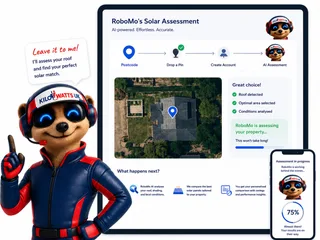

STEP 1
Choose Home, Business or Industrial
Enter your postcode to start your assessment.
STEP 2

Drop a pin on your roof
STEP 3

Create your free account
STEP 4

Sit back and watch RoboMo™ work
RoboMo™ analyses your roof and builds your personalised solar comparison.

Kilowatts UK is an authorised representative
Flower Turbines
Compact vertical-axis turbines built for real UK sites, not just open farmland.
They start in light wind, sit in a small footprint, and are bird-safe by design. Cluster them as a bouquet and the group performs better together than the same turbines standing alone. Enter your postcode for a location-based generation estimate. Figures use area weather data and will differ if buildings, trees or hills sit in the way.
Starts in light UK wind
Built to generate in typical UK wind, not only open farmland.
Small rooftop or ground footprint
Compact towers for roofs, yards and tight sites.
Bird-safe slow rotation
Slow vertical-axis spin, bird-safe by design.
Bouquet clusters raise output
Grouped turbines outperform the same units standing alone.

Step 1
Enter your postcode
Start designing your wind energy system in seconds.

STEP 2

Choose a location
STEP 3

Place your cluster
Tap the map where you want the turbine cluster to go.
STEP 4

Instant generation forecasts
Compare different turbine layouts and see annual generation forecasts instantly.
STEP 5

No commitment required
Explore different configurations before deciding whether to request a quotation.
Related articles
Mo's Mission Nominations
FAQ
Need Help? RoboMo's Got Answers
Are vertical wind turbines suitable for UK homes?
They can be suitable, but only on a minority of domestic sites. The best candidates are exposed rural, coastal, hilltop, farm or smallholding locations with space for a properly engineered mast. Sheltered streets, enclosed gardens and most rooftop positions usually have too much turbulence for good output.
Is a vertical wind turbine better than a traditional horizontal turbine?
Not automatically. Vertical turbines can accept wind from changing directions, but they still need strong, smooth airflow to generate useful electricity. In clean wind, a horizontal axis turbine may be more efficient, so the right choice depends on the site rather than the shape of the turbine.
Can I put a vertical wind turbine on my roof?
A rooftop turbine is often difficult for a home. Roofs create disturbed airflow around ridges, chimneys, dormers and neighbouring buildings, so a turbine may spin without producing much useful energy. There are also structural, vibration, noise, waterproofing and maintenance issues to check before considering roof mounting.
Do I need planning permission for a domestic vertical wind turbine?
You may need planning permission, and the rules depend on where you live in the UK, the turbine type, height, siting and local constraints. Permitted development rights for domestic wind are tightly conditional and do not apply in many situations. Check with your local planning authority before buying equipment, especially if you are in a protected area, conservation area or near neighbours.
Can a vertical wind turbine connect to the grid and export electricity?
Yes, some systems can be grid connected, but the electrical design and Distribution Network Operator process must be correct. Depending on the system size and arrangement, G98, G99 and possibly export limitation requirements may be relevant. Export payments are not automatic, so you should check supplier terms, metering and eligibility before assuming income.
Will a vertical wind turbine save money on my electricity bills?
It depends mainly on the usable annual generation at your exact site. Brochure rated power is not the same as real yearly output, because wind speed, turbulence, mounting height, downtime, losses, export limits and maintenance all affect the result. Treat payback claims cautiously unless they are based on a site-specific assessment.
Can a battery make a vertical wind turbine more worthwhile?
A battery can help you use more of the electricity generated on site, especially if generation happens when the home is not using much power. It cannot fix a poor wind resource or make a turbulent site perform well. Battery sizing should consider household demand, charge rates, usable capacity, export limits and any existing solar system.
What should I ask an installer before choosing a vertical wind turbine?
Ask how they have assessed wind speed, exposure, turbulence and mounting height at your property. They should also explain planning risk, structural design, noise, safe shutdown, maintenance access, grid connection and realistic annual kWh output. Be cautious if the proposal relies mainly on rated power, product images or general claims about urban wind.