


Can Your EV Power Your Home? The Battery on the Drive
Published: 2026-09-05 13:55:35
Updated: 2026-10-06 12:36:01
A typical EV battery stores several times more than a home battery — but only bidirectional cars and chargers can send that energy back into the house.

The Battery on Your Driveway: Why Your EV Is Usually the Biggest Store You Own
If you have solar panels, a home battery and an electric car, the largest energy store on your property is almost certainly the one parked outside in the rain. A typical EV traction battery holds several times the usable energy of a typical home battery — which is why the idea of running the house from the car is so appealing on a dark British evening. The catch is simple and it has nothing to do with size: energy can only travel back down the charging cable if both the car and the charger support bidirectional flow. Most cars and most wallboxes sold to date do not. This companion piece explains what that means in practice, how vehicle-to-load, vehicle-to-home and vehicle-to-grid differ, what to check before you assume your EV can keep the lights on, and how any of this interacts with a solar and battery system on a UK home.
"Several times the usable store, sitting on your driveway most evenings."
Why the car battery usually dwarfs the home battery
Home batteries are sized for a house. They are designed to soak up a day's surplus solar in summer, shift cheap overnight import into expensive evening hours, and fit tidily on a garage wall or in a utility room. Car batteries are sized for a motorway. They have to carry a tonne and a half of vehicle at speed, in cold weather, with the heater on, for a distance most people rarely drive in a single day.
That difference in design brief is why the volumes are so far apart. In the episode we show it as pure volume — a small translucent cylinder beside the garage wall, a much larger one lying under the car — because the point is proportion, not a number on a spec sheet. Every model differs, and quoting a single figure would be misleading. What holds true across the market is the shape of the comparison: several times the usable store, sitting on your driveway most evenings.
There is a second, quieter truth behind this. A typical EV's range vastly exceeds the average daily journey, which is why range anxiety is usually unfounded — and it also means a large slice of that battery is simply idle overnight. The energy is already there. The only question is whether the hardware will let it move.
What 'bidirectional' actually means, in plain English
Ordinary charging is one-way. Electricity leaves the consumer unit, travels along the lead, and stops in the car. A bidirectional setup allows the flow to reverse, so the car can act as a source rather than only a sink. You will see three labels used, and they are not interchangeable.
Vehicle-to-load (V2L) is the simplest. The car itself provides a normal socket, either in the boot or via an adaptor on the charge port, and you plug appliances directly into the vehicle. It does not involve your house wiring at all. Handy for a kettle at a campsite or a freezer during an outage, but it will not run your lighting circuits.
Vehicle-to-home (V2H) is the one people picture: energy travels back up the charging lead, through a compatible bidirectional charger, and into the property's own circuits, so the house draws from the car the way it would draw from a wall-mounted battery. That is the luminous path running the 'wrong' way in the episode. Vehicle-to-grid (V2G) goes one step further and exports beyond the property boundary, which means the equipment and the arrangements with your energy supplier and network operator matter as much as the car does. All three depend on the same underlying capability, and none of them are unlocked by battery size.

The hardware decides, not the car's capacity
This is the mechanism the third beat of the film is built around: a two-headed arrow pulsing along the cable, and beside it a ghosted charger showing a one-way arrow only, dimming out. Two things have to be true at once.
First, the vehicle must be designed to discharge through its charge port under external control. Many EVs simply are not, regardless of how large or new the battery is. Some support V2L but not V2H. Some support bidirectional operation only on certain connector standards or only after a manufacturer software update. Second, the charge point must be a bidirectional unit, and it must be compatible with your specific vehicle. A standard smart wallbox cannot be reprogrammed into a bidirectional one; the power electronics inside are different. Compatibility lists are model-specific and change over time, so the honest answer to 'will it work with my car?' is always 'check the current list for that exact vehicle and that exact charger'. There is a third practical layer around all of this: the installation itself. Sending power back into a property's circuits, and potentially beyond them, is a different job from fitting a one-way charger. A qualified installer will confirm what protection, isolation and notification your specific setup requires before anything is commissioned. That is not a formality to design around — it is part of what makes the system safe to live with.
How this changes the way you think about a home battery
It is tempting to conclude that a bidirectional EV makes a home battery redundant. In some households it genuinely reduces the case for a large one. In many it does not, and the reason is availability rather than capacity.
A wall-mounted battery is always present. It charges from your panels at midday whether or not anyone is home, and it discharges at teatime without needing anyone to have plugged anything in. A car is only an energy asset when it is on the drive and connected. If your vehicle spends weekdays at a workplace car park, the largest store on the property is absent during exactly the hours your solar array is producing its surplus.
There is also the small matter of what the car is for. Discharging to the house means arriving at a lower state of charge than you left it, so any sensible bidirectional setup lets you reserve a floor — a minimum charge the house is never allowed to touch. The practical outcome for most people is not 'car instead of battery' but 'car as a very large, occasionally available top-up alongside a smaller, always-present one'. Deciding which shape suits your household is a sizing conversation, and it is worth having before you buy either.
Solar, dark evenings and where the energy actually comes from
None of this creates energy. A bidirectional car is a store, and stores only move energy in time. What makes the arrangement worthwhile is the gap between when electricity is cheap or free and when it is expensive.
On a British summer day, a well-sized array often produces more than the house can use at midday. That surplus has to go somewhere: into the home battery, into the car, or out to the grid. On a grey October afternoon there is far less to play with, though it is worth remembering that UK homes still generate useful solar power on overcast days — diffuse light through cloud is not nothing, it is simply less. And counter-intuitively, panels generate more efficiently in cold weather than in hot, so a bright, crisp winter day is kinder to the cells than a heatwave.
What a very large store on the driveway changes is your capacity to hold cheap energy — whether that is your own midday surplus or off-peak import — through to the evening peak. It also changes how much of the small stuff you can absorb. Standby draw on idle appliances wastes a meaningful amount of household energy over a year, and the background load it creates is precisely the kind of demand a battery quietly covers overnight instead of your meter.
A practical checklist before you count on your car
Work through these in order. If you fail at step one or two, the rest is academic.
- Does your exact vehicle, in its exact trim and software version, support bidirectional discharge to a property — not just V2L? Check the manufacturer's current documentation, not a forum post from two years ago. 2. Is there a bidirectional charge point on the market that lists your vehicle as compatible? Compatibility is a pairing, not a property of either device alone. 3. Does your existing electrical installation suit it? Supply capacity, consumer unit condition, earthing arrangement and cable route all affect what is possible and what it costs. 4. Has your installer confirmed what notification or approval your network operator and supplier require for the setup you want, particularly if you are exporting rather than only running the house? 5. Is the car actually home during the hours that matter? Map a typical week honestly. A vehicle absent from ten until six is not an evening peak solution on its own. 6. What reserve will you set? Decide the minimum state of charge the house may never dip below, and check the system lets you enforce it. 7. What does the vehicle warranty say about discharge cycles used for anything other than driving? Terms differ by manufacturer and this is worth reading before, not after. 8. Would a smaller home battery plus ordinary smart charging get you most of the benefit for less complexity? Sometimes the tidier answer wins.

Questions people ask next
Can I retrofit bidirectional capability to my existing wallbox? No. The conversion happens inside the power electronics, and a one-way unit does not contain the hardware to reverse the flow. Adding the capability means changing the charge point.
Will running my house from the car wear the battery out? Every charge and discharge cycle contributes to long-term degradation, in a car battery just as in a home one. Sensible systems limit depth of discharge and avoid unnecessary cycling, and manufacturers who support the feature design with that in mind. The honest position is that it is a real consideration, not a scare story, and the warranty wording is the place to find your specific answer.
Will it keep the lights on in a power cut? Only if the system is specifically designed and installed to provide backup supply. Grid-connected equipment normally disconnects during an outage for safety reasons, so islanded or backup operation is a separate design decision with its own hardware requirements. Ask about it explicitly rather than assuming it comes as standard. Does it work without solar? Yes. Bidirectional charging is fundamentally about moving energy in time. If your tariff makes overnight import cheaper than evening import, a large store can be useful with no panels at all. Solar simply gives you a second, free source to fill it from. Should I wait? If you are buying an EV, panels or a battery now, it costs nothing to design the installation so a future bidirectional charger is straightforward to add — cable routes, spare capacity, a sensible consumer unit. That is cheaper than retrofitting the groundwork later.
Video transcript
Mo: The biggest battery here is the home one? RoboMo: No. The car's usually larger. Bidirectional hardware sends that energy home.
Mo: So how much bigger are we talking? RoboMo: Several times the usable store, sitting on your driveway most evenings.
Mo: So any EV can power the house? RoboMo: Only if the car and the charger both support flow in both directions. Mo: The biggest battery here is the home one? RoboMo: No. The car's usually larger. Bidirectional hardware sends that energy home. / Mo: So how much bigger are we talking? RoboMo: Several times the usable store, sitting on your driveway most evenings. / Mo: So any EV can power the house? RoboMo: Only if the car and the charger both support flow in both directions.
Wrapping up
The scale point and the mechanism point are separate, and confusing them is where disappointment starts. Yes, the car on your driveway almost certainly holds several times more energy than the battery on your garage wall. No, that does not mean it can power your house. Size is set by the vehicle; direction is set by the hardware at both ends of the cable. Get the pairing right and you have a very large, occasionally available store that can carry a household through the evening peak. Get it wrong and you have an expensive one-way lead. The good news is that this is a question with a definite answer for any given car and charger — you just have to ask it before you buy, rather than after.
Next step
If you are weighing up panels, a battery, a charge point, or all three, it is worth mapping the whole thing once rather than bolting it together in stages. A survey will tell you what your roof, your supply and your driving pattern actually support — and, just as usefully, what they do not.
Plan, Compare & Buy Renewable Energy Solutions
AI does the thinking.
You get the perfect solar match.
Use RoboMo™ to assess your property, compare available technologies and connect with trusted UK installers, suppliers and manufacturers.
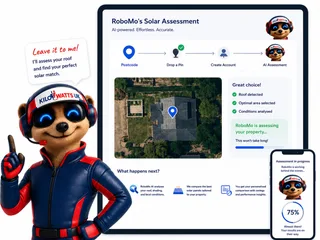
Simply enter your postcode, drop a pin on your roof, create your free account and let RoboMo™ analyse your property to find the best solar panels for your home.

You don't have to think
RoboMo™'s AI analyses your roof and does all the hard work.

Accurate & tailored
AI-powered assessment based on your roof, location, and conditions.

Best options, maximum savings
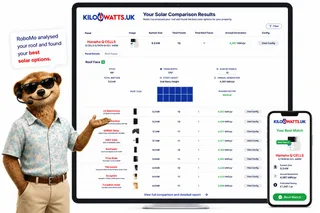
Compare top solar panels for the best performance and value.

Simple, fast & effortless
Provide a few details, sit back and watch your results unfold.
STEP 1
Choose Home, Business or Industrial
Enter your postcode to start your assessment.
STEP 2

Drop a pin on your roof
STEP 3

Create your free account
STEP 4

Sit back and watch RoboMo™ work
RoboMo™ analyses your roof and builds your personalised solar comparison.

BATTERY ROI TOOL
See what a battery saves on your bill
Enter the day rate, off-peak rate and export rate. The calculator ranks batteries in the Kilowatts shop over 10 years.
Home batteries also suit offices and small commercial sites. Industrial batteries are listed on their own calculator.

Step 1
Enter your postcode
Start designing your wind energy system in seconds.
Are you an installer, distributor or renewable energy business?
Kilowatts UK is expanding the Flower Turbines partner network across the UK.
Become A Flower Turbines PartnerKilowatts UK is an authorised representative
Flower Turbines
Compact vertical-axis turbines built for real UK sites, not just open farmland.
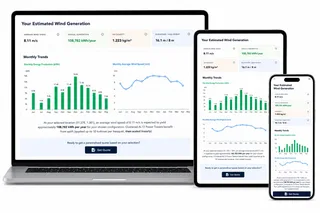
They start in light wind, sit in a small footprint, and are bird-safe by design. Cluster them as a bouquet and the group performs better together than the same turbines standing alone. Enter your postcode for a location-based generation estimate. Figures use area weather data and will differ if buildings, trees or hills sit in the way.
Starts in light UK wind
Built to generate in typical UK wind, not only open farmland.
Small rooftop or ground footprint
Compact towers for roofs, yards and tight sites.
Bird-safe slow rotation
Slow vertical-axis spin, bird-safe by design.
Bouquet clusters raise output
Grouped turbines outperform the same units standing alone.

STEP 2

Choose a location
STEP 3

Place your cluster
Tap the map where you want the turbine cluster to go.
STEP 4

Instant generation forecasts
Compare different turbine layouts and see annual generation forecasts instantly.
STEP 5

No commitment required
Explore different configurations before deciding whether to request a quotation.
FAQ
Need Help? RoboMo's Got Answers
Can any electric car power a home?
No. The car must support bidirectional discharge to a property, and the charger must support it too. A large EV battery on its own does not mean energy can flow back into your house.
What is the difference between V2L, V2H and V2G?
V2L, or vehicle-to-load, lets you plug appliances directly into the car, usually through a socket or adaptor. V2H, or vehicle-to-home, sends power into your home's circuits through a compatible bidirectional charger. V2G, or vehicle-to-grid, can export beyond the home, so supplier and network arrangements become more important.
Can I upgrade my existing EV charger to make it bidirectional?
Usually not. A standard one-way wallbox does not contain the power electronics needed to reverse the flow of electricity. If you want V2H or V2G, you normally need a compatible bidirectional charge point matched to your exact vehicle.
Will an EV keep my house running during a power cut?
Only if the system is specifically designed and installed for backup operation. Grid-connected equipment normally disconnects during an outage for safety, so backup or islanded supply is a separate requirement. Ask about this before buying if power-cut protection is a priority.
Will using my EV to power the house damage the car battery?
Every charge and discharge cycle contributes to long-term battery wear, whether in a car or a home battery. Sensible systems can limit how deeply the battery is discharged, and you should be able to set a reserve for driving. Check the vehicle warranty wording before relying on the feature.
Do I still need a home battery if my EV can discharge to the house?
Possibly. An EV can be a much larger store, but it only helps when it is at home, plugged in and above its reserve level. A home battery is smaller but always available, which may suit households where the car is away during the day or early evening.
Does bidirectional charging work without solar panels?
Yes. Bidirectional charging is about storing energy and using it later, so it can work with electricity imported from the grid. Solar can make the setup more useful by giving you another source of energy to store, especially when there is surplus generation.
What should I check before buying a bidirectional charger?
Check that your exact car model, trim and software version supports V2H or V2G, not just V2L. Then check that the specific charger lists your vehicle as compatible. A qualified installer should also assess your consumer unit, supply, earthing, cable route and any network or supplier requirements for the setup you want.