


Will Solar Panels Run a Heat Pump? The UK Reality
Published: 2026-09-24 07:30:02
Updated: 2026-10-06 12:15:18
Heat pump demand peaks when UK solar output collapses. Here is how the two curves actually interact, where summer surplus goes, and what to plan for.

Will Solar Panels Run a Heat Pump? The Curves That Don't Overlap
The short answer is: rarely, and not in the months you most want it to. A heat pump's electricity demand climbs steeply through November, December and January. A UK solar array's output does the precise opposite, collapsing to a fraction of its summer figure over exactly those weeks. Plot both across a calendar year and you get something close to a mirror image — one curve high while the other sits low, crossing only briefly in the shoulder seasons of spring and autumn. That is not a fault, a sizing error, or a badly specified system. It is geometry: the sun is low and the days are short precisely because it is cold. This article explains what that mismatch means in practice for a UK home, why your summer surplus still earns its keep even when the heating is switched off, where midwinter heat genuinely comes from, and how to make sensible decisions if you are considering solar and a heat pump together rather than assuming one powers the other.
"Mo: So my solar panels will run the heat pump? RoboMo: Rarely. Heating peaks as solar collapses; they overlap only in shoulder seasons."
Why heating demand and solar generation sit almost opposite each other
A heat pump works hardest when the temperature difference between outside and inside is greatest. In a UK winter that means long run hours, colder source air and a lower coefficient of performance — so the unit draws more electricity per unit of heat delivered, at the same time as it is being asked for more heat overall.
Solar generation is governed by an entirely different variable: how much light reaches the panels. In midwinter the sun tracks low and shallow across the sky, daylight hours are short, and cloud cover is at its most persistent. A rooftop array that comfortably produces several hours of strong output on a June afternoon may deliver only a thin trickle across a December day, and much of that arrives in the middle of the day rather than the cold, dark early morning and evening when the heating load is heaviest.
So the two curves are not slightly out of step — they are close to inverted, both across the year and across the day. That is the single most useful thing to understand before you plan either technology, because it changes what you are actually buying solar for.
The shoulder seasons: where the overlap genuinely happens
There is a real overlap, and it is worth having. In the shoulder seasons — roughly March to May, and September into October — daylight is long enough and bright enough to produce meaningful solar output, while the house still has a modest heating requirement on cooler mornings and evenings.
This is the window where a heat pump can genuinely run on self-generated electricity for part of the day. Crucially, these are also the conditions in which a heat pump is at its most efficient: mild outdoor air means a smaller temperature lift, so each kilowatt-hour of electricity delivers more heat. Solar is contributing electricity at the exact moment the heat pump needs the least of it per unit of warmth. That is a favourable combination, and it is why shoulder-season overlap punches slightly above its weight.
What it is not, however, is a winter solution. Treat the spring and autumn overlap as a welcome bonus rather than the core reason to install solar.

So in summer the solar just goes to waste?
No — and this is where a lot of otherwise sensible people talk themselves out of a good decision. When the heating is off, the heat pump simply stops asking for electricity. That does not mean the generation disappears into nothing; it means it is used by everything else in the house.
In practical UK terms, a summer surplus typically serves three things. First, hot water — most heat pump installations include a cylinder, and heating domestic hot water on solar during the middle of the day is one of the most reliable uses of surplus generation there is. Second, general household load: fridges and freezers, cooking, laundry, dishwashing, home offices, and EV charging if you have a car on the drive during daylight. Third, export: whatever the house genuinely cannot use leaves the property and is credited under whatever export arrangement you hold with your supplier. So the correct mental model is not "solar powers the heat pump". It is "solar powers the house, and the heat pump is one of several things the house sometimes wants". In summer the heating is not in the queue. Everything else still is.
How much of the heating can solar realistically cover?
Honestly: a modest share, weighted heavily towards spring and autumn. Anyone promising that a domestic rooftop array will carry a UK heating season is describing a different country's sunshine.
Midwinter heat comes from one of two places. The first is straightforward grid import — your heat pump runs on mains electricity, as it is designed to. The second, and the more interesting one, is stored cheap import: a home battery charged during a low-cost overnight tariff window and discharged during the expensive part of the day. In winter, that battery is mostly acting as a price-shifting device rather than a solar store, because there is very little solar to store. In summer it flips role and soaks up genuine daytime surplus.
That dual behaviour is the key planning insight. A battery bought purely as a "solar store" looks weak in January. A battery understood as a time-of-use tool that also stores solar looks sensible all twelve months. Same hardware, very different expectations.
The cold-weather paradox worth knowing
a true fact that surprises most people, and it makes the mismatch even more poignant: solar panels are actually more efficient in cold weather than in hot weather. Photovoltaic cells lose a measurable amount of efficiency as their temperature rises, which is why a bright, crisp, cold day can produce a strikingly good instantaneous output figure while a sweltering July afternoon delivers slightly less per unit of light than you might expect.
The limiting factor in a British winter is therefore not temperature — it is light. Short days, a shallow sun angle and heavy cloud simply mean there is not much resource to convert, however willing the panels are. Related and equally useful: UK homes do still generate genuinely useful power on overcast days. Diffuse light is not zero light. It is not summer output, but it is not nothing either, and it is one of the reasons UK solar performs better over a full year than pessimists assume.
Both facts point the same way. Solar is a strong annual-energy proposition in Britain. It is a weak midwinter-heating proposition. Those are different claims and should be assessed separately.
A practical decision checklist for solar and a heat pump together
If you are weighing up both technologies, work through these in order:
- Assess them independently first. Ask whether the heat pump makes sense on its own terms — insulation, radiator or underfloor sizing, flow temperatures, hot water cylinder — and whether the solar makes sense on its own terms based on roof orientation, pitch, shading and annual generation. Do not let one justify the other. 2. Check your annual electricity picture, not just the summer one. A heat pump meaningfully increases your yearly consumption. That improves the case for solar overall, even though it barely improves the winter overlap. 3. Prioritise hot water as a surplus destination. Diverting summer surplus into the cylinder is one of the most dependable ways to use generation you would otherwise export. 4. Judge a battery on tariff arbitrage as well as solar storage. If cheap overnight import matters to your winter heating costs, price the battery on that basis too, not solely on solar self-consumption. 5. Be sceptical of any figure presented as a single headline percentage. "Solar covers X% of your heating" means very little without stating which months, what flow temperature and what tariff. 6. Ask to see monthly rather than annual modelling. An annual total can hide a total winter mismatch. A month-by-month generation and demand profile shows you the truth immediately. 7. Get the export arrangement in writing. Summer surplus has value; know what that value is before you commit.

Follow-up questions people usually ask next
Does this mean solar and heat pumps are a bad pairing? No. It means the marketing shorthand is wrong. They pair well across a full year because the heat pump raises your total electricity demand and solar reduces your total electricity bill. They just do not shake hands in January.
Would more panels fix the winter gap? Only marginally. Scaling up an array multiplies a very small winter number and a very large summer one, so you mostly create more summer export rather than more winter heating. Roof space and budget are usually better weighed against other measures.
Would a bigger battery fix it? A battery cannot store energy that was never generated. In winter it is charging from cheap grid import, not from your roof. Size it around your daily consumption and tariff window, not around a hoped-for winter yield. What about east–west arrays? Splitting an array across two aspects tends to widen the generation day and flatten the peak, which can help self-consumption across the shoulder seasons. It does not change the fundamental midwinter light shortage. Is it better to install both at once or in stages? Either can work. Installing together allows a single coherent electrical design; staging lets you observe real consumption data before sizing the array. What matters is that whoever specifies the second element sees honest data from the first.
Video transcript
Mo: So my solar panels will run the heat pump? RoboMo: Rarely. Heating peaks as solar collapses; they overlap only in shoulder seasons.
Mo: So in summer the solar just goes to waste? RoboMo: No. Surplus serves hot water, appliances and export — heating simply isn't asking for it.
Mo: So how much of the heating can solar actually cover? RoboMo: A modest share, mostly spring and autumn. Midwinter heat comes from the grid or stored cheap import. Mo: So my solar panels will run the heat pump? RoboMo: Rarely. Heating peaks as solar collapses; they overlap only in shoulder seasons. / Mo: So in summer the solar just goes to waste? RoboMo: No. Surplus serves hot water, appliances and export — heating simply isn't asking for it. / Mo: So how much of the heating can solar actually cover? RoboMo: A modest share, mostly spring and autumn. Midwinter heat comes from the grid or stored cheap import.
Wrapping up
The curves do not overlap, and pretending otherwise is how expectations get broken. A UK heat pump's demand peaks in the exact months a UK solar array's output collapses, and the genuine overlap is confined to the mild shoulder weeks of spring and autumn — where, helpfully, the heat pump is also at its most efficient. The rest of the winter is met from the grid or from stored cheap import, which is entirely normal and entirely fine. Meanwhile, the summer surplus that the heating never asks for is not wasted: it goes into hot water, household appliances, EV charging and export. Understood properly, solar and a heat pump are a sound annual pairing built on two different jobs rather than one powering the other. Understood badly, they produce a disappointed homeowner in February. The difference is nothing more than reading the monthly numbers before you sign anything.
Next step
If you would like to see how the two curves actually look for your own roof and your own consumption, our team can model it month by month rather than as a single annual headline. You can explore how residential solar is specified, compare approaches side by side, or arrange a no-pressure survey when you are ready — no urgency, and no obligation either way.
Plan, Compare & Buy Renewable Energy Solutions
AI does the thinking.
You get the perfect solar match.
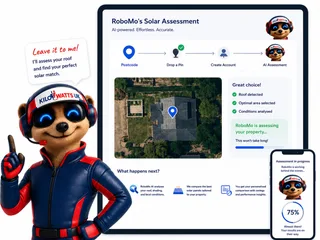
Use RoboMo™ to assess your property, compare available technologies and connect with trusted UK installers, suppliers and manufacturers.
Simply enter your postcode, drop a pin on your roof, create your free account and let RoboMo™ analyse your property to find the best solar panels for your home.

You don't have to think
RoboMo™'s AI analyses your roof and does all the hard work.

Accurate & tailored
AI-powered assessment based on your roof, location, and conditions.

Best options, maximum savings
Compare top solar panels for the best performance and value.

Simple, fast & effortless
Provide a few details, sit back and watch your results unfold.

STEP 1
Choose Home, Business or Industrial
Enter your postcode to start your assessment.
STEP 2

Drop a pin on your roof
STEP 3

Create your free account
STEP 4

Sit back and watch RoboMo™ work
RoboMo™ analyses your roof and builds your personalised solar comparison.

Kilowatts UK is an authorised representative
Flower Turbines
Compact vertical-axis turbines built for real UK sites, not just open farmland.
They start in light wind, sit in a small footprint, and are bird-safe by design. Cluster them as a bouquet and the group performs better together than the same turbines standing alone. Enter your postcode for a location-based generation estimate. Figures use area weather data and will differ if buildings, trees or hills sit in the way.
Starts in light UK wind
Built to generate in typical UK wind, not only open farmland.
Small rooftop or ground footprint
Compact towers for roofs, yards and tight sites.
Bird-safe slow rotation
Slow vertical-axis spin, bird-safe by design.
Bouquet clusters raise output
Grouped turbines outperform the same units standing alone.

Step 1
Enter your postcode
Start designing your wind energy system in seconds.

STEP 2

Choose a location
STEP 3

Place your cluster
Tap the map where you want the turbine cluster to go.
STEP 4

Instant generation forecasts
Compare different turbine layouts and see annual generation forecasts instantly.
STEP 5

No commitment required
Explore different configurations before deciding whether to request a quotation.
FAQ
Need Help? RoboMo's Got Answers
What is Will Solar Panels Run a Heat Pump? The UK Reality about?
The short answer is: rarely, and not in the months you most want it to. A heat pump's electricity demand climbs steeply through November, December and January. A UK solar array's output does the precise opposite, collapsing to a fraction of its summer figure over exactly those weeks. Plot both across a calendar year an
Who is this video for?
UK homeowners and anyone comparing the renewable-energy options discussed in Will Solar Panels Run a Heat Pump? The UK Reality.