


How Workplace Charging Differs from Home Charging
Published: 2026-08-04 00:08:41
Updated: 2026-08-10 08:00:20
Workplace EV charging means EV charge points provided at an employer’s premises for staff, fleet vehicles, visitors, or a mix of users.
Workplace EV charging in the UK.
Workplace EV charging means EV charge points provided at an employer’s premises for staff, fleet vehicles, visitors, or a mix of users. For a UK homeowner, it can be a very useful part of an EV routine, but it should not be assumed to replace a home charger. The answer depends on your commute, parking access, employer policy, charger availability, electricity pricing, vehicle range, and whether you have a dependable backup.
A typical workplace setup uses shared AC chargers because cars are usually parked for several hours. That can be enough for many commuting patterns, but the practical value comes from access and reliability rather than headline charging speed. A slower charger available most office days is often more useful than a faster charger that is usually occupied.
For homeowners, workplace charging works best when the employer has clear rules, sensible bay management, transparent pricing, and a maintenance process. It is less suitable if bays are oversubscribed, charging is restricted to fleet use, or your working pattern changes too often to rely on it.
How workplace charging differs from home charging.
Home charging is usually designed around one household, one parking space, and predictable overnight charging. Workplace EV charging is a shared facility, so the important questions move beyond the charger itself and into access rules, payment, parking behaviour, electrical capacity, inspection, fault handling, and future demand. At home, the decision often starts with off-street parking, the consumer unit, supply capacity, cable route, charger location, and your electricity tariff. At work, the starting point is different. The employer has to consider how many drivers need to charge, when they park, whether fleet vehicles have priority, how the site supply is managed, and how the system will be operated after installation.
| Charging option | Best suited to | Main advantage | Main limitation |
|---|---|---|---|
| Workplace charging | Drivers parked at work for several hours | Convenient charging during the working day | Access may be shared, restricted, or oversubscribed |
| Home charging | Households with suitable off-street parking | Predictable overnight charging routine | Not practical for every property |
| Public charging | Longer journeys and occasional top-ups | Wider network availability | Pricing, queuing, and reliability can vary |
| Destination charging | Shops, hotels, leisure sites, and car parks | Useful while parked for another reason | Usually not designed as a daily charging plan |
Overview
For many households, the best arrangement is a mix rather than one solution. Home charging may cover most nights, workplace charging may reduce pressure during office days, and public charging may still be needed for longer journeys or unexpected changes.
When workplace EV charging makes sense for a homeowner.
Workplace EV charging makes most sense when your car is parked at the same site for long enough to add useful range and when you can access a charger without regular uncertainty. A car parked for a full working day on a standard AC workplace charger can often recover a meaningful amount of commuting range, but the exact result depends on charger output, vehicle efficiency, battery state, weather, and whether the car remains connected for the whole session.
It can be especially valuable if you cannot install a charger at home because you do not have off-street parking, live in a flat, rent your property, or have parking arrangements that make a domestic charge point difficult. It can also help households with two EVs, where one home charger has to support more than one vehicle.
The most important test is not whether workplace charging exists. It is whether you can rely on it often enough for your real weekly mileage.
When it may not be the right answer.
Workplace charging may not be a good base plan if the site has too few charge points for the number of EV drivers. Shared chargers can become difficult to use when bays are blocked, vehicles stay connected after charging, or drivers treat EV bays as ordinary parking spaces.
It may also be unsuitable if your working pattern is irregular. Hybrid working, shift work, field roles, temporary sites, and changing office locations can all reduce the value of workplace charging. In those situations, it is safer to treat workplace charging as a useful extra rather than the foundation of your EV ownership plan.
Limited access
Some employers prioritise fleet vehicles, visitors, pool cars, disabled parking needs, or specific staff groups.Unclear pricing
Drivers need to know whether charging is free, subsidised, billed through an app, or charged at a rate set by the employer.No backup option
Relying on one workplace site is risky if you cannot charge at home or nearby.Parking pressure
EV bays can create disputes if there are too few spaces or no rule for moving after charging.Slow fault response
A broken shared charger affects several drivers and can quickly undermine trust in the system.
A good test is to imagine the charger being unavailable on a wet winter morning before a long return journey. If that would cause a serious problem, you need a backup plan.
What homeowners should ask their employer.
If you are buying an EV or planning to depend more on workplace charging, ask practical questions before making assumptions. The most useful questions are about how the chargers are managed day to day, not just how many are installed.
These answers matter because workplace charging is a shared service. A small number of well-managed chargers can be more useful than a larger installation with no booking system, no access policy, and no clear process when equipment fails.
Access policy
Ask who can use the chargers and whether staff, fleet drivers, visitors, or specific teams have priority.Future demand
Ask whether the employer plans to add more chargers as EV use increases.Pricing method
Ask whether charging is free, subsidised, paid through an app, paid by RFID card, or reclaimed through expenses.Fault reporting
Ask who maintains the chargers and how drivers report faults.Data and receipts
Ask whether you can obtain charging records if you need them for expenses or company car reporting.Booking and bay rules
Ask whether spaces are first come first served, reservable, time limited, or monitored for overstaying.
If you do not have reliable home charging, be more cautious. Workplace charging can be very helpful, but only if the employer’s access policy gives you dependable use rather than occasional availability.
What businesses need to plan before installing chargers.
For an employer, workplace EV charging is both an electrical installation and an operational system. The project should begin with parking demand, vehicle dwell time, staff and fleet needs, existing electrical capacity, cable routes, metering requirements, user access, payment arrangements, and maintenance responsibilities.
In real projects, the common mistake is choosing charger hardware before understanding the site. A business may install too few charge points, choose the wrong bays, underestimate groundworks, ignore future expansion, or create a system that is technically sound but difficult for drivers to use.
Bay location
Choose spaces that are safe, visible, accessible, and unlikely to create trailing cable hazards.Charger type
Match charger output to parking duration rather than assuming faster is always better.Driver demand
Identify current EV drivers, likely future users, fleet requirements, visitor needs, and working patterns.Access control
Decide whether users need RFID cards, app access, contactless payment, staff accounts, or back-office reporting.Maintenance plan
Set out responsibility for inspections, faults, software updates, user support, and emergency contact procedures.Electrical capacity
Assess the incoming supply, distribution equipment, spare capacity, cable routes, and whether dynamic load management is needed.
Good workplace charging design allows for expansion where practical. Even if the first phase is small, spare ducting, sensible cable routes, and space for additional equipment can reduce disruption later.
Technical checks that affect safety and performance.
Workplace charging should be specified by competent electrical professionals because shared EV charging can place significant demand on a site’s electrical system. The survey should consider the existing supply, distribution boards, protective devices, cable sizing, earthing arrangements, charger locations, isolation, metering, and the way chargers interact with other building loads.
Load management is often important. It allows chargers to reduce or share available power when the building is using more electricity elsewhere. This can help avoid unnecessary supply upgrades in some cases, but it must be designed correctly and matched to how the workplace actually operates.
DNO considerations can also arise where new or additional electrical load is being connected. The exact process depends on the installation, existing supply, equipment, and local network requirements, so employers should not assume that every site can add multiple chargers without assessment or notification.
AC charging
Common for workplaces because vehicles are parked for long periods and do not usually need rapid turnaround.Load management
Useful where several chargers need to share limited capacity with the building.Metering and billing
Important when costs need to be allocated to staff, fleets, visitors, or departments.Earthing and protection
Must be assessed as part of the electrical design rather than treated as a generic charger feature.Inspection and maintenance
Shared equipment needs periodic checks, fault response, and clear responsibility after handover.
The technical design should support the user policy. For example, if the employer wants staff billing, usage reporting, or fleet priority, those requirements need to be specified before equipment is selected.
Rules, grants, and responsibilities to check.
UK workplace EV charging involves electrical safety, workplace responsibilities, parking management, user payment, and sometimes grant eligibility. Employers should check current official guidance from GOV.UK and the Office for Zero Emission Vehicles before relying on any support scheme, because eligibility rules, scheme availability, and funding levels can change.
For workplace charging grants, the key point is to use the current GOV.UK guidance rather than relying on old articles or supplier summaries. Employers should confirm who is eligible, what property or parking conditions apply, whether the installation and equipment must meet scheme requirements, and what evidence is needed before work starts. A homeowner using the chargers normally does not apply for the workplace grant personally.
Electrical work should be designed and installed in line with applicable UK requirements, including the current edition of the IET Wiring Regulations as relevant to EV charging installations. Employers should also consider Health and Safety Executive guidance on workplace safety where cables, parking areas, pedestrian routes, and equipment access could affect staff or visitors.
GOV.UK and OZEV
Check current workplace charging scheme details, eligibility, claim process, and any technical conditions.IET Wiring Regulations
Ensure the electrical design addresses EV charging requirements, protection, earthing, isolation, and installation quality.Ofgem and tariff context
Understand that electricity pricing, standing charges, and metering arrangements can affect how charging is billed or recovered.Insurance and site policies
Confirm whether the employer’s insurance, lease, landlord consent, or parking rules affect installation or operation.HSE workplace safety guidance
Consider cable routes, trip risks, lighting, signage, traffic movement, and safe access to equipment.
The employer remains responsible for operating the system fairly and safely after installation. That includes deciding who can use the chargers, how pricing is communicated, what happens when bays are misused, and who responds when equipment is damaged or faulty.
Costs, savings, and what affects value.
The cost of workplace EV charging cannot be reduced to one reliable figure without a site survey. Charger hardware is only one part of the project. Cable runs, groundworks, distribution upgrades, civil works, bay marking, signage, payment software, load management, network communications, maintenance, and future expansion can all affect the final cost.
For homeowners, the value depends mainly on how often you can use the charger and what your employer charges. If workplace charging is free or priced favourably, it may reduce reliance on public charging. If it is priced close to public charging, the benefit may be convenience rather than meaningful saving.
Businesses usually judge value through a wider lens. Workplace charging may support staff, fleet electrification, visitor facilities, sustainability reporting, and reduced reliance on external charging. However, chargers that are rarely used may be difficult to justify, while chargers that are heavily used need strong access rules and prompt maintenance to avoid frustration. No credible answer should promise savings without understanding mileage, tariff structure, charging behaviour, and utilisation. A good proposal should separate essential electrical work from optional extras so the employer can see what is necessary, what improves management, and what helps future expansion.
Practical charging examples for homeowners.
A common misunderstanding is to judge workplace charging only by charger speed. For commuters, time parked is often just as important. If the vehicle is plugged in for most of the working day, even an AC charger can add enough energy for many routine journeys, but the result varies with charger rating, car efficiency, temperature, battery condition, and whether charging is limited by the vehicle or site.
A practical example is a driver who cannot charge at home but parks at work for several full days each week. If access is dependable, workplace charging may cover much of their normal commuting need. The same arrangement is weaker for a hybrid worker who only visits the office occasionally or a driver who arrives after all charging bays are already taken.
Irregular worker
Workplace charging is useful when available but should not be treated as guaranteed.Two EV household
Charging one car at work can reduce pressure on a single home charge point.High mileage driver
Workplace charging may help, but additional home, depot, or public charging may still be needed.No driveway household
Workplace charging can reduce public charging reliance but should be backed up by nearby public or destination charging options.Regular office commuter
Workplace charging may cover routine mileage if the car is parked for long sessions and bay access is dependable.
The sensible approach is to map a normal week. Look at when the car is parked, how often workplace charging is realistically available, and what you would do if the charger was busy for two or three consecutive days.
Common mistakes to avoid.
Workplace charging projects often fail because the installation is treated as a simple hardware purchase. In practice, the long-term success of the system depends on electrical design, parking layout, user behaviour, payment arrangements, and maintenance.
Homeowners can make the opposite mistake by assuming workplace charging will always be there when needed. Shared chargers can be busy, restricted, offline, or reserved for fleet use, so they should be built into a wider charging plan rather than treated as a guaranteed personal charger.
A reliable workplace system should be easy for drivers to understand. They should know where to park, how to start a session, what it costs, when to move, and who to contact if something fails.
Practical next steps.
If you are a homeowner, start with your real routine rather than the charger specification. Work out where the car is parked during a normal week, how many miles you drive, whether home charging is possible, how dependable workplace charging would be, and what your backup plan is.
If you are an employer, start with a site survey and a user brief. Identify who needs charging, when vehicles are parked, how costs will be handled, what access rules are required, whether the electrical supply can support the proposed load, and whether future expansion should be included from the start.
For both homeowners and businesses, the best decision is based on routine, reliability, and management. Workplace EV charging can be a strong part of a UK charging strategy, but it works best when it is safely installed, fairly operated, clearly priced, and matched to real driving habits.
Plan, Compare & Buy Renewable Energy Solutions
AI does the thinking.
You get the perfect solar match.
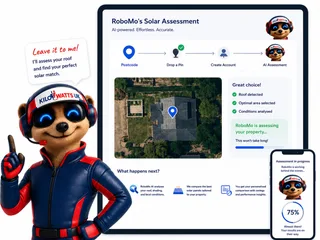
Use RoboMo™ to assess your property, compare available technologies and connect with trusted UK installers, suppliers and manufacturers.
Simply enter your postcode, drop a pin on your roof, create your free account and let RoboMo™ analyse your property to find the best solar panels for your home.

You don't have to think
RoboMo™'s AI analyses your roof and does all the hard work.

Accurate & tailored
AI-powered assessment based on your roof, location, and conditions.

Best options, maximum savings
Compare top solar panels for the best performance and value.

Simple, fast & effortless
Provide a few details, sit back and watch your results unfold.

STEP 1
Choose Home, Business or Industrial
Enter your postcode to start your assessment.
STEP 2

Drop a pin on your roof
STEP 3

Create your free account
STEP 4

Sit back and watch RoboMo™ work
RoboMo™ analyses your roof and builds your personalised solar comparison.

Step 1
Enter your postcode
Start designing your wind energy system in seconds.
Are you an installer, distributor or renewable energy business?
Kilowatts UK is expanding the Flower Turbines partner network across the UK.
Become A Flower Turbines PartnerKilowatts UK is an authorised representative
Flower Turbines
Compact vertical-axis turbines built for real UK sites, not just open farmland.
They start in light wind, sit in a small footprint, and are bird-safe by design. Cluster them as a bouquet and the group performs better together than the same turbines standing alone. Enter your postcode for a location-based generation estimate. Figures use area weather data and will differ if buildings, trees or hills sit in the way.
Starts in light UK wind
Built to generate in typical UK wind, not only open farmland.
Small rooftop or ground footprint
Compact towers for roofs, yards and tight sites.
Bird-safe slow rotation
Slow vertical-axis spin, bird-safe by design.
Bouquet clusters raise output
Grouped turbines outperform the same units standing alone.


STEP 2

Choose a location
STEP 3

Place your cluster
Tap the map where you want the turbine cluster to go.
STEP 4

Instant generation forecasts
Compare different turbine layouts and see annual generation forecasts instantly.
STEP 5

No commitment required
Explore different configurations before deciding whether to request a quotation.
Related articles
Mo's Mission Nominations
FAQ
Need Help? RoboMo's Got Answers
Can I rely on workplace EV charging instead of installing a home charger?
It can help, but it should not automatically be your only charging plan. Workplace chargers are shared, so access may depend on employer rules, bay availability, working patterns and faults. If you cannot charge at home, check that you have a reliable backup such as nearby public or destination charging.
Is workplace EV charging usually fast enough for a daily commute?
Many workplace charge points are AC chargers because cars are parked for several hours during the working day. That can be enough to add useful commuting range, depending on the charger output, your vehicle efficiency, weather and how long you stay plugged in. Availability is often more important than headline charging speed.
What should I ask my employer before depending on workplace charging?
Ask who can use the chargers, whether fleet vehicles or visitors have priority, and whether bays can be booked or time limited. You should also ask how pricing works, how faults are reported, and whether charging records or receipts are available. Clear rules make workplace charging much easier to rely on.
Will workplace charging be free for employees?
Not necessarily. Some employers may offer free or subsidised charging, while others may charge through an app, RFID card, staff account or expenses process. Always check the current policy and price before assuming it will be cheaper than home or public charging.
Is there a UK grant for workplace EV chargers?
Workplace charging support has existed through government schemes, but eligibility, funding levels and rules can change. Employers should check the latest GOV.UK and Office for Zero Emission Vehicles guidance before planning or claiming. A homeowner using a workplace charger would not normally apply for the workplace grant personally.
What happens if all the workplace EV bays are occupied?
That is one of the main limitations of shared charging. A well-run workplace should have clear rules for overstaying, bay blocking, booking and fault reporting. If bays are often full, treat workplace charging as a useful top-up rather than the basis of your EV routine.
Is workplace charging better than public charging for homeowners?
It can be more convenient if your car is parked at work for several hours and the charger is reliably available. Public charging is still useful for longer journeys, unexpected trips and days when the workplace charger is unavailable. Many EV owners use a mix of home, workplace and public charging rather than relying on one option.