


Do You Need Permission to Install an EV Charger at Home?
Published: 2026-06-28 23:09:19
Updated: 2026-08-01 07:20:13
However, “no planning permission” does not mean “no checks, approvals or paperwork”.
Do you need permission to install an EV charger at home?
Most UK homeowners with a private driveway do not need planning permission to install an EV charger at home. However, “no planning permission” does not mean “no checks, approvals or paperwork”. You may still need landlord or freeholder consent, DNO notification or approval, Building Regulations certification, and local authority permission if the work affects the public highway.
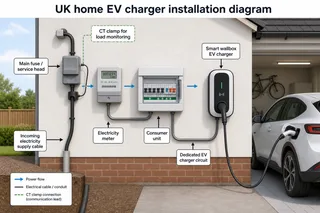
For a typical freehold house with off-street parking, the route is usually straightforward. A competent EV installer checks the electrical supply, designs a suitable charger circuit, installs and tests the equipment, issues certification, and handles the required Distribution Network Operator process. If you are still at the early research stage, this guide to how to install an EV charger explains the basics before you request quotes. The main problems tend to arise where the homeowner does not fully control the parking space, wall, cable route, electrical supply, or external appearance of the property.
In practical terms:
- A freehold house with a private driveway is usually the simplest case.
- A rented home needs written landlord permission.
- A leasehold flat may need freeholder or managing agent consent.
- A listed building or conservation area needs extra planning caution.
- A home with only on-street parking may not be suitable for a private charger.
- Every installation still needs proper electrical design, testing, certification and DNO handling.
This guidance is based on UK domestic EV charger installation practice, including the usual DNO process, Part P electrical requirements in England and Wales, the IET approach to EV charging safety, and official planning principles such as those explained by the Planning Portal and local planning authorities. Local rules can vary, so a competent installer should always check the property-specific position before work starts.
What permission can mean in practice.
The word permission causes confusion because it can mean several different things. An installer may correctly say that planning permission is not required, while a landlord, freeholder, council, DNO, building manager or highways authority may still need to approve part of the work.
The main categories are:
Planning permission: Local planning authority approval may be needed where the work falls outside permitted development rights or affects a restricted building or location. Listed building consent: Separate consent may be needed if the property is listed, even where the charger looks minor. Landlord or freeholder consent: This applies where you do not fully control the wall, parking bay, communal area, riser, cable route or electrical infrastructure. DNO notification or approval: The local electricity network operator must be notified and may need to approve the connection before installation. Building Regulations certification: The electrical work must be installed, inspected and tested correctly, with the right certificates issued. Local highways permission: This may apply where the plan affects a pavement, dropped kerb, verge, public highway or on-street parking arrangement. These approvals are separate. Getting one does not automatically give you the others. The most common mistake is assuming that “permitted development” or “no planning needed” means the installation can go ahead immediately. A simple example is a freehold semi-detached house with a driveway and a standard 7kW wall-mounted charger on a side wall. Planning may not be an issue, but the installer still needs to assess the main fuse, consumer unit, earthing, cable route and DNO requirements. By contrast, a leasehold flat with an allocated bay may have no planning problem at all, but still be delayed because the cable route crosses communal areas and needs managing agent approval, fire-stopping details and a licence to alter.
When planning permission is usually not needed.
In England, a small domestic EV charge point is often covered by permitted development rights, provided it stays within the relevant limits and does not create a planning issue. Similar principles apply across the UK, but Wales, Scotland and Northern Ireland have their own planning systems, and local planning authorities may apply additional controls.
For an ordinary freehold house with private off-street parking, a standard 7kW wall-mounted charger is normally a low-risk planning item. It is usually small, fixed to the property or a suitable structure, and installed for private domestic use.
Planning becomes more sensitive when the charger is prominent, mounted on a front elevation facing a highway, installed on a boundary feature, placed in an unusual location, or combined with wider works such as a new driveway, wall opening, trench, pillar, canopy or dropped kerb. If the installation changes the external appearance of the property or affects drainage, access or the public highway, check with the local planning authority before work starts. You should be especially cautious if the property is:
- A listed building.
- In a conservation area.
- Subject to an Article 4 direction.
- Close to a scheduled monument.
- Facing planning controls on front elevations.
- Being altered to add a new driveway or dropped kerb.
Listed buildings are the clearest example where a standard answer can be misleading. Fixing a charger, cable, conduit, isolator, meter box or protective equipment to a listed structure can require listed building consent. This can apply even if the charger is small and even if a similar installation would be permitted at a non-listed home. If you are unsure, use your council’s planning guidance or the Planning Portal as a starting point, then ask the local planning authority for property-specific advice. A good installer can usually provide drawings, product details and cable-route information to support the check.
Renters, leaseholders, flats and shared parking.
If you rent your home, you need written permission from your landlord before installing a charger. This applies even if you have an allocated parking space. The landlord may want details of the installer, insurance, charger model, electrical route, certification, maintenance responsibility and what happens when the tenancy ends.
Leaseholders often face a similar process. A flat owner may own the lease to the flat but not the external wall, parking area, risers, communal corridors, intake room or incoming electrical infrastructure. A licence to alter may be required, and the freeholder or managing agent may insist on approved contractors, method statements, fire-stopping details, cable containment, metering arrangements and evidence of certification.
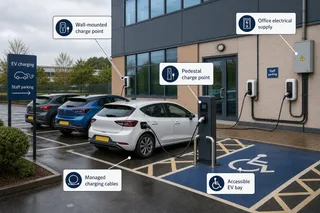
Shared car parks need more design work than many people expect. The issue is not only whether one charger can be fitted, but whether the building can safely and fairly support multiple chargers over time. Cable routes, fire safety, liability, energy billing, bay ownership, load management and future expansion all need to be considered. A common leasehold scenario is an apartment owner with an allocated bay in a basement or communal car park. The charger itself may be straightforward, but the cable route might pass through a service riser, fire compartment, plant room or communal ceiling void. In that case, the managing agent is likely to ask for evidence that any penetrations are correctly sealed, that the cable is mechanically protected, and that the installation will not compromise building safety or future access. For flats and maisonettes, the best first step is to gather the right information before making a formal request. Ask the installer to identify the proposed cable route, supply source, charger location, protective devices, isolation point, metering arrangement and certification route. A vague request is easier for a landlord or managing agent to refuse or delay.
Homes with on-street parking.
Home charging is most practical when the vehicle is parked on land you control. If you only have on-street parking, permission becomes much more difficult because the pavement, kerb and road are normally part of the public highway.
Running a cable across a pavement is usually not allowed without council approval. A cable protector does not automatically make it lawful or safe. The council may have concerns about trip risks, wheelchair and pushchair access, liability, street works, drainage, maintenance and whether the parking space can be reserved. In most cases, you cannot claim a public parking bay as your private charging space.
Some councils are trialling pavement charging channels, cross-pavement charging solutions and dedicated kerbside systems, but availability varies by local authority. Lamppost chargers and kerbside charging schemes are usually arranged by councils or charge point operators rather than individual householders installing private equipment in the street. A typical on-street example is a terraced home where the owner wants to mount a charger on the front wall and run a cable over the footway at night. Even if the electrical work inside the house is possible, the public pavement creates a separate highways issue. The right next step is to contact the council, not to buy a charger and rely on a cable mat. A dropped kerb is also a separate permission issue. You need permission from the local highways authority, and planning permission may also be needed in some situations, especially on classified roads or where front garden surfacing drains onto the highway. If your plan depends on turning a front garden into off-street parking, check the driveway, drainage and kerb permissions before buying the charger.
DNO approval is not planning permission.
Every home EV charger installation should involve the local Distribution Network Operator. The DNO owns and manages the local electricity network. Its role is to make sure the local network and your service connection can support the additional electrical load safely.
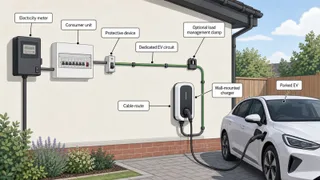
A standard UK home charger is usually a 7kW single-phase unit drawing around 32 amps. That is a significant load, especially in a home with electric heating, a heat pump, battery storage, an electric shower, induction cooking or an older electrical supply. The DNO process helps identify whether the charger can be connected immediately or whether approval, load management, fuse work, unlooping or a supply upgrade is needed first.
The installer should check the main fuse rating, meter tails, earthing arrangement, consumer unit, maximum demand and whether the supply is looped with a neighbour. A looped supply can limit available capacity and may need further work by the DNO before a charger is connected at full power. Prior DNO approval is more likely where:
- The property has a small main fuse.
- The home already has several high-load electrical appliances.
- The supply is looped with another property.
- More than one EV charger is being installed.
- The customer wants a higher-power charger.
- A heat pump and EV charger will operate at the same property.
Some DNO notifications are routine. Others require assessment before the installation can be connected. Fuse upgrades, unlooping work or service alterations can take longer and may involve separate appointments or charges. This is why a proper pre-installation survey matters. A low headline installation price is not helpful if it ignores the supply constraints. The Energy Networks Association provides the framework used by DNOs for low-carbon technology connections, including EV chargers and heat pumps. In practice, your installer should know which forms and notifications are required and whether the job is “notify after” or “apply before” for your specific site. Load calculations show the installation may exceed the agreed supply capacity.
Building Regulations and electrical certification.
An EV charger is not just an outdoor socket. It is a dedicated electrical installation that must be designed and installed safely. In England and Wales, a new EV charger circuit is usually notifiable work under Part P of the Building Regulations.
A registered electrician can normally self-certify notifiable work. After the installation, you should receive the correct electrical certification and, where applicable, a Building Regulations compliance certificate. Keep these documents because they may be needed for property sales, warranty claims, landlord records, insurance queries or future charger upgrades.
The installer should design the circuit in line with current electrical requirements for EV charging, including BS 7671 and EV-specific guidance such as the IET Code of Practice for Electric Vehicle Charging Equipment Installation. Important details include RCD protection, DC leakage protection, cable sizing, isolation, weather protection, impact risk, labelling, circuit design and earthing. Many UK homes use PME earthing, which needs specific protection against certain open-PEN fault conditions. Some chargers include built-in PEN fault protection, while other installations may require separate equipment. This is one reason why EV charging should not be treated as a general handyman job. A neat-looking charger can still be unsafe or non-compliant if the protective devices, earthing arrangement or certification are wrong. Good paperwork should normally include: An Electrical Installation Certificate or appropriate electrical certificate. Building Regulations compliance documentation where applicable. DNO notification or approval evidence. Manufacturer commissioning records where provided. User instructions for smart charging, isolation and basic operation. If an installer cannot explain what certification you will receive, treat that as a warning sign. For wider due diligence, it is also worth knowing how to choose a qualified electrician before you commit to electrical work at home.
Smart charger rules and charger upgrades.
Most new private home charge points sold in Great Britain must meet smart charging requirements. These rules include smart functionality, off-peak default settings and randomised delay features. Northern Ireland has separate requirements, so local rules should be checked.
The smart charger rules are separate from planning permission. A charger can be planning-compliant but still unsuitable if it does not meet the relevant product requirements, cannot connect reliably, or does not work with the homeowner’s tariff and charging routine.
An EV charger upgrade can mean several different things. It might be replacing a 3-pin plug routine with a dedicated 7kW charger, swapping an older non-smart charger for a compliant smart unit, moving a charger to a new location, adding a second charger, or attempting to move from 7kW to 22kW. If you are comparing models, it helps to understand what makes the best home EV charger for your parking setup, tariff and electrical supply. A 22kW charger is not automatically better for a normal UK home. It usually needs a three-phase supply, and most UK homes do not have one. Upgrading to three-phase can be expensive, slow or impractical depending on the local network and property connection. Even a like-for-like replacement may need inspection and testing. If the circuit, protective device, cable route, load calculation or charger location changes, the installer should reassess the installation rather than simply swap the box. A practical upgrade example is a household adding a second EV after already installing solar, battery storage and a heat pump. The charger location may still be acceptable, but the combined electrical demand could require load management or DNO approval before another charge point is added. The permission issue is not the charger brand; it is the total load and how it is controlled.
How property type affects the permission route.
The permission route is usually predictable once you know who controls the wall, parking space, cable route and electricity supply. This is often more important than the charger model.
A freehold house with a driveway is usually the simplest case, subject to electrical checks, DNO handling and local planning restrictions. A rented property can be simple if the landlord agrees, but it should not proceed without written consent. A leasehold flat can be feasible, but communal areas and parking rights often make approval slower.
Shared car parks need a long-term approach. If one resident installs a charger without thinking about future capacity, the building may later face disputes over fairness, cable routes and available electrical load. Good managing agents usually want a scalable plan rather than one-off informal installations. Homes with only on-street parking face the greatest practical barrier. The issue is not charger technology; it is the lack of controlled parking and the need to protect public footways. As a rule of thumb:
- If you own the house, wall and driveway, focus on electrical suitability and certification.
- If someone else owns the wall, structure, land or parking bay, get written consent.
- If the cable crosses communal or public land, expect extra approvals.
- If the building is listed or restricted, check planning and conservation requirements first.
- If the vehicle parks on the public highway, speak to the council before assuming home charging is possible.
What to check before you book an installer.
Before ordering a charger, collect the information that affects permission, cost and feasibility. This avoids wasted surveys and makes conversations with councils, landlords or managing agents more productive.
Confirm whether you own or rent the property. Check whether the property is freehold or leasehold. Confirm that you have private off-street parking. Check whether the building is listed or in a conservation area. Ask whether an Article 4 direction or estate restriction applies. Ask whether a dropped kerb or new driveway is needed.
A good installer will want these details before giving a firm quote. If an installation is priced without checking the electrical supply, parking arrangement and cable route, treat the quote cautiously. For rented and leasehold homes, it is sensible to ask the installer for a short written proposal that can be shared with the landlord or managing agent. This should show the charger location, cable route, supply origin, protective equipment, installer credentials and certification plan. Clear information reduces delay and helps decision-makers understand that the work is being handled professionally. Photograph the meter, consumer unit, parking space and proposed charger wall. Photograph any likely cable route, especially through garages or communal areas. Ask the installer to check the main fuse, earthing and spare consumer unit capacity. Ask whether the supply appears to be looped. Ask whether DNO notification or prior approval is needed. Get written consent before work starts if a landlord, freeholder or managing agent is involved. Ask what electrical and Building Regulations certificates you will receive.
Common mistakes to avoid.
The biggest mistake is focusing only on the charger unit. In real projects, the cable route, supply capacity, permissions and paperwork often decide whether the installation is simple or difficult.
Assuming no planning permission means no approvals. Installing in a rented home without written landlord consent. Fitting equipment to a listed building without checking listed building consent. Running a charging cable across a pavement without council approval. Choosing a 22kW charger for a home without three-phase supply. Ignoring a looped supply or undersized main fuse.
A 3-pin plug can be useful occasionally, but it is not ideal as the main long-term charging method. Standard sockets can overheat if heavily used or if the wiring is not suitable, and extension leads should not be used for routine EV charging. Another common problem is poor charger placement. A charger may be electrically possible but inconvenient or vulnerable to damage if it is too far from the parking position, close to vehicle impact, exposed to awkward cable tension, or installed where the smart signal is weak. Charger location should be agreed during the survey, not improvised on the day. Using a 3-pin socket as a long-term charging solution. Forgetting that flats may need fire-stopping and managing agent approval. Accepting a quote that does not include certification and DNO handling. Assuming an allocated parking bay automatically gives a right to install cables or equipment. Buying the charger before checking whether the property can support it.
What affects cost and timing.
A straightforward 7kW home charger installation is usually quicker than a complex one, but the real cost and timescale depend on site conditions. Long cable runs, trenching, consumer unit upgrades, supply alterations, protective equipment, difficult drilling, weak internet connectivity and landlord approvals can all change the job.
Rather than relying on a generic price, ask for a quote that clearly separates:
The charger unit. Standard installation labour. Cable route and containment. Consumer unit or protective device work. Earthing and PEN fault protection arrangements. DNO application or notification handling. DNO lead times vary. Some notifications are routine, while approval, fuse upgrades or unlooping work can take longer. Landlord, freeholder and managing agent approvals can also add time, particularly in apartment blocks. If the project involves a dropped kerb, new driveway, listed building consent or local authority highways approval, the charger installation may need to wait until those permissions are resolved. Connectivity is another overlooked issue. Many smart chargers rely on Wi-Fi, Ethernet or mobile data for app control and tariff scheduling. If the charger is mounted far from the router or in a weak signal area, the smart features may not work reliably without extra networking. For buyers comparing quotes, the lowest figure is not always the best value. A proper quote should account for safety, compliance, DNO process, certification and the practical realities of where the vehicle is parked. It is also worth understanding typical charger installation cost factors before judging one quote against another. Any civil works, trenching or reinstatement. Certification and commissioning. Optional extras such as data cabling or load management.
When a home EV charger may not be suitable.
A home charger is usually most suitable if you park on your own driveway or allocated bay, charge overnight and have an electrical supply that can support the load. It may be less suitable where parking is uncertain, permission is unlikely or the electrical upgrade cost is disproportionate.
It may not be the right solution if you only have public on-street parking and your council does not support cross-pavement charging. It may also be difficult if a freeholder refuses consent, the building has limited communal electrical capacity, or the charger would need a long and disruptive cable route through shared areas.
In these cases, alternatives may include workplace charging, public rapid charging, council-backed kerbside charging, lamppost charging or waiting until the building introduces a shared charging scheme. These options are not always as convenient as driveway charging, but they may be more realistic than forcing a private installation into an unsuitable setting. A home charger may also be the wrong first step if wider electrical upgrades are planned. For example, if you intend to add a heat pump, battery storage, solar PV or a second EV, it may be better to assess the whole-home electrical load rather than installing one charger in isolation and redesigning the system later.
Practical next steps.
Start by identifying which type of permission applies to your situation. If you own a freehold house with a private driveway, focus on electrical suitability, DNO handling, certification and any local planning restrictions. If you rent, live in a flat, own a leasehold property or use shared parking, get written consent before installation work is booked.
For on-street parking, contact the local council before buying equipment or planning a cable route. Do not assume that a cable mat, pavement channel or nearby parking space gives you the right to charge from your home supply.
Use official sources where they apply: Check local planning restrictions with your council or the Planning Portal. Check landlord, lease and freeholder requirements before authorising work. Make sure the installer understands DNO processes and EV charger notification requirements. Ask for electrical certification and Building Regulations documentation. Confirm the charger complies with the relevant smart charge point rules for your location. Choose an installer who understands EV-specific electrical requirements, DNO processes, load balancing, smart charger rules and the practical realities of your property type. If you are ready to move from research to installation, Kilowatts UK can help with residential EV charging for suitable homes. If your EV plans are part of a wider home energy upgrade, you may also want to compare home solar options before finalising the overall setup. The right question is not only whether a charger can be fixed to a wall. It is whether it can be installed legally, safely, reliably and usefully for the way you park and charge.
Plan, Compare & Buy Renewable Energy Solutions
AI does the thinking.
You get the perfect solar match.
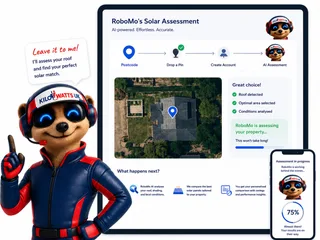
Use RoboMo™ to assess your property, compare available technologies and connect with trusted UK installers, suppliers and manufacturers.
Simply enter your postcode, drop a pin on your roof, create your free account and let RoboMo™ analyse your property to find the best solar panels for your home.

You don't have to think
RoboMo™'s AI analyses your roof and does all the hard work.

Accurate & tailored
AI-powered assessment based on your roof, location, and conditions.

Best options, maximum savings
Compare top solar panels for the best performance and value.

Simple, fast & effortless
Provide a few details, sit back and watch your results unfold.

STEP 1
Choose Home, Business or Industrial
Enter your postcode to start your assessment.
STEP 2

Drop a pin on your roof
STEP 3

Create your free account
STEP 4

Sit back and watch RoboMo™ work
RoboMo™ analyses your roof and builds your personalised solar comparison.

Step 1
Enter your postcode
Start designing your wind energy system in seconds.
Are you an installer, distributor or renewable energy business?
Kilowatts UK is expanding the Flower Turbines partner network across the UK.
Become A Flower Turbines PartnerKilowatts UK is an authorised representative
Flower Turbines
Compact vertical-axis turbines built for real UK sites, not just open farmland.
They start in light wind, sit in a small footprint, and are bird-safe by design. Cluster them as a bouquet and the group performs better together than the same turbines standing alone. Enter your postcode for a location-based generation estimate. Figures use area weather data and will differ if buildings, trees or hills sit in the way.
Starts in light UK wind
Built to generate in typical UK wind, not only open farmland.
Small rooftop or ground footprint
Compact towers for roofs, yards and tight sites.
Bird-safe slow rotation
Slow vertical-axis spin, bird-safe by design.
Bouquet clusters raise output
Grouped turbines outperform the same units standing alone.


STEP 2

Choose a location
STEP 3

Place your cluster
Tap the map where you want the turbine cluster to go.
STEP 4

Instant generation forecasts
Compare different turbine layouts and see annual generation forecasts instantly.
STEP 5

No commitment required
Explore different configurations before deciding whether to request a quotation.
Related articles
Mo's Mission Nominations
FAQ
Need Help? RoboMo's Got Answers
Do I need planning permission to install an EV charger at home?
Most UK homeowners with a private driveway do not need planning permission for a standard wall-mounted home EV charger. However, you may still need other approvals, such as landlord or freeholder consent, DNO notification or approval, Building Regulations certification, or local authority permission if the work affects a pavement, kerb, driveway or public highway.
What permissions might be needed for a home EV charger?
Permission can mean several different things. Planning permission is only one part of the process. Depending on the property, you may also need listed building consent, landlord consent, freeholder or managing agent approval, DNO approval, Building Regulations certification, or highways permission from the local council. These approvals are separate, so being told that planning permission is not needed does not automatically mean the installation can go ahead.
Do I need permission if I own a freehold house with a driveway?
A freehold house with private off-street parking is usually the simplest situation. Planning permission is not normally needed for a standard domestic charger, but the installer still needs to check the electrical supply, main fuse, earthing, consumer unit, cable route and DNO requirements. The installation should also be tested and certified properly.
Do renters need landlord permission for an EV charger?
Yes. If you rent your home, you should get written permission from your landlord before installing an EV charger, even if you have an allocated parking space. The landlord may ask for details of the charger model, installer credentials, insurance, cable route, electrical certification, maintenance responsibility and what happens to the charger when the tenancy ends.
Can I install an EV charger in a leasehold flat or apartment?
Possibly, but leasehold flats and apartments often need freeholder or managing agent approval. You may not control the external wall, parking bay, risers, communal areas, plant rooms or electrical infrastructure. The building owner or managing agent may require a licence to alter, fire-stopping details, cable containment plans, metering arrangements and evidence that the work will be certified by a competent electrician.
Can I install a charger if I only have on-street parking?
On-street parking makes a private home EV charger much harder to arrange because the pavement, kerb and road are usually part of the public highway. Running a charging cable across a pavement is normally not allowed without council approval, and a cable mat does not automatically make it lawful or safe. You should speak to your local council before buying equipment or planning a cable route.
Do I need council permission to run a charging cable across the pavement?
Usually, yes. The council may need to approve any arrangement that affects a public footway, including a cable crossing, pavement channel, dropped kerb or other street works. Councils must consider trip hazards, wheelchair and pushchair access, liability, maintenance and whether the parking space can be used reliably. Rules and trial schemes vary between local authorities.
Is DNO approval the same as planning permission?
No. DNO approval is separate from planning permission. The Distribution Network Operator manages the local electricity network and must be notified about home EV chargers. In some cases, the installer can notify the DNO after installation, but in others the DNO must approve the connection first, especially if the supply is limited, looped, heavily loaded or more than one charger is being installed.
Why does the DNO need to know about my EV charger?
A standard 7kW home charger draws around 32 amps, which is a significant electrical load. The DNO needs to know that your service connection and the local network can support it safely. The installer should check the main fuse, earthing, consumer unit, maximum demand and whether the supply is looped with a neighbour before deciding whether the job can proceed immediately or needs prior approval.
What certificates should I receive after a home EV charger installation?
You should normally receive an appropriate electrical certificate, and in England and Wales a Building Regulations compliance certificate may also be required for a new EV charger circuit under Part P. You should also have evidence of DNO notification or approval where applicable, plus any manufacturer commissioning records or user instructions. Keep these documents for future property sales, insurance queries, warranty claims or charger upgrades.
Can I install an EV charger on a listed building?
You should be very cautious. A listed building may require listed building consent before fixing a charger, conduit, cable, isolator, meter box or protective equipment to the structure. This can apply even if the charger is small and even if planning permission would not be needed for a similar installation at a non-listed property. Check with the local planning authority before work starts.
What if my home is in a conservation area?
A standard charger may still be possible, but extra planning caution is needed in conservation areas, especially if the charger is visible from the highway or affects the external appearance of the property. Local restrictions, Article 4 directions or rules on front elevations may apply, so it is sensible to check council guidance before installation.
Do I need permission for a 22kW home charger?
A 22kW charger is not automatically suitable for a typical UK home because it usually requires a three-phase electricity supply. Most UK homes have single-phase supplies and are more commonly fitted with 7kW chargers. If you want a 22kW charger, the installer and DNO will need to assess whether the supply can support it, and a supply upgrade may be expensive, slow or impractical.
Can I replace or upgrade an existing EV charger without checks?
Not necessarily. Even a like-for-like charger replacement should be inspected and tested. If the charger location, circuit, protective devices, cable route, load calculation or electrical supply conditions have changed, the installer should reassess the installation. Upgrades such as adding a second charger, moving a charger or replacing an older non-smart charger may also require DNO handling and updated certification.
Are smart charger rules the same as planning permission?
No. Smart charger rules are separate from planning permission. Most new private home charge points sold in Great Britain must meet smart charging requirements, including smart functionality, off-peak default settings and randomised delay features. A charger can be acceptable from a planning point of view but still unsuitable if it does not meet product rules, cannot connect reliably or does not work with your charging routine.
What should I check before booking an EV charger installer?
Before booking, confirm whether you own or rent the property, whether it is freehold or leasehold, whether you have private off-street parking, and whether the building is listed, in a conservation area or subject to restrictions. You should also photograph the meter, consumer unit, parking space and proposed cable route, and ask the installer to check the main fuse, earthing, spare capacity, DNO requirements and certification process.
What are the most common mistakes when installing a home EV charger?
Common mistakes include assuming that no planning permission means no approvals, installing in a rented property without written consent, fitting equipment to a listed building without checking consent, running a cable across a pavement without council approval, choosing a 22kW charger without a three-phase supply, ignoring a looped supply or undersized main fuse, and accepting a quote that does not include DNO handling and certification.
Is a 3-pin plug suitable for regular EV charging?
A 3-pin plug can be useful occasionally, but it is not ideal as the main long-term way to charge an electric vehicle. Standard sockets can overheat if heavily used or if the wiring is unsuitable, and extension leads should not be used for routine EV charging. A properly installed dedicated charger is usually safer, faster and more practical.
What affects the cost and timescale of a home EV charger installation?
Cost and timing depend on the charger model, cable route, consumer unit condition, protective devices, earthing arrangement, DNO process, supply capacity, civil works, connectivity and certification requirements. Landlord, freeholder, managing agent, council or DNO approvals can also add time. A good quote should explain what is included rather than relying on a headline installation price.
When might a home EV charger not be suitable?
A home charger may not be suitable if you only have on-street parking and your council does not allow a safe cross-pavement solution, if a freeholder refuses consent, if the building has limited communal electrical capacity, or if the cable route would be too long, disruptive or unsafe. In these cases, workplace charging, public charging, council-backed kerbside charging or a shared building charging scheme may be more realistic.