


Why Rapid Charging Is Slower When Your EV Is Cold
Published: 2026-09-29 17:16:33
Updated: 2026-09-29 10:21:20
Cold lithium cells accept charge slowly, so a rapid charger delivers less power on a frosty UK morning. Here is why preconditioning fixes it.

The Cold Pack At The Rapid Charger: Why Winter Charging Starts Slow
If you have ever plugged into a rapid charger at a dark motorway services in January and watched the display sit stubbornly low, you have probably blamed the charger. In most cases the charger is innocent. A lithium battery that is cold physically cannot accept charge quickly, so the car itself limits the current until the cells warm up. The rate then climbs as the pack heats, which is why the same car, same charger and same cable can deliver a very different experience at seven in the morning in February than it does on a mild afternoon in May. This article explains what is actually happening inside the pack, why preconditioning exists, how to use it on a typical UK trip, and how to judge whether a slow session is the charger's fault or simply physics. It is the written companion to a ten-second episode of Solar, Clearly with Mo and RoboMo — but everything you need is here, whether or not you watch the clip.
"No. Cold cells accept charge slowly. Rate climbs as they warm."
What actually happens inside a cold lithium pack
A lithium-ion cell charges by moving lithium ions from one electrode, through a liquid electrolyte, into the other. Everything about that journey is temperature-sensitive. When the cells are cold the electrolyte is more viscous, ion movement slows, and internal resistance rises. Push high current into a cold cell anyway and you risk plating lithium metal onto the anode, which permanently damages capacity. So the battery management system does the sensible engineering thing: it caps the charging current until conditions are safe.
That cap is not a fault, a defect or a sign of a tired battery. It is a protection strategy, and it is the reason your car is deliberately charging more slowly than the charger could supply. As current flows, the pack's own internal resistance generates heat, and many cars will also run a heater or circulate warmed coolant. The cells warm, the permitted current rises, and the delivered power climbs with it. Watch a charger display for ten or fifteen minutes on a freezing morning and you will often see exactly that shape: a low, flat start that gradually steps upward.
The charger is rarely the bottleneck
This is the part that surprises people. A 150 kW or 350 kW rapid unit is, in engineering terms, an offer. It says: here is the maximum I am prepared to deliver. The car then negotiates and requests whatever current it considers safe given the pack's state of charge, temperature and health. The lower of those two numbers wins, and on a cold morning the lower number is almost always the car's.
This matters practically, because it changes what you should do when a session feels slow. Unplugging and moving to a different bay usually achieves nothing if the limit is thermal — you simply restart the warm-up clock with a pack that is still cold. It also matters for how we judge public charging infrastructure fairly. A charge point that appears disappointing at 06:40 on a frosty forecourt may be performing perfectly. Knowledge beats marketing here: understanding the mechanism protects you from both unfair complaints and unrealistic expectations.

Preconditioning: warming the pack on the move
Preconditioning is simply the car warming its battery to the right temperature window before you arrive, using energy it is already drawing while driving. Because the warming happens during the journey rather than at the bay, the pack is ready the moment the connector clicks home. Instead of a slow climb that only reaches full rate around minute ten, the car starts high and holds it.
Most EVs with this feature trigger it automatically when you set a rapid charger as a destination in the car's own navigation system. That last detail catches a lot of drivers out: routing to a charger using a phone map app on a windscreen mount typically does not tell the vehicle anything, so no preconditioning occurs. Some models also offer a manual preconditioning button you can press ten to twenty minutes before arrival. The energy used to heat the pack is real and does slightly reduce range on that leg, but it is generally repaid several times over by a shorter stop.
A practical winter charging checklist for UK drivers
None of this requires technical skill — just a few habits that line up with how the hardware works.
• Set the rapid charger as a destination in the car's built-in navigation, not only on your phone, so the vehicle knows to precondition.
• If your car has a manual battery preconditioning control, activate it roughly fifteen to twenty minutes before you expect to plug in. • Where you have the choice, charge after a decent motorway run rather than immediately after a cold start from a supermarket car park. • Aim to arrive at a lower state of charge. Rapid charging naturally tapers as the pack fills, so a session starting at 15 per cent behaves very differently from one starting at 60 per cent. • Do not judge the charger in the first two minutes. Give the session time to show its shape before deciding something is wrong. • Treat slow winter sessions as expected, not exceptional, and build a little extra time into February trip planning rather than extra frustration. • At home, remember that slow overnight AC charging is barely affected by cold in the same way — the currents involved are far lower, so the thermal limit rarely bites.
Why this matters less than it sounds for everyday driving
It is worth keeping the problem in proportion. A typical EV range vastly exceeds the average daily journey in the UK, so most drivers rarely need a rapid charger at all — they plug in at home, wake up full, and never watch a kW figure in the cold. Cold-weather rapid charging is a long-journey issue, not a daily-life issue.
That reframing is useful when people are deciding whether an EV suits them. The honest version is: on the handful of winter days you make a long motorway trip, your stop may take longer than the headline charging figure suggests, and preconditioning largely solves it. On the other three hundred and fifty days, you are charging quietly overnight at a lower rate where cell temperature is not the limiting factor.
How this connects to solar and home energy
There is a neat piece of symmetry here that is worth knowing. Cold hurts battery charging rates, but it helps photovoltaic panels: solar panels generate more efficiently in cold weather than in hot weather, because cell efficiency falls as panel temperature rises. A bright, crisp winter day can be a genuinely productive one for a UK array, even though the days are short.
For households running both solar and an EV, the practical takeaway is that home charging and generation behave very differently from motorway rapid charging. Overnight home charging at 7 kW sits far below any thermal limit, and daytime solar charging in mild conditions is gentle on the pack by nature. If you are weighing up how a home array, a battery and an EV would work together on your roof and your driveway, our guide to residential solar panel installation sets out the realistic version, and the compare page lays the options side by side without the sales gloss.

Common follow-up questions
Is slow cold charging damaging my battery? No — the opposite. The car is limiting current precisely to avoid the damage that fast charging a cold pack would cause.
Will leaving it plugged in longer fix it? Partly. The rate should climb as the pack self-heats, so a longer session often ends up delivering more than the opening minutes suggest. It is simply less efficient use of your time than arriving preconditioned.
Does my car definitely have preconditioning? Not necessarily. It is common on newer models but not universal, and on some cars it only activates via the built-in navigation. Check the owner's handbook rather than assuming. Does preconditioning waste energy? It uses energy, yes. Whether that is waste depends on the trade: a few percent of range against a materially shorter stop. On a long winter journey the maths usually favours preconditioning. Should I precondition before a home AC charge? Generally no. The currents are low enough that cell temperature is not the constraint, so you would be heating the pack for no charging benefit. Why did my second stop of the day feel faster? Because the pack was already warm from driving and from the previous session. Same car, same charger, warmer cells.
Video transcript
Mo: A rapid charger is rapid in any weather... right? RoboMo: No. Cold cells accept charge slowly. Rate climbs as they warm.
Mo: So the charger isn't the limit here? RoboMo: Correct. The car is. It limits current until the cells warm.
Mo: So a car that warms its pack on the way? RoboMo: Arrives ready. Full rate from the first minute, not the tenth. Mo: A rapid charger is rapid in any weather... right? RoboMo: No. Cold cells accept charge slowly. Rate climbs as they warm. / Mo: So the charger isn't the limit here? RoboMo: Correct. The car is. It limits current until the cells warm. / Mo: So a car that warms its pack on the way? RoboMo: Arrives ready. Full rate from the first minute, not the tenth.
Wrapping up
The headline on the charger is a ceiling, not a promise, and on a frosty morning the number that matters is the one the car is willing to accept. Cold cells charge slowly because physics says so, the rate climbs as they warm, and preconditioning moves that warming phase into the journey where it costs you nothing but a little range. Once you know that, a slow winter session stops being a mystery or a grievance and becomes a predictable, plannable part of long-distance driving. Facts beat opinions, and engineering beats hype — particularly when it is three degrees on a motorway forecourt and everyone else is glaring at the display.
Next step
If you are thinking about how solar, a home battery and EV charging would actually fit together at your property, we are happy to talk it through honestly — including when the answer is 'not yet'. You can read the detail on our residential solar pages, or arrange a no-pressure survey at a time that suits you.
Plan, Compare & Buy Renewable Energy Solutions
AI does the thinking.
You get the perfect solar match.
Use RoboMo™ to assess your property, compare available technologies and connect with trusted UK installers, suppliers and manufacturers.
Simply enter your postcode, drop a pin on your roof, create your free account and let RoboMo™ analyse your property to find the best solar panels for your home.

You don't have to think
RoboMo™'s AI analyses your roof and does all the hard work.

Accurate & tailored
AI-powered assessment based on your roof, location, and conditions.

Best options, maximum savings
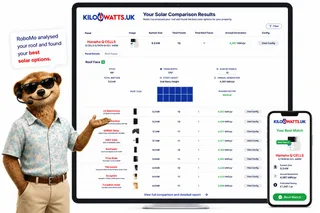
Compare top solar panels for the best performance and value.

Simple, fast & effortless
Provide a few details, sit back and watch your results unfold.
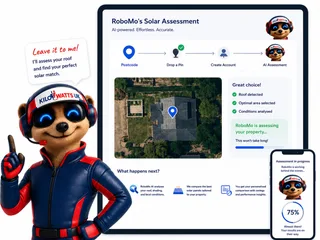
STEP 1
Choose Home, Business or Industrial
Enter your postcode to start your assessment.
STEP 2

Drop a pin on your roof
STEP 3

Create your free account
STEP 4

Sit back and watch RoboMo™ work
RoboMo™ analyses your roof and builds your personalised solar comparison.

BATTERY ROI TOOL
See what a battery saves on your bill
Enter the day rate, off-peak rate and export rate. The calculator ranks batteries in the Kilowatts shop over 10 years.
Home batteries also suit offices and small commercial sites. Industrial batteries are listed on their own calculator.

Step 1
Enter your postcode
Start designing your wind energy system in seconds.
Are you an installer, distributor or renewable energy business?
Kilowatts UK is expanding the Flower Turbines partner network across the UK.
Become A Flower Turbines PartnerKilowatts UK is an authorised representative
Flower Turbines
Compact vertical-axis turbines built for real UK sites, not just open farmland.
They start in light wind, sit in a small footprint, and are bird-safe by design. Cluster them as a bouquet and the group performs better together than the same turbines standing alone. Enter your postcode for a location-based generation estimate. Figures use area weather data and will differ if buildings, trees or hills sit in the way.
Starts in light UK wind
Built to generate in typical UK wind, not only open farmland.
Small rooftop or ground footprint
Compact towers for roofs, yards and tight sites.
Bird-safe slow rotation
Slow vertical-axis spin, bird-safe by design.
Bouquet clusters raise output
Grouped turbines outperform the same units standing alone.


STEP 2

Choose a location
STEP 3

Place your cluster
Tap the map where you want the turbine cluster to go.
STEP 4

Instant generation forecasts
Compare different turbine layouts and see annual generation forecasts instantly.
STEP 5

No commitment required
Explore different configurations before deciding whether to request a quotation.
FAQ
Need Help? RoboMo's Got Answers
Is slow charging in the cold damaging my battery?
No. The car limits current precisely so a cold pack is not forced to accept a high rate, which can plate lithium on the anode and permanently reduce capacity. The slow start is a protection strategy, not a fault or a sign of a worn battery. As the cells warm, the permitted current rises and the session speeds up.
Why does a rapid charger start so slowly on a frosty morning?
A cold lithium pack cannot safely take high current, so the car requests less power than the charger is offering. The headline rating on the unit is a ceiling, not a promise, and the lower of the two figures wins. On a cold morning that lower figure is almost always set by the car. Watch for ten or fifteen minutes and the rate often climbs as the pack warms itself.
Will moving to another bay, or staying plugged in longer, fix a slow winter charge?
Moving bay rarely helps if the limit is battery temperature rather than the charge point. Unplugging simply restarts the warm-up with a pack that is still cold. Staying plugged in does let the rate build as the cells heat, so the session often delivers more than the opening minutes suggest. It is still a poorer use of time than arriving with the pack already warm.
Does every electric car precondition the battery before a rapid charge?
No. Preconditioning is common on newer models but it is not universal, and on some cars it only starts when a rapid charger is set as a destination in the car’s own navigation. A phone map on a windscreen mount usually does not tell the vehicle to warm the pack. Check the owner’s handbook, and use a manual preconditioning control about fifteen to twenty minutes before arrival if your car has one.
Does preconditioning waste energy?
It uses energy, so range on that leg falls a little. Whether that is waste depends on the trade: a small range cost against a much shorter stop. On a long winter journey the time saved at the charger usually outweighs the energy used to heat the pack. The warming happens while you are already driving, rather than while you wait at the bay.
Should I precondition before charging at home overnight?
Generally no. Home AC charging uses much lower currents than a rapid charger, so cell temperature is rarely what limits the session. Heating the pack beforehand would use energy without a useful charging benefit. Keep preconditioning for rapid stops on longer trips, and treat slow winter rapid sessions as something to plan extra time for, not as a daily problem.
Why was my second rapid stop of the day much faster?
The pack was already warm from driving and from the earlier charge. The same car on the same charger can behave very differently once the cells are in the right temperature window. A stop straight after a cold start will almost always be slower than one after a decent motorway run. Arriving at a lower state of charge also helps, because rapid charging tapers as the pack fills.
Does cold weather make an EV, or home solar charging, impractical in the UK?
Not for everyday driving. A typical EV range covers most daily UK journeys, so many people charge quietly at home and rarely need a rapid charger at all. Cold mainly lengthens the handful of winter motorway stops, and preconditioning largely deals with that. Solar panels often generate more efficiently in cold, bright weather than in heat, even though winter days are shorter.