


Export Limits Explained: Does Your Solar Get Throttled?
Published: 2026-10-05 18:10:19
Updated: 2026-10-05 11:10:51
An export limit caps what your solar sends to the grid, not what your home uses. Here is how UK inverters manage surplus, and why annual losses stay small.
The Invisible Export Ceiling: What an Export Limit Really Does to Your Solar System
If someone has told you your solar installation will be "export limited", the first question is almost always the same: does that mean the whole system is throttled? The short answer is no. An export limit is a ceiling on how much surplus electricity can flow out of your property and into the local network. It is not a ceiling on how much your panels can produce for your own home, and it is not a ceiling on how much your battery can absorb. Your kettle, heat pump, EV charger and hot water cylinder all sit on the house side of that ceiling, and they are entirely unaffected by it. This article explains, in plain UK terms, what an export limit is, what the inverter actually does when your battery is full and the grid door is only open so wide, how quickly normal output resumes when demand returns, and why the total energy lost across a whole year is usually a thin sliver rather than a serious dent. It is the written companion to a ten-second episode of Solar, Clearly with Mo and RoboMo — but it is written so it stands on its own if you cannot play the video.
"No. Only export is capped. The home and battery still charge."
What an export limit actually is
Every grid-connected solar system in the UK is connected under an agreement with the local distribution network operator — the company that owns the cables in your street, not your energy supplier. That agreement can specify the maximum amount of power your property is permitted to push back into the network at any moment. Where a limit applies, it is configured in the inverter and enforced automatically, usually with the help of a current sensor at your incoming supply so the system can see exactly what is flowing in which direction. The key point is where the ceiling sits. It sits at the boundary between your property and the street, not at the roof. Picture the energy streams as the episode does: one stream from the panels into the house, one into the battery, and one out along the pavement cable to the grid. Only the third stream meets a translucent ceiling. The other two carry on as normal. That is why RoboMo's answer is so blunt — the system is not throttled, only export is capped.
No. Only export is capped. The home and battery still charge.
Self-consumption comes first, and that is the valuable part anyway
There is a happy accident buried in this. The electricity you use yourself is worth more to you than the electricity you export, because it displaces a unit you would otherwise have bought at the full import rate. Export payments are welcome, but they are the lower-value use of a kilowatt-hour. So when the inverter prioritises the house and the battery, and only trims the third stream, it is trimming the least valuable path. A household that shifts flexible loads into daylight — washing machine, dishwasher, immersion heater, EV charging, dehumidifier — pushes even less into the ceiling, because the house is drinking the surplus before it ever reaches the boundary. If you are still weighing up whether to add storage, our solar and battery comparison guide walks through how self-consumption changes the arithmetic.
What happens when the battery is full and the house is quiet
This is the moment people worry about. Panels are producing strongly, the battery has reached full charge, nobody is home, and the export path is already at its ceiling. Where does the extra go? It is not dumped, burned off in a resistor, or forced anywhere it should not be. The inverter simply reduces generation at source. Modern inverters can move the panels away from their maximum power point, which means the array produces less because it has been asked to produce less. There is no build-up of heat to manage, no stress event, and nothing being discarded. The energy is not created in the first place, which is a very different thing from energy being wasted. This behaviour is designed in, not a fault condition. An inverter operating at reduced output on a bright afternoon is doing precisely what it was engineered to do. Nothing is damaged.
The moment demand returns, full output comes back
The second concern is that once the inverter has dialled back, it stays dialled back for the rest of the day. It does not. Inverter control loops run continuously, and the response is effectively immediate on human timescales — the moment someone boils a kettle, the oven pre-heats, the heat pump calls for hot water, or the EV starts charging, the house-side demand opens up and the inverter restores full output within about a second. That is worth sitting with, because it reframes the whole issue. Throttling is not a state your system falls into and stays in. It is a brief, self-correcting response to a very specific combination of conditions: high irradiance, a full battery, and a quiet house, all at once. Change any one of those three and the ceiling stops mattering.
How much do you actually lose across a year?
This is the question that deserves the honest answer, and the honest answer is: less than the anxiety suggests. Picture a year of daily generation arcs stacked side by side. Most of those arcs never come near the ceiling at all. Winter days are low and broad. Spring and autumn days peak briefly. Overcast days — of which Britain has a generous supply — sit well below the line, because while UK homes do generate genuinely useful power under cloud, they do not generate peak power under cloud. What is left is a handful of bright, clear hours around midday in the sunniest months, when the array is at full tilt, the battery has already filled, and household demand happens to be low. Only that paper-thin sliver at the very top of a few arcs gets clipped. Across a full twelve months, the total lost energy stays small relative to everything the system produced. This is why export limitation is a design constraint to understand rather than a reason to shrink a system. There is a related fact worth knowing, because it runs in the opposite direction: solar panels are more efficient in cold weather than in hot weather. Panel output falls slightly as cell temperature rises, so the very hottest afternoons are not always the highest-output ones. A crisp, bright day in spring can be a stronger performer than a sweltering one in high summer.
A practical checklist for living well under an export ceiling
If an export limit applies to your property, these are the practical levers that genuinely matter: - Ask your installer, in writing, what export limit has been agreed with your distribution network operator and how it is enforced in the inverter. Vague answers are a red flag. - Confirm that the limit is applied to export only, using a sensor at the incoming supply — not applied as a blanket cap on total inverter output. These are different configurations with very different outcomes for you. - Check whether the system logs how many hours per year it spends at reduced output. Good monitoring turns this from a worry into a number you can look at. - Look at your daily load shape. If most of your consumption happens after dark, storage does more for you than extra panels. If you are home during the day, shifting flexible loads into daylight is free and immediate. - Consider whether battery capacity is well matched to your bright-day surplus. A battery that fills by 11am on a sunny day leaves a longer window of trimmed output than one sized with a little more headroom. - Do not shrink the array purely to avoid clipping. Undersizing costs you output on every dull day of the year in exchange for avoiding losses on a few bright hours. That trade rarely favours the homeowner. - Treat any quote that claims to bypass or ignore an export limit with deep suspicion. Compliance with your network operator's connection terms is not optional.
Follow-up questions people usually ask next
Does an export limit reduce my export payments? Only during the specific hours when the ceiling is actually reached, which is a small fraction of the year. Outside those hours, export flows normally up to the agreed limit. Will I notice it happening? Almost certainly not, unless you are watching live monitoring on a very bright, very quiet afternoon. There is no noise, no interruption and no change to anything inside the house. Is it bad for the panels or the inverter? No. Operating below maximum output is a lower-stress condition, not a higher-stress one. Nothing is being forced anywhere. Can the limit change later? Connection arrangements can be revisited with your network operator, and adding storage or changing your consumption pattern changes how often the limit is relevant even if the number itself stays the same. Any change to the agreed limit is a matter for the network operator, not something an installer can simply switch off. Does a battery remove the issue? It substantially reduces it, because the battery absorbs surplus that would otherwise have to leave the property. It does not eliminate it, because a full battery on a bright day still leaves the export path as the only route out. Should this change the size of system I buy? Usually not on its own. Sizing should follow your roof, your consumption and your budget. An export limit is a boundary condition to design around, not a reason to buy less generation than your home can genuinely use.
Video transcript
Mo: Export limited. So the whole system is throttled? RoboMo: No. Only export is capped. The home and battery still charge. Mo: And when the battery is full? RoboMo: The inverter reduces generation at source. Nothing is wasted. Nothing is damaged. Mo: So that surplus is simply lost? RoboMo: No. Demand returns. The inverter restores full output within a second. Mo: So across a whole year, how much do we lose? RoboMo: Only a few bright hours clip. Annual loss stays small. Mo: Export limited. So the whole system is throttled? RoboMo: No. Only export is capped. The home and battery still charge. / Mo: And when the battery is full? RoboMo: The inverter reduces generation at source. Nothing is wasted. Nothing is damaged. / Mo: So that surplus is simply lost? RoboMo: No. Demand returns. The inverter restores full output within a second. / Mo: So across a whole year, how much do we lose? RoboMo: Only a few bright hours clip. Annual loss stays small.
Wrapping up
An export limit is one of those phrases that sounds like bad news and turns out, on inspection, to be an ordinary piece of engineering. The ceiling sits at the pavement, not the roof. Your home and your battery are served first. When the battery is full and the house is quiet, the inverter quietly produces less rather than wasting or damaging anything, and it returns to full output within about a second of demand reappearing. Spread across a year of British weather — where plenty of days never approach the ceiling at all — only a few bright hours clip, and the annual loss stays small. Knowing that is the difference between a design constraint you understand and a worry someone can sell you a solution to.
Next step
If you would like to know what export limit is likely to apply at your address and how it would affect your own generation, our team can talk it through honestly before anything is quoted. You can read more about how we design domestic systems on our residential solar page, or arrange a no-pressure survey whenever you are ready.
Plan, Compare & Buy Renewable Energy Solutions
AI does the thinking.
You get the perfect solar match.
Use RoboMo™ to assess your property, compare available technologies and connect with trusted UK installers, suppliers and manufacturers.
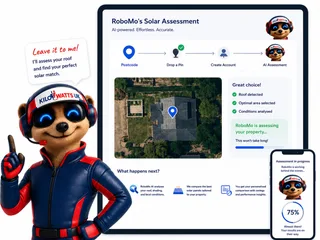
Simply enter your postcode, drop a pin on your roof, create your free account and let RoboMo™ analyse your property to find the best solar panels for your home.

You don't have to think
RoboMo™'s AI analyses your roof and does all the hard work.

Accurate & tailored
AI-powered assessment based on your roof, location, and conditions.

Best options, maximum savings
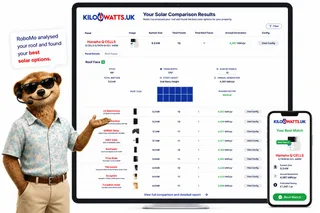
Compare top solar panels for the best performance and value.

Simple, fast & effortless
Provide a few details, sit back and watch your results unfold.
STEP 1
Choose Home, Business or Industrial
Enter your postcode to start your assessment.
STEP 2

Drop a pin on your roof
STEP 3

Create your free account
STEP 4

Sit back and watch RoboMo™ work
RoboMo™ analyses your roof and builds your personalised solar comparison.

Step 1
Enter your postcode
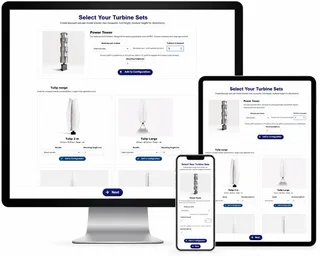
Start designing your wind energy system in seconds.
Are you an installer, distributor or renewable energy business?
Kilowatts UK is expanding the Flower Turbines partner network across the UK.
Become A Flower Turbines PartnerKilowatts UK is an authorised representative
Flower Turbines
Compact vertical-axis turbines built for real UK sites, not just open farmland.
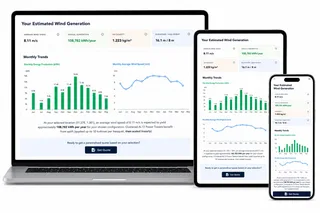
They start in light wind, sit in a small footprint, and are bird-safe by design. Cluster them as a bouquet and the group performs better together than the same turbines standing alone. Enter your postcode for a location-based generation estimate. Figures use area weather data and will differ if buildings, trees or hills sit in the way.
Starts in light UK wind
Built to generate in typical UK wind, not only open farmland.
Small rooftop or ground footprint
Compact towers for roofs, yards and tight sites.
Bird-safe slow rotation
Slow vertical-axis spin, bird-safe by design.
Bouquet clusters raise output
Grouped turbines outperform the same units standing alone.
STEP 2

Choose a location
STEP 3
Place your cluster
Tap the map where you want the turbine cluster to go.
STEP 4

Instant generation forecasts
Compare different turbine layouts and see annual generation forecasts instantly.
STEP 5

No commitment required
Explore different configurations before deciding whether to request a quotation.
FAQ
Need Help? RoboMo's Got Answers
Does an export limit throttle my whole solar system?
No. An export limit only caps how much surplus electricity can flow from your property into the local network. Your panels can still supply the home, and your battery can still charge, because those paths sit on the house side of the ceiling. The kettle, heat pump, EV charger and hot water cylinder are not limited by it.
What is an export limit and who sets it?
An export limit is the maximum power your property is allowed to push back into the local network at any moment. It comes from the connection agreement with your distribution network operator, the company that owns the cables in your street, not your energy supplier. Where a limit applies, it is usually set in the inverter and enforced with a current sensor at the incoming supply.
What happens when the battery is full and the house is quiet?
The inverter reduces generation at source rather than dumping or burning off surplus. Modern inverters can move the panels away from their maximum power point so the array produces less because it has been asked to. This is normal operation, not a fault, and nothing is damaged.
How quickly does full output return when someone uses electricity?
Very quickly on human timescales. Inverter control runs continuously, so when a kettle, oven, heat pump or EV charger creates house-side demand, full output typically returns within about a second. Throttling is a brief response to high generation, a full battery and low demand together, not a state that lasts all day.
How much energy do you lose to an export limit over a year?
Usually less than the worry suggests. Many days never reach the ceiling, including dull, winter and shoulder-season days. Clipping is mainly a thin slice of bright midday hours in sunnier months when the battery is already full and the house is quiet, so annual lost energy is small relative to total generation.
Does an export limit cut my export payments?
Only in the specific periods when the ceiling is actually reached, which is a small fraction of the year. Outside those times, export can flow normally up to the agreed limit. Export is also the lower-value use of a unit compared with using it yourself, because self-consumption avoids buying electricity at the full import rate.
Will a battery remove export limiting?
A battery substantially reduces how often the limit matters, because it absorbs surplus that would otherwise leave the property. It does not remove the limit. Once the battery is full on a bright, quiet day, export is still the only remaining path, and generation may be reduced if that path is already at its ceiling.
Should I buy a smaller system to avoid clipping?
Usually not on its own. Sizing should follow your roof, consumption and budget, with the export limit treated as a boundary to design around. Undersizing the array can cost you generation on many dull days just to avoid losses in a few bright hours. Ask your installer, in writing, what limit has been agreed and confirm it caps export only, not total inverter output.