


East and West Roofs on One String: The Hidden Solar Loss
Published: 2026-09-30 22:37:27
Updated: 2026-09-30 15:42:16
Wiring an east roof and a west roof into one solar string forces both to share one operating point. Here is why that costs output, and how two MPPTs fix it.
The Two Roofs On One String: Why East and West Shouldn't Share a Circuit
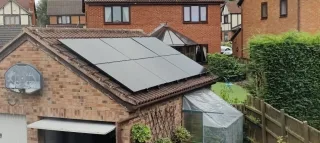
If you have a British semi or terrace with an east-facing slope and a west-facing slope, someone will eventually suggest putting panels on both and wiring them together. It looks tidy on a quote. It is often a quiet mistake. Panels connected in a single series string are electrically locked together: they must all operate at the same current, at the same instant, whatever the sun is doing to each of them. At nine in the morning your east roof is blazing and your west roof is cold and dull, and one shared operating point cannot suit both. The short answer to the search that brought you here is this: an east–west array should normally be split across two separate MPPT inputs on the inverter, so each roof can find its own best point independently. This article explains what an operating point is, where the shortfall actually comes from, when a shared string is genuinely acceptable, and the exact questions to put to an installer before you sign anything.
"One string means one current. The weaker face limits both."
One string means one current — and the weaker face sets the pace
A series string is a chain. Voltages add up along the chain, but the current has nowhere else to go: whatever flows through one panel flows through every panel in that string. Panels are current devices in the way that matters here — the more light landing on the cells, the more current they can produce. So when you put a brightly lit east slope and a shaded, low-angle west slope into the same chain, the string cannot run two currents at once. It settles somewhere in between, and both faces are pulled away from where they would each individually prefer to sit.
This is not a fault, a defect, or a sign of bad panels. It is simply how series wiring behaves. The industry word for it is mismatch: any time panels in one string are exposed to meaningfully different conditions — different orientation, different pitch, a chimney shadow, a dormer, a different panel model — the string operates at a compromise rather than the sum of its parts. Orientation mismatch is the most predictable kind, because it happens every single day, twice a day, by design.
What an 'operating point' actually is, and why trackers exist
Every solar array has a curve of voltage against current, and somewhere on that curve there is a single combination that yields the most power at that moment. Move the voltage up or down from there and power falls away. That sweet spot shifts constantly — with irradiance, with cell temperature, with cloud, with the sun's position through the day.
The inverter's job is to hunt for that point continuously. The function is called Maximum Power Point Tracking, or MPPT. A tracker sweeps the voltage, watches the power, and parks the array where output is highest, revising the decision every few seconds. It is quietly one of the cleverest things in your loft or on your side passage wall.
The catch is arithmetic. One tracker can find one best point. If two roofs with genuinely different light are wired into one tracker, the tracker finds the best available compromise — which is the best single point for the combined array, not the best point for either roof on its own. It is doing its job perfectly. It has simply been given an impossible brief.
Where the shortfall comes from — and why it is not a single number
The loss is the gap between what the shared point delivers and what the two faces would have delivered at their own separate peaks, added together. Picture two generation curves squashed onto one shared marker, with the combined output bar sitting below the sum of the two individual peaks. That gap is the cost of the compromise.
We deliberately will not quote you a headline percentage, because an honest figure does not exist in the abstract. The size of the shortfall depends on how different the two faces really are — the azimuth split, the pitch of each slope, how many panels sit on each side, whether the string is balanced or lopsided, shading from neighbouring roofs and trees, and the specific electrical characteristics of the modules. A near-symmetrical east–west split at a shallow pitch behaves very differently from a steep east roof paired with three straggler panels on a shallow west extension. What is consistent is the shape of the problem: the penalty is largest in the morning and late afternoon, when the difference between the two faces is greatest, and smallest at midday when both are similarly lit. That is precisely the part of the day an east–west array was supposed to be good at — spreading generation across the morning and evening rather than piling it all into a midday spike. A shared string erodes the very benefit you built the split roof for.
Two inputs, two peaks: how the fix is actually wired
Most modern residential string inverters have more than one MPPT input. The fix is unglamorous and cheap in engineering terms: run the east panels as one string into MPPT 1, run the west panels as a separate string into MPPT 2. Same inverter, same meter, same consumer unit, same roof — two independent circuits that never electrically touch until the DC has been converted.
Now each tracker has one job and one roof. The east string runs at its own best point through the morning while the west string idles at its own lower, but honest, output. As the sun swings west through the afternoon, the roles reverse without either side dragging the other. The combined figure rises above where the single shared string would have sat, and the generation profile broadens the way an east–west layout is supposed to.
Where an inverter genuinely has only one usable tracker, or where the roof geometry is more complicated than two clean faces, module-level electronics are the usual alternative: per-panel optimisers or microinverters give each module its own operating point, at the cost of more components on the roof. Neither is automatically better. The right answer comes from the survey, the shade study and the actual panel count on each slope, not from a product preference.
When a shared string is genuinely fine
Not every multi-slope array needs splitting, and we are not in the business of manufacturing problems. A single string is perfectly reasonable when the panels all sit on one face with the same pitch and no meaningful shading, or when a second face differs only slightly — a small azimuth offset on the same broad orientation, for example.
There are also practical constraints that pull the other way. Each MPPT input has a voltage window it needs the string to sit inside, and a minimum sensible string length to get there. If you only have three panels for the west slope, a two-panel string may not reach the inverter's start-up voltage in winter, and forcing the split could cost you more than the mismatch would have. Sometimes the correct engineering answer is a different inverter, sometimes it is optimisers on the smaller slope, and sometimes it is deciding those three panels do not belong in the design at all.
This is also a reminder worth keeping in mind for the whole conversation: UK homes still generate useful solar power on overcast days. A roof that is 'only' facing east is not a dead roof, and diffuse light on a grey Tuesday is still real generation. The goal is not to chase perfect orientation. It is to stop good panels being held back by the wiring around them.
Your string-design checklist before you sign
Take this list to any quote that involves more than one roof face. None of these questions are aggressive; they are the things a competent designer has already thought about and will be happy to answer.
- How many MPPT inputs does the proposed inverter have, and how many am I actually using? - Which panels are on which string? Ask for a simple stringing diagram, not just a panel count. - Are any two roof faces with different orientations or pitches sharing a single string? If so, why? - What is the design string voltage at the coldest and hottest expected conditions, and does it sit inside the inverter's MPPT window at both ends? - If a face is too small for its own string, what is the alternative — optimisers, a different inverter, or dropping those panels? - Has shading been surveyed properly, including chimneys, dormers, neighbouring roofs and trees at different times of year? - Does the generation estimate account for the actual stringing, or does it assume each face performs independently? - If I add a battery or EV charging later, does this DC design still make sense? If the answers are vague, or if the stringing diagram does not exist, that is your signal to slow down rather than to argue. A design that cannot be explained on one sheet of paper is rarely a design at all.
Follow-up questions people ask about east–west solar
Is an east–west array worth doing at all? Often, yes. It flattens the generation curve, producing earlier in the morning and later in the evening, which can line up better with how a household actually uses electricity than a narrow midday peak. The condition is that it is wired to behave like two arrays, because that is what it is.
Can I just add the west panels to my existing string later? That is exactly the situation this episode is about. Adding a different-orientation face to an existing string is the cheapest-looking option and the one most likely to disappoint. Check whether your current inverter has a spare MPPT input first.
Do optimisers make MPPT inputs irrelevant? No. Module-level electronics solve mismatch at the panel level and are genuinely useful on complex or shaded roofs, but they add components, cost and failure points. They are a tool, not a default. Will splitting the strings change my export or metering? No. The split happens on the DC side, before the inverter. Everything downstream — the AC connection, metering and any export arrangement — is unaffected by how the DC is grouped. Does hot weather help? Counter-intuitively, no. Solar panels generate more efficiently in cold, bright conditions than in hot ones, because cell voltage falls as temperature rises. A crisp, clear February morning can be a surprisingly good day for a solar roof. Can I tell from my app whether this is affecting me? Sometimes. If your inverter reports per-MPPT or per-string figures, compare the morning and afternoon shapes. If everything is reported as one lumped number, you are looking at a shared string and you will not see the mismatch directly — only the total that it has already reduced.
Video transcript
Mo: East face, west face, one string. Fine? RoboMo: No. One string means one current. The weaker face limits both.
Mo: So how much are we actually losing? RoboMo: Each face is held off its own best point. The shortfall is the gap between the shared point and both peaks.
Mo: And two inputs fixes that? RoboMo: Yes. Separate trackers let each roof find its own peak, independently, all day. Mo: East face, west face, one string. Fine? RoboMo: No. One string means one current. The weaker face limits both. / Mo: So how much are we actually losing? RoboMo: Each face is held off its own best point. The shortfall is the gap between the shared point and both peaks. / Mo: And two inputs fixes that? RoboMo: Yes. Separate trackers let each roof find its own peak, independently, all day.
Wrapping up
Two roofs are not one roof, and wiring them as though they were is a design decision with a daily cost. The physics is simple enough to hold in your head: one string, one current, one operating point — and a compromise that suits neither face. The fix is equally simple, and usually already sitting unused inside the inverter you were going to buy anyway. What matters is that someone looks at your actual slopes, your actual shading and your actual panel counts, and decides deliberately rather than by habit. Good solar is not about heroic components. It is about not leaving free output on the roof because the wiring took the shortest route.
Next step
If you have two roof faces and you are not sure how your quote strings them together, it is a fair thing to ask about before anything is ordered. You can read how we approach residential solar design, compare options at your own pace, or book a survey when you want a proper look at your roof.
Plan, Compare & Buy Renewable Energy Solutions
AI does the thinking.
You get the perfect solar match.
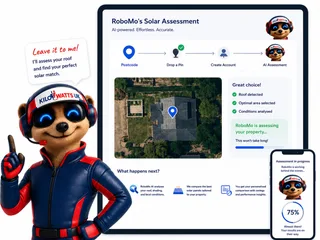
Use RoboMo™ to assess your property, compare available technologies and connect with trusted UK installers, suppliers and manufacturers.
Simply enter your postcode, drop a pin on your roof, create your free account and let RoboMo™ analyse your property to find the best solar panels for your home.

You don't have to think
RoboMo™'s AI analyses your roof and does all the hard work.

Accurate & tailored
AI-powered assessment based on your roof, location, and conditions.

Best options, maximum savings
Compare top solar panels for the best performance and value.

Simple, fast & effortless
Provide a few details, sit back and watch your results unfold.
STEP 1
Choose Home, Business or Industrial
Enter your postcode to start your assessment.
STEP 2

Drop a pin on your roof
STEP 3

Create your free account
STEP 4

Sit back and watch RoboMo™ work
RoboMo™ analyses your roof and builds your personalised solar comparison.

BATTERY ROI TOOL
See what a battery saves on your bill
Enter the day rate, off-peak rate and export rate. The calculator ranks batteries in the Kilowatts shop over 10 years.
Home batteries also suit offices and small commercial sites. Industrial batteries are listed on their own calculator.

Step 1
Enter your postcode
Start designing your wind energy system in seconds.
Are you an installer, distributor or renewable energy business?
Kilowatts UK is expanding the Flower Turbines partner network across the UK.
Become A Flower Turbines PartnerKilowatts UK is an authorised representative
Flower Turbines
Compact vertical-axis turbines built for real UK sites, not just open farmland.
They start in light wind, sit in a small footprint, and are bird-safe by design. Cluster them as a bouquet and the group performs better together than the same turbines standing alone. Enter your postcode for a location-based generation estimate. Figures use area weather data and will differ if buildings, trees or hills sit in the way.
Starts in light UK wind
Built to generate in typical UK wind, not only open farmland.
Small rooftop or ground footprint
Compact towers for roofs, yards and tight sites.
Bird-safe slow rotation
Slow vertical-axis spin, bird-safe by design.
Bouquet clusters raise output
Grouped turbines outperform the same units standing alone.


STEP 2

Choose a location
STEP 3

Place your cluster
Tap the map where you want the turbine cluster to go.
STEP 4

Instant generation forecasts
Compare different turbine layouts and see annual generation forecasts instantly.
STEP 5

No commitment required
Explore different configurations before deciding whether to request a quotation.
FAQ
Need Help? RoboMo's Got Answers
Should east- and west-facing panels share one string?
Normally, no. Panels in a series string must all run at the same current, so a bright east roof and a dull west roof are forced to one compromise operating point that suits neither face. The usual fix is to put each orientation on its own MPPT input, so each roof can track its own best point. If the inverter has only one usable tracker, optimisers or microinverters are the common alternatives, chosen from the survey rather than by habit.
Is an east–west array worth doing at all?
Often, yes, provided it is wired as two arrays rather than one shared string. An east–west layout produces earlier in the morning and later in the evening, which can match household use better than a narrow midday peak. A shared string erodes that benefit, because the mismatch is largest when the two faces differ most. A roof that only faces east is not a dead roof; the aim is to stop good panels being held back by the wiring.
Can I add west-facing panels to my existing string later?
That is the cheapest-looking option and the one most likely to disappoint, because a different orientation on the same string creates mismatch every day. Check first whether your current inverter has a spare MPPT input that can take the new face as its own string. If that slope is too small to reach a sensible string voltage, the better choices may be a different inverter, optimisers on that slope, or leaving those panels out.
When is it acceptable for two roof faces to share a string?
A single string is reasonable when the panels all sit on one face, with the same pitch and no meaningful shading, or when a second face differs only slightly in direction. It can also be the lesser compromise if a small group of panels cannot reach the inverter’s start-up or MPPT voltage window on its own, especially in winter. In that case the designer should compare a shared string, optimisers, a different inverter, or dropping the small face.
Do optimisers make separate MPPT inputs irrelevant?
No. Optimisers and microinverters give each module its own operating point, which helps on complex or shaded roofs, but they add components and more things that can fail. They are a tool for mismatch, not a default substitute for sensible string design. Separate MPPT inputs remain the straightforward fix when each roof face can form a valid string on its own.
Will splitting the strings change my export or metering?
No. The split happens on the DC side, before the inverter converts power to AC. Metering, the AC connection and any export arrangement sit downstream and are unaffected by how the panels are grouped. What should change is the generation estimate, which ought to reflect the actual stringing rather than assume each face performs independently.
Can I tell from my monitoring app whether a shared string is costing me output?
Sometimes. If the inverter reports per-MPPT or per-string figures, compare the morning and afternoon shapes: each face should lead at a different time of day. If you only see one combined number, you cannot see the mismatch directly, only the total it has already reduced. There is no single loss figure for every roof; it depends on direction, pitch, panel counts, shading and the modules themselves.
What should I ask before accepting a quote for two roof faces?
Ask how many MPPT inputs the inverter has, how many you will actually use, and for a simple stringing diagram showing which panels sit on which string. Ask whether faces with different orientation or pitch share a string, and why, and whether the design voltage stays inside the inverter’s window in cold and hot conditions. Also ask whether shading has been surveyed through the year, including chimneys, dormers, neighbouring roofs and trees.