


Why the UK Solar Peak Isn't at Noon — It's Nearer One
Published: 2026-09-29 22:05:56
Updated: 2026-10-05 11:14:26
British Summer Time runs an hour ahead of the sun, so a UK solar array peaks nearer 1pm. Here's how to time washing, dishwashers and EV charging properly.
Why the UK Solar Peak Isn't at Noon — It's Nearer One
If you've ever set the washing machine for twelve o'clock because "midday is the solar peak", you've almost certainly been running it an hour early for half the year. From late March to late October the UK runs on British Summer Time, which is deliberately set one hour ahead of the sun. The clock says noon; the sun hasn't got there yet. The real summit of a typical UK array's generation curve lands nearer one in the afternoon, and the best hour of usable surplus sits entirely after midday. Once the clocks go back, the peak slides neatly back towards twelve. This article explains why that happens, what it means for appliance timers, battery charging and EV plugs, and how to find your own household's true peak without guessing. It's the written companion to the Solar, Clearly episode "The Peak That Isn't At Noon" — the full transcript is at the end for anyone who can't play the video.
"In summer, clocks run an hour ahead; output peaks nearer one."
The clock is an hour ahead of the sun, not the other way round
Solar panels don't read clocks. They respond to how high the sun sits in the sky and how directly its light strikes the glass. The moment the sun reaches its highest point of the day is called solar noon, and that moment is fixed by astronomy, not by legislation.
British Summer Time is legislation. Every spring the clocks move forward an hour so that more daylight falls into the evening. Nothing about the sun changes — only the numbers we've agreed to call it. So for roughly seven months of the year, solar noon in the UK arrives at around one o'clock on the dial rather than twelve. The generation curve climbs straight past the 12:00 marker and keeps going, because as far as the roof is concerned midday hasn't happened yet.
That single hour is the whole misunderstanding. It's not a fault, a shading issue or an underperforming inverter. It's a naming convention, and it quietly sends thousands of households to their utility room sixty minutes before their own roof is at its best.
The roof is honest — the clock is the thing running early
When people first see their generation graph, the instinct is to assume something is wrong with the installation: the panels must be facing slightly off, or the morning is being lost to a tree. Usually neither is true. A south-facing array produces a curve that is roughly symmetrical about solar noon, rising through the morning, peaking, then falling away through the afternoon in much the same shape.
Plot that curve against a summer clock and the symmetry looks broken, because the reference line is in the wrong place. Draw the line at solar noon instead and the shape falls into place immediately. The roof was telling the truth the entire time.
Two smaller effects nudge the timing further, and both are worth knowing. First, longitude: solar noon arrives later the further west you live, by roughly four minutes for every degree, so western Northern Ireland sees it around half an hour after east coast England. Second, the Earth's orbit isn't a perfect circle, so solar noon drifts by up to roughly a quarter of an hour either side of the average across the year. Neither changes the headline — in summer, the peak is after midday — but they explain why your neighbour's graph and a national average don't line up to the minute.
What "nearer one" actually means for your washing machine
The practical goal isn't to hit the exact peak minute. It's to sit your biggest loads inside the broad plateau around the peak, where output is strong and steady, and to make sure the appliance has finished before the curve drops away.
A washing machine or dishwasher cycle takes time — often well over an hour on a normal programme. If you start it at twelve on a summer day, a meaningful chunk of the cycle runs while generation is still building. Start it nearer one and the whole cycle sits under the fattest part of the curve, which means more of it is powered by your own roof and less is pulled from the grid. The same logic applies to anything with a delay timer: tumble dryers, immersion heaters, hot water cylinders, pool or hot tub pumps, and EV charging on a home charger. Where an appliance can be told to start at a specific time, that time should be set against the sun, not against habit. One caveat worth holding onto: it's surplus that matters, not raw generation. Your house is already drawing a baseline of power for the fridge, router, standby loads and lighting. The genuinely useful window is where generation comfortably exceeds that baseline — which, in summer, sits entirely to the right of midday.
When the clocks change, move your timers back
Because the shift is caused by the clock and not by the sky, it reverses the moment the clocks go back in late October. Under GMT, solar noon lands close to twelve again, and the traditional advice finally becomes correct — just in the months when there's least to harvest.
So the honest rule is a two-setting rule rather than a single magic hour. Through British Summer Time, aim your heaviest loads at roughly one in the afternoon. Through the winter months, aim them at roughly midday. Add "check the appliance timers" to whatever you already do when the clocks change — smoke alarm batteries, oven clock, car dashboard.
Winter also compresses the useful window considerably. The curve is lower and much narrower, so there's less room for error and less scope to run several big loads back to back. That's normally the season where a battery, or simply doing one heavy load per day instead of three, earns its keep.
A short checklist for timing loads against your real peak
Work through this once and you won't need to think about it again until the clocks change.
- Look at your own data first. Your inverter app or monitoring portal will show a generation curve for a clear day. Find the actual summit — that's your household's peak, including your roof's orientation and any local shading. 2. Note the shape, not just the point. A due-south array peaks sharply. An east-facing array peaks earlier in the morning; a west-facing one peaks later in the afternoon; a split east–west array gives a flatter, wider plateau with two gentle shoulders. 3. Subtract your baseline. Compare generation against what the house draws when nobody is doing anything special. The gap is your real surplus window. 4. Work backwards from cycle length. If a wash takes ninety minutes, start it far enough before the peak that the bulk of the cycle — especially the heating stage — sits under strong output. 5. Set delay timers, not intentions. Appliances that can be programmed should be programmed. Human memory at 1pm on a working Tuesday is unreliable. 6. Stagger, don't stack. Two heavy appliances running simultaneously will usually exceed even a good summer peak, pulling the difference from the grid. 7. Re-check twice a year, in March and October, when the clocks move.
Follow-up questions people usually ask next
Does a battery make all of this irrelevant? It makes it much less critical. A battery absorbs surplus whenever it appears and releases it whenever you need it, so a badly timed wash simply draws from stored energy instead of the grid. Timing still helps — it reduces the number of round trips through the battery — but it stops being something you have to police.
What about cloudy days? UK homes still generate useful solar power on overcast days. Diffuse light passing through cloud is weaker than direct sun, but it is not nothing, and the shape of the day still follows the same curve. The peak is still after midday in summer; it's just a lower summit.
Doesn't hot weather boost output? It's light that produces electricity, not heat. Solar panels actually generate more efficiently in cold weather than in hot weather, which is why a bright, crisp spring day can outperform a hazy, sweltering one. Sunshine helps; heat mildly hinders. Should I charge my EV at the solar peak? If you're charging from surplus rather than a cheap overnight rate, yes — the afternoon plateau is the right target. Worth remembering too that a typical EV range vastly exceeds the average daily journey, so most households don't need a full charge every day and can be relaxed about grabbing sunshine when it's there. Is this worth chasing at all? It costs nothing to change a timer. Alongside simple habits like cutting standby waste on idle appliances, shifting loads into the real surplus window is one of the few improvements that requires no hardware and no spending.
Video transcript
Mo: Midday's the solar peak, so I wash at twelve? RoboMo: In summer, clocks run an hour ahead; output peaks nearer one.
Mo: So the roof's wrong — or the clock is? RoboMo: The clock. The sun reaches its highest point later than the dial shows.
Mo: So when should the washing machine actually run? RoboMo: Nearer one in summer; back around noon once the clocks change. Mo: Midday's the solar peak, so I wash at twelve? RoboMo: In summer, clocks run an hour ahead; output peaks nearer one. / Mo: So the roof's wrong — or the clock is? RoboMo: The clock. The sun reaches its highest point later than the dial shows. / Mo: So when should the washing machine actually run? RoboMo: Nearer one in summer; back around noon once the clocks change.
Wrapping up
There's no clever trick here and nothing to buy. A UK solar array peaks when the sun is highest, and for most of the year our clocks describe that moment as one o'clock rather than twelve. Move your heaviest loads an hour later through British Summer Time, move them back when the clocks change in October, and let your own monitoring data settle any remaining doubt about your particular roof. It's a small correction that costs nothing, applies to every household in the country, and quietly increases how much of your own generation you actually use — which is, in the end, where solar pays.
Next step
If you're weighing up solar, or you already have panels and want to understand what your generation curve is genuinely telling you, our residential solar pages walk through the engineering without the sales pitch. When you're ready for specifics about your own roof, a survey is the sensible next step — no pressure, just numbers.
Plan, Compare & Buy Renewable Energy Solutions
AI does the thinking.
You get the perfect solar match.
Use RoboMo™ to assess your property, compare available technologies and connect with trusted UK installers, suppliers and manufacturers.
Simply enter your postcode, drop a pin on your roof, create your free account and let RoboMo™ analyse your property to find the best solar panels for your home.

You don't have to think
RoboMo™'s AI analyses your roof and does all the hard work.

Accurate & tailored
AI-powered assessment based on your roof, location, and conditions.

Best options, maximum savings
Compare top solar panels for the best performance and value.

Simple, fast & effortless
Provide a few details, sit back and watch your results unfold.
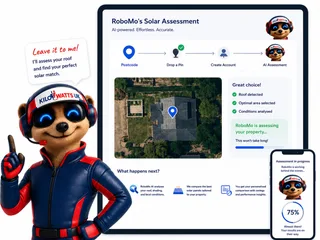

STEP 1
Choose Home, Business or Industrial
Enter your postcode to start your assessment.
STEP 2

Drop a pin on your roof
STEP 3

Create your free account
STEP 4

Sit back and watch RoboMo™ work
RoboMo™ analyses your roof and builds your personalised solar comparison.

Step 1
Enter your postcode
Start designing your wind energy system in seconds.
Are you an installer, distributor or renewable energy business?
Kilowatts UK is expanding the Flower Turbines partner network across the UK.
Become A Flower Turbines PartnerKilowatts UK is an authorised representative
Flower Turbines
Compact vertical-axis turbines built for real UK sites, not just open farmland.
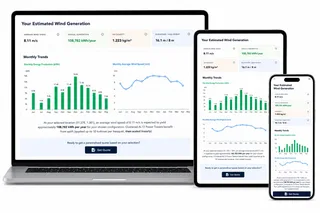
They start in light wind, sit in a small footprint, and are bird-safe by design. Cluster them as a bouquet and the group performs better together than the same turbines standing alone. Enter your postcode for a location-based generation estimate. Figures use area weather data and will differ if buildings, trees or hills sit in the way.
Starts in light UK wind
Built to generate in typical UK wind, not only open farmland.
Small rooftop or ground footprint
Compact towers for roofs, yards and tight sites.
Bird-safe slow rotation
Slow vertical-axis spin, bird-safe by design.
Bouquet clusters raise output
Grouped turbines outperform the same units standing alone.

STEP 2

Choose a location
STEP 3

Place your cluster
Tap the map where you want the turbine cluster to go.
STEP 4

Instant generation forecasts
Compare different turbine layouts and see annual generation forecasts instantly.
STEP 5

No commitment required
Explore different configurations before deciding whether to request a quotation.
FAQ
Need Help? RoboMo's Got Answers
Why does UK solar generation peak nearer 1pm than noon?
Solar panels follow the sun, not the clock. Solar noon is when the sun is highest, and from late March to late October British Summer Time puts the clock one hour ahead of that moment. A typical south-facing array therefore climbs past 12:00 and peaks nearer one in the afternoon. This is a naming convention, not a fault with the roof or the inverter.
When should I set washing machine and dishwasher timers?
Through British Summer Time, start heavy loads nearer 1pm so the cycle sits under the strongest part of the curve. After the clocks go back in late October, solar noon moves closer to 12:00, so midday is a better target again. A long cycle started at noon in summer often runs while generation is still building. Surplus matters more than raw generation: the useful window is where output comfortably exceeds the house's baseline load.
Does my roof's direction change the peak time?
Yes. A due-south array is roughly symmetrical about solar noon. East-facing roofs peak earlier in the morning, west-facing roofs later in the afternoon, and a split east–west array gives a flatter, wider plateau. Longitude also shifts solar noon later further west, by roughly four minutes per degree, and the Earth's orbit can drift it by up to about a quarter of an hour either side of the average. Your inverter data on a clear day is the reliable guide for your own roof.
Does a home battery make load timing irrelevant?
It makes timing much less critical, not pointless. A battery stores surplus whenever it appears and supplies it when you need it, so a badly timed wash can draw from stored energy instead of the grid. Timing loads into the real surplus window still helps, because it reduces how often energy has to go into the battery and back out again. In winter the useful window is shorter and lower, which is when stored energy or fewer heavy loads in a day tends to matter more.
Do cloudy days still peak after midday in summer?
Usually yes, just at a lower level. Overcast skies still let through diffuse light, so UK arrays often generate useful power even without direct sun. The shape of the day still follows the sun's path, so the summer summit remains after midday on the clock. Output is simply weaker than on a clear day.
Does hot weather increase solar panel output?
No. Electricity comes from light, not heat. Panels are generally more efficient in cold conditions than in hot ones, so a bright, crisp day can outperform a hazy, hot one. Strong sunshine helps; high temperatures mildly hinder.
Should I charge an electric vehicle at the solar peak?
If you are charging from surplus rather than a cheap overnight tariff, the afternoon plateau in summer is the right target, and nearer midday once the clocks are back on GMT. Most households do not need a full charge every day, because typical daily mileage is well below a car's range. Grabbing sunshine when it is there is often enough. If a time-of-use tariff is cheaper overnight than using your own solar, compare the two rather than assuming daytime charging is always best.
How do I find my household's real solar peak?
Open your inverter app or monitoring portal and look at a clear day's generation curve. The summit of that curve is your peak, including orientation and any local shading. Compare it with what the house draws when nothing special is running; the gap is your surplus window. Then set delay timers so the bulk of a cycle, especially any heating stage, sits under strong output, and stagger heavy appliances so they do not all run at once. Recheck in March and October when the clocks change.