
LinkedIn profile for David Coleman David Coleman
Founder & Renewable Energy Author, kilowatts.uk


LinkedIn profile for David Coleman David Coleman
Founder & Renewable Energy Author, kilowatts.uk
Article
Unused suitable roof space can represent decades of forgone generation, so system value should be considered over its lifetime.

Unused suitable roof space can represent decades of forgone generation, so system value should be considered over its lifetime.
Solar panels do not generate after dark. The flow is tied to sunlight, not to the clock on the wall. A home battery is what lets that daytime generation wait for you: it fills while the roof is working, then discharges once the house wakes up for the evening.
That is the film in one breath. A full battery is not a gadget glowing in the cupboard. It is stored solar, being used when the panels have already stopped. Two homes can look identical from the street and still need different systems, because they do not use electricity at the same hours.
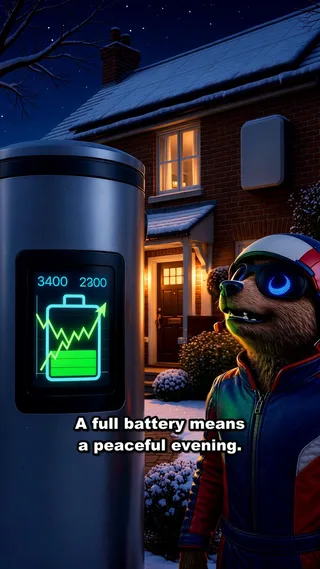
If you have ever stood under a dark sky and wondered whether the array is still doing something, the answer is no. Without sun, there is no solar flow. Cloud, season and the angle of the roof change how much you get while it is light. Night does not.
That sounds obvious until you try to size a system from the look of the house. The panels do not care that you cook at seven, that the heating comes on after work, or that the car plugs in when you get home. They care that it is day. Anything you do not use while they are generating has to go somewhere else: into the house later, via a battery, or out to the grid, to be bought back when you need it.
A battery does not make night-time solar. It stores excess solar for later use. Fill it in the day. Draw it down after dark. That is the whole mechanism.
The line in the film is plain on purpose. A full battery means a peaceful evening, because that is when the stored solar is being used.
Peaceful here is not a mood. It is the house running on energy that was made hours earlier, instead of importing the lot the moment the sun drops. Cooking, lights, a bit of heat, the odd appliance left on — none of that needs the panels to be generating at that moment, if the battery already holds the surplus from earlier.
If the battery is empty by late afternoon, the evening is ordinary grid power again. If you never had surplus to store, there was nothing to move. The battery only helps the hours after dark when the day actually produced more than the house used at the time.

Unused suitable roof can stand there for decades and never generate. That forgone output is the reason you think about a system over its life, not over a single sunny afternoon. But filling the roof is not the same as designing the system.
A home that uses most of its power while the sun is up can take a large share of generation live. The kettle, the washing, a home office, a heat pump running through the day — that demand lines up with the panels. Less needs to be stored. Less comes back in the evening as an import.
A home that is quiet all day and then loads the evening is a different curve on the same roof. Cooking, heating and an EV after sunset cannot drink midday solar as it is made. Without storage, or without a deliberate decision about when you charge, that surplus is exported and the evening is bought in. Same panels. Same installer quote, even. Still the wrong mix if the demand was never measured. The battery is not a fashion extra on an evening-heavy house. It is how you move daytime generation to the hours that house actually uses power. An EV usually changes that storage question, or the time you charge, more than it changes the size of the roof.
You will not see this from the brickwork, or from whatever your neighbour fitted. In Britain the honest record is your own half-hourly smart meter data: when the house draws power, and how that sits against daylight.
Pull a year if you can, not one bright Saturday. Mark when cooking, heating, laundry and any car charging actually happen. Notice whether those hours are in the sun or after it has gone. Then ask two plain questions. What happens to surplus around the middle of the day — used in the house, stored, or exported? What does the house still buy after sunset?
Those two patterns tell you more than a brochure array size. If demand rises with the sun, a larger useful fraction of generation can be used on site, and extra panels may earn their keep without a large battery. If demand spikes after dark, storage — or a timed charge when you are on a tariff that makes that sensible — matters more than adding modules for their own sake. Design follows that measured demand. It does not follow how the house looks from the pavement.
Solar, a battery and the timing of heavy loads belong in the same conversation. Treat them as separate shopping items and you will optimise the wrong thing: a roof that looks full, a battery chosen because the neighbour has one, a car that charges whenever you remember.
Before anyone sizes kit, sit with the load. You are looking for a few facts, not a perfect model.
From there the questions in the film answer themselves. Can two identical houses need different solar systems? Yes, if they use electricity at different times. Does an evening-heavy house need storage more than a daytime-heavy one? Usually yes, because it cannot use as much generation live. Does an EV force a bigger roof? Not necessarily. It more often changes the battery, or when you charge. None of that is a price, a grant or a promised saving. It is the same point as the short film: measure the home, then design around that demand. Watch the seasons move and the counter climb if you want the picture. Then open your own half-hourly data before you treat two similar roofs as the same job.
Solar comparison
Enter your postcode to assess your roof, compare solar options and get quotes from UK installers.
Choose home, business or industrial, then enter your postcode. RoboMo maps the roof and ranks panel brands by fit.
1. Postcode Start the assessment for your property.
2. Pin the roof Mark the array on the map.
3. Compare RoboMo™ builds your options.

Battery ROI tool
Enter the day rate, off-peak rate and export rate. The calculator ranks batteries in the Kilowatts shop over 10 years. Home batteries also suit offices and small commercial sites.

Authorised UK partner
Choose a location, configure Flower Turbines and see estimated annual generation from location-specific wind data. No account required.
Open the designer and lay out turbines on your site.
1. Postcode Open the designer for your site.
2. Layout Place turbines in the space you have.
3. Forecast See estimated annual generation.
Reading
Solar panels
Shop
Write for Kilowatts.uk
Write it here under your own name. Sign in, put a profile up, and start a guide. Pay only if you want more links from your articles out to your own site.
Create a Kilowatts.uk account, or sign in if you already have one.
Put your name, photo and experience on a public author page.
Write a guide or a blog. Free authors can put one followed link to their own site in articles each month.
FAQ
Live help
Talk to RoboMo™ and get instant answers.
Live chat