


Do Solar Panels Need Cleaning? Roof Pitch Is the Answer
Published: 2026-09-25 05:39:32
Updated: 2026-10-06 11:25:30
Rain rinses steep UK solar arrays fairly well, but near-flat roofs hold grime. Here's why, what soiling costs you, and how to check and clean safely.
The Roof That Cleans Itself: Why Steep Solar Arrays Stay Clean and Flat Ones Don't
If you have searched "do solar panels need cleaning?", the honest answer is: it depends almost entirely on how steeply your panels are pitched. On a steep British roof, rain does a genuinely decent job. Water sheets down the glass in fast rivulets, picks up dust and pollen on the way, and carries it off the bottom edge into the gutter. On a near-flat array — a garage roof, a flat-roofed extension, a low-pitch bungalow — rain lands, dimples, pools and then simply evaporates where it sits, leaving the dirt behind as pale tide marks. Over a run of dry spells that film thickens, and because it shades every cell it touches, it quietly costs you output. This companion piece to the Kilowatts UK episode "The Roof That Cleans Itself" explains the mechanism, how to tell whether your own array is affected, and how to clean it without doing any damage — all in plain UK terms, whether or not you can play the video.
"Rain rinses steep roofs fairly well. Near-flat arrays hold grime."
The short answer: pitch decides whether rain is enough
Most UK homeowners are told at some point that solar panels are self-cleaning. That claim is not wrong — it is just incomplete. It is true of a steeply pitched roof, and it becomes progressively less true as the angle flattens out.
Think of the two arrays in the episode. On the left, a steep main roof: during a downpour, water gathers speed as it runs, and moving water has energy to spare. It lifts loose dust, pollen and light soot and takes them with it. On the right, a near-flat garage roof: the same rain arrives, but it has nowhere to go in a hurry. It sits in shallow puddles, and the only way it leaves is by evaporating. Everything it was carrying stays exactly where it was.
So the rule of thumb is simple. The steeper your array, the more likely rain alone will keep it in reasonable condition. The flatter it is, the more likely it will repay an occasional wash. Nothing about the panels themselves has changed — only the geometry.
Why sheeting water cleans and standing water doesn't
The distinction that matters is between water that leaves and water that dries. Sheeting water is a transport mechanism: it flows off the module, and whatever it has picked up flows off with it. Standing water is a settling tank: the water goes, the solids stay.
You can see the evidence on any near-flat array after a dry week following rain. The puddle edges show as pale rings or tide marks, because that is where the suspended material was concentrated as the last of the water evaporated. Add a British spring's worth of pollen bloom, a summer of dry dust and the fine grey film that road and chimney traffic deposits everywhere, and you get a layer that builds up slightly more with each cycle instead of resetting after each shower.
There is a second, sneakier version of the same problem even on pitched roofs: the bottom edge of the module. Most frames sit slightly proud of the glass, so a thin lip of water and silt can be held along the lowest inch of the panel. That narrow band is often the dirtiest part of an otherwise clean array, and it matters more than its size suggests — which brings us to why a thin film costs anything at all.
What a thin film of grime actually costs in output
A solar panel is not one light sensor; it is a series of cells wired together, and a module is wired in a string with its neighbours. Uniform light across the whole surface is what lets a system perform as designed. Anything that dims part of the glass reduces what that section can contribute, and in a series circuit the weakest link has an influence out of proportion to its area.
A thin, even film of dust behaves like a very slight, very wide shade. It does not stop generation — you will not see a dramatic collapse on your app — it just trims a little off the top, all day, every day, until it is removed. That is exactly why soiling is easy to miss. It does not announce itself. It drifts. The same series logic explains why a stubborn band of silt along the bottom edge of a module, or a patch of bird mess, can be a bigger deal than a general grey haze. Concentrated, opaque soiling on a small area can hold back the cells behind it far more sharply than the same amount of dirt spread thinly. Worth noting alongside this: your panels are not fussy about British weather in general. UK homes still generate useful solar power on overcast days — diffuse light through cloud is perfectly usable. Soiling is the loss you can do something about; cloud is not, and it is not the problem people usually assume it is.
Which UK arrays actually collect dirt — and which don't
Pitch is the biggest factor, but it is not the only one. In practice the arrays that build up noticeable soiling tend to combine a shallow angle with a local source of muck.
More likely to need attention: flat or near-flat garage and extension roofs; low-pitch bungalow roofs; ground-mounted arrays set at a shallow tilt; anything under or near overhanging trees, which adds leaf litter, sap and a great deal of bird traffic; homes close to busy roads, farmland or building sites; and properties where a chimney, flue or extraction outlet sits upwind of the array.
Less likely to need attention: a steeply pitched main roof in an open suburban or rural setting with no overhanging vegetation. These arrays genuinely do most of their own housekeeping, and in the episode's data overlay it is the steep line that holds steady week after week while the flat line drifts. Moss, lichen and gutter debris are a related but separate issue. They are less about the glass and more about what accumulates around and beneath the array — at the bottom edge, in the gap between roof and module, and in the gutter that the panels now discharge into. That is a maintenance point for the roof as much as the solar system.
A practical checklist: does your array actually need a wash?
Before paying anyone to clean anything, work through this. It takes ten minutes and costs nothing.
- Identify your pitch honestly. Steep main roof, moderate pitch, low pitch, or effectively flat? If it is flat or near-flat, assume soiling is a live issue rather than a theoretical one.
- Look at the glass from ground level, ideally with binoculars or a zoomed phone photo taken after a dry spell. You are looking for tide marks, a uniform dull haze, pollen bloom, bird mess and a dark band along the bottom edge of the modules. 3. Compare like with like in your monitoring. Pick two clear, bright days in the same month — one from earlier in the year, one from now — and compare the peak and the shape of the curve. Soiling shows up as a gentle downward drift across weeks, not as a sudden drop. 4. Compare arrays if you have more than one. If your steep roof and your garage roof are on separate strings or inverters, you have a built-in control experiment. Divergence between them over a dry summer is the clearest possible signal. 5. Rule out other causes first. A sudden drop is far more likely to be a shading change, an inverter fault, a tripped isolator or new tree growth than dirt. Soiling is gradual by nature. 6. Time it well. Late spring, after pollen season, and late summer, after a long dry run, are the two moments a wash usually earns its keep in the UK. Cleaning in the depths of December buys you very little generation. 7. Check whether one wash restores the line. In the episode, the flat-roof trace steps straight back up after a single clean. If yours does not, dirt was not your problem — investigate further.
Cleaning safely: what to do, and what never to do
Solar glass is tough but the module as a whole is a sealed electrical product with a coated surface, and it is usually sitting somewhere you should not be standing.
Do: use plenty of plain water, ideally deionised or filtered so it dries without leaving mineral spotting. Use a soft brush or microfibre head on a telescopic pole so you can work from the ground or from a safe platform. Work in the early morning or on a cool, overcast day so the glass is not hot. Rinse generously and let it air dry. If access is genuinely difficult, use a professional with proper access equipment and insurance. Do not: walk on the panels — microcracks in cells are invisible from the outside and permanent. Do not use a pressure washer; forcing water at the frame edges and seals is a good way to turn a cosmetic issue into a real one. Do not use abrasive pads, scrapers, washing-up liquid, solvents or bleach. Do not clean hot glass with cold water. Do not go up a ladder onto a wet or mossy roof to save a modest amount of generation — the maths never favours that. And do not over-service. If you have a steep, unshaded array, an annual visual check from the ground is generally proportionate. Routine paid cleaning contracts on a steep roof are, in most UK settings, solving a problem the rain has already solved.
Follow-up questions homeowners ask
Does snow need clearing? Generally no. Snow slides off pitched glass readily as soon as the surface warms, and clearing it involves exactly the roof access you should be avoiding. On a flat array it will sit longer, but it will also melt without help.
Will self-cleaning coatings solve it? Coatings can help water sheet more freely, which is useful — but they cannot make gravity steeper. On a near-flat array, water still has to go somewhere, and if it can only evaporate, the solids still stay.
Can I stop the problem at design stage? Largely, yes, and this is the more valuable conversation. On a flat roof, tilt frames give water somewhere to run instead of somewhere to sit. Sensible module spacing, keeping the array clear of overhanging branches and flue outlets, and thinking about where run-off actually discharges all reduce future maintenance. It is far cheaper to design out soiling than to keep washing it off. Does a dirty panel damage anything? A general film does not damage the module — it just reduces output until removed. Persistent organic matter, moss growth at the frame edge and standing debris are worth dealing with, because they hold moisture against the frame and the roof. Should I clean before checking my monitoring? No. Check first. Data beats guesswork, and knowing what your system looked like before the wash is the only way to know whether it was worth doing.
Video transcript
Mo: So solar panels never need cleaning? RoboMo: Rain rinses steep roofs fairly well. Near-flat arrays hold grime.
Mo: Why doesn't the flat one rinse itself too? RoboMo: Sheeting water carries dust away. Standing water evaporates and leaves it behind.
Mo: So is that actually costing me output? RoboMo: A thin film shades every cell. Steepest roofs stay near clean. Flattest ones repay a wash. Mo: So solar panels never need cleaning? RoboMo: Rain rinses steep roofs fairly well. Near-flat arrays hold grime. / Mo: Why doesn't the flat one rinse itself too? RoboMo: Sheeting water carries dust away. Standing water evaporates and leaves it behind. / Mo: So is that actually costing me output? RoboMo: A thin film shades every cell. Steepest roofs stay near clean. Flattest ones repay a wash.
Wrapping up
"Do solar panels need cleaning?" is really two questions wearing one coat. For a steep, unshaded British roof, rain is a genuinely effective maintenance system and you can largely leave it to get on with it. For a near-flat array — garage, extension, bungalow, shallow ground mount — rain arrives, sits, evaporates and leaves its cargo behind, and a thin film that shades every cell will slowly trim your generation until someone rinses it off. The good news is that this is one of the few solar losses that is fully reversible, cheap to fix and easy to verify: clean it once, watch the line step back up, and you know exactly what it was worth. The better news is that it can be designed out at the start, by giving water somewhere to run rather than somewhere to pool.
Next step
If you are planning an array — especially on a flat garage or extension roof — it is worth getting the tilt, spacing and run-off right before anything is bolted down. You can read how we approach residential solar design, compare options at your own pace, or arrange a survey when you are ready. No pressure either way; the roof will still be there next week.
Plan, Compare & Buy Renewable Energy Solutions
AI does the thinking.
You get the perfect solar match.
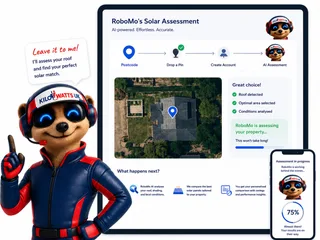
Use RoboMo™ to assess your property, compare available technologies and connect with trusted UK installers, suppliers and manufacturers.
Simply enter your postcode, drop a pin on your roof, create your free account and let RoboMo™ analyse your property to find the best solar panels for your home.

You don't have to think
RoboMo™'s AI analyses your roof and does all the hard work.

Accurate & tailored
AI-powered assessment based on your roof, location, and conditions.

Best options, maximum savings
Compare top solar panels for the best performance and value.

Simple, fast & effortless
Provide a few details, sit back and watch your results unfold.

STEP 1
Choose Home, Business or Industrial
Enter your postcode to start your assessment.
STEP 2

Drop a pin on your roof
STEP 3

Create your free account
STEP 4

Sit back and watch RoboMo™ work
RoboMo™ analyses your roof and builds your personalised solar comparison.

Kilowatts UK is an authorised representative
Flower Turbines
Compact vertical-axis turbines built for real UK sites, not just open farmland.
They start in light wind, sit in a small footprint, and are bird-safe by design. Cluster them as a bouquet and the group performs better together than the same turbines standing alone. Enter your postcode for a location-based generation estimate. Figures use area weather data and will differ if buildings, trees or hills sit in the way.
Starts in light UK wind
Built to generate in typical UK wind, not only open farmland.
Small rooftop or ground footprint
Compact towers for roofs, yards and tight sites.
Bird-safe slow rotation
Slow vertical-axis spin, bird-safe by design.
Bouquet clusters raise output
Grouped turbines outperform the same units standing alone.

Step 1
Enter your postcode
Start designing your wind energy system in seconds.

STEP 2

Choose a location
STEP 3

Place your cluster
Tap the map where you want the turbine cluster to go.
STEP 4

Instant generation forecasts
Compare different turbine layouts and see annual generation forecasts instantly.
STEP 5

No commitment required
Explore different configurations before deciding whether to request a quotation.
FAQ
Need Help? RoboMo's Got Answers
What is Do Solar Panels Need Cleaning? Roof Pitch Is the Answer about?
If you have searched "do solar panels need cleaning?", the honest answer is: it depends almost entirely on how steeply your panels are pitched. On a steep British roof, rain does a genuinely decent job. Water sheets down the glass in fast rivulets, picks up dust and pollen on the way, and carries it off the bottom edge
Who is this video for?
UK homeowners and anyone comparing the renewable-energy options discussed in Do Solar Panels Need Cleaning? Roof Pitch Is the Answer.