


Why Heat Reduces Your Solar Panels' Output in the UK
Published: 2026-09-07 12:48:09
Updated: 2026-10-06 12:37:21
Solar panels want light, not heat. Here's why rising cell temperature cuts voltage and output, and why a cold bright British morning can beat a hot afternoon.
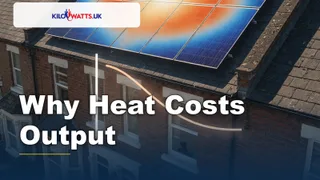
Why Heat Costs Your Panels Output — And Why Cold, Bright Days Win
If you have solar panels on a British roof, you have probably noticed something that feels wrong: a blazing August afternoon does not always produce the numbers you expected, while a crisp, cloudless morning in February quietly outperforms it per hour of sunshine. You have not misread the app. Solar panels convert light, not warmth, and as the cells themselves heat up their voltage falls — which means their electrical output falls with it. This article explains the mechanism in plain English, separates the two variables that people constantly confuse (irradiance and cell temperature), and shows what it means practically for how a UK system should be designed, mounted and judged. It is the written companion to the ten-second episode of Solar, Clearly, so if you cannot play the video, everything you need is here.
"They want light. Rising cell temperature reduces electrical output."
Panels want light, not heat — the difference matters
The intuitive model most people carry around is that solar panels are a bit like a greenhouse or a solar thermal collector: the hotter it gets, the more you get out. That model is wrong for photovoltaics. A PV cell is a semiconductor device. Photons of light knock electrons loose and create current; the panel's voltage comes from the physics of the semiconductor junction. Heat does not help that process — it interferes with it.
As a silicon cell warms, its open-circuit voltage drops. Current creeps up very slightly, but nowhere near enough to compensate, so the net power output falls. This is not a fault, a defect, or a sign of a poor installation. It is a published, measurable property of every panel on the market, and every manufacturer prints it on the datasheet as a temperature coefficient — a percentage change in power for every degree Celsius above the standard test temperature of 25°C. Modern monocrystalline modules typically sit somewhere in the region of a few tenths of a percent lost per degree; the exact figure varies by product, which is precisely why the datasheet exists.
The important consequence is that panel ratings are laboratory figures. A module rated at, say, 440 watts is rated at 25°C cell temperature under a defined light intensity. On a still summer afternoon, a dark panel bolted to a dark roof in full sun will be running far hotter than 25°C — often dramatically so. The panel is behaving exactly as designed. It is simply being asked to work in conditions warmer than the test bench.
Same sun, less power: irradiance and cell temperature are two different dials
The moment that trips people up is watching output drift downward while the sun has visibly not moved. This is the crux of the episode: the light did not change, so what did?
Think of it as two independent dials. The first is irradiance — how much light energy is actually landing on the glass, measured in watts per square metre. Irradiance is driven by the sun's height in the sky, cloud, haze, dust, shading and the angle of your roof relative to the sun. Irradiance mainly drives current. More light, more current, more power.
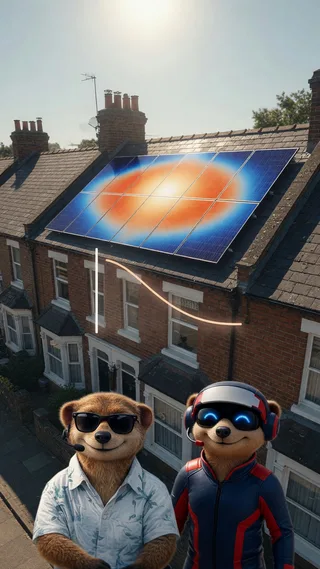
The second dial is cell temperature — how hot the silicon behind the glass has become. That is driven by ambient air temperature, wind speed, how the panel is mounted, and how long it has been baking. Cell temperature mainly drives voltage. Hotter cells, lower voltage, less power. On a hot, hazy afternoon both dials are working against you at once: haze softens irradiance while heat suppresses voltage. On a bright, cold morning both dials work with you: clean, direct light and cold silicon holding a high voltage. Once you can see the two variables separately — which is exactly what the data ribbon in the episode does — the behaviour stops being mysterious and becomes predictable.
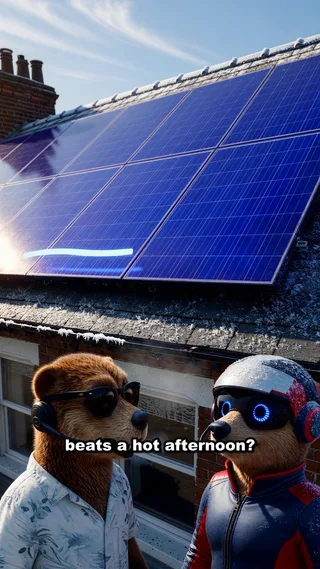
Why a frosty February morning can out-produce a hot August afternoon
This is the part that surprises people most, and it is one of the genuinely useful facts about solar in a northern maritime climate: solar panels generate more efficiently in cold weather than in hot weather.
On a frost-edged morning, cell temperature may be close to or below the 25°C test condition. The panels are running at or above their rated efficiency. Cold air, a clean sky washed by overnight rain and a low, hard sun can produce genuinely strong instantaneous output. Many UK systems record their punchiest single readings not in the depths of July but on clear, cold, bright days in the shoulder seasons, when high irradiance meets low panel temperature. Two caveats keep this honest. First, efficiency is not the same as total yield. A winter day is short and the sun sits low, so the total kilowatt-hours banked across the day will still usually be smaller than a long summer day, even though the panels are working more efficiently while the sun is up. Efficiency is about how well the panel converts the light it gets; yield is about how much light it gets, for how long. Second, this is about instantaneous performance and comparable irradiance — a cold overcast day is still a cold overcast day. What it does mean is that British weather is far less of an enemy to solar than the holiday-brochure image of solar suggests. Cool, bright, breezy conditions are close to ideal operating conditions for photovoltaics, and UK homes still generate useful power on overcast days too. The climate is not the problem people assume it is.
What good design does about heat — and about cold
You cannot change physics, but a well-engineered installation manages both ends of the temperature range rather than ignoring them.
Ventilation is the first lever. Panels mounted on rails above the tiles, with a genuine air gap behind them, shed heat by convection far better than modules pressed tight to the roof surface. That air gap is not cosmetic; it is thermal management. Roof-integrated (in-roof) arrays, which sit flush and replace tiles, look tidy and are often preferred on new builds or conservation-sensitive properties, but they generally run warmer than an on-roof array because there is less airflow behind them. That is a legitimate trade-off to make with your eyes open, not a reason to avoid in-roof systems outright.
Wind and orientation matter too. An exposed roof cools better than a sheltered one. Loft insulation and roof build-up influence how much heat is trapped beneath the array. None of these will eliminate temperature losses, but together they decide whether your panels sit a little above ambient or a long way above it on a still summer afternoon. The cold end has its own engineering requirement, and it is the one homeowners rarely hear about. Because cold cells produce higher voltage, a string of panels reaches its highest open-circuit voltage on the coldest, brightest morning of the year — not in summer. A competent designer sizes the string length against the lowest expected temperature for your location, so the array never exceeds the inverter's maximum input voltage. Get that wrong and the consequence shows up on exactly the sort of glorious frosty morning that should be a good day. This is one of several reasons why array design deserves more scrutiny than panel branding.
A practical checklist: is heat actually costing you output?
Before assuming something is wrong with your system, work through this. It separates normal thermal behaviour from a genuine issue.
- Check the shape of the curve, not just the peak. A summer day that plateaus below rated output, with a slight sag through the hottest hours and a recovery as the air cools in the late afternoon, is textbook temperature behaviour. A sudden cliff-edge drop is not. 2. Compare like with like. Put a clear, cool spring day next to a hot, hazy summer day at the same time of day. If the cooler day matches or beats the hotter one, your panels are behaving exactly as the physics predicts. 3. Find the temperature coefficient on your panel datasheet. It is usually listed as %/°C for power, voltage and current. Knowing your own module's figure is more useful than any generic rule of thumb. 4. Look at the mounting. Is there a visible air gap behind the array, or is it flush to the roof? Flush-mounted arrays run hotter — expect it and factor it into your expectations. 5. Rule out the real faults first. Soiling, bird mess, a new aerial or tree shadow, a failed optimiser or a string that has dropped offline all look far worse than heat losses and often appear as an abrupt change rather than a gradual seasonal pattern. 6. Check your winter mornings. If clear cold mornings look strong and steady, your array's voltage behaviour is healthy. If cold bright mornings behave oddly, ask your installer to confirm string voltage against the inverter's cold-temperature limits. 7. Judge the system annually, not hourly. Solar performance is an annual number. Single afternoons make poor evidence.
Follow-up questions people ask next
Should I hose my panels down to cool them? No. The gain is brief, the water usually leaves mineral deposits on the glass, and climbing on a roof to chase a few minutes of cooler cells is a poor trade in every respect. Cleaning is about soiling, not temperature, and is best done from ground level with the right equipment or by a professional.
Do some panel types handle heat better than others? Temperature coefficients vary between technologies and between products within a technology. If your roof is in a hot, sheltered spot, the coefficient is a specification worth comparing alongside efficiency and warranty rather than treating panel choice as a single headline wattage number.
Does heat damage panels permanently? Normal operating heat is designed for and covered by manufacturer performance warranties. The temperature effect described here is a reversible, day-to-day change in output, not degradation. Panels cool overnight and return to full performance. Does the same apply to batteries and inverters? They have their own thermal considerations, but the mechanism is different. Inverters throttle output to protect themselves if they overheat, which is why they should be mounted somewhere cool, shaded and ventilated rather than on a sun-baked south wall or in an unventilated loft corner. Does this change whether solar is worth it in Britain? If anything, it argues the other way. Our cool, bright, windy weather is closer to ideal photovoltaic operating conditions than the hot climates people picture when they imagine solar power. The limiting factor in the UK is daylight hours and cloud, not warmth.
Video transcript
Mo: Panels want heat, don't they? RoboMo: They want light. Rising cell temperature reduces electrical output.
Mo: But the sun hasn't moved — same light, less power? RoboMo: Correct. Irradiance is unchanged. Only cell temperature rose, so voltage fell.
Mo: So a freezing bright morning actually beats a hot afternoon? RoboMo: Frequently. Cold cells run at higher voltage, so a bright winter roof can out-produce a hot one. Mo: Panels want heat, don't they? RoboMo: They want light. Rising cell temperature reduces electrical output. / Mo: But the sun hasn't moved — same light, less power? RoboMo: Correct. Irradiance is unchanged. Only cell temperature rose, so voltage fell. / Mo: So a freezing bright morning actually beats a hot afternoon? RoboMo: Frequently. Cold cells run at higher voltage, so a bright winter roof can out-produce a hot one.
Wrapping up
The single idea worth keeping is that light and heat are separate inputs with opposite effects. Light is the fuel; heat is the tax. That is why the sun can sit motionless in a clear sky while your output quietly drifts down, and why a frost-edged February roof under a low, hard sun can post numbers that embarrass a sweltering August afternoon. It also explains why the British climate is a far better home for photovoltaics than its reputation suggests — cool and bright is close to what these devices actually want. Understanding the mechanism changes how you read your own data: you stop panicking at summer plateaus, you start noticing whether your array is properly ventilated, and you ask better questions about string design at the cold end of the year. Facts beat opinions, and engineering beats hype — particularly on a hot day.
Next step
If you are weighing up solar for your own roof and want the design questions answered properly — mounting, ventilation, string voltage and realistic annual yield rather than headline wattage — our residential solar guide is a good place to start, and a no-obligation survey will tell you what your specific roof can actually do.
Plan, Compare & Buy Renewable Energy Solutions
AI does the thinking.
You get the perfect solar match.
Use RoboMo™ to assess your property, compare available technologies and connect with trusted UK installers, suppliers and manufacturers.
Simply enter your postcode, drop a pin on your roof, create your free account and let RoboMo™ analyse your property to find the best solar panels for your home.

You don't have to think
RoboMo™'s AI analyses your roof and does all the hard work.

Accurate & tailored
AI-powered assessment based on your roof, location, and conditions.

Best options, maximum savings
Compare top solar panels for the best performance and value.

Simple, fast & effortless
Provide a few details, sit back and watch your results unfold.


STEP 1
Choose Home, Business or Industrial
Enter your postcode to start your assessment.
STEP 2

Drop a pin on your roof
STEP 3

Create your free account
STEP 4

Sit back and watch RoboMo™ work
RoboMo™ analyses your roof and builds your personalised solar comparison.

BATTERY ROI TOOL
See what a battery saves on your bill
Enter the day rate, off-peak rate and export rate. The calculator ranks batteries in the Kilowatts shop over 10 years.
Home batteries also suit offices and small commercial sites. Industrial batteries are listed on their own calculator.

Step 1
Enter your postcode
Start designing your wind energy system in seconds.
Are you an installer, distributor or renewable energy business?
Kilowatts UK is expanding the Flower Turbines partner network across the UK.
Become A Flower Turbines PartnerKilowatts UK is an authorised representative
Flower Turbines
Compact vertical-axis turbines built for real UK sites, not just open farmland.
They start in light wind, sit in a small footprint, and are bird-safe by design. Cluster them as a bouquet and the group performs better together than the same turbines standing alone. Enter your postcode for a location-based generation estimate. Figures use area weather data and will differ if buildings, trees or hills sit in the way.
Starts in light UK wind
Built to generate in typical UK wind, not only open farmland.
Small rooftop or ground footprint
Compact towers for roofs, yards and tight sites.
Bird-safe slow rotation
Slow vertical-axis spin, bird-safe by design.
Bouquet clusters raise output
Grouped turbines outperform the same units standing alone.


STEP 2

Choose a location
STEP 3

Place your cluster
Tap the map where you want the turbine cluster to go.
STEP 4

Instant generation forecasts
Compare different turbine layouts and see annual generation forecasts instantly.
STEP 5

No commitment required
Explore different configurations before deciding whether to request a quotation.
FAQ
Need Help? RoboMo's Got Answers
Why do solar panels produce less power when they get hot?
Solar panels convert light into electricity, not heat. As the solar cells warm up, their voltage falls, which reduces power output. This is normal behaviour and is listed on panel datasheets as a temperature coefficient.
Can a cold sunny day produce more solar power than a hot summer day?
Yes, in terms of instant output per hour of sunshine, a bright cold day can beat a hot afternoon. Cold cells hold a higher voltage, while clear light provides strong irradiance. However, summer usually still produces more energy across the whole day because the days are longer.
Does heat mean there is something wrong with my solar panels?
Usually not. A gentle dip or plateau during the hottest part of a clear summer day is typical temperature behaviour. Sudden drops, missing strings, new shading, heavy soiling or inverter faults are more likely to suggest a real issue.
Should I hose down my panels to cool them?
No, it is not a good approach. Any gain is short-lived, water can leave mineral deposits, and working near or on a roof is risky. Cleaning should be about removing dirt or bird mess, not trying to cool the panels.
Do in-roof solar panels run hotter than on-roof panels?
They generally can, because in-roof panels usually have less airflow behind them. On-roof panels mounted on rails have an air gap that helps heat escape. In-roof systems can still be a valid choice, but the thermal trade-off should be understood.
What is a solar panel temperature coefficient?
It is the figure on the manufacturer’s datasheet that shows how much output changes as cell temperature rises above the test condition. It is usually shown as a percentage per degree Celsius. A lower loss per degree can be useful to compare, especially on a hot or sheltered roof.
Why does cold weather matter for solar panel design?
Cold solar cells produce higher voltage, especially on bright winter mornings. A competent system design checks that the number of panels in a string will not exceed the inverter’s maximum input voltage in cold conditions. This is one reason proper electrical design matters as much as panel wattage.
Does UK weather make solar panels less worthwhile?
Not simply. The UK has plenty of cloudy weather and shorter winter days, but cool, bright and breezy conditions are good for photovoltaic efficiency. Solar performance should be judged over the year, not by one hot afternoon or one dull day.