


Funded ownership vs PPA in the UK
Published: 2026-07-19 15:07:22
Updated: 2026-07-26 18:33:29
A solar PPA usually reduces upfront cost and operational responsibility.
Funded ownership vs PPA in the UK
Funded ownership usually gives the highest long-term financial upside if you can access suitable finance, expect to use the site for long enough, and are comfortable taking responsibility for the solar PV asset. A solar PPA usually reduces upfront cost and operational responsibility, but it ties you into a long electricity-purchase contract with less control over the system.
For most UK homes, funded ownership is normally the simpler and more common route. For larger commercial roofs, a PPA can be worth considering where capital is limited, daytime electricity demand is stable, the roof is suitable, and the organisation expects to remain in control of the property for the length of the agreement.
This guide is written for UK property owners comparing real solar proposals. It is not legal, tax, mortgage, or financial advice. For commercial PPAs especially, the contract should be reviewed by an adviser who understands both energy agreements and property obligations. A useful way to frame the difference is this: Funded ownership is a way to pay for a solar asset. A PPA is a way to buy electricity from a solar asset someone else owns. The right choice depends on roof life, electricity use, finance cost, export value, DNO limits, maintenance responsibility, contract length, and what happens if the property is sold, refinanced, re-roofed, extended, or redeveloped.
What funded ownership means
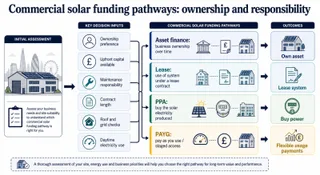
Funded ownership means you buy the solar PV system using cash, a loan, hire purchase, asset finance, or another funding product. You normally receive the benefit of the electricity the system generates, including lower grid imports and any export payments you are eligible for. In some finance structures, legal title may transfer only after the final payment, so the finance wording matters.
For a homeowner, funded ownership usually means buying a domestic solar PV system, sometimes with a battery. A typical UK domestic 3 to 5 kWp solar PV system commonly costs about £5,500 to £9,000 installed, while a domestic PV system with a battery commonly costs about £9,000 to £14,000 installed. Actual prices vary with roof access, scaffolding, electrical work, battery size, inverter choice, monitoring, roof type, and installation complexity.
For businesses, funded ownership may involve paying from capital reserves or using asset finance. Small commercial PV systems can cost about £800 to £1,300 per kWp installed, while medium commercial systems often cost about £600 to £1,000 per kWp installed. The cost per kWp can be lower on larger, straightforward roofs, but roof structure, access, asbestos, fire routes, cable runs, metering, grid connection requirements, and out-of-hours working can change the design and price. The main advantage is control. You choose the system design, installer, equipment, export tariff, maintenance approach, and whether to add batteries or EV charging later. The trade-off is that you carry more of the risk. If an inverter fails outside warranty, monitoring stops working, bird protection is needed, or the roof requires work, you are responsible unless a service agreement, warranty, or insurance policy covers it. Funded ownership is not always outright ownership from day one. A cash purchase is usually straightforward. Hire purchase, asset finance, leases, and other funding products can differ in title, balance-sheet treatment, VAT handling, early settlement, and what happens if you sell the property or business. Those details should be checked before signing.
What a solar PPA means
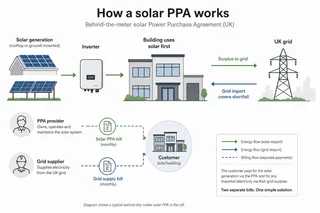
A PPA, or Power Purchase Agreement, is a contract to buy electricity generated by a solar system installed on your premises. The PPA provider usually funds, owns, operates, and maintains the system. You pay for the solar electricity you use, usually at a rate intended to be below your grid import price.
PPAs are more common on UK commercial roofs than on typical homes. They are often considered by businesses, schools, warehouses, factories, leisure centres, farms, and other organisations with significant daytime electricity demand. Residential PPAs are less common in the UK, and older rent-a-roof style arrangements have sometimes created conveyancing, mortgage, lease, and roof-access complications.
A typical onsite solar PPA term can be 10 to 25 years. The price may be fixed, index-linked, or reviewed periodically. Some PPAs include annual increases linked to CPI or RPI. A low starting pence-per-kWh rate can look attractive, but the comparison should be made over the full contract term, not just year one. The PPA provider prices in its finance cost, design risk, installation cost, maintenance, insurance, monitoring, operational risk, legal cost, and profit. That is why a PPA can reduce upfront capital pressure but usually gives less long-term upside than owning a well-performing system outright. A PPA is not “free solar”. It is a long-term energy contract attached to a physical asset on your building. That can be a sensible arrangement, but only if the contract is clear, the roof is suitable, the price mechanism is fair, and the exit provisions are workable.
The main differences at a glance
The simplest distinction is control versus commitment. Funded ownership puts the asset, savings, responsibilities, and long-term upside with you. A PPA puts ownership and much of the operational responsibility with the provider, while you commit to buying solar electricity under the contract.
Funded ownership is usually easier to understand at the end of the finance period. Once the finance is repaid, the system can continue producing electricity for the rest of its useful life, subject to maintenance and component replacement. Solar panels commonly have 25 to 30-year performance warranties and can continue generating after that, although output gradually declines. String inverters commonly last about 10 to 15 years, so replacement should be allowed for in the economics.
A PPA can be operationally simpler day to day, because the provider normally monitors and maintains the system. The complexity tends to appear in the contract. You need to understand what happens if your demand changes, you shut down at weekends, export is constrained, you sell the building, your lease changes, the roof needs replacing, or you want to buy the system later.
Control
Funded ownership gives more control over design and future changes, while a PPA is limited by contract terms.Maintenance
Funded ownership leaves you responsible unless contracted out, while a PPA usually places maintenance with the provider.Upfront cost
Funded ownership needs cash or finance, while a PPA usually needs little or no upfront capital.Property impact
Funded ownership is usually simpler, while a PPA can complicate sale, lease, refinance, roof works, or redevelopment decisions.Long-term savings
Funded ownership normally has higher potential savings, while a PPA shares the value with the provider.Contract complexity
Funded ownership is mainly a finance and installation decision, while a PPA is a long-term energy and property contract.
Neither route is automatically better. The best choice is the one that matches the site, electricity demand, roof condition, finance position, and appetite for long-term contractual obligations. Accounting treatment — Funded ownership and PPAs can be treated differently for tax, VAT, balance sheet, and budgeting purposes, so commercial buyers should take advice. End-of-life position — With funded ownership, you normally decide when to replace or remove equipment. With a PPA, the contract should state whether the system is removed, transferred, extended, or bought out.
Which usually saves more money
Funded ownership usually saves more over the long term where the system is well designed, the finance cost is reasonable, and the owner remains on site long enough to benefit. This is because the owner keeps the avoided grid electricity value and may receive export payments where eligible.
UK solar PV commonly generates about 750 to 1,100 kWh per kWp per year. Southern England is often nearer the higher end of that range, while Scotland, Northern England, shaded sites, and less favourable roof orientations may sit nearer the lower end. A 4 kWp home system may generate about 3,000 to 4,400 kWh per year. A 50 kWp commercial system may generate about 37,500 to 55,000 kWh per year. A 100 kWp commercial system may generate about 75,000 to 110,000 kWh per year.
The value of that generation depends heavily on self-consumption. Imported electricity normally costs much more than exported electricity is worth, so using solar on site is usually more valuable than sending it to the grid. Domestic solar without a battery may self-consume about 25% to 50% of generation, while a domestic system with a battery may self-consume about 50% to 80%. Commercial sites with steady daytime loads may self-consume about 50% to 95%, but this varies widely by business type. With a PPA, you do not normally keep all of that upside because the provider owns the system and sells electricity to you. That does not make the PPA poor value. It simply means the provider is taking on capital cost, maintenance, and operational responsibility, and needs a return for doing so. The financial comparison should model at least: Installed cost or PPA rate Finance interest, fees, deposit, and repayment profile Annual generation estimate and degradation assumption Self-consumption percentage Import tariff and expected future electricity price assumptions Export tariff or export ownership Be careful with payback claims. A simple payback figure can be useful, but it does not show all risks. For commercial decisions, a whole-life comparison using net present value, internal rate of return, and sensitivity analysis can be more informative than a single payback number. Inverter replacement allowance Monitoring, maintenance, cleaning, inspection, and insurance costs PPA indexation and review clauses Contract length and end-of-term position Cost of early termination or buyout Roof works risk and reinstatement cost Tax, VAT, and accounting treatment where relevant
What affects the comparison in real projects
The funded ownership versus PPA decision can change once proper design work is done. A desktop quote may assume ideal output, but the final design can be affected by roof loading, shading, export limits, cable routes, inverter location, fire access, rooflights, parapets, plant rooms, skylights, roof warranties, and safe access requirements.
DNO approval is particularly important. Small single-phase systems may fall under G98 rules, while larger or more complex systems usually need G99 approval. The local network may allow full export, restrict export, require export limitation equipment, or require network reinforcement. A roof might physically fit more panels than the grid connection can sensibly accept.
Roof condition is one of the most important checks and should not be treated as an afterthought. Solar PV can remain in place for decades, so the roof beneath it needs enough remaining life to justify the installation. If a roof is likely to need replacement within the next 10 to 15 years, installing solar before dealing with the roof can be expensive. Removing and reinstating an array for re-roofing adds cost, downtime, and risk. Roof condition matters under both ownership and PPA routes, but it is especially sensitive under a PPA because the provider may need roof access rights and protection for its asset. If you later need to replace the roof, the contract should say who pays to remove, store, protect, reinstate, recommission, and test the system. For pitched domestic roofs, check tile or slate condition, roof age, battens, underlay, rafters, roof penetrations, chimneys, and whether scaffolding access is practical. For flat commercial roofs, check membrane age, warranty restrictions, drainage, wind loading, ballast limits, insulation condition, plant equipment, edge protection, and whether the roof warranty allows solar fixings or ballast. For industrial roofs, check asbestos, fragile surfaces, purlin capacity, rooflight safety, and access routes.
Shading
Chimneys, trees, parapets, plant, rooflights, and neighbouring buildings can materially reduce output.Roof life
A tired roof can undermine both ownership and PPA economics.Export limits
DNO restrictions can reduce system size or require extra equipment.Roof warranty
Some coverings have warranty conditions that restrict fixings, ballast, penetrations, or third-party access.Electricity profile
Daytime use improves value, while high export can reduce financial benefit.Structural capacity
The roof must be assessed for dead load, wind uplift, snow load, and maintenance access.
A good comparison should model the whole life of the decision, not just the installed cost or the opening PPA rate. Access costs — Scaffolding, edge protection, netting, MEWPs, cranes, and out-of-hours work can affect pricing. Finance terms — Interest, fees, repayment profile, and early repayment rules affect funded ownership. PPA indexation — Annual increases can materially change the long-term comparison. Future property plans — Sale, lease changes, redevelopment, re-roofing, or change of use can make a long contract less attractive. Metering and data — Poor metering assumptions can distort self-consumption and savings projections. Insurance and fire requirements — Insurers may have requirements for isolators, labelling, access routes, shutdown procedures, and maintenance records.
When funded ownership is likely to be better
Funded ownership is often the better fit where the customer has access to affordable finance, expects to stay at the property, and wants the greatest long-term benefit from the solar generation. It is usually the normal route for UK homeowners who can afford the upfront cost or repayments.
It can also work well for commercial owner-occupiers with stable sites, suitable roofs, and meaningful daytime demand. Businesses may also want accounting advice on VAT recovery, capital allowances, balance sheet treatment, and how different finance products are treated. The tax position can differ between outright purchase, hire purchase, lease, and other funding structures.
Funded ownership is especially attractive when you want flexibility. You can choose whether to oversize the PV array, add a battery, integrate EV charging, change export tariffs, alter your maintenance contract, or replace equipment with your preferred specification later. You also avoid a long-term obligation to buy electricity from a third-party asset owner. Funded ownership is usually strongest where: The roof has a long remaining life. You expect to own or occupy the property for many years. You can use a good share of the generation on site. Finance costs are affordable and predictable. The DNO connection position is manageable. You want control over equipment, warranties, monitoring, and future upgrades. It may not be suitable if you plan to move soon, cannot access affordable finance, have major shading, have a roof nearing replacement, or do not want responsibility for monitoring, insurance, maintenance, and replacement parts. For homeowners, another practical point is mortgage and conveyancing simplicity. An owned domestic solar system installed with appropriate certification, warranties, and building-control compliance is usually easier to explain during a sale than a third-party ownership or roof-lease arrangement. Buyers should still keep MCS certificates, electrical certificates, DNO notifications, warranty documents, building-control records where applicable, and maintenance records. You are willing to manage maintenance or pay someone to do it. Property sale, refinance, or redevelopment is unlikely in the short term.
When a PPA is likely to be better
A PPA can be a good fit for a commercial organisation that wants solar without committing capital upfront. It is most likely to work where the site has a large usable roof, strong daytime electricity demand, long-term occupancy, and a straightforward legal position.
PPAs can be useful where capital budgets are reserved for core operations, or where an organisation prefers buying energy as an operating cost rather than owning generation equipment. The provider usually manages maintenance and system performance, which can reduce the internal workload for facilities and finance teams.
The strongest PPA candidates are often buildings that operate during daylight hours and expect stable demand for many years. Warehouses with weekday loads, factories, cold stores, leisure centres, schools, hospitals, universities, farms with daytime loads, and offices can all be candidates, but only if the solar output aligns well with consumption and the contract terms are sound. A PPA is more likely to work where:
- The building has a large, simple, structurally suitable roof.
- The roof has enough remaining life for the PPA term.
- Daytime electricity demand is stable and material.
- The occupier expects to remain for the contract term.
- Landlord, lender, and freeholder consents are obtainable.
- The PPA rate is genuinely competitive over the full term.
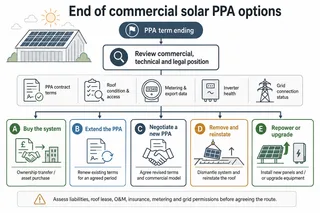
A PPA may not suit short-term occupiers, buildings likely to be sold or redeveloped, sites with uncertain future demand, properties with complex landlord or lender restrictions, or customers who want full control of the asset. It may also be less competitive on very small systems because the provider still has legal, finance, design, installation, monitoring, and maintenance costs to recover. For tenants, a PPA needs particular care. The solar contract must work alongside the lease. If the lease expires before the PPA, or if landlord consent is conditional, the tenant may be exposed to costs or obligations that are difficult to control. Landlords also need to understand roof access rights, reinstatement obligations, insurance, roof warranty implications, and what happens if the tenant leaves. Indexation is clear and not excessive. Maintenance obligations and response times are enforceable. Buyout and termination provisions are transparent. Sale, assignment, and change-of-control provisions are workable.
Contract points to check before choosing
The biggest mistakes usually come from comparing a simple ownership quote with a headline PPA rate. The two offers are not the same thing, so you need to normalise the comparison.
For funded ownership, check the full installed cost, finance rate, arrangement fees, deposit, early repayment rules, title transfer, warranty holder, workmanship warranty, inverter warranty, battery warranty, monitoring costs, maintenance exclusions, insurance requirements, DNO approval status, handover documents, MCS status where relevant, electrical certification, structural assumptions, roof warranty impact, and export tariff eligibility.
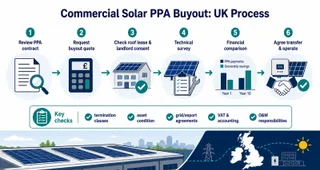
For a PPA, check the contract term, starting pence-per-kWh price, indexation method, minimum purchase obligations, deemed generation clauses, export ownership, metering method, data access, maintenance response times, downtime compensation, roof access rights, insurance responsibilities, damage responsibility, sale provisions, assignment rights, landlord consent, lender consent, buyout formula, end-of-term ownership, removal obligations, and reinstatement obligations. A good PPA contract should be understandable without relying only on the sales proposal. The signed agreement should match the financial model and clearly allocate risks. If the provider’s commercial model depends on assumptions that are not written into the contract, treat that as a warning sign. Minimum purchase obligations: These can require payment even if your usage falls below expectations. Deemed generation clauses: These can charge for electricity the system would have produced in certain circumstances, even if you did not consume it. Export ownership: The provider may keep export revenue unless the contract says otherwise. Indexation: CPI, RPI, fixed annual uplifts, or review mechanisms can materially change the real cost over time. Buyout terms: The formula can be expensive if you want to end the arrangement early. Roof access rights: These can affect maintenance, future roof works, and property transactions. When assessing PPA quality, look beyond the starting tariff. A stronger PPA will usually have clear metering, transparent indexation, realistic generation assumptions, reasonable buyout provisions, sensible roof-work clauses, defined maintenance standards, fair downtime rules, and practical transfer provisions if the property is sold. A weaker PPA often relies on a low opening rate while pushing risk into deemed generation, long terms, unclear indexation, expensive termination, or restrictive property obligations. Legal review is particularly important for PPAs, because the contract may affect the property as well as the energy bill. Roof works clauses — The contract should state who pays for removal and reinstatement if the roof needs repair or replacement. Performance obligations — The provider should have clear monitoring, maintenance, and response obligations. Metering rules — The contract should define how solar electricity is measured, billed, disputed, and reconciled. Change in demand — The contract should deal with reduced operations, shutdowns, extended closures, or changes in business use. Sale and assignment — You need to know whether the PPA can transfer to a buyer, landlord, tenant, or group company. End-of-term rules — You need to know whether the system is removed, transferred, extended, or bought out.
Common mistakes to avoid
A common mistake is assuming that no upfront cost means free electricity. A PPA is not free solar. It is a long-term agreement to buy electricity from a system someone else owns. That may be a sensible trade, but it should be assessed as a contract, not as a giveaway.
Another mistake is ignoring roof condition. Solar panels can last for decades, but roof coverings, membranes, fixings, battens, and warranties may not. If the roof needs work, deal with that before signing a long-term finance or PPA arrangement where possible.
Customers also overestimate the value of export. Smart Export Guarantee rates vary by supplier and tariff, and export is commonly worth less than avoided grid imports. A system that looks excellent on annual generation alone may perform less well financially if much of the electricity is exported at a low rate. Battery assumptions also need care. A battery can improve self-consumption and backup capability in some situations, but it does not always pay for itself. The extra usable energy value must justify the battery cost, degradation, losses, usable capacity, replacement risk, and warranty limits. Another mistake is comparing proposals with different assumptions. One quote may assume high self-consumption, full export permission, no inverter replacement, and optimistic electricity inflation. Another may use more cautious assumptions. The cheaper-looking proposal is not always the better one if the model is less realistic. Commercial buyers should also avoid signing a PPA before checking property restrictions. Landlord consent, lender consent, superior leases, roof warranties, insurance conditions, fire strategies, and planned maintenance can all affect whether the project can proceed. These issues are easier to solve before contract signature than after installation. Finally, do not rely only on the cheapest quote or lowest starting PPA rate. Design quality, structural assessment, DNO response, inverter placement, monitoring, access, warranties, and maintenance arrangements can matter more over the life of the project.
How to make the decision
Start by deciding whether you want to own an asset or buy solar electricity as a service. If ownership fits your budget and time horizon, it will often provide the stronger long-term return. If preserving capital is more important and the site is commercially attractive, a PPA may be worth detailed negotiation.
Then test the decision against the building. A suitable roof, safe access, good orientation, limited shading, adequate structure, sensible cable routes, and manageable DNO requirements are all more important than the finance label. A poor site does not become good simply because the payment structure changes.
For homes, funded ownership is usually the default option to explore first. For commercial premises, compare both routes if the roof is large enough, daytime demand is reliable, and the organisation expects to control the site for the length of the agreement. A practical decision process is:
- Confirm the roof has enough remaining life and structural capacity.
- Check electricity demand, half-hourly data where available, and daytime self-consumption.
- Obtain comparable system designs using the same roof area and constraints.
- Confirm the likely DNO route and any export limitation requirements.
- Model funded ownership using realistic finance, maintenance, and replacement assumptions.
- Model the PPA using the full contract term, indexation, minimum purchase rules, and buyout terms.
The best next step is to gather comparable proposals that use the same assumptions for system size, annual generation, self-consumption, export, maintenance, inverter replacement, finance cost, roof condition, DNO position, and contract length. Only then can you see whether funded ownership or a PPA is the better fit for your UK property. Check property, lease, lender, insurance, and roof warranty constraints. Compare whole-life cost, risk allocation, control, and exit flexibility. Take legal, tax, and accounting advice where the decision is material. Choose the route that remains attractive under cautious assumptions, not only under the best-case model.
Plan, Compare & Buy Renewable Energy Solutions
AI does the thinking.
You get the perfect solar match.
Use RoboMo™ to assess your property, compare available technologies and connect with trusted UK installers, suppliers and manufacturers.
Simply enter your postcode, drop a pin on your roof, create your free account and let RoboMo™ analyse your property to find the best solar panels for your home.

You don't have to think
RoboMo™'s AI analyses your roof and does all the hard work.

Accurate & tailored
AI-powered assessment based on your roof, location, and conditions.

Best options, maximum savings
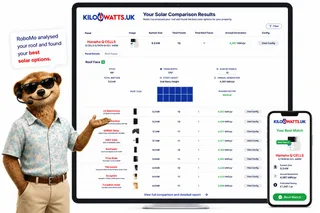
Compare top solar panels for the best performance and value.

Simple, fast & effortless
Provide a few details, sit back and watch your results unfold.
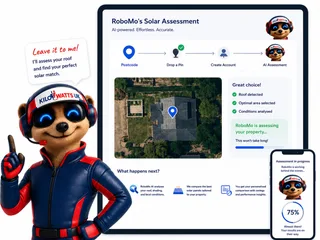
STEP 1
Choose Home, Business or Industrial
Enter your postcode to start your assessment.
STEP 2

Drop a pin on your roof
STEP 3

Create your free account
STEP 4

Sit back and watch RoboMo™ work
RoboMo™ analyses your roof and builds your personalised solar comparison.

Flower Turbines
Design your wind energy system.
Instantly forecast generation.
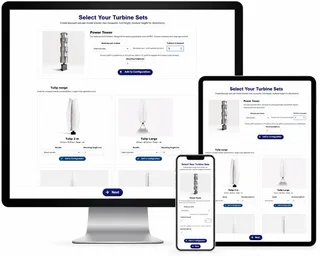
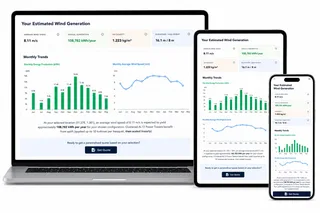
Choose a location, configure your Flower Turbines and instantly see estimated annual generation using location-specific wind data. No account required.

Real location data
Generation forecasts based on the location you select.

Build your own layout
Configure Flower Turbines to suit your available space.

Instant generation forecasts
See estimated annual generation and energy production instantly.

No commitment required
Explore different configurations before deciding whether to request a quotation.
STEP 1
Enter your postcode
Start designing your wind energy system in seconds.
STEP 2
Choose a location
STEP 3
Build your layout
STEP 4
Instant generation forecasts
Compare different turbine layouts and see annual generation forecasts instantly.
STEP 5
No commitment required
Explore different configurations before deciding whether to request a quotation.
Are you an installer, distributor or renewable energy business?
Kilowatts UK is actively expanding the Flower Turbines partner network across the United Kingdom. Contact us to discuss installation, reseller and project partnership opportunities.
Become A Flower Turbines PartnerRelated articles
FAQ
Need Help? RoboMo's Got Answers
What is the difference between funded ownership and a solar PPA?
Funded ownership means you buy the solar PV system using cash, a loan, hire purchase, asset finance, or another funding product. You normally receive the benefit of the electricity generated, including reduced grid imports and any export payments where available, but you are also responsible for monitoring, maintenance, insurance, and replacement parts unless warranties or service agreements cover them. A solar PPA is a long-term contract to buy electricity from a solar system installed on your property but owned and operated by a third-party provider.
Which option usually saves more money in the long term?
Funded ownership usually offers the highest long-term savings if the system is well designed, finance costs are reasonable, and you stay at the property long enough to benefit. This is because you keep more of the value from avoided grid imports and any export income. A PPA can still reduce electricity costs and remove much of the upfront cost, but the provider must recover installation, finance, maintenance, legal, operational, and profit costs through the electricity rate.
Is a solar PPA the same as free solar?
No. A solar PPA is not free solar. It usually reduces or removes the upfront installation cost, but you commit to buying electricity generated by the system under a long-term contract. The real cost depends on the PPA rate, annual indexation, contract length, minimum purchase rules, deemed generation clauses, buyout terms, export ownership, and end-of-contract obligations.
Are PPAs common for UK homes?
Solar PPAs are much less common for typical UK homes than funded ownership. Most homeowners who install solar use cash, loans, or other finance to own the system. Older rent-a-roof style arrangements have sometimes caused issues with mortgages, conveyancing, roof access, leases, roof works, and property sales, so homeowners should be cautious about any third-party ownership arrangement attached to the roof.
When is funded ownership likely to be the better choice?
Funded ownership is usually a better fit if you can access affordable finance, expect to remain in the property for several years, have a roof with a long remaining life, and want control over the system. It is also attractive if you want flexibility to add a battery, install EV charging, change export tariffs, choose maintenance arrangements, upgrade equipment later, or avoid a long-term obligation to buy electricity from a third-party provider.
When is a solar PPA likely to be the better choice?
A solar PPA can be suitable for commercial organisations that want solar without using capital upfront. It is most likely to work well on large, structurally suitable roofs with strong daytime electricity demand, long-term occupancy, clear landlord and lender consent, and a contract with fair pricing, transparent indexation, practical buyout terms, enforceable maintenance standards, and clear roof access arrangements.
How long does a solar PPA usually last?
An onsite solar PPA in the UK commonly lasts around 10 to 25 years. The exact term matters because it affects property flexibility, sale or lease arrangements, roof works, buyout costs, and the total amount paid for electricity. A low starting tariff should always be assessed over the full contract term, including indexation and any circumstances where charges may still apply even if your electricity demand changes.
What should I check in a PPA contract?
Key points include the contract length, starting electricity rate, indexation method, minimum purchase obligations, deemed generation clauses, export ownership, metering method, billing process, data access, maintenance response times, downtime rules, roof access rights, insurance responsibilities, landlord and lender consent, early termination costs, buyout formula, sale or assignment rights, change-of-control provisions, and what happens at the end of the term.
Why does roof condition matter so much?
Solar PV can remain in place for decades, so the roof beneath it needs enough remaining life to justify the installation. If the roof needs replacement or major repair during the finance or PPA term, removing, storing, reinstalling, recommissioning, and testing the system can add significant cost and disruption. Roof condition is especially important under a PPA because the provider’s asset is physically attached to the building and the contract should say who pays for removal, reinstatement, and making good.
What happens if I sell the property?
With funded ownership, an owned solar PV system is usually simpler to explain during a sale if documentation is complete, including certificates, warranties, DNO records, export tariff details, and maintenance history. With a PPA, the contract may need to be assigned to the buyer or bought out, and the buyer, lender, landlord, or solicitor may have concerns about roof rights, long-term payment obligations, termination terms, and future roof works. Sale provisions should be checked before signing.
Who maintains the solar panels?
With funded ownership, you are normally responsible for monitoring, maintenance, insurance, cleaning where needed, and replacing components outside warranty unless you have a maintenance agreement. With a PPA, the provider usually operates and maintains the system, but the contract should clearly state response times, performance obligations, downtime rules, monitoring standards, access requirements, and who is responsible for damage, roof-related disruption, and loss of generation.
What happens at the end of a PPA?
The PPA should clearly state whether the system is removed, transferred to you, sold to you through a buyout, or kept in place under an extended agreement. It should also explain who pays for removal, reinstatement, testing, roof repairs, electrical works, and any making-good obligations. These terms should be understood before signing, not left until the end of the contract.
Does export income make a big difference?
Export income can help the economics, but using solar electricity on site is usually more valuable than exporting it. Imported electricity normally costs more than the amount paid for exported electricity, so self-consumption is a major driver of savings. Under a PPA, export revenue may belong to the provider unless the contract says otherwise, so export ownership should be checked before comparing proposals.
Should I include battery storage in the comparison?
Battery storage can improve self-consumption and may add resilience or help with time-of-use tariffs, but it does not always pay for itself. The comparison should include battery cost, usable capacity, efficiency losses, degradation, warranty limits, replacement risk, and the value of the extra solar electricity used on site. Batteries should be modelled separately rather than assumed to be automatically worthwhile.
What financial assumptions should I compare?
Compare installed cost or PPA rate, finance interest, arrangement fees, deposit, annual generation, panel degradation, self-consumption, import tariff assumptions, export tariff, maintenance costs, inverter replacement, monitoring, insurance, PPA indexation, contract length, buyout costs, roof works risk, VAT, tax, and accounting treatment where relevant. The best comparison uses the same technical and financial assumptions for both options.
How do DNO limits affect funded ownership and PPAs?
DNO approval can affect the system size, export level, connection cost, and project timescale under both routes. Some systems can proceed through simpler notification processes, while larger or more complex systems usually need approval before installation. The local network may allow export, restrict export, require export limitation equipment, or require reinforcement. A proposal should not be judged only by how many panels fit on the roof; it should also reflect what the grid connection can sensibly accept.
Can tenants use funded ownership or a PPA?
Tenants may be able to use either route, but the solar arrangement must work with the lease. Landlord consent, roof access rights, reinstatement obligations, insurance, roof warranties, lease expiry dates, break clauses, and responsibility for electricity bills all matter. A PPA is especially sensitive if the PPA term is longer than the lease, because the tenant may be left with obligations that are difficult to control after leaving the property.
Are there tax, VAT, or accounting differences?
Yes, especially for businesses. Outright purchase, hire purchase, asset finance, leasing, and PPAs can be treated differently for VAT, tax, capital allowances, budgeting, and balance sheet purposes. The best option can depend on the organisation’s structure, tax position, finance policy, and accounting treatment. Commercial buyers should take professional advice before relying on projected returns.
Do I need professional advice before signing?
For homeowners buying a standard owned system, good installation documentation, clear finance terms, MCS certification where relevant, DNO records, warranties, and electrical certification are usually the main priorities. For commercial PPAs, professional advice is strongly recommended because the agreement can affect energy costs, property rights, accounting treatment, tax, landlord consent, lender consent, insurance, roof warranties, and future sale or redevelopment plans.