


Why businesses should generate their own electricity in the UK
Published: 2026-07-18 19:55:31
Updated: 2026-07-26 22:23:12
Understand business energy independence in the UK, with clear explanations, examples, and practical next steps.
Key points to consider
Meta title: Why UK businesses should generate their own electricity
Meta description: Learn why UK businesses generate their own electricity with solar PV, batteries and on-site generation, including costs, risks, grid approvals and feasibility checks.
# Why businesses should generate their own electricity in the UK Businesses should generate some of their own electricity because it can reduce exposure to high grid prices, improve long-term cost control, support carbon targets and make operations more resilient. In the UK, this usually means partial business energy independence, not going fully off-grid. The strongest case is normally for sites with steady daytime electricity demand, suitable roof or land space, long-term site control and the ability to use most of the generated power on site. The practical summary is straightforward.
- Generate on site to reduce imported electricity.
- Size the system around real consumption data.
- Use exported power as a secondary benefit, not the main business case.
- Treat batteries as useful in the right circumstances, but not automatic.
- Check roof condition, grid approval, insurance and lease constraints early.
- Model future loads such as EV charging before finalising the design.
This is not only an environmental decision. For many UK businesses, generating electricity on site is a risk-management decision. Electricity bought from the grid includes wholesale energy costs, network costs, balancing costs, supplier margins, metering, VAT and policy-related charges such as the Climate Change Levy where applicable. Businesses are also not protected by the domestic energy price cap, as Ofgem explains in its energy advice for businesses, so a contract signed at the wrong time can leave a site exposed to painful rates for years. Government data also shows why energy planning needs to be treated commercially rather than casually. The Department for Energy Security and Net Zero publishes UK electricity price and energy market data through its Energy Trends and energy price statistics collections. These data sets show that electricity costs can move significantly over time, and non-domestic users are affected differently depending on contract structure, demand profile and site circumstances. Last reviewed: July 2026.
Why business energy prices feel so high
Business energy prices are high because a company’s electricity bill is more than the wholesale price of power. The delivered price includes the cost of moving electricity through transmission and distribution networks, balancing the grid in real time, supplier risk, metering, standing charges, VAT and other charges that vary by site and contract. For more background on the wider market, see our guide to why UK electricity prices are so high.
Gas still has a strong influence on UK electricity prices because gas-fired generation often helps set the marginal price in the power market. When gas prices rise, electricity prices can rise too, even if a business buys electricity from a supplier with a renewable tariff. Non-domestic contracts also vary widely depending on when the contract was agreed, the credit profile of the business, the meter type, the region, the volume used and the level of supplier risk.
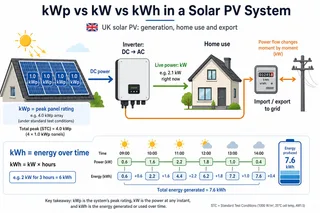
For half-hourly metered sites, the bill can be more complicated than a simple unit rate. Peak-time use, agreed capacity, poor power factor, network charges and metering arrangements can all affect the final cost. This is why two businesses using the same annual kWh can face noticeably different bills. Generating electricity on site does not remove all of those charges. A grid-connected business will still pay for electricity imported from its supplier and may still pay standing charges, capacity charges and other costs. However, on-site generation reduces the amount of electricity bought through that system. Every kilowatt hour used directly from your own solar panels is a kilowatt hour you did not have to buy from your supplier at the full delivered import rate.
Business energy independence means control, not isolation
Business energy independence is often misunderstood. It rarely means cutting the cable to the grid. For most UK companies, the grid remains essential for winter demand, night-time use, unusually high loads and backup when equipment is being maintained.
A better definition is reducing dependency on imported electricity where it makes operational and financial sense. A business with solar PV might still import from the grid every day, but it can reduce daytime imports, improve budget certainty and make part of its electricity cost depend on an asset it controls rather than a market price it cannot control.
This matters because the best on-site generation projects are not judged by how many panels are fitted. They are judged by how much imported electricity is avoided at valuable times. A smaller, well-matched system can outperform a larger system that exports too much low-value power or is constrained by the local grid connection. Energy independence should therefore be treated as a spectrum.
- A modest system may reduce daytime imports and cut bills.
- A larger system may support carbon reporting and long-term energy strategy.
- A solar and battery system may increase self-consumption and help with peak demand.
- A backup-capable system may protect specific critical loads during outages.
- A full off-grid system is usually unsuitable for most mainstream commercial sites because of cost, complexity and reliability requirements.
For most businesses, the right goal is not isolation from the grid. It is more control over a material operating cost.
How on-site generation works for a business
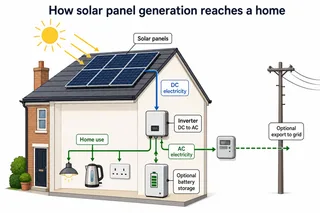
Most commercial on-site generation is “behind the meter”. This means electricity is generated on the business premises and used by the site before electricity is imported from the grid. If generation exceeds demand, the excess can be exported, curtailed or stored in a battery if one is installed and configured to do so.
Solar PV is usually the most practical technology for UK businesses because many commercial sites have large roofs and daytime electricity demand. Warehouses, factories, offices, farms, schools, retail units, cold stores and leisure facilities can all be candidates, although the match varies strongly by load profile and building condition. Businesses at this stage can compare commercial solar options to understand what may suit their site and usage pattern.
Other technologies can work in specific circumstances.
- Wind can be suitable for exposed rural or coastal sites, but planning, grid connection and performance modelling are more complex.
- Hydro is highly site-specific and depends on water rights, flow, head and environmental constraints.
- Anaerobic digestion can suit farms, food processors and waste operators with suitable feedstock.
- Combined heat and power can work where there is a constant heat demand, although fossil-fuel CHP is not the same proposition as renewable electricity generation.
- Private wire arrangements can work for multi-site, landlord-and-tenant or neighbouring-user situations, but they need careful legal, metering and commercial design.
For most businesses starting the process, solar PV is the first technology to assess because it is modular, proven and comparatively straightforward to model against electricity consumption.
Why solar PV is usually the first option to assess
Commercial solar PV suits the UK better than many businesses assume. Panels generate from daylight, not heat, so cloudy weather reduces output but does not stop generation. UK output is commonly around 850 to 1,100 kWh per kWp per year, depending on location, roof orientation, shading, pitch, system design and maintenance.
Solar generation is strongest from spring to early autumn and lower in winter. This makes it particularly effective where a business has regular daytime demand during the brighter months. Cold stores, offices, farms with daytime processing loads, manufacturing sites and warehouses with steady electrical loads can be strong candidates. A school, by contrast, may have a weaker summer match if its buildings are lightly used during holidays, although term-time consumption and export arrangements can still make a project viable.
The economics usually favour self-consumption over export. If a business avoids buying electricity at a high import rate, that saving is normally worth more than selling surplus electricity at an export rate. Export can still help, especially where a supplier offers a suitable export purchase agreement, but a project based mainly on export income is usually less robust than one based on reducing imports. Solar PV also has strategic benefits beyond direct bill savings.
- It can reduce scope 2 electricity-related emissions where the reporting treatment is appropriate.
- It can support ESG, procurement and customer requirements.
- It can provide a visible investment in lower-carbon operations.
- It can help protect against future electricity price volatility.
- It can be integrated with EV charging, heat pumps or process electrification where these are planned properly.
Those benefits are useful, but they should not replace the core feasibility question: does the site use enough electricity at the right times to justify the investment?
The financial case is about reducing exposure
The financial case for self-generation is strongest when it turns part of a variable operating cost into a long-life asset cost. A commercial PV system may operate for 25 to 30 years, while inverters often need replacement after around 10 to 15 years. Lifetime planning should therefore include maintenance, monitoring, inverter replacement, roof access, cleaning where needed, insurance requirements and possible communications upgrades.
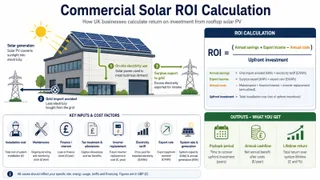
Commercial solar payback can be around 4 to 8 years where daytime self-consumption is high, the roof is straightforward and the import electricity rate is material. It can be longer where electricity rates are low, export is high, the roof is complex, finance costs are high or grid works are required. Small systems also tend to cost more per kWp than larger systems.
A simple roof with good access and modern electrical infrastructure is very different from an older site with fragile roof sheets, asbestos, weak switchgear and restricted export capacity. Larger sites with heavy loads may also want to compare industrial solar options rather than using a generic commercial estimate. Businesses should also consider financing structure.
- Buying the system outright can give more control and potentially stronger lifetime value, but it uses capital.
- A power purchase agreement can reduce upfront cost, but it commits the business to a long-term electricity purchase contract.
- Asset finance may spread cost while keeping ownership clearer than some third-party funded models.
- A landlord-funded system may work for tenants, but the lease, electricity supply and maintenance responsibilities need careful drafting.
No funding route is automatically better. The right option depends on capital availability, tax position, site control, contract length, appetite for ownership and long-term business plans. Businesses should take tax, legal and accounting advice where those issues are material.
Batteries can help, but they are not always needed
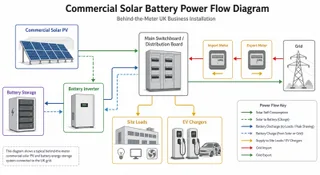
Battery storage can improve self-consumption, reduce peak imports and support resilience where the system is designed for backup. It can be particularly useful where solar generation regularly exceeds daytime demand, where peak charges are material or where the site has EV charging loads that can be managed intelligently. For sites where this is a genuine constraint, commercial solar battery storage can be assessed alongside the PV design rather than treated as an automatic add-on.
However, batteries add cost, space requirements, fire safety considerations and operational complexity. Commercial battery warranties are often around 10 years, and lifespan depends on cycling, temperature, depth of discharge, battery chemistry and control strategy. Lithium iron phosphate batteries are common for stationary storage, but the right design still depends on the site.
A common mistake is assuming a battery automatically keeps the business running during a power cut. Standard solar PV shuts down during a grid outage for safety. Backup requires islanding-capable equipment, protection design and a decision about which loads are essential. Whole-site backup is much more expensive than supporting selected circuits such as refrigeration, servers, tills, security systems, pumps or communications equipment. Battery projects should be assessed with clear objectives.
- Store surplus solar for later on-site use.
- Reduce maximum import demand.
- Avoid peak-time electricity where the tariff supports it.
- Support EV charging without increasing grid capacity.
- Provide backup for defined critical loads.
- Participate in flexibility or grid services where the commercial arrangements are suitable.
If the objective is unclear, the battery may become an expensive accessory rather than a useful asset.
The best projects start with half-hourly data
A business should not start by asking how many panels will fit on the roof. It should start by understanding when electricity is used. Twelve months of half-hourly consumption data gives a much better basis for sizing than annual kWh from bills.
- Daytime demand improves the value of solar generation.
- Weekend shutdowns can increase export.
- Seasonal closures can weaken the match.
- Night-time loads may need storage or a different strategy.
- EV charging plans can change future demand.
- Heat pumps or process electrification can materially change the load profile.
- Production shifts, refrigeration cycles and compressed-air use can affect the solar match.
The aim is to model generation against real load patterns, then choose a system size that delivers useful self-consumption without excessive export or curtailment. Self-consumption above 70% often improves project economics, while self-consumption below 50% can weaken the case unless export terms are strong or carbon objectives justify the additional generation. This is also where efficiency matters. Reducing waste first can reduce the size and cost of the generation system needed. LED lighting, controls, compressed-air leak reduction, refrigeration maintenance, motor efficiency, voltage optimisation where appropriate and demand scheduling can all improve the economics of generation. Good modelling should include sensitivity checks rather than a single optimistic forecast. At minimum, a business should understand how the project performs if import prices fall, export rates change, consumption drops, maintenance costs increase or the site’s operating pattern changes.
Site constraints can decide whether a project works
A business may have a strong electricity case but a weak site case. Roof condition, structural capacity, switchgear, grid capacity, access, planning restrictions, fire strategy, insurance requirements and landlord consent can all determine whether a project is viable.
Planning
Many commercial roof-mounted systems are permitted development, but restrictions can apply in conservation areas, listed buildings, airports, sensitive settings and ground-mounted projects.Operations
Roof access, plant maintenance, drainage, fragile surfaces, asbestos management and future roof works all need to be considered.Roof condition
PV can last longer than the roof covering, so end-of-life roofs should usually be repaired or replaced first.Grid connection
Larger systems usually need G99 approval, and export limits or reinforcement costs can affect design.Structural capacity
Flat roofs may need checks for ballast, wind uplift, panels, walkways and maintenance access.Electrical infrastructure
Main switchgear, metering, cable routes, voltage rise and protection settings can limit system size.Insurance and fire safety
Insurers may require isolation, access routes, maintenance procedures, fire service information and documentation.
Grid connection is especially important. Distribution Network Operators need to know when generation is being connected to their networks, and approval requirements depend on system size, export arrangements and local network conditions. Export-limited systems can sometimes avoid reinforcement, but the limitation needs to be properly engineered and accepted by the relevant network operator. Leased premises need particular care. A tenant may need landlord consent, a roof licence, lease amendments or agreement over who owns the system and who is responsible for maintenance. If the business expects to move soon, the economics become harder unless the asset can be transferred or the lease terms support the investment.
A bigger system is not always better
It is tempting to fill every available roof area, but oversizing can reduce financial performance if much of the extra generation is exported at a lower value or curtailed because of a grid export limit. More panels also mean more weight, more mounting, more cable management, more roof interaction and more maintenance obligations.
The right design depends on the business objective.
Best resilience
Design separate backup functions rather than assuming solar alone will protect the site.Lowest imported kWh
Focus on high self-consumption and sensible demand matching.Lowest upfront cost
Consider PPAs or phased installation, while checking long-term contract implications.Lowest carbon footprint
Consider annual generation, carbon reporting rules and asset ownership.Maximum long-term control
Ownership may be preferable where capital, roof control and maintenance capacity allow.Best fit for future electrification
Model EV charging, heat pumps, new equipment and production changes before finalising the system size.
The most resilient commercial decision is usually not the largest installation, but the one that matches demand, respects the building and can be maintained properly. A good proposal should explain why the recommended system size has been chosen. If a design simply maximises roof coverage without showing load matching, export assumptions, grid constraints and maintenance access, it may not be the best commercial answer.
When generating your own electricity may not be suitable
On-site generation is not right for every business. A site with low daytime demand, heavy shading, a weak roof, short lease term, planned redevelopment, poor grid connection options or unresolved landlord restrictions may struggle to justify the investment.
It may also be less attractive where electricity prices are already low, where capital is urgently needed elsewhere or where export is the main source of value. A cheap installation can become expensive if it causes roof leaks, creates access problems, fails to satisfy insurers or lacks proper monitoring and maintenance.
There is also uncertainty. Electricity prices, export rates, tax treatment, business rates, technology costs and site operations can change. A good appraisal should test the project under different assumptions rather than relying on a single optimistic payback figure.
- Businesses should be especially cautious where:
- the roof is near the end of its life;
- the site lease is shorter than the expected payback period;
- future relocation or redevelopment is likely;
- the proposed design depends on unusually high export income;
- the installer has not requested half-hourly data;
- grid approval has not been considered;
- insurance requirements have not been checked;
- access for maintenance has not been designed properly.
In some cases, the right first step is not installing generation. It may be reducing consumption, improving controls, renewing electrical infrastructure or negotiating a better supply contract before committing capital to on-site assets.
What businesses should check before committing
A practical feasibility process should combine energy analysis, site inspection, commercial review and connection planning. The goal is to find out whether the project works as a business asset, not just whether equipment can be installed.
- Collect at least twelve months of half-hourly electricity data.
- Review current unit rates, standing charges, VAT and applicable levies.
- Check whether the current supply contract allows export or requires notification.
- Check roof age, roof warranty, access and structural capacity.
- Identify shading from plant, parapets, trees and neighbouring buildings.
- Review switchgear, metering, cable routes and communications.
- Ask about DNO approval, export limits and possible reinforcement.
- Speak to insurers before installation.
- Confirm ownership, maintenance and export income arrangements.
- Include inverter replacement and O&M in lifetime costs.
- Check whether the system will affect the lease, mortgage, landlord consent or future sale of the property.
- Confirm who monitors performance and what happens if output is lower than forecast.
- Review warranties, workmanship guarantees and maintenance responsibilities.
- Decide whether future EV charging or electrification should be included in the model.
- Useful evidence for a commercial decision includes:
- half-hourly load analysis;
- generation modelling using the proposed orientation and shading assumptions;
- self-consumption and export estimates;
- import tariff and export tariff assumptions;
- grid connection route and approval requirements;
- structural and roof condition findings;
- maintenance and replacement cost assumptions;
- sensitivity analysis for lower savings or higher costs.
A good installer or consultant should be willing to explain constraints, not just estimate headline savings. If the design depends on high export income, unusually low installation cost or assumptions that do not match your operating pattern, it deserves closer scrutiny. An early commercial electrical inspection can also help identify switchgear, metering and safety issues before the solar design is finalised. That evidence does not guarantee a perfect outcome, but it makes the investment decision much more robust.
The opinionated answer
UK businesses should generate their own electricity where the site, load profile and long-term plans support it because it gives practical control over a cost that has become difficult to predict. The objective is not total independence from the grid. It is reducing avoidable imports, locking in a portion of long-term energy supply and making the business less exposed to contract timing and market volatility.
Solar PV is the first option most businesses should investigate, especially if they own or control a suitable building and use electricity during the day. Batteries, PPAs, private wire arrangements, wind, CHP or other technologies may be useful in the right setting, but they should be justified by the actual load, not added because they sound strategic. If future demand includes fleet charging, commercial EV charger installation should be modelled with the solar proposal rather than bolted on later.
The best projects are boring in the right ways. They are based on real consumption data, conservative assumptions, sound roofs, safe electrical design, clear grid approval, insurer engagement and a maintenance plan. Businesses that approach generation this way are not chasing energy independence as a slogan. They are building a more controlled and resilient electricity strategy.
Ready to compare your options?
Get tailored comparisons and connect with trusted installers in under a minute.
Plan, Compare & Buy Renewable Energy Solutions
AI does the thinking.
You get the perfect solar match.
Use RoboMo™ to assess your property, compare available technologies and connect with trusted UK installers, suppliers and manufacturers.
Simply enter your postcode, drop a pin on your roof, create your free account and let RoboMo™ analyse your property to find the best solar panels for your home.

You don't have to think
RoboMo™'s AI analyses your roof and does all the hard work.

Accurate & tailored
AI-powered assessment based on your roof, location, and conditions.

Best options, maximum savings
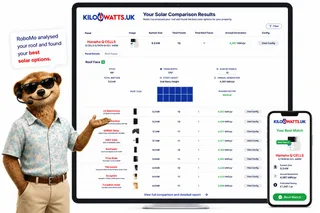
Compare top solar panels for the best performance and value.

Simple, fast & effortless
Provide a few details, sit back and watch your results unfold.
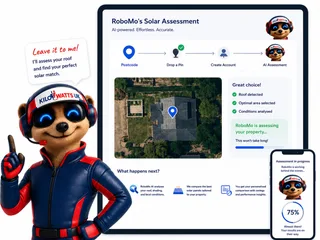
STEP 1
Choose Home, Business or Industrial
Enter your postcode to start your assessment.
STEP 2

Drop a pin on your roof
STEP 3

Create your free account
STEP 4

Sit back and watch RoboMo™ work
RoboMo™ analyses your roof and builds your personalised solar comparison.

Kilowatts UK is an authorised representative
Flower Turbines
Compact vertical-axis turbines built for real UK sites, not just open farmland.
They start in light wind, sit in a small footprint, and are bird-safe by design. Cluster them as a bouquet and the group performs better together than the same turbines standing alone. Enter your postcode for a location-based generation estimate. Figures use area weather data and will differ if buildings, trees or hills sit in the way.
Starts in light UK wind
Built to generate in typical UK wind, not only open farmland.
Small rooftop or ground footprint
Compact towers for roofs, yards and tight sites.
Bird-safe slow rotation
Slow vertical-axis spin, bird-safe by design.
Bouquet clusters raise output
Grouped turbines outperform the same units standing alone.
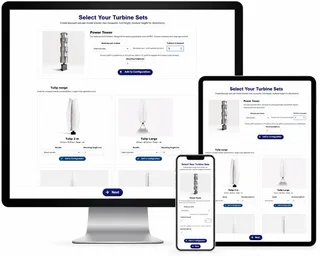
Step 1
Enter your postcode
Start designing your wind energy system in seconds.
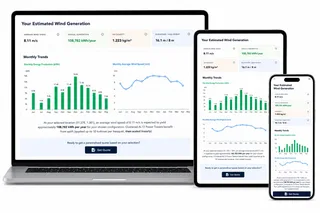
STEP 2

Choose a location
STEP 3

Place your cluster
Tap the map where you want the turbine cluster to go.
STEP 4

Instant generation forecasts
Compare different turbine layouts and see annual generation forecasts instantly.
STEP 5

No commitment required
Explore different configurations before deciding whether to request a quotation.
Related articles
Mo's Mission Nominations
FAQ
Need Help? RoboMo's Got Answers
Should UK businesses generate their own electricity?
UK businesses should consider generating their own electricity if they have suitable premises, steady electricity demand and long-term control of the site. For many companies, the main benefit is not going fully off-grid, but reducing the amount of electricity bought from the grid at commercial import rates. On-site generation can improve cost control, reduce exposure to market volatility, support carbon targets and improve resilience when designed properly.
Does generating your own electricity mean going off-grid?
No. For most UK businesses, generating their own electricity means partial energy independence, not disconnecting from the grid. The grid usually remains necessary for night-time demand, winter use, maintenance periods and unusually high loads. A practical goal is to reduce avoidable imports and make part of the business’s electricity supply depend on an asset it controls.
Why is solar PV usually the first option for businesses?
Solar PV is often the first technology to assess because it is proven, modular and well suited to many commercial buildings with roof or land space. It works particularly well where a business uses electricity during daylight hours, such as offices, warehouses, factories, farms, cold stores, schools, retail units and leisure facilities. Solar panels generate from daylight rather than heat, so UK conditions can still be suitable even though output is lower in winter and on cloudy days.
Is on-site generation mainly about saving money or reducing carbon?
It can do both, but the strongest business case is usually based on reducing imported electricity at commercial rates. Carbon reduction, ESG reporting and customer or procurement requirements can add value, but they should not replace proper financial modelling. A project should be assessed against real electricity use, expected self-consumption, export assumptions, maintenance costs, roof condition and grid connection requirements.
How much can a commercial solar PV system save?
Savings depend on how much generated electricity the business uses on site, the import electricity rate, the export rate, system size, installation cost and maintenance requirements. Commercial solar payback can often be around 4 to 8 years where daytime self-consumption is high and the site is straightforward, but it can be longer where export is high, electricity rates are lower, finance costs are significant, the roof is complex or grid works are needed.
Is a bigger solar system always better?
No. A larger system can look attractive, but it may export too much electricity at a lower value or be limited by the local grid connection. The best system is usually the one that matches the site’s demand profile, roof condition, electrical infrastructure and long-term plans. A well-sized system with high self-consumption can outperform a larger installation that produces surplus electricity the business cannot use effectively.
What data is needed before sizing a system?
A business should ideally provide at least twelve months of half-hourly electricity consumption data. This shows when electricity is actually used, including daytime demand, weekend shutdowns, seasonal changes, night loads and peak periods. Annual kWh figures from bills are useful, but they are not enough to design a strong commercial system because timing is critical to self-consumption and savings.
Are batteries always worth adding to business solar?
No. Batteries can be useful where they increase self-consumption, reduce peak imports, support EV charging or provide backup for specific critical loads. However, they add cost, space requirements, fire safety considerations and operational complexity. A battery should be included only where there is a clear purpose and the financial or operational benefit justifies the extra investment.
Will solar panels keep a business running during a power cut?
Not automatically. Standard grid-connected solar PV systems shut down during a power cut for safety reasons. Backup power requires suitable islanding equipment, protection design and a decision about which loads are essential. Supporting selected circuits, such as refrigeration, servers, tills, security systems or communications equipment, is usually more practical than trying to back up an entire site.
What site checks are needed before installing commercial solar?
Important checks include roof condition, structural capacity, roof warranty, shading, access, asbestos risk, switchgear, cable routes, metering, communications, fire safety, insurance requirements and maintenance access. Businesses should also check whether planning restrictions apply, whether the building is leased and whether landlord consent or lease amendments are needed.
Does a business need grid approval for on-site generation?
In many cases, yes. Distribution Network Operators need to know when generation is connected to their network, and approval requirements depend on system size, export arrangements and local network conditions. Larger systems normally need G99 approval. Export limits or network reinforcement costs can affect system design, so grid connection should be checked early.
Should export income be part of the business case?
Export income can help, but it should usually be treated as a secondary benefit. The economics of commercial solar are normally strongest when the business uses the generated electricity on site and avoids buying power at the full delivered import rate. A project that depends mainly on export income may be less robust unless the export agreement is strong and the risks are understood.
What should leased businesses consider before installing solar?
Tenants should check lease length, landlord consent, roof rights, maintenance responsibilities, ownership of the system, insurance obligations and what happens if the business moves. If the lease is shorter than the expected payback period, the project may be harder to justify unless there is a clear agreement for transfer, compensation or continued use of the system.
When might generating electricity on site not be suitable?
On-site generation may not be suitable where a site has low daytime demand, heavy shading, a weak or ageing roof, short lease term, planned redevelopment, poor grid connection options or unresolved landlord restrictions. It may also be less attractive if electricity prices are already low, capital is needed elsewhere or the proposal relies heavily on optimistic export income.
What should a business check before committing to a project?
A business should review half-hourly electricity data, current tariffs, export assumptions, roof condition, structural capacity, grid approval, insurance requirements, planning constraints, maintenance costs, inverter replacement, warranties and future electricity demand. Planned EV charging, heat pumps, new machinery or process electrification should be modelled before the system size is finalised.