


Commercial EV Charging with Solar Panels: Costs, Load
Published: 2026-11-26 04:11:18
Updated: 2026-11-25 20:12:10
Plan commercial EV charging with solar panels for your UK site. Estimate installation costs and see how load management shares power across bays.
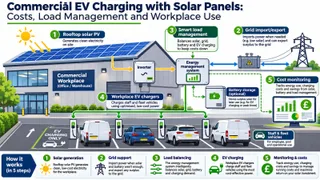
Can commercial EV charging work with solar panels?
Yes. Commercial EV charging can use electricity from solar panels connected to the same site supply. It works best when vehicles are plugged in while the panels generate more power than the building needs. The grid can cover shortfalls, and dynamic load management can share the available power across bays. Installation costs depend on charger ratings, cable routes, groundworks and the capacity of the existing supply.
Start with how much energy each vehicle needs by departure. Compare those charging windows with half-hourly site demand and expected solar output before choosing the number of bays, charger ratings or battery size.
How much solar power can your vehicles use?
A site can generate as much electricity as its EVs use over a year and still import most of its charging electricity. A depot that exports at midday and plugs in its vans after dark has little overlap between generation and charging. An office with cars parked through the middle of the day can use more solar directly, although heating, cooling or machinery may already use much of the output.
Ask for a solar estimate based on your postcode, usable roof area, orientation, pitch and shading. Check the roof’s condition and structural capacity, along with any landlord consent, before settling on an array size. Compare expected generation with half-hourly electricity use across seasons. If you already have panels, match inverter generation readings to metered import and export readings for the same periods where available. Import readings alone can understate site demand because electricity generated and used on site bypasses the import meter.
The array’s kilowatt-peak rating (kWp) describes its rated output under standard test conditions. Kilowatts (kW) measure power at a given moment, and kilowatt-hours (kWh) measure energy over time. A vehicle drawing 7 kW continuously for three hours takes 21 kWh at the charge point. Charging losses reduce the amount that reaches the battery.
Which chargers suit staff, fleets and visitors?
Choose charger power based on how long vehicles park and how much energy they need by departure. Workplace AC charge points commonly come in 7, 11 and 22 kW ratings. The power a vehicle draws depends on its onboard AC charging limit, the power available on the phases it uses and any limits set by the charging controller. A higher-rated socket offers little benefit to a car that already reaches its onboard limit on a lower-rated one.
Overview
Decide who can use the chargers before specifying payment and access controls. GOV.UK’s *Public Charge Point Regulations 2023 guidance* distinguishes bays reserved for staff or fleet use from customer charging, which can fall within scope even on private land or during restricted opening hours. If customers can use the bays, check which pricing and payment requirements apply and establish who will act as the charge point operator.
How does load management affect how many EVs can charge?
Dynamic load management adjusts the power available to chargers as demand elsewhere on site changes. When machinery or other large loads switch on, the controller can reduce EV charging. When demand falls, it can allocate more power to the bays. This can support more sockets on an existing supply if vehicles can still get the energy they need before departure.
Consider three vans on 7 kW AC bays at a depot with 14 kW available for charging from 16:00 to 19:00, even on a dull day. Van A parks from 16:00 to 17:00 and needs 7 kWh. Van B parks from 16:00 to 18:00 and needs 14 kWh. Van C arrives at 16:30, leaves at 19:00 and needs 14 kWh. All targets are measured at the charge point and already allow for charging losses.
Give A and B 7 kW each from 16:00 to 17:00. A reaches 7 kWh by departure, and B receives its first 7 kWh. Give B and C 7 kW each from 17:00 to 18:00. B leaves after receiving 14 kWh, and C reaches 14 kWh after another hour at 7 kW. Sharing the power equally among all three vans from 16:30 would leave A with only about 5.8 kWh by 17:00, even though the site has enough energy across the full window. The schedule assumes each van can sustain 7 kW when allocated. A and B have no spare time, so test late arrivals, lower charging power and unexpected site loads before relying on it. Ask whether the controller can prioritise departures while following surplus solar and draw from the grid when waiting for sunshine would leave a vehicle short. Have the installer verify the agreed import capacity, switchboard rating, loading on each phase and any export limit. Ask them to demonstrate what happens if the controller loses its meter signal or communications. Confirm the connection route with your distribution network operator (DNO) before ordering equipment, especially if the project adds solar or storage. The Energy Networks Association’s *Electric Vehicle Chargepoint and Heat Pump Combined Installation Process Flow Chart* explains when installers need to notify the DNO and when they need to apply before connection. UK Power Networks also publishes commercial EV connection guidance for sites in its area that need a new or upgraded supply.
When is a battery worth considering?
A battery is worth modelling if you regularly have spare solar at midday and vehicles need to charge later. It can also help cover a short charging peak if it stores enough energy and can discharge fast enough. Usable capacity in kWh determines how long the battery can help. Discharge power in kW limits how much charging demand it can cover at once.
Compare the same vehicle timetable with and without battery storage. Use the same import tariff and export assumptions, and account for round-trip losses, usable capacity, warranty throughput limits and any savings from reducing a billed demand peak. If vehicles already spend most of the working day on site, test how much extra solar they could use by shifting charging into daylight before adding storage to the proposal.
What affects the installed and running costs?
As a UK budget reference for November 2026, installer Electric Car Chargers UK gives an indicative pre-grant range of £2,500 to £3,500 for two wall-mounted 7 kW AC units serving two bays on short cable runs, including installation and commissioning. For budgeting, assume a suitable existing distribution board, short final circuits with protection, and no trenching or resurfacing. The guide leaves VAT treatment unspecified. If the range excludes VAT and standard-rate VAT applies, allow £3,000 to £4,200 including VAT. Confirm the scope and VAT basis in the written quote.
The same installer gives a pre-grant range of £10,000 to £16,000 for a business or warehouse car park with four 22 kW pedestal chargers, trenching and load management. The guide leaves resurfacing and supply upgrades unitemised. Ask bidders to price hardware, electrical works, civils, commissioning and recurring fees separately. If you expect to add bays, ask for prices for spare duct capacity and switchboard provision during the first survey.
For running costs, suppose the charge points deliver 100 kWh in a day. On-site solar supplies 40 kWh that would otherwise earn 8p/kWh on export. At an assumed import price of 25p/kWh, grid-only charging would cost £25. With solar, imports cost £15 and forgone export income comes to £3.20. The combined energy cost is £18.20, a saving of £6.80. At an import rate of 15p/kWh, the same mix costs £12.20, compared with £15 for grid-only charging, reducing the saving to £2.80. If the surplus would earn nothing on export, the saving at the 25p import rate rises to £10. These rates are illustrative. Use your contract rates for the hours when vehicles charge and include any software, connectivity, maintenance and demand-related charges. If staff pay for charging or fleet teams need to allocate costs, check whether the platform can export metered energy data by session, user or vehicle. If the project includes a new array, factor your solar finance options into the budget.
What should you ask a commercial EV charging installer?
Share a site plan, details of any existing solar panels and a realistic charging schedule. Include a year of half-hourly electricity data if available. For fleets, give arrival times, departure deadlines and the energy needed for the next route. Ask the installer to survey the switchboard, cable routes, parking layout and communications coverage before finalising the design.
Give each bidder the same busy-day scenario. Ask them to show how much energy each vehicle can receive by departure, how much charging could come from solar over the year and what happens when site demand peaks. The proposal should say who handles the DNO process, what it assumes about the existing supply and which costs depend on the survey.
Solar comparison
Compare solar for your property
Enter your postcode to assess your roof, compare solar options and get quotes from UK installers.
- Free postcode start
- Home, business and industrial
- RoboMo™ maps your roof
See which panels fit your roof
Choose home, business or industrial, then enter your postcode. RoboMo maps the roof and ranks panel brands by fit.
1. Postcode Start the assessment for your property.
2. Pin the roof Mark the array on the map.
3. Compare RoboMo™ builds your options.

Battery ROI tool
See what a battery saves on your bill
Enter the day rate, off-peak rate and export rate. The calculator ranks batteries in the Kilowatts shop over 10 years. Home batteries also suit offices and small commercial sites.
Reading
Sources and further reading
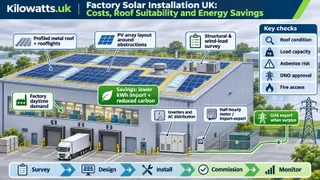
Assess roof suitability and budget for a UK factory solar installation. See how production shifts and grid export limits affect electricity savings.
Read article
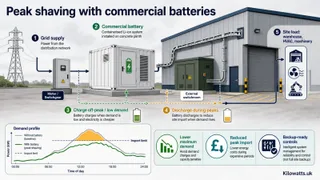
See when peak shaving with commercial batteries can cut UK capacity and excess charges, and why kVA, half-hourly data and reserve energy decide the result.
Read article
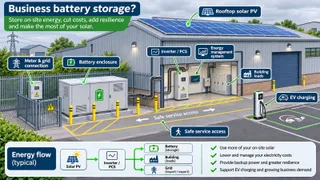
See how tariffs and charging losses affect business battery storage payback, with a worked example and checks for comparing UK installation quotes.
Read article
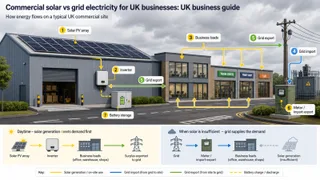
Commercial solar does not replace grid electricity for UK businesses. It cuts imported units when daytime demand matches generation, not standing charges.
Read article



Mo's Solar Mission
Mo's Mission Nominations
Garlinge Primary School and Nursery
Garlinge Primary School and Nursery is a foundation primary school on Westfield Road in Margate, Kent, for children aged 3 to 11. It is m...
St Luke's Church of England Primary SchoolSt Luke's Church of England Primary School is a voluntary controlled Church of England primary school on Jubilee Road in Formby, Merseysi...
Comberbach Nursery and Primary SchoolComberbach Nursery and Primary School is a primary academy on Mather Drive in the village of Comberbach, near Northwich in Cheshire, for...
Locations
Solar installation near you
Write for Kilowatts.uk
Got a trade and something worth saying?
Write it here under your own name. Sign in, put a profile up, and start a guide. Pay only if you want more links from your articles out to your own site.
Register
Create a Kilowatts.uk account, or sign in if you already have one.
Author profile
Put your name, photo and experience on a public author page.
Start creating
Write a guide or a blog. Free authors can put one followed link to their own site in articles each month.
FAQ
Need Help? RoboMo's Got Answers
Can workplace EV chargers run on solar panels and grid electricity?
Yes. Chargers can use solar electricity generated on the same site while vehicles are plugged in. The building may use some of that generation, and the grid can make up any shortfall. Compare expected solar output, site demand and vehicle parking times across the seasons to estimate how much charging solar could cover.
What affects the cost of installing commercial EV charge points?
The number and rating of the charge points, cable routes, groundworks and the condition and capacity of the existing electrical supply all affect the installed cost. Ask for an itemised quote covering hardware, electrical works, commissioning and any supply upgrade. Check the VAT basis and budget separately for recurring software, connectivity and maintenance fees.
Can load management help us install more chargers on our existing supply?
Dynamic load management adjusts charging power as the building's electricity demand changes. It can support more bays if vehicles still receive enough energy before they leave. Ask the installer to check the site's supply and phase limits and test a busy day with low solar generation.
What charging speed do staff, fleet vehicles and visitors need?
Start with how long vehicles are parked and how much energy they need before departure. Staff cars parked all day can often charge at a lower power, while fleet vans with tight turnarounds and visitors making short stops may need more power. Check each vehicle's AC charging limit before paying for a higher-rated charge point.
Should we add a battery to charge vehicles after sunset?
A battery is worth modelling if you regularly have surplus solar during the day and vehicles mainly charge later. Compare the same charging schedule with and without storage, using your import and export rates and allowing for battery losses. Check whether the battery can store enough energy and discharge fast enough to meet your charging needs.
How much could solar panels save on workplace EV charging?
For each unit of solar electricity used for charging, compare the grid import cost you avoid with any export payment you give up. Use the rates that apply at the times vehicles charge and estimate how much surplus solar is actually available then. If you are installing new panels or a battery, include those costs when assessing the overall savings.
Can customers use the same charge points as staff?
Yes, if you set up access for both groups. Allowing customers to charge can bring the bays within public charge point rules, even on private land. Check the applicable pricing and payment requirements and agree who will operate the charge points before choosing a system.
What should we give an installer before asking for a quote?
Share a site plan, details of any existing solar panels and a year of half-hourly electricity data if available. For fleet vehicles, include arrival times, departure deadlines and the energy needed for each route. Ask the installer to show how the proposed system would perform on a busy day and confirm who will handle any notification or application to the distribution network operator.
Live help
Need help right now?
Talk to RoboMo™ and get instant answers.