


How much to install ev charging station?
Published: 2026-11-24 15:39:02
Updated: 2026-11-24 07:40:03
Compare UK EV charging station installation costs for homes, workplaces and public rapid sites. See how groundworks and grid upgrades affect your quote.
How much does it cost to install an EV charger in the UK?
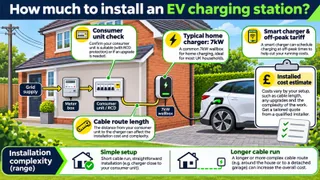
A typical home EV charger costs £800–£1,200 fitted before any grant, according to Energy Saving Trust. Blink Charging estimates £1,500–£4,000 for a single-socket workplace AC charger with standard installation and £15,000–£35,000 per installed 50 kW rapid charger. The cable route, groundworks and spare electrical capacity make the biggest difference to the cost of EV charger installation. A complete public rapid charging site needs a project quote. Energy Saving Trust home charging guidance · Blink Charging’s September 2026 cost guide
What makes a home EV charger installation more expensive?
A wall-mounted charger beside a driveway is often straightforward to fit if there’s a short, accessible cable route from the supply. A detached garage or a bay at the far end of the drive can mean more cable, a mounting post, digging and repairs to paving or tarmac. Ask the installer to mark the route and confirm how much cable the quote includes. Check that the charging lead reaches the car’s inlet from your usual parking spot, especially if two cars share the drive.
The installer should check the incoming supply, consumer unit, earthing and circuit protection. If you have a heat pump or other high-demand equipment, ask about dynamic load management. It reduces charging power when demand elsewhere rises. Check whether the car can still get the charge it needs in the time it’s usually parked. Ask whether your distribution network operator needs to approve the connection before installation or can be notified afterwards.
If you rent or use an allocated bay at a block of flats, find out who can approve the charger location, the cable route and access to the supply. If you park on the street, check whether your council allows cross-pavement charging and how reliably you can park within reach before paying for equipment. Energy Saving Trust home charging guidance
How much do workplace and public EV chargers cost?
Blink Charging’s September 2026 guide includes equipment and standard installation labour. Significant groundworks, supply upgrades and ongoing costs are priced separately. JPR Electrical’s 2026 UK guide gives a similar range for AC units and the same starting price for rapid chargers, covering units rated at 50 kW and above. Neither supplier specifies whether its figures include VAT. Blink Charging cost guide · JPR Electrical’s 2026 UK installation cost guide
Overview
For a public site, factor in the grid connection, trenching and reinstatement, bay layout, payment equipment, software and maintenance before setting a budget. For a workplace charging setup, ask whether the price is per unit or per socket. If you’re considering a dual-socket unit, check how much power each vehicle gets when both sockets are in use. Ask each supplier to show the price excluding VAT, the VAT amount and the total including VAT.
What charging speed is worth paying for?
Start with how much energy each vehicle needs in kilowatt-hours (kWh) and how long it will be parked. Divide the kWh by the available hours to get the average charging power in kilowatts (kW), then allow for charging losses and periods of reduced power. For a fleet, do the sums for the busiest return period and check which vehicles need to leave first. Sharing power across bays may let you get every vehicle ready for departure without a supply upgrade. Energy Saving Trust business charging guidance
A 22 kW AC chargepoint typically needs a three-phase supply. The car’s onboard AC charger may also accept less power than the chargepoint can deliver. Check both before paying for a higher-rated unit. At home, compare running costs separately from the fitted price. A smart charger can schedule sessions for cheaper tariff hours. The savings depend on how much charging you can fit into those hours. Energy Saving Trust smart charging guidance
Can a UK grant reduce the installation cost?
Under the rates in effect from 1 April 2026, eligible renters and flat owners can get 75% of eligible purchase and installation costs, capped at £500 for one socket. A separate scheme offers the same rate and cap to eligible households with on-street parking that meet the cross-pavement charging requirements. Funding for both schemes is confirmed until 31 March 2027. Renters and flat owners should get a quote from an OZEV-authorised installer, secure the required permissions and wait for the Office for Zero Emission Vehicles (OZEV) to confirm eligibility before work starts. GOV.UK grant for renters and flat owners · GOV.UK grant for households with on-street parking
The Workplace Charging Scheme covers up to 75% of eligible purchase and installation costs including VAT, capped at £500 per socket and 40 sockets across an eligible applicant’s sites. It is scheduled to run until 31 March 2027. Apply for the voucher before installation and check that the installer and chargepoint meet the scheme requirements. For any grant-funded installation, ask for the full price including VAT, the expected grant deduction and what you would owe if the grant is unavailable. OZEV’s April 2026 grant changes · GOV.UK Workplace Charging Scheme guidance
How to compare EV charger installers and quotes
Give each installer the same information. Send photos of the meter, consumer unit, proposed charger location and route to the parking space. For a workplace or depot, say how many bays you want to equip, when vehicles return and leave, and whether you plan to expand the fleet. If the route crosses shared land or you’re unsure how much spare electrical capacity you have, ask for a site survey before treating the quote as fixed.
Compare what each quote includes. Check the charger model, whether it comes with a charging lead, the cable allowance, mounting and electrical protection. Check whether the price covers trenching, reinstatement, commissioning and VAT. Ask who handles any network application and what electrical certification, warranty and aftercare you’ll receive. For commercial charging, ask for separate prices for software, payment processing and maintenance so you can compare ongoing costs alongside the fitting price.
Use the Kilowatts UK directory to shortlist EV chargepoint installers, then ask each for an itemised quote based on the same parking layout, cable route and charging needs. If you’re also considering other energy upgrades at home, you can book a home energy survey.
Solar comparison
Compare solar for your property
Enter your postcode to assess your roof, compare solar options and get quotes from UK installers.
- Free postcode start
- Home, business and industrial
- RoboMo™ maps your roof
See which panels fit your roof
Choose home, business or industrial, then enter your postcode. RoboMo maps the roof and ranks panel brands by fit.
1. Postcode Start the assessment for your property.
2. Pin the roof Mark the array on the map.
3. Compare RoboMo™ builds your options.

Battery ROI tool
See what a battery saves on your bill
Enter the day rate, off-peak rate and export rate. The calculator ranks batteries in the Kilowatts shop over 10 years. Home batteries also suit offices and small commercial sites.
Reading
Sources and further reading
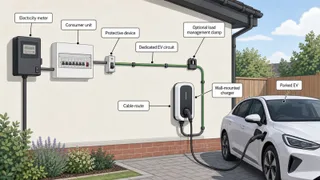
A simple budget installation may be closer to £700 to £1,000, while premium hardware or a more difficult property can push the total to £1,500 to £2,500+.
Read article

A rapid charger only delivers headline power while the pack is fairly empty. Here is why UK EVs taper charging, and why stopping earlier usually gets you home sooner.
Read article
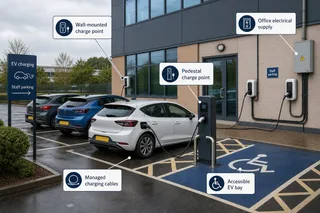
Workplace EV charging means EV charge points provided at an employer's premises for staff, fleet vehicles, visitors, or a mix of users.
Read article

Cold lithium cells accept charge slowly, so a rapid charger delivers less power on a frosty UK morning. Here is why preconditioning fixes it.
Read article



Mo's Solar Mission
Mo's Mission Nominations
Garlinge Primary School and Nursery
Garlinge Primary School and Nursery is a foundation primary school on Westfield Road in Margate, Kent, for children aged 3 to 11. It is m...
St Luke's Church of England Primary SchoolSt Luke's Church of England Primary School is a voluntary controlled Church of England primary school on Jubilee Road in Formby, Merseysi...
Comberbach Nursery and Primary SchoolComberbach Nursery and Primary School is a primary academy on Mather Drive in the village of Comberbach, near Northwich in Cheshire, for...
Locations
Solar installation near you
Write for Kilowatts.uk
Got a trade and something worth saying?
Write it here under your own name. Sign in, put a profile up, and start a guide. Pay only if you want more links from your articles out to your own site.
Register
Create a Kilowatts.uk account, or sign in if you already have one.
Author profile
Put your name, photo and experience on a public author page.
Start creating
Write a guide or a blog. Free authors can put one followed link to their own site in articles each month.
FAQ
Need Help? RoboMo's Got Answers
How much does it cost to install an EV charger at home in the UK?
Energy Saving Trust puts a typical fitted home EV charger at £800–£1,200 before any grant. A long cable run, digging up a driveway or electrical upgrades can increase the price. Ask for an itemised quote that shows the total including VAT.
Will I need an electrical upgrade to install a home EV charger?
It depends on your incoming supply, consumer unit, earthing and how much electricity your home uses at busy times. Ask your installer to check whether dynamic load management could help by reducing the charger’s power when demand elsewhere in the house rises. The installer should also confirm whether your electricity network operator needs to approve the connection in advance or can be notified afterwards.
Is a 7 kW home charger fast enough, or should I pay for 22 kW?
A 7 kW charger can deliver about 28 kWh in four hours at full power before charging losses. Compare that with the energy you typically need to replace and how long your car is parked at home. A 22 kW AC charger typically needs a three-phase supply, and your car must support 22 kW AC charging to use the full output.
Can I install an EV charger if I rent, live in a flat or park on the street?
If you rent or use a bay in a shared car park, check who can approve the charger location, cable route and connection to the electricity supply. Depending on the property, that may be your landlord, freeholder or managing agent. If you park on the street, check whether your council permits cross-pavement charging and whether you can regularly park within reach.
Can I get a grant towards EV charger installation?
Some renters, flat owners and households with on-street parking may qualify for help with the cost. Check the current GOV.UK eligibility criteria and application steps for your circumstances before installation. Ask your installer to show the full price including VAT, the expected grant deduction and what you would pay if the grant is unavailable.
What should I check when comparing EV charger installation quotes?
Give each installer the same details about your parking space and proposed cable route. Compare the charger model, cable allowance, electrical protection and whether the total includes VAT. If digging is needed, check who will make good the paving or driveway, and ask what certification and warranty you’ll receive.
How much does it cost to charge an EV at home after installation?
Multiply the electricity drawn from the supply in kWh by your tariff’s unit rate. A smart charger can schedule charging for cheaper hours if your tariff offers them. When estimating savings, check how much of your usual charge fits into those hours and allow for charging losses.
Live help
Need help right now?
Talk to RoboMo™ and get instant answers.