


Allye's Battery-Buffered EV Charger Promises 300kW From a Small Depot Supply - Check the Maths
Published: 2026-11-24 10:29:19
Updated: 2026-11-24 02:30:21
See whether Allye’s MEV300 EV charger can meet your UK fleet’s charging needs on a 63 A depot supply, and how battery recharge limits shape each shift.
Overview
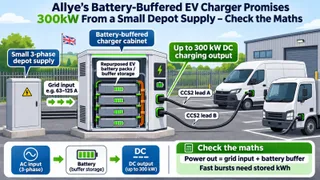
Create a landscape technical illustration of battery-buffered EV charging at a UK fleet depot. In the first panel, show spare capacity from the depot’s three-phase supply refilling repurposed EV battery packs inside a plinth-mounted charger cabinet. In the second panel, show stored energy flowing from the cabinet to two parked fleet vans through CCS2 leads labelled “Shared DC output”. Use clear directional arrows, a white background and a restrained colour palette. Omit logos, watermarks and interface screenshots.
Can the Allye MEV300 deliver 300 kW from a small depot supply?
Allye rates its MEV300 battery-buffered EV charger at up to 300 kW of DC output. The depot supply recharges the onboard battery, which supplies the extra power for rapid charging. Whether the charger reaches 300 kW, and how long it can hold that output, depends on the charge left in the buffer, the charger’s operating limits and how much power the vehicles can accept. Over a full shift, the number of vehicles it can charge also depends on the depot’s spare import capacity and when the buffer can refill. Allye MEV300 specification
Allye lists 232 kWh of battery capacity for the MEV300 and rates the MEV200 at up to 200 kW. The range uses repurposed EV battery packs and lists a 16–125 A three-phase input range, with a single-phase option. As with other commercial battery storage systems, usable capacity and recharge rate matter when sizing the installation. Ask Allye how much of the MEV300’s battery capacity is usable, how fast it can recharge on your supply and under what conditions it can sustain peak output. Allye MEV range
What can a 63 A three-phase supply deliver over a shift?
At a nominal 400 V, a balanced 63 A three-phase supply provides about 43.6 kVA. At unity power factor, that is about 43.6 kW, or 349 kWh over eight hours at full current. That is the upper limit before conversion losses and other site loads. If 63 A is the rating for the entire depot, the charger can draw only what the rest of the site leaves available.
Allye estimates that seven to ten vehicles could each take 55–70 kWh over eight hours on a 63 A supply. Seven sessions at 55 kWh need 385 kWh, so the buffer must start the shift with energy already stored. Ten sessions at 70 kWh need 700 kWh. Adding the MEV300’s full listed battery capacity of 232 kWh to 349 kWh of grid input gives about 581 kWh. Even that ceiling assumes the full battery capacity is available at the start, the charger can draw the full current throughout and there are no losses. Allye’s depot throughput estimate
Suppose the depot can spare 30 kW continuously for eight hours. That gives 240 kWh of grid input. If the buffer has 200 kWh of usable capacity above its reserve and starts the shift at 75% of that usable range, it has another 150 kWh available. If 90% of the energy from each source reaches the vehicle connectors, the charger delivers about 351 kWh. That leaves seven 55 kWh sessions 34 kWh short, even if the schedule allows the charger to use all eight hours of grid input and draw the buffer down to its reserve. For a quote, ask the supplier to model losses on each path, including when grid energy passes through the buffer before reaching a vehicle.
How fast will vehicles actually charge?
Allye lists up to 300 kW for a suitable 800 V vehicle and about 160 kW for a 400 V vehicle on the MEV300. The two CCS2 connectors share the cabinet’s available output. Each vehicle’s charging curve affects the rate it can accept. A cold battery or one close to its target charge may draw considerably less power than the charger can supply. Allye MEV300 charging specifications
Build the schedule around when each vehicle arrives, how much energy it needs and when it must leave. If two vans return together before a second shift, ask how the charger splits power and whether it can prioritise the van due out first. Ask for a model that shows output at each connector and the buffer’s state of charge over time, including when it reaches its reserve. Run it over consecutive busy days to see whether the buffer recharges enough overnight for the next morning.
When does battery-buffered rapid charging make sense for a UK depot?
Battery buffering suits a return-to-base fleet with short charging windows and quieter periods when the buffer can refill. If most vehicles park for several hours, managed lower-power charging may meet the same departure targets. A depot that needs rapid charging across successive shifts may need more import capacity if there is little time to recharge the buffer.
Overview
Allye reports that J&M Murdoch’s Glasgow depot uses a MAX300 on a 32 A supply to buffer separate DC chargers. The case study describes that installation without publishing session-level energy or power figures for the MEV300. Ask for metered results from an MEV300 installation with a similar supply, vehicle mix and turnaround schedule. Look for site import, energy delivered per vehicle, sustained output and buffer charge at the start and end of the shift. Allye’s J&M Murdoch depot case study
What should the installer and network operator check?
Start with the site’s agreed import capacity and half-hourly meter readings from representative working days. Ask the installer to check shorter demand peaks and current on each phase. The busiest phase can limit what a balanced three-phase charger can draw, even when the total load looks manageable. The chargepoint installation survey should also cover the main switchboard, spare ways, cable routes, lifting access, vehicle turning space, connector reach and impact protection around the plinth. GOV.UK guidance on connecting EV chargepoints
Confirm the connection route with the local distribution network operator before ordering. Give the installer the proposed operating modes and details of any existing solar or battery storage. National Grid Electricity Distribution’s storage guidance covers the G99 application route for export-capable storage and G100 export limitation schemes where applicable. Ask your local operator which requirements apply, including any export cap or zero-export setting, and get them in writing. Check planning requirements separately for the proposed location. National Grid Electricity Distribution guidance on connecting storage National Grid Electricity Distribution guidance on export limitation
What does the Allye MEV cost and what should a quote cover?
Allye advertises the MEV range from £70,000 excluding VAT, depending on specification, and quotes separately for leasing. The supplier expects deliveries from Q2 2027. Confirm the price and availability of the MEV300 configuration you need. Ask for an itemised quote covering the plinth, cabling, switchboard work, commissioning, any network work and ongoing support. If the fleet relies on remote operation, check whether the charger can integrate with the site’s energy management system. Confirm who can change charging schedules, who gets fault alerts and how the charger behaves if the connection drops. Allye MEV pricing and delivery information
For the second-life battery packs, ask what usable capacity the warranty covers, how capacity loss is measured and who pays for replacement packs and labour. Compare the ownership costs of all three charging approaches using the same fleet timetable and tariff. Include conversion losses, software and maintenance charges, any changes to import capacity charges and the cost of any network works. If solar is part of the depot upgrade, use the fleet timetable when you compare solar installation quotes to assess how much generation could be used on site.
Give installers a representative week of meter readings, vehicle arrivals, departures and required top-ups. Ask each to show which vehicles would have enough charge to leave on time on consecutive busy days. Use the same schedule to agree a commissioning test with measurable targets for energy delivered and buffer recovery.
Solar comparison
Compare solar for your property
Enter your postcode to assess your roof, compare solar options and get quotes from UK installers.
- Free postcode start
- Home, business and industrial
- RoboMo™ maps your roof
See which panels fit your roof
Choose home, business or industrial, then enter your postcode. RoboMo maps the roof and ranks panel brands by fit.
1. Postcode Start the assessment for your property.
2. Pin the roof Mark the array on the map.
3. Compare RoboMo™ builds your options.

Battery ROI tool
See what a battery saves on your bill
Enter the day rate, off-peak rate and export rate. The calculator ranks batteries in the Kilowatts shop over 10 years. Home batteries also suit offices and small commercial sites.
Reading
Sources and further reading
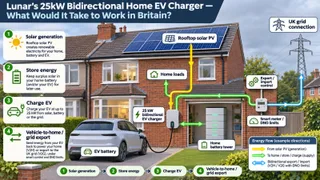
Could Lunar’s 25 kW bidirectional EV charger work at your UK home? See how your car, electricity supply and export limits could affect what it can do.
Read article

UK home EV chargers need roughly six amps - about 1.4 kW - before a session can start. Here's why small solar surpluses export instead of charging.
Read article
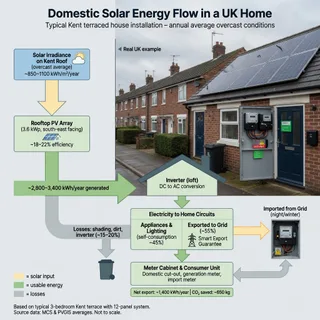
A UKPN grid connection for Kent solar is G98 or G99 permission to run in parallel, not a tariff or planning decision. Check the DNO, MPAN and export cap.
Read article
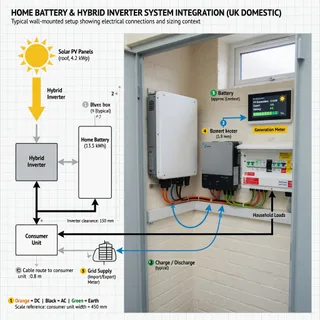
What battery do I need depends on usable kilowatt-hours you can shift, inverter power, and whether the charge window and connection can fill it.
Read article






Mo's Solar Mission
Mo's Mission Nominations
Garlinge Primary School and Nursery
Garlinge Primary School and Nursery is a foundation primary school on Westfield Road in Margate, Kent, for children aged 3 to 11. It is m...
St Luke's Church of England Primary SchoolSt Luke's Church of England Primary School is a voluntary controlled Church of England primary school on Jubilee Road in Formby, Merseysi...
Comberbach Nursery and Primary SchoolComberbach Nursery and Primary School is a primary academy on Mather Drive in the village of Comberbach, near Northwich in Cheshire, for...
Locations
Solar installation near you
Write for Kilowatts.uk
Got a trade and something worth saying?
Write it here under your own name. Sign in, put a profile up, and start a guide. Pay only if you want more links from your articles out to your own site.
Register
Create a Kilowatts.uk account, or sign in if you already have one.
Author profile
Put your name, photo and experience on a public author page.
Start creating
Write a guide or a blog. Free authors can put one followed link to their own site in articles each month.
FAQ
Need Help? RoboMo's Got Answers
Can the Allye MEV300 really deliver 300 kW from a small depot supply?
Allye rates the MEV300 at up to 300 kW of DC output. Its onboard battery stores energy from the depot supply and provides extra power during rapid charging. How long it can sustain peak output depends on the usable energy in the buffer, the charger’s operating limits and how much power the vehicle can accept.
How many vans could a 63 A three-phase supply charge in an eight-hour shift?
A balanced 400 V, 63 A three-phase supply can provide about 349 kWh over eight hours at full current and unity power factor, before losses and other depot loads. Seven 55 kWh top-ups require 385 kWh, so the buffer would need to start the shift with energy already stored. Ten 70 kWh top-ups would require 700 kWh, above the theoretical ceiling of about 581 kWh even if all 232 kWh of listed battery capacity were available at the start and there were no losses.
Can two vans charge at the same time, and how fast will each charge?
The MEV300 has two CCS2 connectors that share the cabinet’s available output. Allye lists up to 300 kW for a suitable 800 V vehicle and about 160 kW for a 400 V vehicle. Actual power depends on how the charger splits its output and what each van can accept at its battery temperature and state of charge. Ask whether the charger can prioritise the van with the earliest departure.
How long does the MEV300’s battery buffer take to refill?
Replacing 150 kWh at a steady 30 kW would take five hours before losses. The actual time depends on the depot’s spare import capacity, the charger’s recharge limit and how much energy the buffer needs. Ask the supplier to model consecutive busy days, including overnight recovery, using your depot’s meter readings and vehicle timetable.
When is battery-buffered rapid charging worth considering?
It can suit a return-to-base fleet that needs quick top-ups and has quieter periods when the buffer can refill. If vans are parked for several hours, managed lower-power chargers may deliver enough energy before departure. If rapid sessions continue across successive shifts with little recovery time, check whether the depot needs more import capacity.
What should the installer and local network operator check before I order?
Ask the installer to verify the site’s agreed import capacity and measure spare capacity on each phase during representative working days. The survey should also cover the switchboard, cable routes, vehicle access and protection around the charger. Confirm the connection route with your local distribution network operator and explain whether the system can export or will operate alongside existing solar or battery storage.
What should an MEV300 quote and battery warranty cover?
Ask for an itemised quote for the exact configuration, including installation, commissioning, any network works, software and ongoing support. Check what usable capacity the warranty covers for the repurposed battery packs, how it measures capacity loss and who pays for replacement packs and labour. Agree a commissioning test using your fleet timetable, with measurable targets for energy delivered before departure and how much the buffer recovers between shifts.
Live help
Need help right now?
Talk to RoboMo™ and get instant answers.