


Lunar's 25kW Bidirectional Home EV Charger - What Would It Take to Work in Britain?
Published: 2026-11-23 19:42:51
Updated: 2026-11-23 11:43:52
Could Lunar’s 25 kW bidirectional EV charger work at your UK home? See how your car, electricity supply and export limits could affect what it can do.
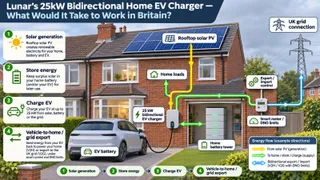
Could Lunar’s 25 kW bidirectional EV charger work in Britain?
Lunar’s 25 kW bidirectional EV charger could work in Britain if Lunar releases a UK version, confirms which cars can discharge through it and supplies equipment suitable for connection to the local electricity network. Lunar’s US announcement targets mid-2027 for the Fast Charger and gives no UK launch date or installed price. For a British buyer, the decision would come down to the charging rate the system can sustain, the capacity of the incoming supply and whether backup or paid export is available. Lunar Energy’s product announcement
How the Lunar Fast Charger connects to the home battery
A conventional home AC chargepoint supplies alternating current, which the car’s onboard charger converts to direct current for the battery. The Lunar Fast Charger connects to the DC side of Lunar’s next-generation home battery system and supplies DC directly to the car. A compatible car can also send energy back through the same connection. The system inverter converts DC to AC for household circuits.
Lunar specifies a 13.4 kW inverter and 10–30 kWh of storage per battery tower. The kW figures measure power at different points in the system. The kWh figure measures stored energy. A UK quote should show the sustained EV charging rate, maximum grid import, backup output and agreed grid export limit separately. Ask how much energy the home battery can supply to the car after allowing for any backup reserve. Lunar Energy’s system specifications
How much charging power could a UK driveway support?
Lunar’s 25 kW figure is the peak DC charging rate into the car. The actual rate depends on how much power the car can accept and how much the system can supply at the time. A cold or nearly full EV battery can reduce the rate. Ask what the system can sustain over your usual charging window when the home battery is low or solar generation drops.
An installer would check whether the supply is single-phase or three-phase, how much power it can deliver, the condition and capacity of the consumer unit, and what else is likely to be running while the car charges. The home battery could supply some of the power for a short burst of charging if the system is designed for it and the battery has enough usable energy. Ask how fast the car could charge if an electric shower or heat pump is already running and the property reaches its grid import limit.
If you already have solar panels, give the installer the inverter model and details of any export limit. Ask whether you can keep the AC inverter, how much surplus solar the new system could use and what equipment would need replacing. If the car is usually away during daylight hours, check how much surplus the home battery could store until the car returns. The same questions apply when adding storage to existing solar.
What would the DNO need to assess?
In Great Britain, the distribution network operator, or DNO, assesses equipment that can discharge in parallel with the public network. The Energy Networks Association’s standard G98 route generally applies if the generating equipment is fully type-tested to G98 and the aggregate registered capacity at the premises is 16 A per phase or less. On a single-phase supply at 230 V, that is about 3.68 kW. The installer needs to include existing grid-connected solar and battery equipment where applicable and check the type-test evidence for the equipment that connects to the grid. If the proposal falls outside G98, the installer should confirm the applicable G99 process with the DNO before installation. GOV.UK guidance on connecting energy devices and vehicle-to-grid equipment
A G100 export limitation scheme can keep net export at the property’s connection point within a limit agreed by the DNO. The DNO still assesses the aggregate registered capacity, even with an export cap of 16 A per phase. Ask the installer to document both figures and confirm which connection route the DNO requires.
Which cars could power the home or export to the grid?
The car would need explicit support for discharging through the Lunar Fast Charger, even if the plug fits and the car accepts DC charging. Before buying, ask for confirmation covering the exact UK model, model year and software version. If you plan to use both home backup and grid export, check the vehicle warranty terms for each. GOV.UK guidance on vehicle-to-grid compatibility
Vehicle-to-home, or V2H, uses energy from the car to power circuits at the property. Backup during a power cut requires equipment that can isolate those circuits from the public network. Ask which circuits stay live, how much power they can draw together and whether your solar panels can keep generating in backup mode. Estimate how long the backup could last from the energy available above your driving reserve and the loads you plan to keep on. A fridge, lights and broadband equipment will generally use less energy during an outage than electric cooking or heating.
Vehicle-to-grid, or V2G, sends energy to the public network. For paid export, ask the supplier whether its current terms cover your vehicle and charger, your meter setup and the source of the exported energy. If you already receive solar export payments, check how adding EV discharge would affect them. Compare what the tariff pays with what it costs to recharge the car, allowing for conversion losses and the charge you need to keep for driving.
What should the app let you control?
Lunar says its software will co-ordinate charging for the car and home battery around household demand and electricity costs. Ask whether it can get your car to the charge you need by departure time, stay within the property’s import limit and retain the reserves you set for driving and backup. Check which UK smart tariffs it can schedule around, what you can override and which settings still work if broadband drops. Lunar Energy’s description of automated charging
Ask for a demonstration. If the cheap-rate window is about to end, the home battery is low and the car needs a top-up before an early departure, which gets charged first? At a small business, check who can override the schedule for a van leaving early and whether the site’s import limit still applies during the override.
When could it justify the extra installation cost?
At a steady 7 kW, a 28 kWh top-up takes about four hours before charging losses. Allow extra time if you need the full 28 kWh in the battery. A conventional smart home chargepoint may already cover that top-up if the car is parked overnight. A van that needs the same energy during a two-hour stop would have to average 14 kW into its battery. Compare that requirement with the rate the Lunar system can sustain for your vehicle and site, given how much charge the home battery is likely to have when the van arrives.
Overview
For a flat or shared car park, establish who controls the parking bay and electricity supply, where the cable can run and whose permission you need. At a small business, compare the time vehicles spend parked with the building’s busiest periods for electricity use. A van returning between routes may need its fastest top-up just as demand in the building peaks.
If a UK version launches, ask for an itemised quote covering the charger, battery and inverter, cable route, any supply or consumer unit work, backup equipment and network application work. Confirm who handles warranty claims and servicing in the UK. If you need a chargepoint now, use the Kilowatts UK tools and installer directory to compare options based on your usual top-up in kWh, the shortest time you can reliably leave the car plugged in and the supply available at your parking space. If you’re weighing up charging alongside solar or storage at home, you can book a free energy survey.
Solar comparison
Compare solar for your property
Enter your postcode to assess your roof, compare solar options and get quotes from UK installers.
- Free postcode start
- Home, business and industrial
- RoboMo™ maps your roof
See which panels fit your roof
Choose home, business or industrial, then enter your postcode. RoboMo maps the roof and ranks panel brands by fit.
1. Postcode Start the assessment for your property.
2. Pin the roof Mark the array on the map.
3. Compare RoboMo™ builds your options.

Battery ROI tool
See what a battery saves on your bill
Enter the day rate, off-peak rate and export rate. The calculator ranks batteries in the Kilowatts shop over 10 years. Home batteries also suit offices and small commercial sites.
Reading
Sources and further reading
A 7 kW wallbox doesn't guarantee 7 kW. On AC, your car's onboard charger sets the ceiling. Here's how to work out your real UK home charging speed.
Read article

A typical EV battery stores several times more than a home battery - but only bidirectional cars and chargers can send that energy back into the house.
Read article
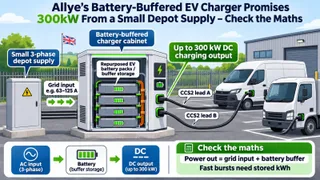
See whether Allye’s MEV300 EV charger can meet your UK fleet’s charging needs on a 63 A depot supply, and how battery recharge limits shape each shift.
Read article
See what the first CETO buoy deployment tested and why the 80 kW wave energy trial’s grid export and servicing data matter for UK wave power.
Read article



Mo's Solar Mission
Mo's Mission Nominations
Garlinge Primary School and Nursery
Garlinge Primary School and Nursery is a foundation primary school on Westfield Road in Margate, Kent, for children aged 3 to 11. It is m...
St Luke's Church of England Primary SchoolSt Luke's Church of England Primary School is a voluntary controlled Church of England primary school on Jubilee Road in Formby, Merseysi...
Comberbach Nursery and Primary SchoolComberbach Nursery and Primary School is a primary academy on Mather Drive in the village of Comberbach, near Northwich in Cheshire, for...
Locations
Solar installation near you
Write for Kilowatts.uk
Got a trade and something worth saying?
Write it here under your own name. Sign in, put a profile up, and start a guide. Pay only if you want more links from your articles out to your own site.
Register
Create a Kilowatts.uk account, or sign in if you already have one.
Author profile
Put your name, photo and experience on a public author page.
Start creating
Write a guide or a blog. Free authors can put one followed link to their own site in articles each month.
FAQ
Need Help? RoboMo's Got Answers
Can I buy Lunar’s 25 kW Fast Charger in the UK?
Lunar’s product announcement targets mid-2027 for the US and gives no UK launch date or installed price. A UK installation would depend on Lunar offering a compatible system for the local electricity supply and confirming which UK vehicles it supports.
Could I charge at 25 kW on a single-phase supply?
Lunar quotes 25 kW as the peak DC charging rate into the car. The rate you can sustain depends on what the car can accept, how much power the property can draw and how much the home battery can contribute. Ask an installer what rate the system could sustain on your supply with a low home battery and other large household loads running.
Which EVs could send power back through the Lunar charger?
The car needs explicit support for discharging through the Lunar Fast Charger, even if the plug fits and the car accepts DC charging. Ask for confirmation for the exact UK model, model year and software version. Check the vehicle warranty terms for home backup and grid export if you plan to use both.
What would my electricity network operator need to check?
In Great Britain, ask your installer to confirm the connection process with your distribution network operator (DNO). The assessment can include the combined registered capacity of equipment that can discharge alongside the grid, including existing solar and battery equipment where applicable. Ask the installer to document that capacity and any agreed export limit.
Could my EV keep the lights on during a power cut?
A compatible EV could supply selected circuits if the installation can isolate them from the public network during an outage. The car would need to be plugged in and have enough energy above the charge you want to keep for driving. Ask which circuits can run together and whether your solar panels can keep generating in backup mode.
Could I get paid for exporting electricity from my EV?
Payment would depend on an eligible export tariff as well as a compatible car and charger and an agreed network export limit. Ask your supplier whether its terms cover your meter setup and electricity discharged from the car, and how this would affect any existing solar export payments. Compare the payment with the cost of recharging the car, allowing for energy lost in the process.
Could I keep my existing solar panels and inverter?
That depends on how a UK Lunar system would integrate with your existing equipment. Give the installer your solar inverter model and any agreed export limit. Ask which equipment you could keep and how much surplus solar the home battery could store for charging the car after it returns.
When would a faster home charger be worth the extra cost?
Start with how much energy you usually need and how long the car is parked. At a steady 7 kW, a 28 kWh top-up takes about four hours before charging losses, so a conventional smart chargepoint may cover an overnight top-up. If you regularly have shorter stops, compare the rate the Lunar system could sustain at your property and ask for an itemised quote covering the charger, home battery system and any electrical work.
Live help
Need help right now?
Talk to RoboMo™ and get instant answers.