


Industrial battery storage
Published: 2026-11-26 04:46:24
Updated: 2026-11-25 20:47:22
Size industrial battery storage for a UK factory or warehouse, compare installed quotes and see how tariff changes and fewer cycles affect savings.
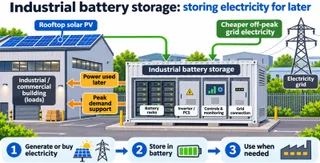
Industrial battery storage in the UK for costs, sizing and savings
Industrial battery storage can cut electricity costs at a factory, warehouse or other industrial site by storing cheaper electricity for later use or reducing peak demand where that lowers a billed charge. A battery energy storage system (BESS) installed behind the site’s meter can charge from surplus solar or from the grid. A system designed for backup can also keep critical equipment running during a power cut.
Whether storage pays depends on the site’s load profile, electricity contract, connection limits and installed cost. Gather a full year of half-hourly meter data and your current electricity contract before asking installers to size a system.
What can an industrial battery do for your site?
Start with a problem you can measure. A warehouse that exports rooftop solar at midday and imports electricity for its evening shift could store that surplus for later. A factory that runs continuously and already uses most of its solar as it is generated has less surplus to store. A site without solar can still shift grid purchases if the difference between its cheaper and dearer rates is wide enough.
Overview
These uses share the battery’s stored energy and inverter capacity. Holding charge in reserve for power cuts leaves less energy available for bill savings. Ask the installer to model the operating priorities together so each discharge is counted once and the backup reserve is available when needed.
How do you size an industrial battery?
Power in kilowatts (kW) tells you how much demand the battery can meet at a given moment. Usable energy in kilowatt-hours (kWh) tells you how long it can sustain that output. A system rated for 250 kW of continuous AC output and 500 kWh of usable AC energy can deliver its rated output for about two hours under the stated rating conditions. A backup reserve, site control limits or auxiliary loads outside the quoted measurement boundary can reduce the energy available for routine use.
Review half-hourly imports across shifts, weekends and seasons. If the site has solar, add generation and export records. Allow for planned loads such as EV chargers, refrigeration or a new production line. Half-hourly averages can hide motor starts and short demand spikes. Use higher-resolution measurements if those events affect inverter sizing or backup design. For peak shaving, model demand over the interval your supplier uses for billing.
If you are adding solar, estimate generation from the usable roof area, orientation and shading, then compare it with demand in the same intervals. Look for periods when the battery can charge from surplus solar and later periods when the site can use that energy. For grid charging, check the spare import capacity during the cheaper tariff window and whether the window is long enough to recharge the battery.
What does industrial battery storage cost, and how do you estimate savings?
Compare fully installed quotes against the same specification. Ask bidders to show what they have included for the battery and inverter, foundations, cable routes, switchgear, protection, metering and commissioning. Identify any separate network works, transformer upgrades or production downtime needed for the connection. Compare continuous AC power and usable AC energy at commissioning, and check where each bidder measures round-trip efficiency and auxiliary consumption.
In a worked example using hypothetical tariffs, a battery delivers 500 kWh of usable AC energy per full equivalent cycle after allowing for its operating limits. At 90% AC round-trip efficiency, it needs about 556 kWh of grid electricity to deliver those 500 kWh. Charging at 12p/kWh costs about £66.67. If the full discharge replaces imports at 24p/kWh, it avoids £120 of purchases. That saves about £53.33 per cycle, or £13,333 over 250 equivalent full cycles a year, before other costs.
If the higher rate falls to 20p/kWh and the charging rate stays at 12p/kWh, the saving falls to about £8,333 a year at 250 cycles. At the original rates but with 150 cycles, it falls to about £8,000. Each scenario assumes the site can recharge at the cheaper rate and use the full discharge in the higher-priced period. Use the rates the site can actually avoid, and test how many cycles its demand and charging windows support. For stored solar, account for any export revenue given up. For peak shaving, count a saving only if the contract or a specific avoided upgrade gives it a value. Compare first-year and later-year cash flows, allowing for expected capacity loss, warranty throughput limits, maintenance, auxiliary consumption outside the efficiency figure and any expected replacement costs. If the projected margin is thin, a narrower tariff spread or fewer cycles can change the investment decision.
What grid, planning and safety checks come first?
Ask the installer to confirm the connection route and available import and export capacity with the distribution network operator (DNO) while the design is still flexible. In Great Britain, Engineering Recommendation G99 is commonly relevant to industrial batteries operating in parallel with the public distribution network. If the design relies on an agreed import or export limit, check how G100 applies with the DNO. Include existing solar and other generation in the review, even if the battery will only serve on-site loads. In Northern Ireland, confirm the applicable G99/NI generation connection route with NIE Networks. References include ENA Engineering Recommendation G99, Issue 2, and ENA Engineering Recommendation G100.
The electrical survey should trace the proposed connection from the incoming supply to the battery. Check transformer and switchboard capacity, protection settings, metering positions and cable routes. Ask how the battery will operate alongside solar and standby generation. Confirm planning requirements for the layout with the local planning authority. Assess flood exposure, vehicle impact, escape routes and emergency access before choosing the final location.
The HSE and Department for Energy Security and Net Zero guidance covers grid-scale storage. Use the hazards it identifies to inform a site-specific assessment for a behind-the-meter installation. For lithium-ion equipment, assess how thermal runaway could spread between modules and where flammable or toxic gases could collect or travel. Check the distance from occupied buildings, air intakes and escape routes. Ask the designer how detection, ventilation and any suppression measures work together. Where relevant, assess how the site would contain contaminated firefighting water. Agree who receives alarms day and night, who calls the emergency services and who can safely isolate the equipment. The emergency plan should show responders how to reach the battery, where to find isolation points and what may remain energised after shutdown. Discuss the layout and emergency arrangements with the local fire and rescue service where appropriate. At handover, test how alarms are escalated and check that the agreed shutdown sequence works.
Can an industrial battery keep equipment running in a power cut?
Yes, if the system can safely isolate from the public network and supply designated circuits. A conventional grid-connected battery may shut down when mains power fails. Specify which loads need backup, how long each can tolerate an interruption and how long each needs to run. Equipment such as process controls may need an uninterruptible power supply to bridge the transfer.
Give the designer a critical-load schedule that includes motor starting demand and identifies loads that restart together. If a generator or an uninterruptible power supply already serves those circuits, ask the designer to explain how they will work with the battery during an outage. Set a minimum charge reserve that allows for expected capacity loss. At commissioning, require a test that demonstrates loss of mains, transfer to backup, operation under representative loads and return to normal supply.
What to prepare before comparing installers
Give each bidder the same half-hourly data, electricity contract, details of existing generation and planned loads, and an electrical single-line diagram if available. State your main objective and ask for a model that shows when the battery charges, discharges or reaches a limit in each interval. Compare the proposed size with a smaller option and ask how savings change if the gap between tariff rates narrows or the battery completes fewer cycles. If you’re still shortlisting battery installers, use the same brief when approaching each one.
If rooftop generation is part of the project, you can use the Kilowatts.uk industrial solar installation comparison tool to explore solar options. Ask bidders to model solar alone and solar with storage using the same demand data, generation assumptions and export rates. Compare how much extra solar electricity you could use on site and what it would be worth after allowing for lost export income.
Solar comparison
Compare solar for your property
Enter your postcode to assess your roof, compare solar options and get quotes from UK installers.
- Free postcode start
- Home, business and industrial
- RoboMo™ maps your roof
See which panels fit your roof
Choose home, business or industrial, then enter your postcode. RoboMo maps the roof and ranks panel brands by fit.
1. Postcode Start the assessment for your property.
2. Pin the roof Mark the array on the map.
3. Compare RoboMo™ builds your options.

Battery ROI tool
See what a battery saves on your bill
Enter the day rate, off-peak rate and export rate. The calculator ranks batteries in the Kilowatts shop over 10 years. Home batteries also suit offices and small commercial sites.
Reading
Sources and further reading
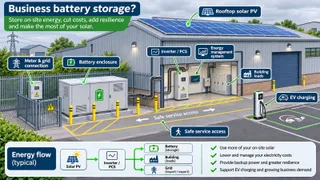
See how tariffs and charging losses affect business battery storage payback, with a worked example and checks for comparing UK installation quotes.
Read article
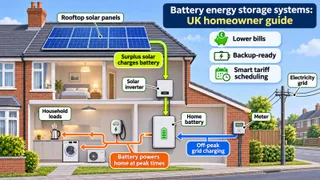
Compare battery energy storage systems for UK homes. Use your electricity readings and tariff to size a battery, estimate savings and check backup options.
Read article
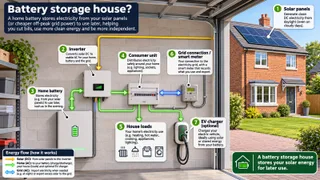
Find the right battery storage for your UK home. Use your tariff and electricity use to weigh up new solar, a battery retrofit or grid charging.
Read article
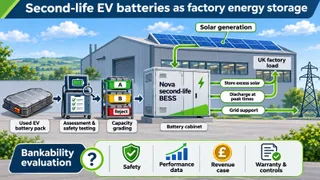
Assess Moment Energy’s 500 kWh Nova second-life EV battery for UK commercial sites. See how usable capacity, warranties and grid limits affect finance.
Read article


Mo's Solar Mission
Mo's Mission Nominations
Garlinge Primary School and Nursery
Garlinge Primary School and Nursery is a foundation primary school on Westfield Road in Margate, Kent, for children aged 3 to 11. It is m...
St Luke's Church of England Primary SchoolSt Luke's Church of England Primary School is a voluntary controlled Church of England primary school on Jubilee Road in Formby, Merseysi...
Comberbach Nursery and Primary SchoolComberbach Nursery and Primary School is a primary academy on Mather Drive in the village of Comberbach, near Northwich in Cheshire, for...
Locations
Solar installation near you
Write for Kilowatts.uk
Got a trade and something worth saying?
Write it here under your own name. Sign in, put a profile up, and start a guide. Pay only if you want more links from your articles out to your own site.
Register
Create a Kilowatts.uk account, or sign in if you already have one.
Author profile
Put your name, photo and experience on a public author page.
Start creating
Write a guide or a blog. Free authors can put one followed link to their own site in articles each month.
FAQ
Need Help? RoboMo's Got Answers
Can industrial battery storage save money without solar panels?
Yes, if your electricity contract lets you charge at a lower rate and use the stored energy when electricity costs more. The price difference needs to cover charging losses and operating costs. A battery can also reduce peak demand if lowering that peak reduces a charge on your bill.
Is it worth adding a battery to existing industrial solar panels?
It can be worthwhile if you regularly export surplus solar and buy electricity later in the day. Compare the cost of the imports you could avoid with the export income you would give up. Use half-hourly generation, import and export data to see how often the battery could charge and discharge.
How do I choose the right size industrial battery?
Use a full year of half-hourly electricity data to see how demand changes across shifts, weekends and seasons. Power in kilowatts tells you how much demand the battery can cover at once, while usable capacity in kilowatt-hours tells you how long it can sustain that output. Include planned equipment and ask for finer measurements if motor starts or short spikes could affect the design.
What should I compare in industrial battery quotes?
Ask for fully installed quotes based on the same continuous AC power and usable AC capacity. Check whether each quote includes groundworks, cable runs, switchgear, metering and commissioning, and ask about any separate network costs or installation downtime. Compare projected savings using the same tariff assumptions, and check what the warranties say about capacity loss and how much energy the battery can deliver over its life.
Can an industrial battery keep my site running during a power cut?
A system designed for backup can supply selected circuits after safely isolating from the public network. Tell the installer which equipment must keep running, how long it needs power and how much interruption it can tolerate. Ask how much charge will be held in reserve and have the backup function tested at commissioning.
What grid connection and planning checks should I make before buying?
Ask the installer to confirm the connection process and available import and export capacity with your local network operator early in the design. Include any existing solar or standby generation in that review, even if the battery is intended to serve on-site loads. Check the proposed location and layout with your local planning authority.
What safety checks should I ask about before choosing a battery location?
Ask how the proposed location affects emergency access, escape routes and exposure to flooding or vehicle impact. For lithium-ion systems, ask how the design handles overheating, fire spread and gases that could reach occupied areas or air intakes. Agree who will respond to alarms and how the equipment can be safely isolated in an emergency.
Live help
Need help right now?
Talk to RoboMo™ and get instant answers.