LinkedIn profile for David Coleman David Coleman
Founder & Renewable Energy Author, kilowatts.uk


LinkedIn profile for David Coleman David Coleman
Founder & Renewable Energy Author, kilowatts.uk
Article
NYSERDA has awarded Inlyte over $2.4 million for a more-than-10-hour grid battery. What the award confirms, and which performance questions remain.
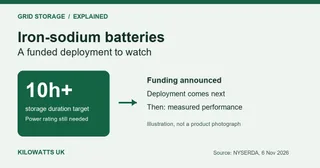
NYSERDA has awarded Inlyte over $2.4 million for a more-than-10-hour grid battery. What the award confirms, and which performance questions remain.
On 6 November 2026, New York's energy research agency NYSERDA announced an award of more than $2.4 million to Inlyte Energy. The planned deployment is an iron-sodium battery providing more than ten hours of storage, intended to help with rising peak demand at substations and resilience on the distribution network. NYSERDA's award announcement is the primary source for those details.
This is a funding and deployment announcement. It does not report a completed site's measured output, efficiency or operating costs. The Inlyte entry gives neither a project power rating in megawatts nor an energy capacity in megawatt-hours. Those figures should not be guessed from the grant amount. You can also read more about Hams Hall battery enters.
Storage duration describes how long a battery can supply a stated power. Power and energy are different quantities: megawatts describe the rate of supply, while megawatt-hours describe the amount delivered.
For example, a hypothetical system supplying 1 MW continuously for ten hours would deliver 10 MWh. At 10 MW for the same duration, it would deliver 100 MWh. These are arithmetic examples, not ratings for Inlyte's project. The useful comparison is energy delivered at a defined output, rather than an hour count on its own.
Inlyte describes itself as a US-based manufacturer of iron-sodium battery systems. It says its team's experience developing and commercialising sodium-metal-chloride chemistry underpins the technology. The company also lists Beta Research in Burton-on-Trent among its locations.
That background explains the company's description of its technology. Independent operating evidence is still needed to compare a particular installation with competing systems. A familiar material name alone cannot establish the installed cost, safety requirements or service life of a complete battery plant. You can also read more about Allye MEV depot charging:.
The next useful information would be a defined site, commissioning timetable and usable power and energy ratings. After commissioning, operating data could show whether the equipment meets its intended duty through changing demand and weather.
When assessing results, look for whole-system round-trip efficiency, including any auxiliary energy, alongside availability, maintenance requirements and the test conditions. An efficiency measured at cell level is not automatically the efficiency at the grid connection. Warranty terms and repeated operation over time matter as well as a single successful discharge.
Cost comparisons also need a common boundary: equipment, connection, site works and operating costs should be distinguished. The funding announcement supplies no basis for quoting a UK installed price, household payback period or guaranteed bill saving.
Ofgem explains long duration electricity storage as storing electricity when renewable generation exceeds demand, or prices are low, for use when demand or prices rise. Its cap-and-floor framework concerns project revenues: consumers support a minimum revenue level and receive benefits when revenues exceed the cap. You can also read more about Illumion battery imaging: why.
The New York award does not establish eligibility for that UK scheme. Our view is that a useful next milestone would be published deployment results that allow like-for-like comparison with other storage options. That is a reason to follow the project, rather than treat the grant as proof of commercial performance.
For a home battery decision today, use the specifications, warranty and tariff assumptions of the actual products available to you. Our battery comparison tools can help explore those assumptions; this grid project is not presented here as a household product for sale.
Solar comparison
Enter your postcode to assess your roof, compare solar options and get quotes from UK installers.
Choose home, business or industrial, then enter your postcode. RoboMo maps the roof and ranks panel brands by fit.
1. Postcode Start the assessment for your property.
2. Pin the roof Mark the array on the map.
3. Compare RoboMo™ builds your options.
Battery ROI tool
Enter the day rate, off-peak rate and export rate. The calculator ranks batteries in the Kilowatts shop over 10 years. Home batteries also suit offices and small commercial sites.
Reading
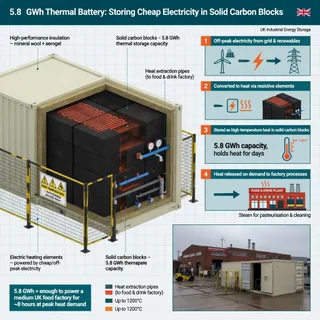
A 5.8GWh thermal battery will store cheap electricity as heat in solid carbon blocks. The Kansas figure is process heat, not a UK grid battery.
Read article
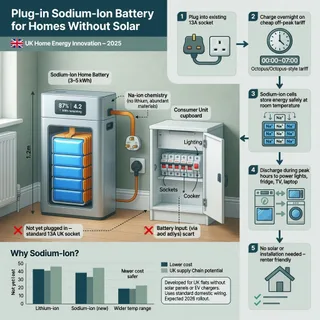
A plug-in sodium-ion battery for homes without solar is in development, not on sale. UK grid rules may still block a simple wall-socket connection.
Read article
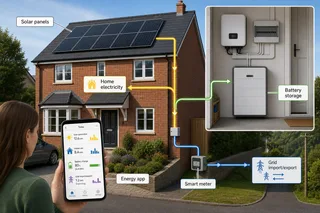
A 5.64 MWh EnerQB unit has been handed over for Australian storage plans. Understand eight-hour duration, the development pipeline and what remains unverified.
Read article
Octopus, CATL and Ampace are exploring smart home batteries, including sodium-ion technology. The agreement has no confirmed product price or UK launch date.
Read article
Write for Kilowatts.uk
Write it here under your own name. Sign in, put a profile up, and start a guide. Pay only if you want more links from your articles out to your own site.
Create a Kilowatts.uk account, or sign in if you already have one.
Put your name, photo and experience on a public author page.
Write a guide or a blog. Free authors can put one followed link to their own site in articles each month.
FAQ
Live help
Talk to RoboMo™ and get instant answers.
Live chat