LinkedIn profile for David Coleman David Coleman
Founder & Renewable Energy Author, kilowatts.uk

LinkedIn profile for David Coleman David Coleman
Founder & Renewable Energy Author, kilowatts.uk
Article
Hams Hall phase one is operating at 350 MW and 1,243 MWh. Understand its roughly 3.55-hour duration and how that differs from a future expansion.
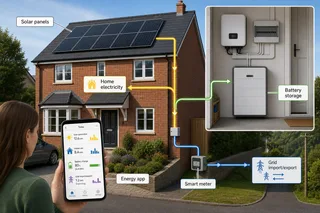
Illustration of a home energy system; it does not depict a product or installation announced in this article.
Published 5 November 2026. Operating capacity checked against BW ESS's announcement dated 2 November.
The first phase of the Hams Hall battery in the West Midlands has entered commercial operation. Its headline figures describe different things: 350 MW is power, while 1,243 MWh is stored energy.
Dividing 1,243 by 350 gives about 3.55 hours. That nameplate calculation helps explain the scale, but it is not a promise of maximum output for that time under every operating condition.
BW ESS's 2 November announcement confirms phase one at 350 MW and 1,243 MWh. A later second phase would bring the site to 400 MW and 1,424 MWh. The future total should not be reported as today's operating capacity.
An EDF announcement describes its floor and optimisation agreement for the project. That concerns commercial operation; it is not a special retail tariff for nearby homes.
A power figure tells you how quickly a battery can deliver electricity. Energy capacity helps explain how long it can sustain delivery. Two projects with the same MW rating can play different roles if one has much more stored energy.
Duration also depends on dispatch power. A battery need not run at its maximum continuously. Its actual schedule can combine different services, charging opportunities and operating limits.
A battery must be charged before it discharges. There are losses between electricity entering and leaving, and usable energy depends on the operating window and equipment condition. Nameplate energy divided by power is an explanatory calculation, rather than a measured round-trip performance result.
Storage can move electricity between times. Whether a particular dispatch reduces costs or emissions depends on charging time, the generation displaced and wider system conditions. Size alone does not establish those outcomes for every cycle.
Hams Hall is a grid-scale project, not a home backup service. A comparison with the number of homes it could support is a power-and-duration illustration, not evidence of continuous supply to those households.
It also does not change the backup capability of an individual solar battery. Domestic backup requires a suitable installation, controls and circuits. A large operating battery elsewhere is a different part of the system.
Look for both MW and MWh, then check whether they describe an operating phase, a consented extension or a development pipeline. Keep commissioning status and measured operating data separate from a developer's targets. Those checks make battery projects easier to compare.
Solar comparison
Enter your postcode to assess your roof, compare solar options and get quotes from UK installers.
Choose home, business or industrial, then enter your postcode. RoboMo maps the roof and ranks panel brands by fit.
1. Postcode Start the assessment for your property.
2. Pin the roof Mark the array on the map.
3. Compare RoboMo™ builds your options.

Battery ROI tool
Enter the day rate, off-peak rate and export rate. The calculator ranks batteries in the Kilowatts shop over 10 years. Home batteries also suit offices and small commercial sites.
Reading
Econergy has announced a 106 MW UK battery portfolio deal with possible longer-duration upgrades. Why MW, MWh and an operating upgrade are different things.
Read article
A 5.64 MWh EnerQB unit has been handed over for Australian storage plans. Understand eight-hour duration, the development pipeline and what remains unverified.
Read article
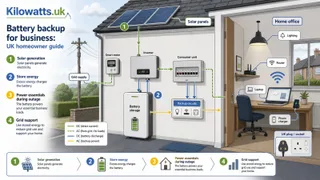
Can a home battery work during a power cut in the UK? A home battery can work during a power cut in the UK, but only if it has the right setup.
Read article

Yes - a home battery can fill from cheap off-peak grid electricity, then run your house through the expensive peak. Here's how it works in UK homes.
Read article
Write for Kilowatts.uk
Write it here under your own name. Sign in, put a profile up, and start a guide. Pay only if you want more links from your articles out to your own site.
Create a Kilowatts.uk account, or sign in if you already have one.
Put your name, photo and experience on a public author page.
Write a guide or a blog. Free authors can put one followed link to their own site in articles each month.
FAQ
Live help
Talk to RoboMo™ and get instant answers.
Live chat