


Pay as you go solar vs PPA vs CAPEX: UK business guide
Published: 2026-09-29 02:23:24
Updated: 2026-10-01 15:51:56
Pay as you go solar is a UK label, not a third technology beside a PPA or CAPEX. Read who owns the plant and who pays when repairs fall due.
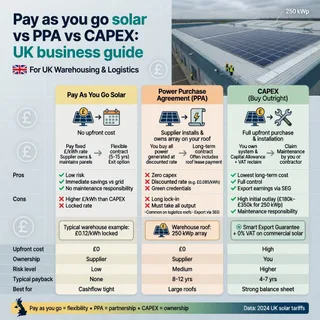
Pay as you go solar vs PPA vs CAPEX - UK business guide
UK business guide B Solar three procurement routes
Pay as you go solar vs PPA vs CAPEX UK
The modules, inverters and building connection can look the same on all three routes. What changes is who pays, who owns the asset, and who pays when an inverter fails or the roof has to be opened. These are commercial labels, not categories fixed in UK energy law. An off-site or sleeved corporate PPA, buying power from a generator elsewhere, is a different product. It does not answer how a rooftop array should be procured.
This is a decision for a facilities, finance or sustainability lead at a warehouse, office, shop or retail park. It is not a domestic quote. After signature you still deal with roof access, landlord consent, monitoring and the host distribution network operator's timetable. A comparison that has not seen half-hourly consumption and a roof inspection is only a screening exercise. It can rule options out. It cannot tell you the outturn cost.
Who owns the system and who pays for repairs
Under CAPEX the business pays for design, equipment and installation from its own funds, or from borrowing or asset finance it arranges, and it owns the system. It uses electricity behind the meter and makes its own arrangement for any export. Maintenance, monitoring, inverter replacement and performance sit with the owner unless a separate operation and maintenance contract says otherwise. A loan or hire purchase does not by itself make the deal a PPA. Ownership follows the contract, not the heading on the proposal. An on-site power purchase agreement usually means a third party funds, owns and operates the plant on the customer's roof or land. The customer buys generated electricity at an agreed price for an agreed term. Repairs are often the funder's job, but only to the extent the offtake contract, the roof licence and the maintenance schedule say so. Do not infer that allocation from the words power purchase agreement alone. Pay as you go is not a defined term in UK regulation. Some providers use it for a genuine on-site PPA. Others use it for a lease, a hire agreement or a service contract, sometimes with a fixed charge rather than a price per kilowatt-hour. Before comparing it with CAPEX, identify which contract you would sign, and who would own the panels, inverters, meters and monitoring login. Check whether payment tracks generation, on-site use, or a minimum that falls due even in a poor month. Treating the offer as a consumer-style prepayment meter will mis-describe the paperwork.
What no upfront cost actually commits you to
You either pay for the asset, or you pay for electricity or a service from an asset someone else owns. CAPEX is a project cost. An on-site PPA is usually a price per kilowatt-hour of generation over an agreed term. A pay-as-you-go offer may use that same structure, or a hire or service charge. The invoice does not set the risk. The contract does.
No upfront cost is not no cost. Customers on these funded routes pay through the energy price, and sometimes through a minimum offtake, a clause that keeps charges running when generation is paused, or an early-termination sum. The funder prices in capital, operations and a return. That can still be a sound deal if daytime use and tenure support it. It is not a discount by definition, and it is not automatically identical to a PPA.
CAPEX is not automatically the lowest-cost route either. It concentrates spend at the start and leaves performance, maintenance and residual value with the owner. It is a weak use of capital if occupation is short, the roof will be replaced inside the period needed to justify the spend, or the business has a better use for the money. It can suit a long-stay occupier with high daytime use that wants the generation and can manage the asset. A modelled bill saving is not a contractual promise unless the agreement contains one.
Which route fits capital, tenure and daytime load
CAPEX suits organisations that can fund the plant, expect to control the roof for a period they accept, want the generation and any export, and will run a maintenance plan. It is a weak fit where capital is tight, the lease is short, the roof is near replacement, or the board wants price and performance risk moved elsewhere. Ownership is not fit-and-forget. Someone still has to notice when monitoring goes quiet, and budget for an inverter that fails during the life of the modules. PPA and pay-as-you-go funding suit occupiers with enough daytime consumption, a credit profile a funder will accept, and a lease or landlord roof agreement that covers the term. They are a weak fit for a small roof, low or highly seasonal daytime load, a connection cost that swamps the project, or a business that needs to alter the roof freely during the term. A weak covenant can close the funded routes even when the roof is excellent. Minimum size, contract length and buy-out sums are provider-specific. There is no UK standard term sheet to quote. Building type changes the load and the roof more than it changes the meaning of CAPEX or PPA. A single-occupier warehouse often has one decision-maker and a large roof, but structure and daytime load still decide viability. Commercial rooftop solar for UK offices can suit core-hours use, yet landlord splits, plant rooms and shading often complicate the layout. Solar for UK retail parks and shops can line up with trading hours. Multi-let sites, canopies and shared supplies add consent and metering problems a simple warehouse does not have. None of the routes suits a failed structural survey, a building that lacks the consent it needs, or a site without safe access for the life of the plant.
Overview
Use that table as a screen, not as a ranking. A short lease can make CAPEX and a funded offer equally poor. A long-stay site with daytime load can make either ownership model workable. The choice then turns on capital, risk and the contract in front of you.
Why the roof or the network can stop every route
All three routes succeed or fail on the same physical limits. Structure, remaining roof life, asbestos, fire separation, access, shading, orientation and the roofing warranty can rule a site out before funding is discussed. A short occupational lease blocks many third-party models. It is also a CAPEX risk if the tenant cannot keep, remove or transfer the plant when the lease ends. Where a funder must remain on the building, landlord consent and a roof licence are the right to be there. They are not a late admin task.
Connection often sets both programme and cost, whether the buyer is the occupier or a funder. Smaller systems may use a simpler notification route. Larger commercial arrays commonly need a G99 application, and the host operator may limit export, require works, or extend the timetable. Exact thresholds and process steps have to come from the current ENA engineering recommendations and that operator, not from another project's paperwork. For a commercial solar G99 DNO connection, treat the offer in hand as the constraint. Reinforcement or an export limit can make a funded scheme and a CAPEX scheme equally unviable.
Planning rules differ between England, Scotland, Wales and Northern Ireland, and between rooftop, ground-mount, listed buildings and conservation areas. Permitted development is common for some non-domestic rooftop schemes where the conditions are met. It is not universal, and no outcome for a particular building is predicted here. What changes the quote, on funded and CAPEX jobs alike, is the cable route, inverter location, whether the existing supply can take a retrofit, and whether export will be accepted. A bill total is not a design. Half-hourly data shows whether load is there in the middle of the day, or whether it is an evening, process or seasonal profile that solar will barely touch.
How on-site solar compares with the grid bill
The usual commercial case is lower imported electricity behind the meter, not export income that pays for the array. Designers treat import reduction as the main potential benefit and export as secondary. That split is site-specific, so it is not stated here as a percentage. Standing charges, and capacity or availability charges on many half-hourly supplies, are not removed by on-site generation. Solar does not take a commercial site off the grid. Night load, peaks and a dull week still come from the supplier.
A PPA price below the current unit rate does not mean the bill falls by that margin every year. Grid prices move. The contract may escalate. Night and peak import remain. If you are weighing commercial solar versus grid electricity for UK businesses, compare a full bill, not a single unit rate. Metering has to separate on-site use from export if the saving, and any export contract, are to be evidenced. Ask who owns the meters and the monitoring login. Without that, a dispute about what was generated and what was used is hard to settle.
There is no single commercial solar panel cost for UK warehouses that can be published responsibly here. Array size, roof works, access, crane or scaffold, electrical upgrades, export limitation and region all move the figure. The same caution applies to offices and retail parks. PPA and pay-as-you-go unit rates are negotiated. They are not a regulated tariff, and no national discount against grid power is established in this guide. Payback in years is unknown until load, import-price assumptions, term, roof works and connection cost are modelled for that building. Inverter replacement cost over a long term is also unknown as a national figure. What matters is which contract carries it. Tax needs the same restraint. Capital allowances, VAT on the installation and business-rates treatment of rooftop PV follow who owns the plant and the rules in force at the time. They are not automatically the same when a funder owns the system and sells power. No allowance, rate or exemption is stated here. Check current HMRC and Valuation Office Agency guidance, and take advice for the contracting party, before anyone puts a tax benefit in the business case. Export products, including the Smart Export Guarantee where a supplier offers one, have eligibility conditions. Check Ofgem and the supplier rules for the size and metering in question. Do not assume export revenue funds the plant.
Which contract terms change the real cost
Headline price is where many comparisons stop, and where they go wrong. A third-party contract needs a roof lease or licence, access for maintenance, and a written position on roof repairs. Someone has to pay to remove and refit panels, and the agreement should say whether payments pause while the array is off. If that is missing, a routine roof repair becomes an argument about lost generation. Match the term to remaining roof life and the occupational lease, not to a generic module warranty. Warranty lengths vary by product and should be read from the datasheet for the equipment specified. They are not a UK field average, and they do not rescue a roof with little life left.
Early termination and the end of the term change the real cost of a PPA or a pay-as-you-go deal. Buy-out, extension, removal and transfer are different outcomes. A low starting price with an expensive exit, or with removal that damages the covering, is not a cheap system. CAPEX does not escape the same discipline. Ownership does not include monitoring, cleaning, call-out or inverter replacement unless you specify them. Price an operation and maintenance scope with the capital cost. Otherwise the idea that the job is finished at handover is incomplete.
Insurance, the roof warranty and safe access need a named party, whoever owns the panels. Penetrations or ballast can affect the roofing guarantee, so the installer and the roofing contractor need a method that keeps that guarantee valid. Retail sites may need scaffold, a crane or out-of-hours working so trading can continue. Those constraints belong in the price on both funded and customer-owned jobs. Where a funder or an export product asks for MCS, or an equivalent, check that requirement for the scheme. It is not a substitute for commercial design, a structural calculation and a network offer.
What to measure before you choose a route
Choose the route after the site has been screened, not the other way round. You need half-hourly data for a representative year, a note on remaining roof life, the occupational lease dates, and a clear answer on whether the landlord will grant a roof licence for the term a funder would need. If those items are weak, neither a sharp funded price nor a CAPEX quote will repair them. If they are sound, compare ownership with a funded offtake on the same design, including the same export limit.
A public claim with very little on-site use is a weak match for all three routes, because the commercial case is usually consumption behind the meter. A battery is not included merely because the paperwork says solar. Storage changes the connection, how the system is controlled, usable capacity and often the funder's risk. Keep it out of the solar comparison until it has been sized against the evening or process load you actually have.
Take those answers back to one design, not to three incompatible brochures. If the funder and the CAPEX price assume different roof works or a different export cap, you are not comparing routes. You are comparing different projects. Until the assumptions match, treat every national price, payback and percent-below-grid claim as unknown.
Plan, Compare & Buy Renewable Energy Solutions
AI does the thinking.
You get the perfect solar match.
Use RoboMo™ to assess your property, compare available technologies and connect with trusted UK installers, suppliers and manufacturers.
Simply enter your postcode, drop a pin on your roof, create your free account and let RoboMo™ analyse your property to find the best solar panels for your home.

You don't have to think
RoboMo™'s AI analyses your roof and does all the hard work.

Accurate & tailored
AI-powered assessment based on your roof, location, and conditions.

Best options, maximum savings
Compare top solar panels for the best performance and value.

Simple, fast & effortless
Provide a few details, sit back and watch your results unfold.
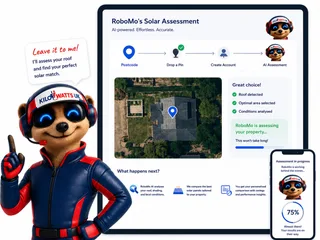
STEP 1
Choose Home, Business or Industrial
Enter your postcode to start your assessment.
STEP 2

Drop a pin on your roof
STEP 3

Create your free account
STEP 4

Sit back and watch RoboMo™ work
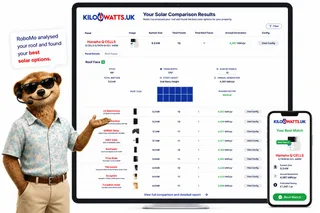
RoboMo™ analyses your roof and builds your personalised solar comparison.

Kilowatts UK is an authorised representative
Flower Turbines
Compact vertical-axis turbines built for real UK sites, not just open farmland.
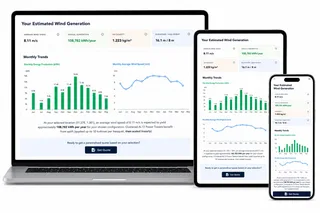
They start in light wind, sit in a small footprint, and are bird-safe by design. Cluster them as a bouquet and the group performs better together than the same turbines standing alone. Enter your postcode for a location-based generation estimate. Figures use area weather data and will differ if buildings, trees or hills sit in the way.
Starts in light UK wind
Built to generate in typical UK wind, not only open farmland.
Small rooftop or ground footprint
Compact towers for roofs, yards and tight sites.
Bird-safe slow rotation
Slow vertical-axis spin, bird-safe by design.
Bouquet clusters raise output
Grouped turbines outperform the same units standing alone.
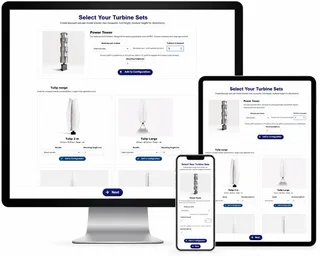
Step 1
Enter your postcode
Start designing your wind energy system in seconds.
STEP 2

Choose a location
STEP 3

Place your cluster
Tap the map where you want the turbine cluster to go.
STEP 4

Instant generation forecasts
Compare different turbine layouts and see annual generation forecasts instantly.
STEP 5

No commitment required
Explore different configurations before deciding whether to request a quotation.
Related articles
Mo's Mission Nominations
FAQ
Need Help? RoboMo's Got Answers
What is the difference between pay as you go solar, an on-site PPA and CAPEX?
These are ways to procure on-site commercial solar, not three different technologies. CAPEX means the business funds and owns the plant, from its own money or from borrowing or asset finance it arranges. An on-site power purchase agreement usually means a third party funds, owns and operates the plant while the business buys the electricity generated at an agreed price for an agreed term. Pay as you go is not a defined term in UK regulation: some providers mean a genuine on-site PPA, and others mean a lease, hire or service contract, sometimes with a fixed charge rather than a price per kilowatt-hour.
Is this comparison for homeowners?
No. It is a decision for a facilities, finance or sustainability lead at a warehouse, office, shop or retail park, not a domestic quote. The modules, inverters and building connection can look similar across routes, but that does not make the paperwork a household product. After signature the business still has to deal with roof access, landlord consent, monitoring and the host distribution network operator's timetable.
Who owns the system and who pays for repairs?
Ownership follows the written contract, not the sales label on the proposal. Under CAPEX the business owns the system, and maintenance, monitoring and inverter replacement sit with the owner unless a separate operation and maintenance contract says otherwise. A loan or hire purchase does not by itself make the deal a PPA. On a funded route, repairs are often the funder's job only to the extent the offtake contract, the roof licence and the maintenance schedule say so, so check who would own the panels, inverters, meters and monitoring login.
Does no upfront cost mean the solar is free?
No. You either pay for the asset, or you pay for electricity or a service from an asset someone else owns. Funded customers pay through the energy price, and sometimes through a minimum offtake, a clause that keeps charges running when generation is paused, or an early-termination sum. The funder prices in capital, operations and a return, which can still be a sound deal if daytime use and tenure support it, but it is not a discount by definition. CAPEX is not automatically the lowest-cost route either, because it concentrates spend at the start and leaves performance, maintenance and residual value with the owner.
Which route fits capital, lease length and daytime load?
CAPEX suits organisations that can fund the plant, expect to control the roof for a period they accept, want the generation and will run a maintenance plan. It is a weak use of capital if occupation is short, the roof will be replaced inside the period needed to justify the spend, or the business has a better use for the money. PPA and pay-as-you-go funding suit occupiers with enough daytime consumption, a credit profile a funder will accept, and a lease or landlord roof agreement that covers the term. They are a weak fit for a small roof, low or highly seasonal daytime load, a connection cost that swamps the project, or a business that needs to alter the roof freely. Minimum size, contract length and buy-out sums are provider-specific, and there is no UK standard term sheet.
Can the roof or the local network stop every option?
Yes. Structure, remaining roof life, asbestos, fire separation, access, shading, orientation and the roofing warranty can rule a site out before funding is discussed. A failed structural survey, a building that lacks the consent it needs, or a site without safe access for the life of the plant suits none of the routes. Connection often sets both programme and cost, whether the buyer is the occupier or a funder: larger commercial arrays commonly need a G99 application, and the host operator may limit export, require works or extend the timetable. Exact thresholds and process steps have to come from the current ENA engineering recommendations and that operator, not from another project's paperwork.
Will on-site solar remove the business energy bill?
No. Solar does not take a commercial site off the grid, and night load, peaks and a dull week still come from the supplier. The usual case is lower imported electricity behind the meter, with export treated as secondary, and that split is site-specific so it is not stated as a fixed percentage. Standing charges, and capacity or availability charges on many half-hourly supplies, are not removed by on-site generation. A PPA price below the current unit rate does not mean the bill falls by that margin every year, because grid prices move, the contract may escalate, and night and peak import remain.
Which contract terms change the real cost?
Headline price is where many comparisons go wrong. A third-party contract needs a roof lease or licence, access for maintenance, and a written position on who pays to remove and refit panels, and whether payments pause while the array is off for roof repairs. Match the term to remaining roof life and the occupational lease, not to a generic module warranty, which varies by product and should be read from the datasheet. Also check whether payment tracks generation, on-site use, or a minimum that falls due even in a poor month, and who owns the meters and the monitoring login. Capital allowances, VAT and business-rates treatment follow who owns the plant and the rules in force, so check current guidance and take advice before anyone puts a tax benefit in the business case.