


Solar panel savings bristol?
Published: 2026-08-19 10:59:48
Updated: 2026-08-20 11:50:06
Solar panel savings in Bristol are worth checking, but there is no single “Bristol saving” that applies to every home.
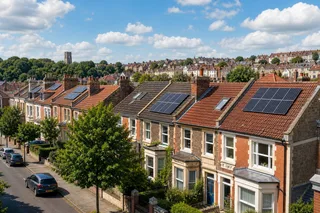
Solar panel savings bristol?
Understand solar panel savings bristol in the UK, with clear explanations, examples, and practical next steps.
Solar panel savings in Bristol: what homeowners can realistically expect.
Solar panel savings in Bristol are worth checking, but there is no single “Bristol saving” that applies to every home. The result depends on roof orientation, shading, usable roof area, electricity use, import and export tariffs, battery choice, planning constraints and the condition of the roof.
For most homes, the main saving comes from using solar electricity on site instead of buying electricity from a supplier. Export payments can add value, but they vary by supplier and should be treated as a supporting benefit rather than the whole financial case.
A credible estimate should be based on your actual electricity use, ideally half-hourly smart meter data, plus a roof and shading assessment. Bristol has many good solar roofs, but it also has terraces, chimneys, older roof coverings, conservation-area sensitivities and mature trees that can change the calculation. If you are already comparing installer proposals, start by checking home solar options on a like-for-like basis.
A worked Bristol solar savings example.
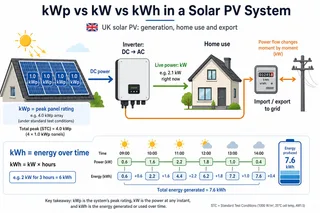
The following example is illustrative, not a quote or a promise. It shows how the calculation should be built, using assumptions that must be replaced with your own roof model, usage data and current tariffs before making a decision. A typical early-stage model might start with a 4 kWp domestic solar PV system on a reasonably clear Bristol roof. Using a broad UK planning assumption of around 850 to 1,050 kWh per kWp per year for well-sited systems, the model might test annual generation around the middle of that range before adjusting for orientation, pitch and shading. A site-specific design tool, such as PVGIS or installer modelling software, should then refine the estimate. If you are unsure what the system size means, it helps to understand kWp in solar before comparing figures. The saving is not simply annual generation multiplied by your electricity price. It is usually calculated as the value of electricity used in the home plus the value of electricity exported.
| Example input | How it affects the estimate | What to replace it with |
|---|---|---|
| System size | Sets the starting point for annual generation. | The proposed kWp from your roof design. |
| Annual generation | Estimates how many kWh the system may produce. | Installer model adjusted for Bristol location, orientation, pitch and shading. |
| Self-consumed electricity | Creates bill savings by reducing imported electricity. | Your daytime usage pattern and smart meter profile. |
| Exported electricity | Creates export income where eligible. | Your chosen Smart Export Guarantee tariff and metering setup. |
| Battery scenario | May increase self-consumption but adds cost and losses. | Battery capacity, warranty, usable capacity and tariff strategy. |
Overview
A simple formula is: annual value equals self-used solar kWh multiplied by your import rate, plus exported solar kWh multiplied by your export rate. If a battery is included, the model should also show how much extra solar is likely to be used at home, how often the battery cycles and whether the added benefit justifies the extra equipment and installation cost.
Why Bristol is a reasonable solar location.
Bristol can be a suitable location for solar panels because solar PV uses daylight, not only direct sunshine. Cloudy days still generate electricity, although output is lower than in bright conditions, and winter output is much lower than summer output. For a plain-English explanation, see how solar panels work in UK conditions.
The South West is generally favourable by UK standards, but the roof still matters more than the regional label. A clear east-west roof in Bristol may suit a household with morning and evening demand better than a theoretically stronger south-facing roof that is partly shaded by chimneys or trees.
For early feasibility, well-sited UK domestic PV systems are often modelled using broad generation assumptions in the region of 850 to 1,050 kWh per kWp per year. That range should be treated as a starting assumption only. A proper estimate should use location data, roof pitch, azimuth, shading and system losses rather than relying on a postcode average.
What affects solar savings on a Bristol home.
Two neighbouring Bristol homes can produce very different savings. A clean roof plane with little shade and strong daytime demand will usually model better than a roof broken up by chimneys, dormers, rooflights or trees, even if both properties have the same postcode. Bristol’s housing stock makes this especially important. Victorian and Edwardian terraces, older semi-detached homes, converted lofts, shared rooflines and mature street trees can all affect the usable roof area and installation design.
| Factor | Why it changes savings | What to check early |
|---|---|---|
| Roof orientation and pitch | They affect annual generation and the timing of output. | Which roof slopes can be used and whether east-west generation matches your demand. |
| Shading | Even partial shading can reduce output if the design does not account for it. | Chimneys, trees, neighbouring buildings, dormers and seasonal shade. |
| Daytime electricity use | Solar is usually most valuable when used directly in the home. | Working from home, appliance timing, EV charging, heat pump use and occupancy. |
| Export tariff | Export payments vary and can change the payback calculation. | Current Smart Export Guarantee options and supplier eligibility requirements. |
| Battery choice | Storage can increase self-consumption but adds cost, losses and complexity. | Evening usage, battery size, warranty terms, location and backup requirements. |
| Roof condition | Weak or ageing roofs can make installation uneconomic until repaired. | Tile condition, felt, battens, structure, access and likely repair timing. |
| Planning constraints | Some properties need closer checks before installation. | Conservation area status, listed status, flats, shared roofs and leasehold consent. |
Overview
This is why online calculators are best used as a first screen, not a final answer. The actual design must account for scaffolding, cable routes, inverter location, consumer unit condition, metering and grid connection requirements.
How self-consumption changes the payback.
Self-consumption is the share of solar electricity used on site rather than exported to the grid. It is central to savings because each unit used at home avoids buying a unit from your supplier, while exported electricity is paid under a separate export arrangement. Homes with people in during the day often use more solar directly. So can homes that schedule washing machines, dishwashers, immersion diverters, EV chargers or heat pump operation during solar generation hours. A household that is empty all day may still benefit, but more generation may be exported unless usage is shifted or storage is added. A good installer will ask for your annual electricity consumption and, where possible, half-hourly smart meter data. A single yearly kWh figure is useful, but half-hourly data shows whether your demand actually lines up with daylight generation. This is also where realistic break-even timing becomes more useful than a generic payback claim.
Is a battery worth adding in Bristol.
A battery can improve savings when you regularly export spare daytime solar and then buy electricity back in the evening. It stores some surplus generation so you can use more of your own electricity later, but it is not automatically the right choice for every home.
The case depends on usable capacity, round-trip efficiency, warranty, installed cost, tariff structure, available space and your evening demand. A household with low evening use may not cycle a battery enough to justify it, while a home with steady evening demand may see more benefit. Before adding storage to a savings model, compare the assumptions against current solar battery costs.
It is also important to separate storage from backup power. Many domestic battery systems do not keep the whole house running in a power cut unless specific backup hardware, wiring and design choices are included. If backup is important, ask for it explicitly and check which circuits would be supported.
What a good Bristol solar estimate should include.
A reliable solar estimate should be built from your property and usage, not from a generic saving. The installer should inspect or model the roof, confirm usable array size, account for shading and explain the assumptions behind the generation and savings calculation.
The quote should also make clear whether it includes scaffolding, electrical work, monitoring, bird protection if recommended, inverter location, cable routes, consumer unit work and grid connection administration. These details can affect both cost and practicality.
Roof survey
The installer should check tile condition, roof age, access, pitch, orientation and obstructions before confirming the design.Usage review
The calculation should use your electricity consumption and ideally smart meter data rather than only national averages.Generation model
The estimate should show expected annual output and the assumptions used for roof angle, direction and system losses.Export assumptions
Any Smart Export Guarantee income should be based on a real tariff you can access, not a vague export estimate.Battery logic
If storage is included, the quote should show what problem it solves and how it changes self-consumption.
Shading from chimneys, trees and nearby buildings should also be covered because it can affect output throughout the year. The installer should explain the grid connection route, whether notification or prior approval is expected, and what certificates, commissioning information, warranties and handover documents will be provided. If a quote gives a single payback figure without explaining these inputs, ask for the assumptions. The number may still be reasonable, but you need to know what would change it.
Grid connection, SEG export payments and MCS paperwork.
Domestic solar systems in the UK must be connected to the local electricity network correctly. Depending on the inverter capacity, battery arrangement and export setup, the installer may need to notify the distribution network operator or apply before connection under the relevant small-generator process.
For Bristol properties, the local network process will commonly involve National Grid Electricity Distribution, although homeowners should confirm the network operator by postcode. The practical point is that grid paperwork should be handled properly by the installer and not left as an afterthought, especially where a battery, larger inverter or export limitation is involved.
Export payments in Great Britain are commonly made through the Smart Export Guarantee. Ofgem explains the SEG framework, but individual suppliers set their own rates and terms, so the export value used in a savings model should be checked against a current tariff you can actually access. Suppliers may ask for suitable metering and installation documentation, and many homeowners will also need MCS certification or equivalent evidence accepted by the supplier.
Planning and roof constraints in Bristol.
Many domestic roof-mounted solar installations fall under permitted development, but not every Bristol property is straightforward. Listed buildings, conservation areas, flats, shared roofs and unusual roof positions can require closer checks before work starts. If you are unsure where the line is, review the basics of solar planning permission.
Bristol City Council planning information is a sensible source to check where a property is listed, in a conservation area or visually sensitive. Even where formal planning permission is not needed, installations should still be designed carefully so that panels are positioned appropriately and do not create avoidable issues with roof edges, neighbouring properties or heritage features.
Roof condition can be just as important as planning status. If tiles, battens, felt or roof structure are nearing the end of their useful life, installing solar first can be a false economy because panels may need to be removed for roof repairs later.
Common mistakes when estimating solar savings.
The most common mistake is treating solar savings as a fixed local number. Bristol location helps with the starting assumption, but the final figure is personal to the roof, household demand, system design, tariff and paperwork.
Another mistake is oversizing a system without thinking about export limits or self-consumption. A larger array can generate more electricity, but that does not always mean proportionally better savings if much of the extra generation is exported at a lower value or if the grid connection constrains the design.
- Treating export income as guaranteed.
- Ignoring shading from chimneys and mature trees.
- Comparing quotes with different system sizes and assumptions.
- Adding a battery without checking evening demand.
- Installing panels before dealing with roof repairs.
- Assuming backup power is included with every battery.
Homeowners should also be cautious with “free solar” offers or unusually simple payback claims. Any offer should be judged on ownership, contract terms, maintenance responsibility, export rights, future house sale implications and the assumptions used in the savings calculation. A payback figure is only useful if you can see how it was calculated.
How to improve your likely savings before getting quotes.
Before speaking to installers, gather the information that makes the estimate more accurate. Your latest electricity bill, annual kWh consumption, current import tariff and any smart meter usage data will help avoid guesswork.
It also helps to think about how your energy use may change. If you plan to add an EV, heat pump, battery or more home working, the best solar design may be different from a system based only on last year’s electricity use.
- Find your annual electricity consumption.
- Check whether you have half-hourly smart meter data.
- Note when the home is usually occupied during the day.
- Photograph the roof slopes, chimneys, trees and loft access.
- List future changes such as an EV charger or heat pump.
- Check whether the property is listed or in a conservation area.
Also look at the age and condition of the roof covering before committing to a design. This preparation gives installers a better basis for design and makes it easier to compare quotes fairly. It also helps you spot unrealistic savings claims because you can ask how each number was calculated.
When solar may not be the right choice.
Solar panels are not suitable for every Bristol property. A heavily shaded roof, failing roof covering, very limited usable space or complex ownership arrangement can make the economics weak even if the household wants to reduce bills.
There are also situations where it may be better to do other work first. Roof repairs, insulation, consumer unit upgrades, EV charger planning or heat pump design can all affect the best solar specification. Installing in the wrong order may add cost later.
If the property is borderline, ask the installer to explain the trade-off rather than pushing for a standard system. A smaller well-designed array can be better than a larger awkward one, and leaving space for a future battery can sometimes be more sensible than buying one immediately.
Source notes and assumptions to check.
A trustworthy solar savings estimate should make its assumptions visible. For Bristol homes, the main references and checks are usually practical rather than promotional: generation modelling, installer documentation, supplier export requirements, planning status and network connection requirements.
PVGIS and installer design software can help model expected generation using location, roof angle and orientation. MCS documentation is commonly relevant for installation quality evidence and export tariff eligibility, while Ofgem’s Smart Export Guarantee guidance explains the export framework at a national level. Bristol City Council planning information should be checked for listed buildings, conservation areas and properties with unusual constraints.
The figures that most often change between estimates are annual generation, self-consumption, export rate, import rate, battery cycling and installed specification. If those are not visible, the estimated saving is difficult to trust.
Practical next steps for Bristol homeowners.
The best next step is to treat solar savings as a site-specific calculation. Start with your electricity usage, roof suitability and likely daytime demand, then compare quotes that explain system size, expected generation, self-consumption, export assumptions and any battery logic.
Ask each installer how they assessed shading, what grid connection process applies, what warranties are included and whether the estimate depends on a specific import or export tariff. Also ask what happens if the roof survey changes the design, because this is common on older or more complex Bristol properties.
A good solar proposal should leave you understanding why the system is that size, where the savings come from and what could make the result better or worse. That is more useful than a payback claim and much safer than relying on a postcode-only estimate.
Plan, Compare & Buy Renewable Energy Solutions
AI does the thinking.
You get the perfect solar match.
Use RoboMo™ to assess your property, compare available technologies and connect with trusted UK installers, suppliers and manufacturers.
Simply enter your postcode, drop a pin on your roof, create your free account and let RoboMo™ analyse your property to find the best solar panels for your home.

You don't have to think
RoboMo™'s AI analyses your roof and does all the hard work.

Accurate & tailored
AI-powered assessment based on your roof, location, and conditions.

Best options, maximum savings
Compare top solar panels for the best performance and value.

Simple, fast & effortless
Provide a few details, sit back and watch your results unfold.
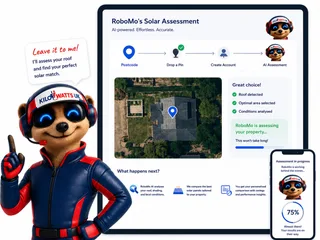
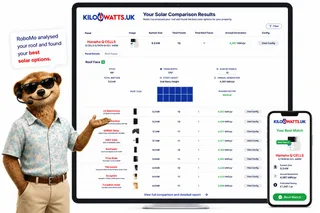
STEP 1
Choose Home, Business or Industrial
Enter your postcode to start your assessment.
STEP 2

Drop a pin on your roof
STEP 3

Create your free account
STEP 4

Sit back and watch RoboMo™ work
RoboMo™ analyses your roof and builds your personalised solar comparison.

Step 1
Enter your postcode
Start designing your wind energy system in seconds.
Are you an installer, distributor or renewable energy business?
Kilowatts UK is expanding the Flower Turbines partner network across the UK.
Become A Flower Turbines PartnerKilowatts UK is an authorised representative
Flower Turbines
Compact vertical-axis turbines built for real UK sites, not just open farmland.
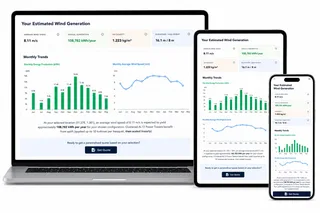
They start in light wind, sit in a small footprint, and are bird-safe by design. Cluster them as a bouquet and the group performs better together than the same turbines standing alone. Enter your postcode for a location-based generation estimate. Figures use area weather data and will differ if buildings, trees or hills sit in the way.
Starts in light UK wind
Built to generate in typical UK wind, not only open farmland.
Small rooftop or ground footprint
Compact towers for roofs, yards and tight sites.
Bird-safe slow rotation
Slow vertical-axis spin, bird-safe by design.
Bouquet clusters raise output
Grouped turbines outperform the same units standing alone.
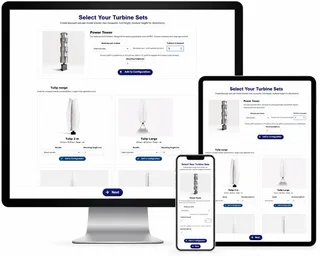
STEP 2

Choose a location
STEP 3

Place your cluster
Tap the map where you want the turbine cluster to go.
STEP 4

Instant generation forecasts
Compare different turbine layouts and see annual generation forecasts instantly.
STEP 5

No commitment required
Explore different configurations before deciding whether to request a quotation.
Related articles

FAQ
Need Help? RoboMo's Got Answers
How much can I save with solar panels in Bristol?
There is no single Bristol saving because it depends on your roof, shading, electricity use, tariffs and system size. The main saving usually comes from using solar electricity at home instead of buying it from your supplier. Export payments can help, but they should be treated as an extra benefit rather than the whole financial case.
Is Bristol a good location for solar panels?
Bristol can be a good location because solar panels work from daylight, not just direct sunshine. The South West is generally favourable by UK standards, but your roof matters more than the regional average. Orientation, pitch, shading from trees or chimneys, and usable roof area all affect output.
What information is needed for an accurate solar savings estimate?
A good estimate should use your actual electricity consumption, ideally half-hourly smart meter data. It should also include a roof assessment covering direction, pitch, shading, available space and roof condition. The savings model should show self-used electricity, exported electricity and the tariffs assumed.
Do solar panels still save money if I am out during the day?
They can, but the savings may be lower if much of the generation is exported rather than used at home. You may improve self-consumption by timing appliances, charging an EV during daylight, or using suitable controls. A battery may help in some homes, but it should be assessed against its cost, usable capacity and your evening electricity demand.
Are export payments guaranteed for Bristol solar owners?
Export payments are usually arranged through a Smart Export Guarantee tariff, but suppliers set their own rates and conditions. You will normally need suitable metering and installation documentation, and some suppliers may require MCS certification or equivalent evidence they accept. Always check a current tariff before relying on export income in a payback calculation.
Do I need planning permission for solar panels in Bristol?
Many domestic roof-mounted solar installations fall under permitted development, but not every property is straightforward. Listed buildings, conservation areas, flats, shared roofs and unusual roof positions may need closer checks. Bristol City Council planning information is a sensible place to confirm any restrictions before installation.
Should I repair my roof before installing solar panels?
Yes, if the roof is ageing or likely to need work soon, it is worth dealing with that before panels are fitted. Removing and refitting panels later for roof repairs can add cost and disruption. A survey should check tiles, battens, felt, structure, access and any obstructions before the design is finalised.
What should I compare between Bristol solar quotes?
Compare the proposed system size, expected annual generation, shading assumptions, inverter and battery details, warranties and monitoring. Check whether scaffolding, electrical work, bird protection, grid paperwork and handover documents are included. Be cautious with quotes that give a payback figure without explaining the assumptions behind it.