


Irish government solar panel grants?
Published: 2026-08-09 14:00:22
Updated: 2026-08-12 23:05:08
Irish government solar panel grants are not available for homes in England, Scotland, Wales or Northern Ireland.
Irish government solar panel grants do not apply to UK homes
Irish government solar panel grants are not available for homes in England, Scotland, Wales or Northern Ireland. If the installation address is in the UK, check UK, devolved nation, local authority, supplier and export-payment routes instead. The answer depends on the property location, whether it is domestic or commercial, your eligibility, and whether you mean an upfront grant or a payment for exported electricity.
The Irish scheme people usually mean is the solar PV support administered through the Sustainable Energy Authority of Ireland, known as SEAI. That route is for eligible properties in the Republic of Ireland, subject to current Irish rules. It should not be assumed to apply to a UK property, even if the homeowner is an Irish citizen, the property is near the border, or the installer also works in Ireland.
For a UK homeowner, confirm the property jurisdiction first. Then check current support from the relevant official route before signing a contract. Solar funding changes, so any grant, export tariff or eligibility claim should be checked against the current source, not an old article, advert or quote. For a UK-specific overview, start with UK solar grants before comparing installer claims.
Why the Republic of Ireland, Northern Ireland and Great Britain are treated differently
Solar funding is tied to the installation address, not the nationality of the owner. A house in the Republic of Ireland may fall under Irish grant rules. A house in Northern Ireland is a UK property and does not become eligible for an Irish government grant because it is close to the border.
Northern Ireland causes the most confusion. It is part of the UK, but its electricity market, network arrangements and policy routes are not always the same as England, Scotland and Wales. Advice written for Great Britain should not automatically be applied to a Northern Ireland home or business.
Great Britain also needs care because solar support can be split between several routes. The Smart Export Guarantee applies in Great Britain as an export-payment mechanism, not as an upfront solar panel grant. Other help may come through energy suppliers, councils or devolved government programmes, often with eligibility conditions.
Where to check official solar grant and export information
The safest way to check eligibility is to start with the official body for the place where the panels will be installed. This does not mean every official source will offer a solar grant. It means it is the right place to confirm whether a scheme is live, who can apply, what conditions apply, and whether the support is a grant, export payment or wider home energy measure.
For the Republic of Ireland, check SEAI information for current solar PV grant rules and application steps. For Great Britain, check GOV.UK and Ofgem information for the Smart Export Guarantee and any national policy updates, then check your energy supplier and local authority for routes that may apply to your household. For Northern Ireland, check NI Direct, Northern Ireland energy advice routes, your electricity supplier and NIE Networks for guidance on connection and export arrangements.
A reliable installer should understand this distinction. They should not describe an Irish grant as available for a UK address, and they should not present an export tariff as if it were the same as an upfront government grant.
How location changes the solar funding route
Location is the first filter because grant rules, export arrangements and network processes are not the same across Ireland and the UK. A useful solar quote should start with the installation address, property type, meter arrangement and network area before making claims about funding. The table below shows the practical distinction. It is not a substitute for checking live scheme rules, but it helps separate the main routes that are often confused.
| Property location | Are Irish government solar grants relevant? | More relevant route to check | What to verify before committing |
|---|---|---|---|
| Republic of Ireland | Potentially, subject to current SEAI rules | SEAI solar PV grant information and Irish process requirements | Eligibility, property type, approved process, installer requirements and current conditions |
| Northern Ireland | No, not as a Republic of Ireland grant | NI Direct, Northern Ireland energy advice, electricity supplier guidance and NIE Networks | Local support, export arrangements, metering, connection requirements and supplier availability |
| England | No | GOV.UK, Ofgem, energy suppliers, local authorities and eligible household support routes | Smart Export Guarantee availability, local support, eligibility, VAT treatment and installer credentials |
| Scotland | No | Scottish, UK, local authority, supplier and export-payment routes where applicable | Current devolved guidance, local criteria, household eligibility, grid connection and roof suitability |
| Wales | No | Welsh, UK, local authority, supplier and export-payment routes where applicable | Current Welsh and local guidance, household eligibility, export tariff options and installation specification |
Overview
This distinction matters for businesses as well as households. Commercial solar decisions are often driven by daytime electricity demand, roof ownership, grid capacity, lease terms, capital budgets and tax treatment rather than household grant routes. A business with high daytime consumption may still have a strong case for solar without an upfront grant, but it needs the right connection, metering and export assumptions. If the property is commercial, compare commercial solar options separately from domestic grant routes.
UK alternatives to an Irish solar panel grant
If your property is in the UK, the relevant question is not whether you can claim an Irish grant. It is whether there is a UK-appropriate route for your address and circumstances. Some support may be national, some may be devolved, some may be council-led, and some may be linked to energy suppliers or fuel-poverty programmes.
The Smart Export Guarantee is a common source of confusion in Great Britain. It is not a grant and it does not reduce the upfront installation cost. It is a mechanism through which eligible small-scale generators can be paid by participating electricity suppliers for electricity exported to the grid, subject to the supplier’s tariff and eligibility requirements. It is one of several possible UK support routes to check, not a replacement for grant eligibility.
It helps to separate the main financial mechanisms before comparing quotes.
Export payments
Ongoing payments for electricity sent to the grid, subject to metering, tariff and supplier requirements.Upfront funding
Support that may reduce the installation cost if the household, property and works are eligible.Running-cost savings
Reduced grid electricity use when solar generation is used directly in the home or business.Wider retrofit support
Help that may focus on insulation, heating, efficiency or fuel poverty rather than solar PV alone.
A solar PV system can still be worthwhile without an upfront grant, but the financial case must be calculated honestly. A quote should make clear how much value is expected from self-consumption, whether a battery is included, whether export income is assumed, and whether any support is essential to the project going ahead.
What Northern Ireland households should check
Northern Ireland is part of the UK, so a Republic of Ireland solar PV grant should not be treated as available for a Northern Ireland property. At the same time, Northern Ireland should not be treated as identical to Great Britain because the electricity market, suppliers, export arrangements and network processes can differ.
If your home or business is in Northern Ireland, check NI-specific sources before relying on advice written for England, Scotland or Wales. Relevant checks may include NI Direct guidance, local energy advice, your electricity supplier’s export or tariff position, and NIE Networks requirements for connecting generation.
A good installer should separate the issues clearly.
Metering
Whether the existing meter and supplier setup support the arrangement being discussed.Export route
Whether exported electricity can be measured and paid for under a suitable supplier arrangement.Network process
What information or approval is needed for the proposed inverter capacity and connection.Grant eligibility
Whether any current support applies to your household, property or project type.Quote assumptions
Whether the financial case depends on a tariff, grant or approval that is not yet confirmed.
This is especially important near the border, where homeowners may hear about SEAI grants from neighbours, family or installers working in the Republic of Ireland. The installation address remains the deciding factor.
What Republic of Ireland homeowners should check
If the installation address is in the Republic of Ireland, Irish government solar panel support may be relevant, but the current rules should be checked directly with SEAI before making decisions. Eligibility, application steps, property conditions, approved processes and installer requirements can change.
Be cautious with UK-focused solar advice if the property is in Ireland. Grid connection, metering, grant documentation and installer requirements are not the same as in the UK. A contractor operating in both markets should still provide country-specific paperwork and should be clear about which process applies.
For people comparing homes across the border, treat each property separately. A house in County Donegal and a house in County Down may be geographically close, but they sit in different jurisdictions for solar grant and energy-market purposes.
What installers should check before quoting solar PV
A grant or export tariff should never be used as a substitute for proper system design. Before a solar PV quote is meaningful, the installer needs to assess the roof, electrical supply, likely generation profile, household usage pattern and whether battery storage makes sense. A low headline price can be poor value if the design is weak or the assumptions are unrealistic. For UK readers, a basic solar installation overview can help separate design questions from funding questions.
For many homes, the panels are only one part of the decision. Roof age, shading, scaffolding access, consumer unit condition, earthing arrangements, meter location, cable routes and network requirements can all affect cost and suitability. If a battery is included, the quote should explain whether it is a hybrid system, an AC-coupled battery, or a design chosen for a specific technical reason. It should also be clear how home battery costs affect the overall case.
Ask the installer to show the assumptions behind the proposal.
Paperwork
What certificates, warranties, handover documents and network documents will be supplied.Battery role
Whether storage is intended for self-consumption, tariff optimisation, backup power or a combination of uses.Export basis
Whether export income is included and what tariff or supplier assumption has been used.System design
Panel layout, inverter type, estimated generation method and shading assumptions.Grid connection
Whether the proposal needs prior approval or can be notified after installation under the relevant process.Funding dependency
Whether the quote remains sensible if no grant or support is approved.
Backup power needs particular care. A standard solar and battery installation does not automatically keep the whole property running during a power cut. If backup is important, it needs to be designed, specified and priced from the start, including the circuits to be backed up and the limitations of the equipment.
Common mistakes when comparing solar grants and quotes
The most common mistake is making the decision around a grant headline rather than the suitability of the installation. Solar PV is a long-term electrical asset on the property, so roof condition, design quality, realistic usage assumptions and aftercare matter more than a funding claim that may not apply.
Another mistake is comparing quotes that are not like for like. One installer may include scaffolding, monitoring, bird protection, network paperwork, battery integration and a proper handover, while another may leave several items out. If one quote assumes grant support or export income and another does not, the comparison becomes even less reliable.
Watch for these warning signs before signing.
A cautious approach is not the same as being negative about solar. It means the financial case should stand up under realistic conditions, and any support should be treated as a verified part of the project rather than a sales assumption. If a quote relies on certificates or eligibility language, ask what MCS certification means for that specific UK installation.
Practical next steps for UK homeowners
If you searched for Irish government solar panel grants because you want to reduce the cost of solar in the UK, redirect your search to UK-relevant support. Start with the installation address, then check the official source for that jurisdiction, then ask installers to show how any funding or export income has been treated in the quote.
For Great Britain, check current information from GOV.UK and Ofgem on export payments, then speak to your electricity supplier about available export tariffs. For Northern Ireland, check NI-specific guidance, supplier arrangements and NIE Networks requirements. For England, Scotland and Wales, also check local authority and devolved routes where relevant, especially if the household may qualify for support linked to income, fuel poverty or wider home energy improvements.
When comparing quotes, focus on the parts that will still matter after the funding question is settled: roof suitability, expected generation, daytime usage, inverter choice, battery compatibility, export arrangements, network process and handover paperwork. Keep a written record of any grant, tariff or tax assumption and ask what happens if eligibility changes before installation. If you are ready to move from research to pricing, compare home solar options using UK-relevant assumptions rather than Irish grant claims.
Plan, Compare & Buy Renewable Energy Solutions
AI does the thinking.
You get the perfect solar match.
Use RoboMo™ to assess your property, compare available technologies and connect with trusted UK installers, suppliers and manufacturers.
Simply enter your postcode, drop a pin on your roof, create your free account and let RoboMo™ analyse your property to find the best solar panels for your home.

You don't have to think
RoboMo™'s AI analyses your roof and does all the hard work.

Accurate & tailored
AI-powered assessment based on your roof, location, and conditions.

Best options, maximum savings
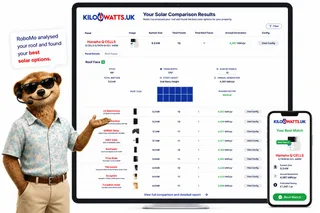
Compare top solar panels for the best performance and value.

Simple, fast & effortless
Provide a few details, sit back and watch your results unfold.
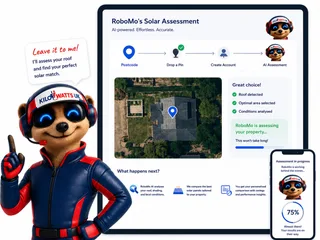
STEP 1
Choose Home, Business or Industrial
Enter your postcode to start your assessment.
STEP 2

Drop a pin on your roof
STEP 3

Create your free account
STEP 4

Sit back and watch RoboMo™ work
RoboMo™ analyses your roof and builds your personalised solar comparison.

Kilowatts UK is an authorised representative
Flower Turbines
Compact vertical-axis turbines built for real UK sites, not just open farmland.
They start in light wind, sit in a small footprint, and are bird-safe by design. Cluster them as a bouquet and the group performs better together than the same turbines standing alone. Enter your postcode for a location-based generation estimate. Figures use area weather data and will differ if buildings, trees or hills sit in the way.
Starts in light UK wind
Built to generate in typical UK wind, not only open farmland.
Small rooftop or ground footprint
Compact towers for roofs, yards and tight sites.
Bird-safe slow rotation
Slow vertical-axis spin, bird-safe by design.
Bouquet clusters raise output
Grouped turbines outperform the same units standing alone.
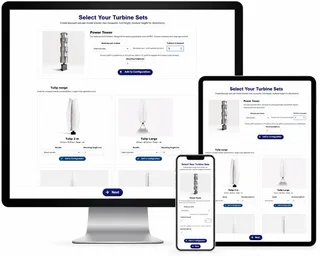
Step 1
Enter your postcode
Start designing your wind energy system in seconds.
STEP 2

Choose a location
STEP 3

Place your cluster
Tap the map where you want the turbine cluster to go.
STEP 4

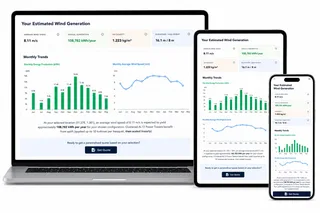
Instant generation forecasts
Compare different turbine layouts and see annual generation forecasts instantly.
STEP 5

No commitment required
Explore different configurations before deciding whether to request a quotation.
Related articles

Mo's Mission Nominations
FAQ
Need Help? RoboMo's Got Answers
Can a UK homeowner claim an Irish government solar panel grant?
No. Irish government solar panel grants are for eligible properties in the Republic of Ireland, not homes in England, Scotland, Wales or Northern Ireland. Eligibility is based on the installation address, not the homeowner’s nationality.
Does an Irish solar grant apply to a home in Northern Ireland?
No. Northern Ireland is part of the UK, so a Republic of Ireland solar PV grant should not be treated as available for a Northern Ireland address. Northern Ireland also has different electricity and policy arrangements from Great Britain, so check NI-specific guidance before relying on advice for England, Scotland or Wales.
What is the SEAI solar PV grant?
SEAI is the Sustainable Energy Authority of Ireland, which administers solar PV support for eligible properties in the Republic of Ireland. The current rules, application process and installer requirements should be checked directly with SEAI. Do not assume the scheme applies to a UK property, even if an installer works on both sides of the border.
What UK support should I check instead of an Irish solar grant?
Start with the official route for the country or area where the panels will be installed. UK homeowners may need to check GOV.UK, Ofgem, devolved government guidance, local authorities, energy suppliers and any relevant household support schemes. Availability and eligibility can change, so confirm the current position before signing a contract.
Is the Smart Export Guarantee the same as a solar panel grant?
No. The Smart Export Guarantee is an export-payment mechanism in Great Britain, not an upfront grant towards installation costs. It may allow eligible small-scale generators to be paid by a participating supplier for electricity exported to the grid, subject to the supplier’s tariff and conditions.
What should I ask an installer before accepting a solar quote?
Ask whether any funding claim is an upfront grant, an export payment or just an estimated bill saving. The quote should explain the system design, expected generation, shading assumptions, battery role, grid connection route and paperwork. Be cautious if an installer says an Irish grant applies to a UK address.
Can solar panels still be worthwhile without a grant?
They can be, but the financial case should be based on realistic assumptions. Savings usually depend on how much solar electricity you use on site, whether you have a battery, export tariff availability and the quality of the installation. A quote should still make sense if no grant or support is approved.