


Industrial Solar Panels UK: Installation, Costs and Payback
Published: 2026-11-26 03:51:40
Updated: 2026-11-25 19:52:45
Planning industrial solar panels for a UK site? Check roof suitability and grid export limits, compare installation quotes and estimate payback.
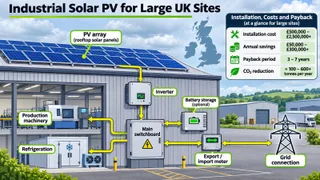
Industrial solar panels in the UK: installation, costs and payback
Industrial solar panels are worth investigating if the roof can support the array and the site uses much of its electricity during daylight hours. Installation costs depend on the roof, access, electrical upgrades and grid connection. To estimate simple payback, divide the upfront cost by the annual net benefit. That benefit includes savings on imported electricity and any export income, minus running costs. Before committing, check the roof’s remaining life, compare projected generation with half-hourly demand and confirm what the local network can accommodate.
A factory with steady daytime production or a cold store with continuous refrigeration may use much of its solar output as it is generated. A warehouse with a large roof and low daytime demand may get a better return from a smaller array unless it can secure worthwhile export terms. A short lease, a roof due for replacement or a costly switchboard upgrade can change the investment case before panel selection begins.
Size the array around when your site uses electricity
Give bidders at least 12 months of half-hourly electricity import data where available. Ask them to account for weekends, shift changes and seasonal shutdowns. If the site already generates electricity, share its generation and export records so bidders can work out total site demand and estimate what the new array would add. Ask them to model more than one array size and show annual generation, direct on-site use, exports and any output lost to export restrictions.
Panel capacity is rated in kilowatt-peak (kWp), inverter AC output in kilowatts (kW) and annual generation in kilowatt-hours (kWh). The agreed export limit applies at the grid connection point. Ask bidders to state each figure and explain how roof orientation, shading and system losses affect their annual generation estimate. If bids specify different modules, use the PV panel comparison guide to help you compare their specifications.
Compare south-facing and east–west layouts against the site’s operating hours. An east–west layout can spread generation across more of the working day. The half-hourly model can show whether that would increase the value of the electricity used on site. Model planned fleet charging, electrified process heat or other major new loads separately, using realistic start dates and operating schedules.
Check the roof and plan installation around operations
Start with the roof condition, structural drawings and expected replacement date. A structural engineer should assess how the deck, purlins and supporting structure will handle the proposed fixings or ballast, wind uplift and temporary installation loads. Agree how the layout will protect rooflights, vents and drainage while preserving access for maintenance and firefighting. If reroofing is already planned, price the jobs together and compare that option with the cost of removing and refitting the array later.
Review the asbestos register and confirm that the survey covers areas the work may disturb. Agree how crews will work around fragile rooflights and sheeting, where lifting equipment will stand and how deliveries will fit around yard traffic and emergency access. Check the roof warranty, insurer requirements and landlord consent before settling the programme. HSE guidance on fragile surfaces and HSE guidance on asbestos surveys.
The electrical survey should confirm the connection point, switchboard capacity, protection requirements and cable routes. Agree when the power can be switched off for connection and testing, who can authorise the outage and how equipment will be restarted. At a cold store, plan how to keep refrigeration running during the outage and allow time to check that equipment has restarted correctly before resuming normal operations.
Check planning and building control before placing orders
Confirm the planning and building control requirements for the proposed design and site address. Send the relevant authority a roof plan and elevations showing panel height, setbacks and any external plant. Ask whether permitted development applies, whether you need prior approval or separate consent and what information building control requires. Mention any listed building or conservation area designation in the enquiry.
In England, start with the Planning Portal’s non-domestic solar guidance. In Wales, use the Welsh Government’s planning guidance for non-domestic solar panels. In Scotland, see Annex C of the Scottish Government’s Planning Circular 2/2024 on non-domestic permitted development rights. In Northern Ireland, check Part 37 of the Planning (General Permitted Development) Order and confirm the position with the council’s planning office.
Establish the grid connection and export limit early
In Great Britain, ask the distribution network operator (DNO) to confirm the connection route early. Large industrial installations generally follow G99. If the design relies on limiting exports, ask whether the DNO requires a scheme that meets G100. Confirm how much the site can export, what reinforcement or protection work is needed, when the connection is likely to be available and what commissioning requires. In Northern Ireland, confirm the applicable process with NIE Networks. G98 and G99 connection guide and Energy Networks Association G100 guidance.
The inverter supplies the site’s electrical system through the switchboard. Site equipment can use that power as it is generated, and any permitted surplus can flow to the network. An export controller measures power at the grid connection point and can reduce inverter output if site demand falls and the surplus would exceed the agreed limit. Ask bidders to estimate how many kWh would be lost to that limit and how a later connection date would affect first-year savings.
With battery storage on site, you can store surplus solar electricity for use when the site would otherwise import power. Compare those savings with the value of exporting the same energy, allowing for conversion losses, usable battery capacity and installed cost. If the site needs backup during a power cut, specify which equipment must keep running and for how long. Standard grid-connected solar generally shuts down during an outage. A backup system must be able to isolate safely from the network and supply the agreed loads.
What drives industrial solar installation costs and payback?
Compare quotes based on the same roof area, electrical connection point and scope of work. Ask bidders to itemise structural work, roof repairs, access equipment, cable runs, switchgear, metering, network charges and commissioning. Separate fixed prices from provisional sums, check how VAT is treated and allow for production downtime and other costs the business will bear directly.
To calculate simple payback, add annual savings on imported electricity to annual export income and subtract annual operating costs. Divide the total upfront cost by that annual net benefit. Base import savings on the unit charge the site avoids when it uses solar. Standing charges and some other bill components may still apply. Use the export rate the site can secure and the volume it can deliver within the agreed grid limit.
Worked example of industrial solar payback
Suppose an installation costs £300,000 upfront and generates 300,000 kWh a year after system losses. In this example, the site uses 240,000 kWh directly at an avoided import cost of 20p per kWh, exports 60,000 kWh at 6p per kWh and spends £5,000 a year on operations and maintenance.
The site saves £48,000 on imports and earns £3,600 from exports. After operating costs, the annual net benefit is £46,600. Dividing £300,000 by £46,600 gives a simple payback of about 6.4 years.
If reduced daytime operations cut direct use to 150,000 kWh and the site can export the remaining 150,000 kWh, import savings fall to £30,000 and export income rises to £9,000. With the same operating costs, the annual net benefit falls to £34,000 and simple payback rises to about 8.8 years. The return falls further if the export limit keeps some of that surplus from reaching the grid. Model demand and generation in half-hourly intervals to see when the site would reach the limit. Before approving the investment, ask for a year-by-year cash-flow forecast that covers tariff changes, panel degradation, inverter replacement, financing and any planned roof work that would require removing and refitting the array. Use the calculation above to check the bidder’s assumptions against the site’s bills, proposed export contract and operating plans.
Compare outright purchase with an on-site power purchase agreement
With outright purchase, the business pays for the installation and takes responsibility for the equipment and its maintenance. Under an on-site power purchase agreement (PPA), a third party typically funds and owns the system, and the site buys electricity under a contract. Compare both options using the same assumptions for generation and demand. Check how the terms would work if production fell, the business moved or the roof needed replacing.
Choose an installer who can deliver on a live industrial site
Give shortlisted installers the same brief. Include half-hourly electricity data, roof drawings or survey reports, a site electrical single-line diagram where available and the times when crews can access the site or shut down equipment. Ask who will handle structural design, the grid application and commissioning. Have bidders flag costs and assumptions that could change after the roof survey, switchboard inspection or connection offer. Ask for references from sites with similar roofs, electrical infrastructure and operating constraints.
Agree what the installer will provide at handover before signing. It should include as-built drawings, test results, isolation procedures, access to monitoring, warranty documents and contacts for reporting faults. Agree who will check performance and how they will tell whether a drop in output is due to a fault or an export limit.
Use Kilowatts UK’s industrial solar installation comparison tool to shortlist installers. Ask each for the recommended array size, expected on-site use, export assumptions, outage plan and full project cost. Have the facilities and finance teams review the same figures so the investment case reflects how the site operates.
Solar comparison
Compare solar for your property
Enter your postcode to assess your roof, compare solar options and get quotes from UK installers.
- Free postcode start
- Home, business and industrial
- RoboMo™ maps your roof
See which panels fit your roof
Choose home, business or industrial, then enter your postcode. RoboMo maps the roof and ranks panel brands by fit.
1. Postcode Start the assessment for your property.
2. Pin the roof Mark the array on the map.
3. Compare RoboMo™ builds your options.

Battery ROI tool
See what a battery saves on your bill
Enter the day rate, off-peak rate and export rate. The calculator ranks batteries in the Kilowatts shop over 10 years. Home batteries also suit offices and small commercial sites.
Reading
Sources and further reading
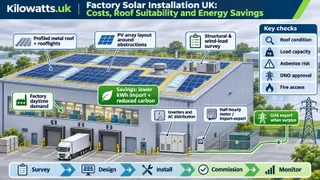
Assess roof suitability and budget for a UK factory solar installation. See how production shifts and grid export limits affect electricity savings.
Read article

Worth depends on your roof, daytime use and the export tariff you can get. This page sets out how to judge a 2026 UK install.
Read article
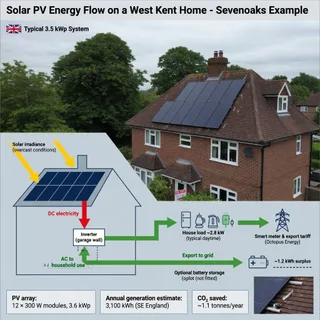
Solar panel installation in Sevenoaks is a roof, shade and planning job under UK Power Networks, not a town price.
Read article
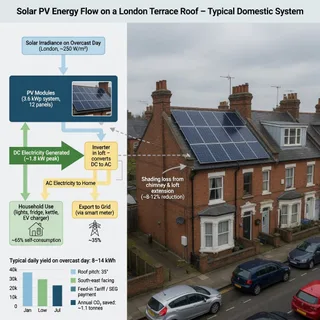
Solar panel installation in London turns on roof area, shade, the lease and UK Power Networks, not the borough. A survey sets the layout and consents.
Read article


Mo's Solar Mission
Mo's Mission Nominations
Garlinge Primary School and Nursery
Garlinge Primary School and Nursery is a foundation primary school on Westfield Road in Margate, Kent, for children aged 3 to 11. It is m...
St Luke's Church of England Primary SchoolSt Luke's Church of England Primary School is a voluntary controlled Church of England primary school on Jubilee Road in Formby, Merseysi...
Comberbach Nursery and Primary SchoolComberbach Nursery and Primary School is a primary academy on Mather Drive in the village of Comberbach, near Northwich in Cheshire, for...
Locations
Solar installation near you
Write for Kilowatts.uk
Got a trade and something worth saying?
Write it here under your own name. Sign in, put a profile up, and start a guide. Pay only if you want more links from your articles out to your own site.
Register
Create a Kilowatts.uk account, or sign in if you already have one.
Author profile
Put your name, photo and experience on a public author page.
Start creating
Write a guide or a blog. Free authors can put one followed link to their own site in articles each month.
FAQ
Need Help? RoboMo's Got Answers
How do I choose the right size solar array for a factory or warehouse?
Give installers at least 12 months of half-hourly electricity data where available, including weekends and shutdowns. Ask them to model several array sizes and show how much electricity the site would use directly, export or lose to export limits. A warehouse with low daytime demand may get a better return from a smaller array.
What affects the cost of installing industrial solar panels?
Costs depend on the roof condition, access for lifting equipment, cable routes and any switchboard or grid connection work. Ask each installer to price the same scope and identify which costs could change after surveys or a connection offer. Budget separately for any production downtime the business will bear.
How do I work out the payback period for industrial solar panels?
Divide the total upfront cost by the annual net benefit. To estimate that benefit, add the savings from buying less electricity to any export income, then subtract annual operating costs. Use the import unit charge your site actually avoids, the export rate it can secure and the amount it can export within its agreed limit. Ask for a year-by-year forecast that includes financing, declining panel output and eventual inverter replacement.
Can my industrial roof support solar panels, and will installation disrupt operations?
Ask a structural engineer to assess the roof and confirm it can support the proposed array and installation loads. If the roof is due for replacement, compare doing both jobs together with the cost of removing and refitting the panels later. Agree access, lifting arrangements and any power outage needed for connection and testing before work begins.
Do I need planning permission or building control approval for industrial solar panels?
Requirements depend on the site location and the proposed design. Share a roof plan and elevations with the relevant authority and ask whether permitted development, prior approval or planning permission applies. Mention any listed building or conservation area designation and confirm what building control requires before placing orders.
Can an industrial solar installation export surplus electricity to the grid?
Ask the local distribution network operator, or NIE Networks in Northern Ireland, to confirm the connection process and how much power the site can export. Check whether the design needs export-limiting equipment and whether connection works could delay commissioning. Ask the installer to estimate how much generation the site might lose when the export limit is reached.
Is battery storage worth adding to an industrial solar installation?
A battery can store surplus solar electricity for times when the site would otherwise buy power from the grid. Compare those savings with the income the same electricity could earn from export, allowing for installed cost, usable capacity and conversion losses. If you need backup during a power cut, specify which equipment must keep running and for how long so the installer can design for it.
Should I buy the solar installation outright or use an on-site power purchase agreement?
With outright purchase, the business pays for the system and takes responsibility for maintenance. Under an on-site power purchase agreement, a third party typically funds and owns the system, and the business buys the electricity under contract. Compare both options using the same generation and demand forecasts, then check how the contract handles price increases, minimum purchases, roof repairs and early termination.
Live help
Need help right now?
Talk to RoboMo™ and get instant answers.