LinkedIn profile for David Coleman David Coleman
Founder & Renewable Energy Author, kilowatts.uk


LinkedIn profile for David Coleman David Coleman
Founder & Renewable Energy Author, kilowatts.uk
Article
We may earn a commission if you buy through these links, at no extra cost to you.
How to choose a portable power station in the UK: Wh vs W, surge, LiFePO4 vs NMC, solar input and safe charging, with a spec comparison and prices dated 9 Nov 2026.
A portable power station is a self-contained battery with its own mains-style sockets, USB ports and a built-in inverter. You can charge it from a wall socket, a car or solar panels, then use it to run things directly: a router and laptop in a power cut, or tools at the end of the garden.
This guide explains how to size one properly, what the battery chemistry and solar figures on spec sheets actually mean, and what UK buyers should watch for. It ends with a shortlist by use case and a comparison table.
We compared models on the specs their manufacturers publish: usable capacity (Wh), continuous and surge output (W), battery chemistry and cycle rating, solar input limits, UPS switchover time, weight and the price on the brand's own UK store. We have not hands-on tested these products, and nothing here is a review. Prices and specs are from EcoFlow UK's product pages as of 9 Nov 2026. Prices change often, so check the current figure before you buy. We link to EcoFlow because we have an affiliate relationship with EcoFlow UK. Other brands sell similar units, and we have not ranked anything by commission.
A portable power station is not a home battery. An installed home battery is wired into your consumer unit, usually charges from solar or a cheap overnight tariff, and only keeps the house running in a power cut if it was designed with backup in mind. If you want a whole home or several circuits covered automatically, read whether a home battery can work during a power cut and how a home battery works first.
A power station makes more sense when you want to keep a few specific things going, need power somewhere without a socket, or rent and cannot install anything permanent.
The continuous output rating (for example 600W or 1800W) is the most power the inverter can supply at the same time. Add up the wattage of everything you want to run together and keep comfortably below that figure. The wattage is printed on the appliance's label or power adapter; use that rather than a guess.
Capacity in Wh is the energy stored. As a rough guide, multiply each appliance's watts by the hours you want to run it, then add the results. For example, if your router's label says 12W and you want 10 hours, that is 120Wh. A 60W laptop charged for 2 hours adds another 120Wh.
Not all of the rated capacity reaches your devices. Converting battery power to 230V AC loses some energy, and the unit uses a little itself. A sensible planning assumption is to expect noticeably less than the headline figure from the AC sockets (many people plan on around 80–85%; this is a rule of thumb, not a manufacturer figure). Using the USB-C or 12V outputs for devices that support them avoids some of that conversion loss.
A power station can run an appliance if the appliance's running watts are below the continuous output and its start-up demand is below the surge rating. For runtime, a simple planning formula is: hours ≈ capacity (Wh) × 0.85 ÷ load (W), using the 85% rule of thumb above for AC losses. For example, a 572Wh unit powering items whose labels add up to 20W gives roughly 572 × 0.85 ÷ 20 ≈ 24 hours. A 1024Wh unit running a 100W load gives roughly 1024 × 0.85 ÷ 100 ≈ 8.7 hours. Fridges cycle on and off, so measure or estimate their average draw rather than using the label wattage for the whole period.
Heating appliances are the usual trap. Kettles, heaters, hairdryers and toasters draw a lot of power (check the label; many UK kettles are rated at 2–3kW), which exceeds small units outright and drains even large ones quickly. Power stations are best at running electronics, lights, networking kit and small motor loads.
Fridges, freezers, pumps and some power tools draw several times their running wattage for a moment when the motor or compressor starts. That is what the surge (or peak) rating is for. If you want to run a fridge, check that the surge figure is well above its start-up demand, not just its running wattage. Some brands also advertise a "boost" mode (EcoFlow calls it X-Boost) that runs resistive appliances such as kettles at reduced power; it does not increase the battery capacity.
Some units switch over within milliseconds when the mains drops, acting as an uninterruptible power supply. That suits routers, computers and network kit. Check the stated switchover time, and remember that a portable power station's UPS only covers what is plugged into it.
Most current power stations use lithium iron phosphate (LiFePO4, also written LFP). Manufacturers typically rate LFP for thousands of cycles before capacity drops to 80%, and the chemistry is more thermally stable. The trade-off is weight: LFP is heavier for the same capacity.
Older and some ultra-light models use NMC (nickel manganese cobalt) cells, which pack more energy into less weight but are usually rated for fewer cycles. If the unit will sit ready for power cuts or be used every weekend, LFP is generally the better long-term choice. If every kilo matters, for example carrying it any distance, NMC can still make sense. Always read the cycle rating on the manufacturer's spec sheet rather than relying on the chemistry name alone.
Every power station has a maximum solar input in watts and an accepted voltage range. Two things matter:
Be realistic about UK sunshine. Portable panels rarely deliver their rated wattage outside ideal test conditions, and winter output in the UK is far lower than summer. Treat solar as a top-up in winter and a meaningful source in summer. For choosing panels themselves, see our guide to the best portable solar panels in the UK.
For keeping broadband and a laptop running, a few hundred Wh with a fast UPS switchover is usually enough. The EcoFlow RIVER 3 Max is a RIVER 3 Plus with a 286Wh extra battery, for 572Wh in total. EcoFlow UK lists it with LiFePO4 cells rated for 3,000 cycles to 80%, 600W AC output across three sockets (1200W surge), a USB-C port of up to 100W and a UPS switchover of under 10 ms (£329 on EcoFlow UK, as of 9 Nov 2026; EcoFlow UK lists this as a pre-order, shipping from mid-November 2026). The extra battery can be removed, so the RIVER 3 Plus part (4.7kg) can be carried on its own.
A fridge needs both more capacity and enough surge to start the compressor. The EcoFlow DELTA 3 is listed at 1024Wh LFP (rated for 4,000 cycles to 80%), with 1800W AC output (3600W surge) across four AC sockets, under 10 ms UPS switchover and one 500W solar input (11–60V). It weighs up to 12.5kg and can be expanded with extra batteries to 5kWh (£649 on EcoFlow UK, as of 9 Nov 2026). The EcoFlow DELTA 3 Max doubles the capacity to 2048Wh with 2400W AC output (4800W surge) and 500W solar input, but weighs about 20.3kg (£1,199 on EcoFlow UK, as of 9 Nov 2026; EcoFlow UK lists this as a pre-order, with shipment from 21 December 2026).
If you are weighing up whole-home backup instead, our power cut guide covers what an installed battery can and cannot do.
For phones, laptops, lights, cameras and 12V devices, weight and port mix matter more than huge capacity. The EcoFlow TRAIL 200 DC is a DC-only unit (no AC socket) listed at 192Wh LFP, 1.83kg, with 140W and 100W USB-C ports (£129 on EcoFlow UK, as of 9 Nov 2026). It suits USB kit, not mains appliances, and it charges through USB-C rather than a dedicated solar port. If you need a mains socket, the EcoFlow RIVER 3 Plus Solar Generator with a 160W panel pairs a 286Wh LiFePO4 unit (600W AC across three sockets, 1200W surge, up to 220W solar input, 4.7kg) with a 160W portable panel (£418 for the bundle on EcoFlow UK, as of 9 Nov 2026; EcoFlow UK lists the 160W panel option as a pre-order, with shipment from 1 December 2026).
Other brands sell portable power stations too. Whichever you consider, compare the same published figures: usable Wh, continuous and surge watts, cycle rating, solar input range, UPS switchover time and weight.
A power station plus portable panels is a "solar generator": the panels charge the battery, and you run appliances from the battery's own sockets. Because it is not connected to your home wiring, it is a different thing from plug-in or balcony solar, which feeds your home circuits and has its own UK rules (see plug-in solar in the UK).
Check that a panel's open-circuit voltage and connector match your station's solar input. For panel choices, see our portable solar guide.
| Model | Capacity | Chemistry | AC output (surge) | Max solar input | UPS switchover | Weight | UK price, 9 Nov 2026 |
|---|---|---|---|---|---|---|---|
| EcoFlow TRAIL 200 DC | 192Wh | LFP | No AC (220W max DC) | No solar port (USB-C charging) | Not listed | 1.83kg | £129 |
| EcoFlow RIVER 3 Plus (+160W panel) | 286Wh (expandable to 858Wh) | LiFePO4, 3,000 cycles to 80% | 600W, 3 sockets (1200W) | 220W (11–55V) | <10 ms | 4.7kg (power station) | £418 (bundle; pre-order, ships from 1 Dec 2026) |
| EcoFlow RIVER 3 Max | 572Wh (RIVER 3 Plus + 286Wh extra battery) | LiFePO4, 3,000 cycles to 80% | 600W, 3 sockets (1200W) | 220W (11–55V) | <10 ms | 4.7kg plus extra battery (not listed) | £329 (pre-order, ships from mid-Nov 2026) |
| EcoFlow DELTA 3 | 1024Wh (expandable to 5kWh) | LFP, 4,000 cycles to 80% | 1800W, 4 sockets (3600W) | 1 × 500W (11–60V) | <10 ms | ≤12.5kg | £649 |
| EcoFlow DELTA 3 Max | 2048Wh | LFP | 2400W, 4 sockets (4800W) | 500W | 10 ms | about 20.3kg | £1,199 (pre-order, ships from 21 Dec 2026) |
Source: EcoFlow UK product pages, 9 Nov 2026. "Not listed" means we could not find the figure on EcoFlow UK's page. Pre-order shipping dates are as EcoFlow UK listed them on that date. Prices and stock change often, so check before you buy.
Add up the watts of what you want to run at the same time (this sets the minimum continuous output), then multiply each item's watts by the hours you need it and add them up (this sets the Wh capacity). Allow headroom for inverter losses and for start-up surges from fridges and pumps. A router, phone charging and a few lights need far less than a fridge-freezer.
LiFePO4 (LFP) cells are usually rated for many more charge cycles and are more thermally stable, but they are heavier for the same capacity. NMC is lighter and more compact. For a unit you keep for power cuts or regular use, LFP is the more common choice now.
No. Never connect a power station to your home's wiring through a socket. Feeding power back into the house circuits is dangerous for you and for network engineers. Whole-circuit backup needs a properly installed changeover or transfer arrangement fitted by a qualified electrician.
Sometimes, but slowly. Panels rarely deliver their rated wattage in the UK, and winter output is much lower than in summer. Treat solar as a top-up in winter and plan to recharge from the mains when you can.
No. A home battery is installed, wired into your consumer unit and usually works with solar and your tariff. A portable power station is a self-contained battery with its own sockets that you plug appliances into directly.
Solar comparison
Enter your postcode to assess your roof, compare solar options and get quotes from UK installers.
Choose home, business or industrial, then enter your postcode. RoboMo maps the roof and ranks panel brands by fit.
1. Postcode Start the assessment for your property.
2. Pin the roof Mark the array on the map.
3. Compare RoboMo™ builds your options.
Battery ROI tool
Enter the day rate, off-peak rate and export rate. The calculator ranks batteries in the Kilowatts shop over 10 years. Home batteries also suit offices and small commercial sites.
Reading
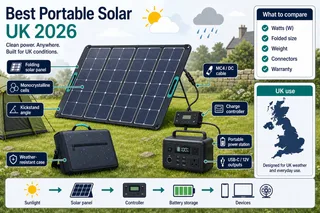
Discover the best portable solar panels for the UK market in 2026. Our expert guide reviews top-rated products for charging devices, camping.
Read article
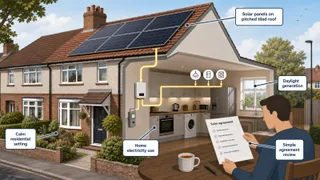
A power purchase agreement solar deal is a long-term contract where a third party funds, owns and usually maintains solar panels on your roof.
Read article
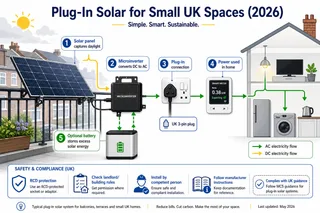
Discover the top plug-in solar kits for UK homes in 2026. Perfect for small roofs, rentals, or low-commitment solar power.
Read article
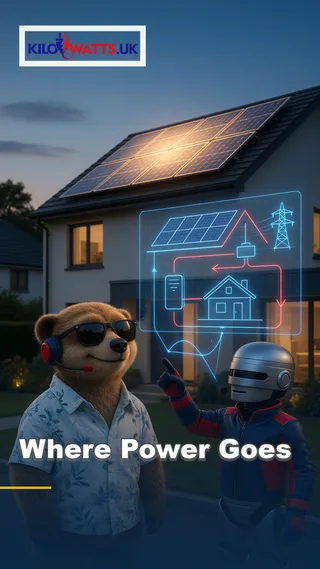
This episode of Solar, Clearly, Mo and RoboMo explore where your solar power actually goes. Learn how your electricity is constantly choosing where to go.
Read article
Write for Kilowatts.uk
Write it here under your own name. Sign in, put a profile up, and start a guide. Pay only if you want more links from your articles out to your own site.
Create a Kilowatts.uk account, or sign in if you already have one.
Put your name, photo and experience on a public author page.
Write a guide or a blog. Free authors can put one followed link to their own site in articles each month.
FAQ
Live help
Talk to RoboMo™ and get instant answers.
Live chat