


Cheapest Home Batteries UK (2026): Real Prices & Costs
Published: 2026-08-24 08:51:26
Updated: 2026-08-24 01:52:27
You want a straight answer in pounds, with VAT included, and a realistic sense of what installation will add.
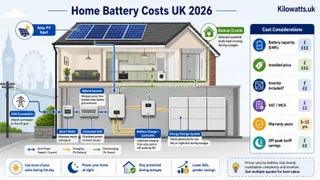
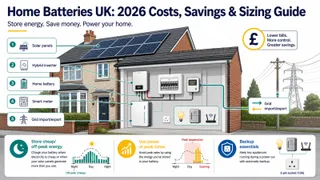
How a Home Battery Works
You want a straight answer in pounds, with VAT included, and a realistic sense of what installation will add.
Overview
If you are asking what the cheapest home batteries in the UK actually cost right now, you have probably already discovered that the internet is full of American prices, DIY forum debates, and sales pitches that do not translate to a terraced house in Manchester or a bungalow in Cardiff. You want a straight answer in pounds, with VAT included, and a realistic sense of what installation will add. You also want to know whether the cheapest option today will still look cheap in eight years. At Kilowatts.uk, we model real savings using our AI-powered RoboMo assessment, and we connect homeowners with vetted UK installers who quote accurately rather than optimistically. This guide gives you the honest numbers, the trade-offs, and the questions to ask before you commit.
Why "Cheapest" Is a Trap (And What to Compare Instead)
The cheapest battery per kilowatt-hour is rarely the cheapest per usable kilowatt-hour over ten years. A £500 battery that lasts 2,000 cycles is worse value than a £900 battery that lasts 6,000 cycles, even though the first one looks like a bargain on the shelf. The metric that matters is cost per kWh per cycle, not the headline price.
UK buyers also face different economics than the American sources that dominate search results. VAT on standalone batteries is currently 0% in 2026, which helps, but UK labour rates, British weather patterns, and our grid tariffs all shift the maths. A cheap unbranded import with no UK support, no CE or UKCA certification, and no warranty backup is a false economy. This article shows you the genuinely cheapest options at every level: DIY, budget prebuilt, and value-for-money premium. You will see where each makes sense, and where it does not. If you are still getting familiar with the basics, start with how a home battery works before comparing prices.
What Actually Drives the Price of a Home Battery?
Cells are the biggest cost. In 2026, LiFePO4 (LFP) chemistry dominates because it is safe, stable, and affordable. Grade A cells come with full traceability and tested capacity. Grade B cells are cheaper but may have cosmetic defects or slightly reduced capacity. Buying ungraded stock is a gamble.
The Battery Management System (BMS) is the safety brain. A cheap BMS can overcharge cells, allow dangerous temperatures, or fail to balance the pack. This is not the place to cut corners. Enclosure and form factor also matter. Wall-mounted units cost more to manufacture than simple server-rack boxes, so you pay for aesthetics.
Certification adds cost for a reason. UKCA or CE marking, UN38.3 transport certification, and compliance with BS 7671 wiring regulations protect your home and your insurance. Finally, you are paying for brand, warranty, and UK support. Someone answering the phone in 2029 when a cell fails has real value. If you are weighing up brand support, chemistry, warranty and expansion, our guide to choosing a home battery is a useful companion.
The Real Cost of Home Batteries in the UK (2026 Prices)
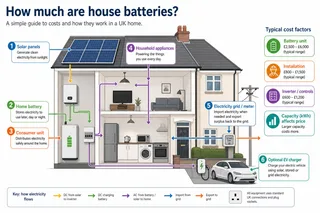
Let us talk in pounds. Budget prebuilt systems of 5 to 10 kWh typically range from £1,500 to £3,500 including VAT. Mid-range units of 10 to 15 kWh sit between £3,500 and £6,000. Premium integrated systems from Tesla, GivEnergy, or Fox ESS start at £6,000 and can exceed £10,000 before installation.
The US research data often quotes 6 to 6 per kWh. In the UK, that translates to roughly £120 to £160 per kWh once you account for shipping, distributor margins, and currency conversion. Prices have been falling steadily through 2025 into 2026, which is good news.
Installation is separate. Typical UK labour runs £800 to £2,000 depending on consumer unit upgrades, cabling runs, and scaffolding. A typical 10 kWh installed system lands at £5,000 to £8,000 all-in as of mid-2026, before any Smart Export Guarantee earnings. London and the South East tend to cost more for labour. For a deeper breakdown of installed pricing, see our guide to home battery cost.
The Genuinely Cheapest Options in the UK Right Now
Option 1 — Budget Prebuilt Batteries (The Safe "Cheapest")
For most homeowners, a budget prebuilt battery is the smartest way to get a warranty, a certified product, and no DIY risk. UK-available brands worth shortlisting include Fogstar, which is highly regarded for value, along with Poweroak and Eco-Worthy. A 5 kWh unit from these brands typically costs £1,200 to £1,800, putting the price per kWh at £240 to £360, higher than the raw cell cost but far safer.
Cheaper prebuilt units from Chinese brands sold via Amazon UK can undercut these prices, but after-sales support and certification are inconsistent. These units usually use LFP cells, offer 3,500 to 6,000 cycles, and carry 5 to 10 year warranties. A 5 kWh budget unit works well as a starter system, especially paired with off-peak tariffs like Octopus Flux or Intelligent Go.
Option 2 — DIY Battery Builds (The True Cheapest, If You're Brave)
A DIY build genuinely delivers the lowest cost per kWh. Raw LFP cells, such as EVE 280K units, cost roughly £60 to £80 per kWh in the UK. Add a BMS at £100 to £250, plus an enclosure, busbars, breakers, and cabling, and you land at around £100 to £120 per kWh all-in. A 15 kWh DIY battery can be built for under £2,000.
The hidden costs are real. Tools, testing equipment, and your own time add up. Many builds take 10 to 20 hours. Safety is the bigger concern. LFP cells store enormous energy, and a short circuit or poor BMS configuration can cause fires. Most UK home insurance policies will not cover self-built battery systems. DIY systems also will not qualify for MCS certification, which means you cannot access SEG export payments. That is a significant financial downside.
Option 3 — Used EV Battery Repurposing (The Niche Cheapest)
Used Nissan Leaf or Tesla Model S modules can be sourced in the UK for £40 to £60 per kWh via eBay or breakers. That is the cheapest raw storage you will find. The challenges are substantial. High-voltage DC is lethal, you need custom BMS integration, and you may need a battery emulator for the inverter to communicate properly.
This route is getting harder as EV batteries become more integrated and harder to repurpose. It is only "cheapest" if you value your time at zero and have advanced electrical skills. For grid-tied homes, it is not recommended.
How to Get the Cheapest Installed Price (Without Getting Burned)
Buy the battery and installation as a package. Installers get trade discounts on hardware, often 20 to 30% below retail, so a bundled quote can beat buying separately. Get at least three quotes. Our free solar and battery assessment matches you with vetted UK installers, and our RoboMo AI models your roof and usage to give installers accurate context, which leads to more precise quotes.
Time your purchase. Battery prices have been dropping steadily, and installer demand is lower in late autumn and winter. Check grant and scheme eligibility. The Boiler Upgrade Scheme does not cover batteries, but some local authorities offer home energy grants. Ask your DNO about flexibility payments for battery control. Finally, factor in SEG tariffs. A battery that earns export payments at 15 to 25p per kWh via Octopus Outgoing can pay back faster.
The Smart Buyer's Checklist: What to Verify Before You Commit
Confirm UKCA or CE marking and that the battery meets BS 7671 wiring regulations. Your installer must sign off on this. Check warranty terms carefully. What is covered: cells, BMS, labour? For how long? Does the warranty survive a house sale?
Understand cycle life versus calendar life. Most LFP batteries are rated for 6,000 to 8,000 cycles but also have a 10-year calendar limit, whichever comes first. Check scalability. Can you add a second battery later? Some brands, including GivEnergy and Fox ESS, make expansion easy. Others lock you in. Confirm compatibility with your inverter. If you already have solar, ensure the battery is AC-coupled or DC-coupled appropriately. This is where a good installer earns their fee. If you are retrofitting storage, read our guide on how to add a battery to an existing solar system.
Is a Cheap Battery Actually Worth It? (The Payback Reality Check)
For most UK homes, a battery's payback period is 5 to 9 years depending on tariff, usage, and battery size. Ignore the 3-year claims some marketers make. Here is a simple worked example. A 10 kWh battery costing £5,500 installed, shifting 8 kWh per day from off-peak at 7p per kWh to peak at 28p per kWh, saves roughly £613 per year. That is a payback of about 9 years.
Add SEG earnings. Exporting 5 kWh per day at 15p per kWh adds £274 per year, cutting payback to around 6 years. The cheapest battery is not always the best payback. A slightly pricier, higher-cycle battery may outlive a budget unit and deliver better lifetime value. Energy independence and blackout resilience have value beyond pure financial return. To test the numbers properly, use a full battery payback calculation rather than relying on headline savings claims.
Final Verdict — What Should You Buy in 2026?
For most homeowners, buy a mid-range prebuilt LFP battery of 5 to 10 kWh from a UK-supported brand like Fogstar, GivEnergy, or Fox ESS. That is the cheapest option that will not let you down. For off-gridders with electrical skills, DIY builds genuinely deliver the lowest cost per kWh, but only if you accept the safety and warranty trade-offs.
For everyone, use our AI-powered solar assessment to model your actual usage and get matched with trusted, vetted UK installers for free. No pressure, just accurate quotes. The cheapest home battery in the UK in 2026 is the one that fits your usage, your roof, and your risk tolerance. That is a decision you can now make with confidence.
Plan, Compare & Buy Renewable Energy Solutions
AI does the thinking.
You get the perfect solar match.
Use RoboMo™ to assess your property, compare available technologies and connect with trusted UK installers, suppliers and manufacturers.
Simply enter your postcode, drop a pin on your roof, create your free account and let RoboMo™ analyse your property to find the best solar panels for your home.

You don't have to think
RoboMo™'s AI analyses your roof and does all the hard work.

Accurate & tailored
AI-powered assessment based on your roof, location, and conditions.

Best options, maximum savings
Compare top solar panels for the best performance and value.

Simple, fast & effortless
Provide a few details, sit back and watch your results unfold.
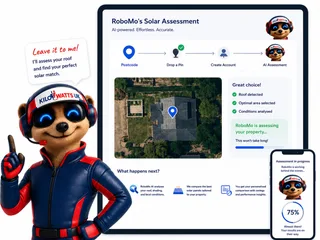
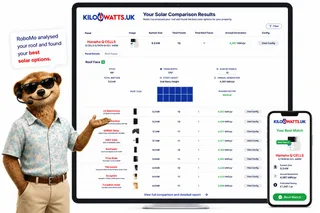
STEP 1
Choose Home, Business or Industrial
Enter your postcode to start your assessment.
STEP 2

Drop a pin on your roof
STEP 3

Create your free account
STEP 4

Sit back and watch RoboMo™ work
RoboMo™ analyses your roof and builds your personalised solar comparison.
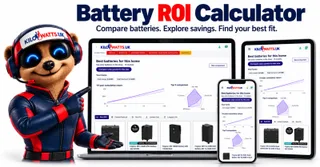
BATTERY ROI TOOL
See what a battery saves on your bill
Enter the day rate, off-peak rate and export rate. The calculator ranks batteries in the Kilowatts shop over 10 years.
Home batteries also suit offices and small commercial sites. Industrial batteries are listed on their own calculator.

Step 1
Enter your postcode
Start designing your wind energy system in seconds.
Are you an installer, distributor or renewable energy business?
Kilowatts UK is expanding the Flower Turbines partner network across the UK.
Become A Flower Turbines PartnerKilowatts UK is an authorised representative
Flower Turbines
Compact vertical-axis turbines built for real UK sites, not just open farmland.
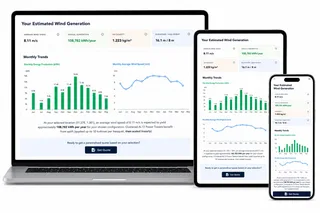
They start in light wind, sit in a small footprint, and are bird-safe by design. Cluster them as a bouquet and the group performs better together than the same turbines standing alone. Enter your postcode for a location-based generation estimate. Figures use area weather data and will differ if buildings, trees or hills sit in the way.
Starts in light UK wind
Built to generate in typical UK wind, not only open farmland.
Small rooftop or ground footprint
Compact towers for roofs, yards and tight sites.
Bird-safe slow rotation
Slow vertical-axis spin, bird-safe by design.
Bouquet clusters raise output
Grouped turbines outperform the same units standing alone.

STEP 2

Choose a location
STEP 3

Place your cluster
Tap the map where you want the turbine cluster to go.
STEP 4

Instant generation forecasts
Compare different turbine layouts and see annual generation forecasts instantly.
STEP 5

No commitment required
Explore different configurations before deciding whether to request a quotation.
Related articles
Mo's Mission Nominations
FAQ
Need Help? RoboMo's Got Answers
How does a home battery work?
A home battery stores electricity so you can use it later instead of taking power from the grid at that moment. It can charge from solar panels, from the grid on an off-peak tariff, or both. An inverter converts electricity between the battery’s DC power and the AC power used in your home.
Can I install a home battery without solar panels?
Yes, many UK homes use a battery without solar by charging it on a cheaper off-peak tariff and using the stored energy during peak-rate hours. Whether it saves money depends on your tariff, daily electricity use, battery size and round-trip efficiency. Solar can add value, but it is not essential for every household.
What size home battery should I buy for a typical UK home?
Many UK homes start by considering a battery in the 5 to 10 kWh range, but the right size depends on your electricity use, solar generation, tariff and aims. A battery that is too small may run out quickly, while an oversized one may not earn back the extra cost. A good installer should use your bills, smart meter data or half-hourly usage where available.
What is the cheapest sensible home battery option for most UK homes?
For most homeowners, the cheapest sensible option is usually a budget or mid-range prebuilt LFP battery with UK support, clear warranty terms and suitable certification. DIY batteries can be cheaper per kWh, but they bring safety, insurance, certification and after-sales risks. For a grid-connected home, the lowest upfront price is not always the best value.
How much does a home battery cost in the UK?
Costs vary widely because the battery, inverter, installation labour, cabling, consumer unit work and monitoring setup can all affect the final quote. Smaller prebuilt batteries may cost a few thousand pounds before installation, while larger or premium systems can cost considerably more. Always compare like-for-like installed quotes, not just the price of the battery box.
Will a home battery keep my house running in a power cut?
Not every home battery provides backup power automatically. Many standard grid-connected systems shut down during a power cut unless they have a dedicated backup or emergency power setup. If blackout protection matters to you, ask the installer exactly which circuits can be backed up and for how long.
Do I need DNO permission for a home battery?
Your installer should check whether the battery and inverter need notification or approval from your local Distribution Network Operator. The requirement depends on the inverter capacity, whether the system can export, and how it connects to your home. Do not assume a battery can simply be plugged into an existing circuit.
How long does a home battery last?
Most modern home batteries gradually lose usable capacity over time rather than suddenly failing. Lifespan depends on chemistry, depth of discharge, temperature, cycle count, installation quality and how the system is controlled. Check both the cycle warranty and the calendar warranty, and ask what capacity is guaranteed at the end of the warranty period.