


The Voltage The Inverter Keeps Hunting
Published: 2026-11-26 21:51:46
Updated: 2026-11-26 13:58:20
An inverter doesn't just convert DC to AC — its MPPT circuitry constantly re-hunts the array's optimum operating voltage, because the maximum power point m

Watch the video
An inverter doesn't just convert DC to AC its MPPT circuitry constantly re-hunts the array's optimum operating voltage, because the maximum power point m
""
An inverter doesn't just convert DC to AC. Its MPPT circuitry constantly re-hunts the array's optimum operating voltage, because the maximum power point moves with every change in light and cell temperature. This short Kilowatts UK film is a companion to a real design question, not a sales pitch. The page below restates what the film teaches, then puts it in practical UK-home context so the article still stands if you cannot play the video.
What the film is asking
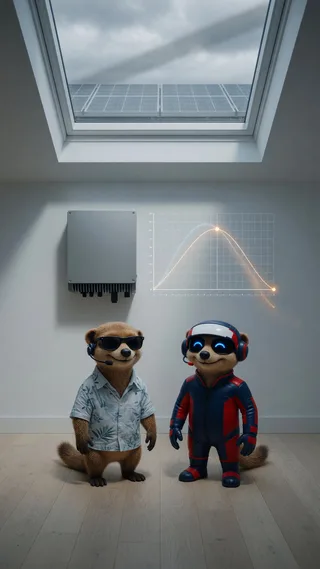
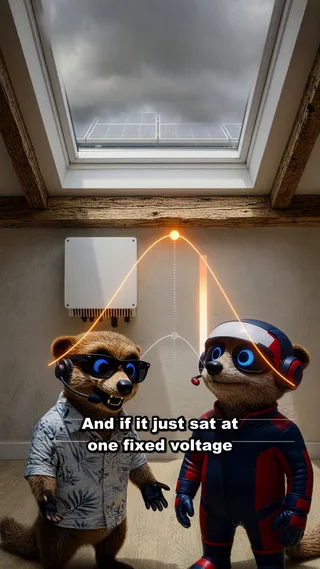
The episode title is “The Voltage The Inverter Keeps Hunting”. The premise is simple: An inverter doesn't just convert DC to AC. Its MPPT circuitry constantly re-hunts the array's optimum operating voltage, because the maximum power point moves with every change in light and cell temperature. On screen: ONE LOCATION: a converted UK loft, wall-mounted inverter humming, large rooflight above showing the roof array and fast-moving cloud. Beat 1 opens mid-event, with a cloud shadow already racing across the rooflight. An elegant floating data visualisation beside the inverter shows the array's power curve collapsing while a tracking marker skids down the slope, live watts falling. Mo stands watching the curve; RoboMo's visor reflects it. Beat 2: light returns through the rooflight, the curve swells back upward and the marker climbs, overshoots slightly, then settles precisely on the new peak. A fine dotted line dropping to the voltage axis shows the operating point has shifted, not just the output. Beat 3: time accelerates inside the same loft. Cloud after cloud sweeps the rooflight, the curve breathing in and out while the marker snaps to each new peak, and a second, dimmer ghost trace locked at one fixed voltage falls steadily behind as a cumulative energy counter rises above it. No cuts, no new location. That is the whole point of the film. Two homes can look identical and still need different solar and storage designs if they use electricity at different times of day.
What Mo and RoboMo actually say
The spoken script is short on purpose. Each line is a design point, not filler. Is there one best voltage for the panels? No. The inverter re-hunts that optimum voltage as light and temperature shift. So the peak itself moves, not just the output? Correct. Brighter light and cooler cells relocate the maximum power point. And if it just sat at one fixed voltage instead? It would sit below the peak most of the day and quietly surrender that energy. Is there one best voltage for the panels? No. The inverter re-hunts that optimum voltage as light and temperature shift. So the peak itself moves, not just the output? Correct. Brighter light and cooler cells relocate the maximum power point. And if it just sat at one fixed voltage instead? It would sit below the peak most of the day and quietly surrender that energy. Read those lines as engineering, not marketing. The film is teaching you to size the system around measured demand rather than around how the house looks from the street.
Why identical houses can need different systems
A solar inverter's MPPT (maximum power point tracking) circuitry continuously adjusts the voltage it draws the array at, because the array's maximum power point shifts with light level and cell temperature. Solar on the roof makes electricity when there is daylight. A home that uses most of its power while the sun is up can consume a lot of that generation directly. A home that stays quiet all day and then loads up in the evening with cooking, heating or EV charging needs somewhere to put surplus daylight energy, or it exports it and buys it back later. So the same roof, the same panels and even the same installer quote can still be the wrong design if the demand curve is different. The battery is not a fashion extra. It is how you move daytime generation to the hours when that particular house actually uses power.
How to tell which house you are
You do not guess this from kerb appeal or from a neighbour’s system. In Britain the honest source is your own half-hourly smart meter data: when the house draws power, and how that lines up with daylight. If demand rises with the sun, a larger useful fraction of generation can be used on site. If demand spikes after sunset, storage or a timed overnight charge matters more than adding more panels for their own sake. An EV on the evening house is the same rule again. The roof may stay the same size. The battery, or the decision to charge off-peak, is what changes. Design follows measured demand, not roof size.
A short checklist before you size anything
Pull a year of half-hourly import data if you can, not a single sunny afternoon. Mark when cooking, heating, laundry and any EV charging actually happen. Note whether those hours sit in daylight or after dark. Ask what happens to surplus midday generation: used in the house, stored, or exported. Ask what the house still buys after sunset. Those two numbers tell you more than a brochure array size. Then look at solar, battery and timed charging as one design, not three separate products. The film’s point is that the right mix depends on your load profile. A survey should start there.
Questions the film is answering
Can two identical houses need different solar systems? Yes, if they use electricity at different times. Does an evening-heavy house need a battery more than a daytime-heavy house? Usually yes, because it cannot consume as much generation live. Does adding an EV change the roof? Not necessarily. Adding an EV more often changes storage or when you charge. How do you know which pattern you have? Your smart meter, not the look of the house. None of that invents a grant, a price or a saving. It is the same teaching as the film: measure the home, then design around that demand.
Video transcript
Mo: Is there one best voltage for the panels? RoboMo: No. The inverter re-hunts that optimum voltage as light and temperature shift.
Mo: So the peak itself moves, not just the output? RoboMo: Correct. Brighter light and cooler cells relocate the maximum power point.
Mo: And if it just sat at one fixed voltage instead? RoboMo: It would sit below the peak most of the day and quietly surrender that energy. Mo: Is there one best voltage for the panels? RoboMo: No. The inverter re-hunts that optimum voltage as light and temperature shift. / Mo: So the peak itself moves, not just the output? RoboMo: Correct. Brighter light and cooler cells relocate the maximum power point. / Mo: And if it just sat at one fixed voltage instead? RoboMo: It would sit below the peak most of the day and quietly surrender that energy. Watch the short, then look at your own half-hourly data before you treat two similar roofs as the same job. The film is a design lesson, not a product push. If you want a second pair of eyes on that data, book a friendly Kilowatts UK survey with no pressure.
Solar comparison
Compare solar for your property
Enter your postcode to assess your roof, compare solar options and get quotes from UK installers.
- Free postcode start
- Home, business and industrial
- RoboMo™ maps your roof
See which panels fit your roof
Choose home, business or industrial, then enter your postcode. RoboMo maps the roof and ranks panel brands by fit.
1. Postcode Start the assessment for your property.
2. Pin the roof Mark the array on the map.
3. Compare RoboMo™ builds your options.

Battery ROI tool
See what a battery saves on your bill
Enter the day rate, off-peak rate and export rate. The calculator ranks batteries in the Kilowatts shop over 10 years. Home batteries also suit offices and small commercial sites.

Authorised UK partner
Design Flower Turbines and forecast generation
Choose a location, configure Flower Turbines and see estimated annual generation from location-specific wind data. No account required.
- Real location data
- Build your own layout
- Instant generation forecasts
Open the turbine designer
Enter a postcode and lay out Flower Turbines on your site.
1. Postcode Open the designer for your site.
2. Layout Place turbines in the space you have.
3. Forecast See estimated annual generation.
Reading
Sources and further reading
Solar panels
Solar panels
Shop
Shop
Mo's Solar Mission
Mo's Mission Nominations
Locations
Solar installation near you
Write for Kilowatts.uk
Got a trade and something worth saying?
Write it here under your own name. Sign in, put a profile up, and start a guide. Pay only if you want more links from your articles out to your own site.
Register
Create a Kilowatts.uk account, or sign in if you already have one.
Author profile
Put your name, photo and experience on a public author page.
Start creating
Write a guide or a blog. Free authors can put one followed link to their own site in articles each month.
FAQ
Need Help? RoboMo's Got Answers
What is maximum power point tracking in a solar inverter?
Maximum power point tracking (MPPT) adjusts the voltage at which the inverter draws power from the panels. It aims for the combination of voltage and current that gives the most power under the conditions at the time.
Why does the best voltage change throughout the day?
As clouds pass, the amount of light reaching the panels changes, which can shift the voltage that gives the most power. Panel temperature matters too. In similar light, cooler solar cells generally reach their maximum power at a higher voltage than hotter cells.
Do panels on different roof faces need separate MPPT inputs?
East- and west-facing panel strings often receive different amounts of sunlight at the same time. Separate MPPT inputs can let each string operate at its own best voltage. Ask your installer how the strings will be grouped and how their voltages fit the inverter’s operating range.
Can two homes with identical roofs need different solar systems?
Yes. A household that uses more electricity during daylight can often use more of its solar generation directly. A household with heavier evening demand may find more value in shifting some electricity use to daylight or storing surplus solar power for later.
How can I use smart meter data to size a solar and battery system?
If you can, use a year of half-hourly electricity import readings to see how your daytime and evening use changes with the seasons. Ask the installer to compare those readings with estimated solar generation for your roof. If you already have solar or a battery, share any generation and battery data you have, because grid import alone shows only what you drew from the grid.
Is a battery worth considering if I use most of my electricity after sunset?
A battery can store surplus daytime solar generation for use after sunset. Its value depends on how much surplus you usually have, how much electricity you use later and what you pay for imports or receive for exports. Compare the estimated costs and savings with and without a battery across the year.
Will getting an electric vehicle mean I need more solar panels or a bigger home battery?
It depends on how much you drive and when the car is usually plugged in. If it is home during daylight, some charging may come directly from surplus solar generation. If you usually charge overnight, compare timed charging on your tariff with the cost of adding panels or battery capacity.
Live help
Need help right now?
Talk to RoboMo™ and get instant answers.