LinkedIn profile for David Coleman David Coleman
Founder & Renewable Energy Author, kilowatts.uk


LinkedIn profile for David Coleman David Coleman
Founder & Renewable Energy Author, kilowatts.uk
Article
A UK board guide to a solar, battery and VAWT mix on one connection. Solar should lead; storage needs a duty; wind needs hub-height evidence.
UK business guide B Solar + Flower Turbines board-level mix
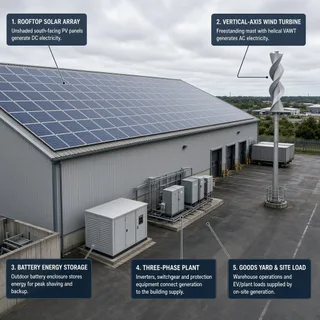
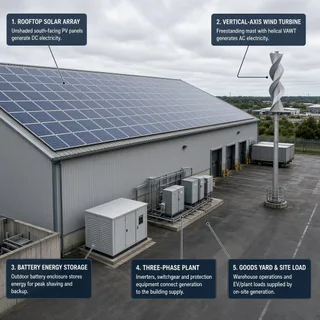
A solar, battery and vertical-axis wind mix can be a workable corporate renewable mix in the UK, but only when each part has a real job on one connection. Solar must fit a usable roof or canopy and a daytime load that can use the generation. The battery needs a defined shifting task, or a specified islanding design if the board wants backup. A vertical-axis wind turbine stays optional until hub-height wind, planning, noise and a certified power curve are in the paper. Nameplate kilowatts are not annual kilowatt-hours, and adding the three nameplates does not give site renewable capacity.
Solar generates in daylight. A battery only stores and releases electricity. A vertical-axis machine generates only when the wind at the turbine is sufficient and operation is permitted. On many UK commercial sites the array, not the turbine, will dominate metered output. The board question is how much of annual site electricity each part can credibly deliver, how they share one connection, and what remains on the supply contract.
This guide compares those roles. It does not rank products. A named turbine, including a Flower Turbines machine, is one manufacturer's vertical-axis product, not the technology class. If a brochure pairs that machine with a named solar supplier, the pairing is a procurement option. It is not evidence of certification, yield, availability or a completed grid connection. Those facts have to come from current documents for each party.
Each asset fails in a different way, which is why a single "green mix" label is a poor design brief. Photovoltaics on a warehouse, office or retail roof, or on a car-park canopy, produce electricity only while the array is lit and unshaded enough to matter. A battery moves that energy, or imported energy, in time. A vertical-axis wind turbine turns on a vertical shaft and does not yaw to face the wind. Accepting wind from any direction is not the same as having a useful wind resource.
Warehouses often combine a large roof with daytime load, so self-consumption follows the load shape more than the marketing name of the package. Offices more often have rooftop plant, shading and less generous structural spare capacity. Retail parks add landlord, tenant and car-park constraints before the electrical design starts. Those site types change the quote more often than the panel brand does.
A self-consumption battery is not business continuity. Backup needs islanding, a defined critical-load board and a stated duration, and that design is often missing from an early quote. Wind and solar can complement each other, daylight and summer against nights and some winter hours, only if the wind at hub height is real. Courtyards and sheltered business parks often do not have that resource. Directional tolerance does not create it.
In practice the solar array is the part most likely to earn its keep, because generation lines up with occupied hours and the resource can be judged from roof drawings, shading and orientation. Wind cannot be judged from a courtyard photograph. A clear southern aspect helps. Shading, a poor tilt and heavy soiling reduce output. A northern roof is not automatically unsuitable if it is large, clear and structurally sound.
What changes the job is rarely the module name. Installers need a structural position, the roof age, the waterproofing warranty, and whether cores, cable routes and edge protection are acceptable to the building owner. Asbestos, a tired membrane, or a roof that cannot take the load, stops the project before inverter choice matters. Three-phase capacity, switchboard space and the route back to the intake often bind before roof area does.
Tenure binds as hard as structure. A tenant on a short lease should not fund a long-lived roof asset unless the landlord's interest, access for maintenance, and the exit or dilapidations position are written down. Commercial rooftop cost, battery cost and turbine capital cost are not stated here, because they move with specification, distribution-network works and civils. Ask for a current site-specific build-up. Do not treat a pound-per-kilowatt slogan, a payback, an export value or a grant as agreed until it is tied to that build-up and to a primary source.
If the connection offer limits export, a battery can absorb solar or wind the site cannot use at that moment and release it later. That has value only if there is a later load, a tariff shape that rewards the shift, or an operational reason to avoid import. Sized for daily cycling, it is an energy-shifting asset. Sized as multi-day backup without the switchgear to island, it is a misunderstanding.
The connection file must say whether the battery charges from the grid as well as from on-site generation. Import and export both affect the study. Phase balance, harmonics and fault level matter on weaker supplies, including rural sites at the end of a feeder. A solar-only application that later gains storage and a turbine is a variation, not a footnote. The electrical design should be to the current BS 7671 requirements for the installation, read with the building's fire strategy, not from a generic product slide.
Fire strategy, access and insurance sit beside that diagram. In England and Wales the responsible person still has duties under the Regulatory Reform (Fire Safety) Order 2005, and building work is judged against the Building Regulations fire-safety guidance for that nation, such as Approved Document B in England. Scotland and Northern Ireland have their own fire-safety legislation, so a note written for England is not enough. Where the store is grid-scale rather than a small plant-room unit, designers and fire services commonly use the National Fire Chiefs Council's current guidance on grid-scale battery energy storage, and the proposal should name the edition. An insurer can still reject a container or room that looked acceptable on a single-line diagram. "Lithium is safe" is not a citation.
A vertical-axis turbine belongs in the proposal only if hub-height wind, planning, noise, foundations and maintenance access all hold. If any of those is missing, the machine is a symbol, and a visible symbol is not a carbon reduction. A short anemometer campaign at the proposed hub height, or a clear statement that none has been done, belongs in the board paper.
Power curves are usually measured in relatively clean flow. Courtyard and roof-edge turbulence can move a machine off that curve, so one annual kilowatt-hour figure is not evidence. Do not assume the unit is roof-mounted or pole-mounted without the current installation manual. Foundations, buried services, crane access and exclusion zones are civil works, and they move cost and programme. Height access, lightning protection, and aviation comment near an aerodrome, are often absent from an early quote. Noise, neighbours, ecology and planning still apply to a small turbine.
It does not fit a sheltered retail park or office courtyard where the turbine is mainly there to be seen. It does not fit a site whose connection offer removes export and whose daytime load cannot absorb the extra generation. Any claim that clustering turbines raises output needs a source. It is not a planning assumption. If the supplier cannot provide UK-relevant certification, noise data and a warranted power curve, describe the wind portion as unproven. Do not fill the gap with an estimate. Domestic solar permitted-development practice is not a permission for non-domestic wind, and the position differs by nation.
Treat solar, storage and wind as one connection study. In Great Britain the technical route is set out in Energy Networks Association engineering recommendations. EREC G98 is the simpler type-tested route used for many small installations. EREC G99 is the usual route for larger or more complex commercial generation, and a battery that can import and export often pulls the job into that fuller study. Do not state a kilowatt cutoff unless the current form for that distribution network operator is in the file. Equipment type, phases and existing capacity change the answer.
The host distribution network operator issues the connection offer. In Great Britain, Ofgem regulates suppliers and network companies. It does not issue that offer, and an Ofgem-regulated supply tariff is not evidence that the plant may connect. Northern Ireland is outside the GB process. Distribution connections there are handled through NIE Networks under the Northern Ireland framework, and the Utility Regulator, not Ofgem, is the economic regulator. Do not describe a GB G99 form as valid across the whole of the UK.
Export limits, existing capacity, and storage that can charge from the grid can all change the study. Where export is limited, the file should name the limitation scheme and the engineering recommendation it follows. Designers commonly cite ENA EREC G100 for customer export limitation, and the offer should say whether that limit curtails wind and solar together. Confirm whether the turbine is type-tested for the route being used. Modelling the limit before anyone quotes savings is what stops a board from treating brochure kilowatts as bill reductions. Two suppliers do not remove the need for one electrical design and one performance model. Warranties, call-out and performance risk must be allocated when brands are paired. Monitoring should split solar, wind, battery, import and export. Without that split, a later review cannot see which part earns its keep.
The useful comparison is not "more renewable kit" against "less". It is whether each added asset changes imported electricity on this site, under this connection, with evidence the board can audit. A green tariff, a renewable supply contract or Renewable Energy Guarantees of Origin are procurement and reporting tools. They are not panels or a turbine on the roof. On-site kit is a physical project with planning, structural and operational risk.
Reporting rules may explain the board's interest. They are not a design standard. Some UK companies and LLPs must report energy and carbon under Streamlined Energy and Carbon Reporting (SECR). Large undertakings may fall under the Energy Savings Opportunity Scheme (ESOS). On-site generation can reduce imported electricity in those numbers if metering and the current guidance say so. Confirm whether this organisation is in scope, and confirm the treatment with the current government or scheme-regulator guidance. Do not copy it from a sales pack, and do not treat a sheltered turbine as a carbon saving because the brochure says it is renewable.
Where an installer or product is described as MCS certified, that means the Microgeneration Certification Scheme and its current scheme documents, including the installation standard for that technology. MCS is a certification route used by schemes that require it. It is not a yield guarantee, not a green tariff, and not a substitute for a site model. Commercial work is not automatically inside an MCS requirement. Ask which document is being claimed, and for which party.
Business rates, VAT and capital allowances move with the specification, the tenure and the tax year. They need a current accountant's view, and for rates a valuer or the relevant valuation body. No figure in a sales pack should be used as that view.
A competent proposal starts with the site, not the product range. The pack should be readable by a director who will not attend the design meeting, and by the designer who has to submit one connection file. If a fact is only in a brochure photograph, it is not yet in the proposal.
Lifespan claims should come from the warranties actually offered for this specification. Wider-market panel warranties are often discussed over long periods, and inverters and batteries are commonly shorter, but those terms must be read from the documents. They should not be remembered from another job. Ask the planner rather than assuming a domestic solar rule covers the turbine. Those positions differ by nation and need a current check.
The mix does not fit a roof that fails structural survey, a listed or tightly constrained site with no planning route, or a connection that cannot accept generation the site cannot use itself. It does not fit a board that needs firm backup unless the battery and switchgear are specified for islanding, critical loads and duration. It does not fit a short lease where the tenant cannot recover the asset or agree an exit with the landlord.
Commercial solar versus staying on grid electricity is still the first comparison. If the roof, the load and the connection do not support solar, a battery and a vertical-axis turbine will not repair that. Wind is the optional layer. The battery is a control and shifting layer unless islanding is designed. Neither turns a poor solar site into a good one, and neither replaces a supply contract for the hours the site still imports.
Costs, yields, paybacks, carbon savings, business-rates treatment and application times are unknown without a current primary source for this site. Distribution-network works and foundations move all of them. Treat any figure that cannot be tied to a drawing, a connection offer, a manufacturer document or advice from an accountant or valuer as marketing, not as a board assumption. The practical next step is a roof, load and tenure review, then one connection question for the nation the site is in, before anyone combines three quotes. Book a free survey once those facts are on the table. Do not order a turbine without hub-height evidence. Name the fire guidance with the insurer before the battery is ordered. Keep SECR, ESOS, VAT, rates and capital allowances as reporting and tax questions, checked against current guidance, not as reasons to approve unproven kit.
Solar comparison
Enter your postcode to assess your roof, compare solar options and get quotes from UK installers.
Choose home, business or industrial, then enter your postcode. RoboMo maps the roof and ranks panel brands by fit.
1. Postcode Start the assessment for your property.
2. Pin the roof Mark the array on the map.
3. Compare RoboMo™ builds your options.

Battery ROI tool
Enter the day rate, off-peak rate and export rate. The calculator ranks batteries in the Kilowatts shop over 10 years. Home batteries also suit offices and small commercial sites.
Reading
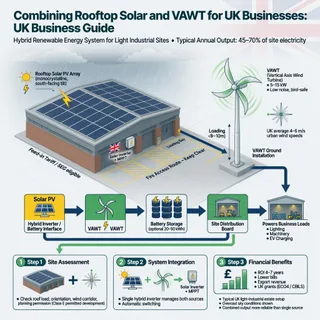
Combining rooftop solar and a VAWT is a UK design question, not a ready-made bundle. Check hub-height wind, structure, consent and the DNO connection.
Read article
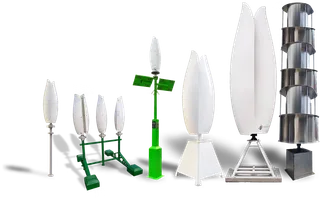
Flower Turbines vs a small HAWT on an urban UK site turns on hub-height wind, not the brochure. Check loads, planning, noise and connection before you buy.
Read article
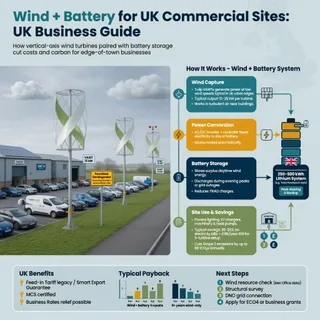
Wind plus battery is credible for a UK commercial site only with usable rotor-height wind, planning and a connection. Storage cannot make wind firm power.
Read article
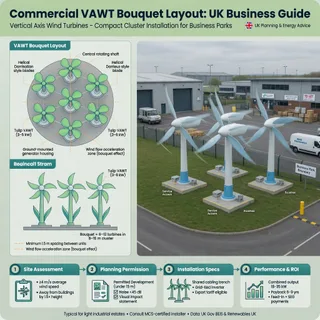
A commercial VAWT bouquet layout groups small vertical-axis turbines tightly. UK businesses still need wind, planning consent and a grid connection.
Read article
Write for Kilowatts.uk
Write it here under your own name. Sign in, put a profile up, and start a guide. Pay only if you want more links from your articles out to your own site.
Create a Kilowatts.uk account, or sign in if you already have one.
Put your name, photo and experience on a public author page.
Write a guide or a blog. Free authors can put one followed link to their own site in articles each month.
FAQ
Live help
Talk to RoboMo™ and get instant answers.
Live chat