


Do i need planning permission for a wind turbine?
Published: 2026-11-26 02:55:43
Updated: 2026-11-25 18:56:38
Check if your wind turbine needs planning permission in the UK. Compare rules by nation and see what to measure before speaking to your council.
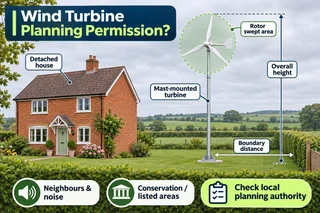
Do I need planning permission for a wind turbine in the UK?
You need to make a planning application if your wind turbine falls outside permitted development rights. Some domestic turbines in England, Wales and Scotland qualify, depending on how they are mounted, their height, blade sweep, distance from boundaries and site restrictions. In Scotland, you must also apply to the planning authority before starting work on a qualifying free-standing turbine. In Northern Ireland, domestic wind turbines require a planning application. For a farm, factory or other business, check which rules apply to the site and intended use before ordering equipment.
Permitted development is planning permission granted by national rules when a proposal meets all the relevant limits and conditions. The same turbine may qualify at one address and need a planning application elsewhere. Existing equipment, such as an air source heat pump, can affect whether it qualifies.
How domestic wind turbine planning rules differ across the UK
The rules depend on where the turbine will stand and how it will be mounted. A free-standing turbine sits on its own mast. A building-mounted turbine is fixed to a building. The two types can follow different planning routes at the same address.
Overview
In England, both routes require compliance with the MCS Planning Standards or equivalent standards and limit the swept area to 3.8 m². The restrictions on existing equipment differ by class. England planning order, Schedule 2, Part 14
Under Class H, a new building-mounted turbine does not qualify if it would bring the total to more than one turbine on the same building or within the relevant curtilage. An existing air source heat pump on the same building or within its curtilage also rules out this route. The turbine can extend up to 3 m above the highest part of the roof, excluding the chimney, and reach up to 15 m overall. Every part must be at least 5 m from the relevant boundary. England planning order, Class H
Under Class I, a new installation can leave at most one free-standing turbine within the curtilage of the house or block of flats. An existing turbine on the house or on a building within the relevant curtilage rules out this route. So does an existing air source heat pump on the house or block of flats or within its curtilage. The highest blade position can reach up to 11.1 m, and the lowest must be at least 5 m above ground level. The nearest part of the turbine, including the blades, must be at least 110% of its overall height from the boundary. England planning order, Class I In Wales, Class H allows a qualifying free-standing turbine up to 11.1 m high, with a maximum swept area of 9.6 m². The lowest blade position must be at least 5 m above ground level, and the setback must be at least 110% of the turbine’s overall height. A new installation can leave at most one free-standing turbine within the home’s curtilage. An existing air source heat pump on the house or within its curtilage rules out this route. Since 1 June 2026, the applicable MCS Planning Standards for wind turbines are those specified in MCS 020(b). Welsh planning order, Part 40 · 2026 Welsh amendment In Scotland, both Class 6G and Class 6HC require compliance with the MCS Planning Standards for wind turbines or equivalent standards. Class 6G allows one qualifying free-standing turbine within the grounds of a dwelling. The highest blade tip can reach up to 15 m, and the lowest must be at least 5 m above ground. The setback from the curtilage of another dwelling must be at least 110% of the blade-tip height. Class 6HC allows one qualifying turbine on a detached house, with a maximum swept area of 4 m². It can extend up to 3 m above the highest part of the roof, excluding the chimney. Every part of the turbine must be at least 5 m from ground level and from the boundary of the home’s curtilage. Scottish Government householder planning guidance For a Scottish Class 6G proposal, send the planning authority a site plan and a written description of the turbine’s siting, design, size and appearance. You can start work when the authority confirms in writing that prior approval is unnecessary, or when it grants any prior approval it requires. You can also start once 28 days have passed since the authority received the application, provided it has given no notice that prior approval is required. Keep a record of when the authority received the application and follow the submitted or approved details, as applicable. Scottish Government Class 6G procedure In Northern Ireland, give your council’s planning team the proposed site and turbine dimensions. The team can tell you which drawings to submit with a domestic application and what evidence it needs on noise or views from nearby homes. Northern Ireland government guidance on wind · Northern Ireland renewable energy planning guidance
What to measure before speaking to the council
Ask the installer for a dimensioned site plan and elevation showing the exact turbine and how it will be mounted. The elevation should show the highest and lowest blade-tip positions and the ground level used for each measurement. Swept area is the area covered by the rotating blades. If the boundary test includes the blades, show how close any part of the turbine can come to the boundary as the rotor spins and changes orientation. Measuring from the mast alone can overstate the clearance.
Mark the home’s curtilage, the land that forms part of the home and its immediate grounds. Show the grounds of any neighbouring dwellings relevant to the setback, along with existing turbines and air source heat pumps. If the installer changes the turbine model, mast height or position, ask for updated drawings and recheck the clearances before committing. If you’re considering a turbine in your garden, use the updated plan to check how much space the mast and blades would need.
Ask the planning authority to check restrictions at the proposed turbine location. Listed buildings, conservation areas, protected sites and aviation safeguarding can affect which rules apply. These vary by nation and installation type. If you need a planning application, ask early what evidence the authority expects on noise, views from neighbouring properties and any effects on heritage or ecology. England planning order, Part 14 · Scottish Government siting and safeguarding guidance
Planning a turbine for a farm, factory or other business
Give the local planning authority the proposed location, turbine dimensions and intended use before commissioning a detailed design. On a farm, show whether the mast would sit in the farmhouse garden or on working land. Explain whether it would supply the house, the business or both. An adjoining field can sit outside the domestic curtilage even if it shares an owner with the farmhouse.
England’s 2026 consultation proposed a permitted development right for small non-domestic wind turbines. Ask the planning authority which rules are in force and apply to your proposal. For an early discussion, provide a site plan showing the mast, nearby homes and the access route for construction and maintenance. UK Government consultation on onshore wind permitted development in England
If you’re considering a vertical-axis model for a business site, read the guide to commercial turbine planning before discussing the design with the planning authority.
Check whether the site can generate enough electricity
Once you know the likely planning route, ask for an annual generation estimate in kWh based on wind conditions at the proposed hub height and the turbine’s power curve. The rated output in kW tells you how much power the turbine can deliver under specified conditions. Roof ridges, neighbouring buildings and trees can disrupt airflow even where a site feels windy. If a planning limit requires a shorter mast, get a revised generation estimate for the lower hub height before comparing quotes. Energy Saving Trust guidance on wind turbines
For a roof-mounted turbine, ask how the building will carry the loads and how the installer will limit vibration. For a free-standing turbine, ask to see the foundation design, cable route and access for lifting and servicing. If you plan to connect to the grid, ask the installer to confirm the distribution network operator’s connection process and account for any existing solar panels or batteries. Look at how much of the expected generation you can use on site when it is produced and how much the system can export. Energy Networks Association distributed generation guide
Once you have a location in mind, use the wind designer on Kilowatts.uk for an initial generation estimate or browse the installer directory to find a business that can assess the site. Give the planning authority the proposed model and dimensioned drawings before ordering equipment. If the estimate suggests the site is a poor fit for wind, you can compare home solar installations before deciding how to generate electricity at home.
Solar comparison
Compare solar for your property
Enter your postcode to assess your roof, compare solar options and get quotes from UK installers.
- Free postcode start
- Home, business and industrial
- RoboMo™ maps your roof
See which panels fit your roof
Choose home, business or industrial, then enter your postcode. RoboMo maps the roof and ranks panel brands by fit.
1. Postcode Start the assessment for your property.
2. Pin the roof Mark the array on the map.
3. Compare RoboMo™ builds your options.

Battery ROI tool
See what a battery saves on your bill
Enter the day rate, off-peak rate and export rate. The calculator ranks batteries in the Kilowatts shop over 10 years. Home batteries also suit offices and small commercial sites.
Reading
Sources and further reading
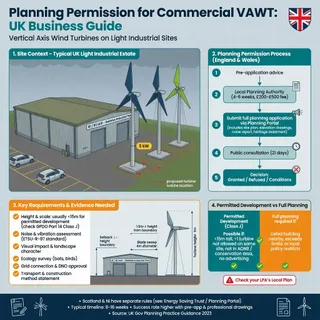
Planning permission for a commercial VAWT in the UK should be treated as required until a planner checks that nation's rules for the site and turbine.
Read article
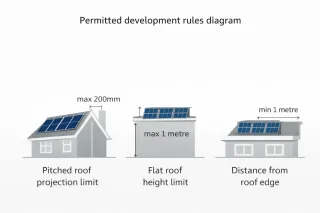
Do I need planning permission for solar panels in the UK Most UK homes can install roof solar panels without applying for planning permission.
Read article
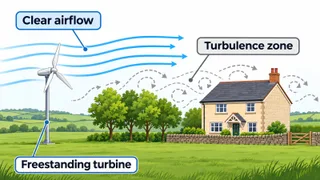
Find out if a home wind turbine is viable for your UK property. Check wind at mast height and weigh forecast electricity output against installation costs.
Read article
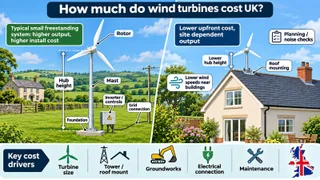
A 6 kW pole-mounted home wind turbine costs about £28,000 installed in the UK. Check what rooftop, farm and factory quotes include before budgeting.
Read article

Mo's Solar Mission
Mo's Mission Nominations
Garlinge Primary School and Nursery
Garlinge Primary School and Nursery is a foundation primary school on Westfield Road in Margate, Kent, for children aged 3 to 11. It is m...
St Luke's Church of England Primary SchoolSt Luke's Church of England Primary School is a voluntary controlled Church of England primary school on Jubilee Road in Formby, Merseysi...
Comberbach Nursery and Primary SchoolComberbach Nursery and Primary School is a primary academy on Mather Drive in the village of Comberbach, near Northwich in Cheshire, for...
Locations
Solar installation near you
Write for Kilowatts.uk
Got a trade and something worth saying?
Write it here under your own name. Sign in, put a profile up, and start a guide. Pay only if you want more links from your articles out to your own site.
Register
Create a Kilowatts.uk account, or sign in if you already have one.
Author profile
Put your name, photo and experience on a public author page.
Start creating
Write a guide or a blog. Free authors can put one followed link to their own site in articles each month.
FAQ
Need Help? RoboMo's Got Answers
Do I need to apply for planning permission for a wind turbine in my garden?
A free-standing domestic turbine may qualify as permitted development in England, Wales or Scotland if it meets the rules for your site. In Scotland, you still need to apply to the planning authority before starting work on a qualifying free-standing turbine. In Northern Ireland, a domestic wind turbine requires a planning application.
Can I put a wind turbine on my roof without a planning application?
A turbine on a detached house may qualify as permitted development in England or Scotland if it meets the relevant limits and site conditions. In Wales and Northern Ireland, a building-mounted domestic turbine requires a planning application. Ask your installer how the building will carry the load and how they will limit vibration.
How close can a garden wind turbine be to a boundary?
The required distance depends on where you live and how the turbine is mounted. In England, the nearest part of a free-standing turbine, including its blades, must be at least 110% of the turbine’s overall height from the boundary to qualify as permitted development. In Scotland, the free-standing setback is measured to the grounds of another dwelling and must be at least 110% of the blade-tip height. Ask your installer to show the relevant clearance on a dimensioned site plan.
Can I install a wind turbine if I already have an air source heat pump?
An existing air source heat pump can rule out permitted development for a new turbine, depending on where the equipment is installed and which rules apply. Show the planning authority where the heat pump and any existing turbines are located so it can advise whether you need a planning application.
Can I install a wind turbine at a listed property or in a conservation area?
Listed building status and conservation area restrictions can affect whether a wind turbine qualifies as permitted development. Ask the planning authority to check the exact location and tell you what permissions or consents you need. If an application is required, ask what evidence it expects on noise, views and effects on historic buildings or their surroundings.
What should I give the planning authority before ordering a wind turbine?
Ask your installer for a dimensioned site plan and elevation showing the turbine model, mounting position, highest and lowest blade-tip heights, and the area swept by the blades. Mark the property boundaries, any relevant neighbouring gardens and existing turbines or air source heat pumps. If the model, mast height or location changes, use updated drawings to check the planning position again.
Can I use domestic permitted development rights for a turbine in a field next to my house?
An adjoining field can fall outside the home’s immediate grounds, known in planning as its curtilage, even if you own both. Show the planning authority where the mast would stand and explain whether the turbine would supply the home, a business or both. That will help the authority advise which planning rules apply.
Does planning permission cover connecting my wind turbine to the electricity grid?
Grid connection is a separate process from planning. If you want a grid-connected turbine, ask your installer to confirm the process with your distribution network operator and take account of any existing solar panels or batteries.
Live help
Need help right now?
Talk to RoboMo™ and get instant answers.