LinkedIn profile for David Coleman David Coleman
Founder & Renewable Energy Author, kilowatts.uk


LinkedIn profile for David Coleman David Coleman
Founder & Renewable Energy Author, kilowatts.uk
Article
Solar battery storage in East Sussex: Energy Saving Trust prices, sizing against winter output, flats and conservation areas, and how to get battery quotes.
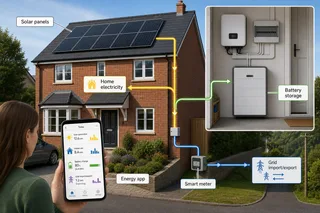
Compare usable capacity, winter solar output, installation space and the complete installed cost.
By David Coleman. Last checked: 4 November 2026. Figures are dated and sourced; estimates are labelled.
A battery does not make your roof produce more electricity. It stores what the panels make at midday, or what you buy when it is cheap, for use in the evening. In East Sussex the case depends less on the county than on three things: how much of your power you use after dark, whether you control the roof and wall space, and what your import and export tariffs are.
The quick answer on price: the Energy Saving Trust puts a 5 kWh battery system at around £4,600, within a range of £1,500 to £10,000, and gives a typical lifespan of 10 to 12 years (checked 4 November 2026). There is no published East Sussex battery price, so treat those as national guide figures.
Want prices for your home? Partner installers quote for battery-only, retrofit or solar plus battery.
Prefer to talk? Call 0800 009 6058.
Housing in the county splits sharply. Census 2021 puts 43.7% of Wealden households and 42.1% of Rother households in detached homes, against 16.7% in Eastbourne and 10.3% in Brighton and Hove, where 50.0% live in flats or conversions (ONS TS044). A house with a garage, utility room or a clear outside wall has somewhere for the battery. A flat often does not, and the freeholder usually has to agree to anything fixed to the building.
Batteries make most sense where:
They make less sense with very low use, no suitable space, or a tariff that pays little difference between day and night.
PVGIS models a south-facing roof near Hailsham at about 1,134 kWh per kWp a year (35° pitch, 14% losses, SARAH3 data, run 4 November 2026; PVGIS 5.3). For a 4 kWp roof that is about 4,536 kWh a year, PVGIS estimate. But winter is thin: about January 172 kWh December 156 kWh for the same roof, against 560 kWh in June. In summer a 5 kWh battery will often fill; in December it may barely charge from the roof alone, which is why many households pair it with off-peak charging.
The Energy Saving Trust says a typical home system might be 10 kWh and that the system usually stops discharging at around 20% to protect the battery. Size it on your smart meter’s evening use, not on the nameplate.
A simple way to see the value: each unit stored and used at home instead of exported swaps an export payment of around 12p (the Energy Saving Trust SEG figure) for an import you no longer pay at up to 26.32p/kWh (the Ofgem price cap Direct Debit rate, 1 October to 31 December 2026). That is about 14.32p a unit, or roughly £0.72 for one full 5 kWh cycle. This is illustrative arithmetic, not a savings estimate: round-trip losses, cloudy days and your actual tariff all change it.
Most batteries go in a garage, utility room or on an outside wall. Indoors, a battery on a house is normally not a planning matter. Outside, it can be:
Town guides: solar panels in Eastbourne, solar panels in Brighton and Hove and the East Sussex solar overview.
Fitting a battery with new panels is usually simpler and cheaper, because the installer is already on site (the Energy Saving Trust makes the same point). A retrofit means either adding a battery beside your existing inverter or replacing it with a hybrid one. Either way, the extra equipment may change how the system is connected: smaller systems are notified after fitting under G98, larger ones need G99 approval from the network operator first. Ask each quote which route it assumes.
Installing a battery in a home is zero-rated under the energy-saving materials relief, including a battery fitted on its own since 1 February 2024, until 31 March 2027 (HMRC Notice 708/6). From 1 April 2027 the rate is due to go back to 5%.
For more on prices, read how much a home battery costs in the UK. Over the border, the Kent home battery guide covers the same questions for Kent homes.
Compare battery quotes for an East Sussex home.
Solar comparison
Enter your postcode to assess your roof, compare solar options and get quotes from UK installers.
Choose home, business or industrial, then enter your postcode. RoboMo maps the roof and ranks panel brands by fit.
1. Postcode Start the assessment for your property.
2. Pin the roof Mark the array on the map.
3. Compare RoboMo™ builds your options.

Battery ROI tool
Enter the day rate, off-peak rate and export rate. The calculator ranks batteries in the Kilowatts shop over 10 years. Home batteries also suit offices and small commercial sites.
Reading
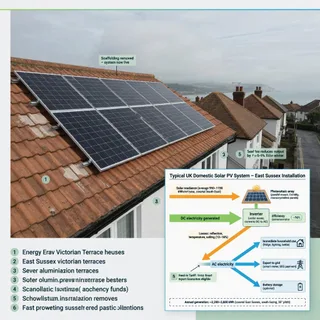
Solar panel installation in East Sussex follows the roof, shade, listed consent and UK Power Networks, not the postcode. Brighton & Hove plans separately.
Read article
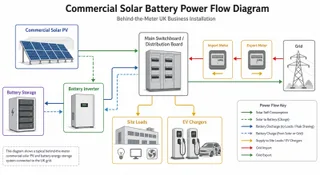
Understand commercial battery storage in the UK, with clear explanations, examples, and practical next steps.
Read article
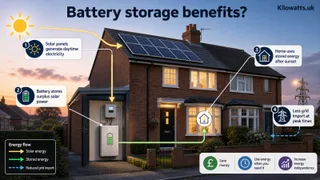
Battery storage can be worth it in the UK when it helps you use more of your own solar electricity, avoid higher-rate grid imports.
Read article
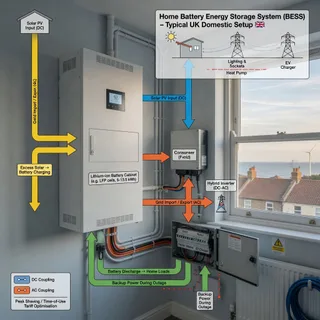
There is no single Kent payback for home battery storage. Compare usable evening energy, tariffs, UK Power Networks and a lawful place to site it.
Read article
Write for Kilowatts.uk
Write it here under your own name. Sign in, put a profile up, and start a guide. Pay only if you want more links from your articles out to your own site.
Create a Kilowatts.uk account, or sign in if you already have one.
Put your name, photo and experience on a public author page.
Write a guide or a blog. Free authors can put one followed link to their own site in articles each month.
FAQ
Live help
Talk to RoboMo™ and get instant answers.
Live chat