


Battery storage costs
Published: 2026-11-26 01:50:30
Updated: 2026-11-25 17:51:12
Compare UK home battery storage costs across three sizes and see how standalone, retrofit and new solar installations affect the fitted price.
Home battery storage costs in the UK
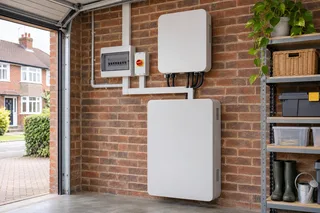
A 5 kWh home battery system costs around £4,600, according to the Energy Saving Trust, which gives a wider range of £1,500 to £10,000. Your fitted price depends on usable capacity, inverter output, any existing solar panels and the electrical work your property needs. If you want power during an outage, ask installers to price backup separately so you can compare quotes on the same basis.
Qualifying installations in UK homes can receive 0% VAT through 31 March 2027. This includes qualifying standalone batteries and retrofits. The reduced rate of 5% is scheduled to apply from 1 April 2027. Ask the installer to state the VAT rate on the quote and explain how a change in installation date could affect the total. See HMRC guidance on electrical storage batteries and the UK legislation explanatory memorandum.
Installed battery prices at 5, 10 and 13.5 kWh
Octopus Energy published these starting prices for battery-only installations in June 2025. They show how fitted prices vary by package size at one supplier. The capacities are rounded where Octopus offers more than one model at a given size. Confirm the usable capacity of the model on your quote.
Overview
The advertised prices cover battery installation without new solar panels. Ask your installer to itemise VAT, any electrical work specific to your property and backup hardware, as the guide gives a single starting price for each package. Some installation work is the same at either size, so doubling capacity can cost less than twice as much. If the larger package also changes the inverter or adds backup, ask how much of the difference pays for extra storage.
How standalone, retrofit and new solar installations affect price
A standalone battery can charge from the grid without solar panels. The quote should cover the battery inverter, metering, controls and cabling back to the consumer unit. If you plan to charge off-peak, ask how much energy the battery can take on during the cheaper tariff window.
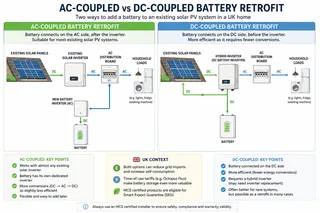
With an AC-coupled retrofit, you can often keep the existing solar inverter and add a separate battery inverter. Give the installer the make and model of your solar inverter and any export-limit paperwork. Ask which equipment can stay and what changes to metering or wiring the quote includes. If you receive Feed-in Tariff payments, check with your provider before changing the metering arrangement.
If you are installing solar and storage together, a compatible hybrid inverter can manage both. Ask for solar-only and solar-plus-battery quotes with the same panel layout. The price difference shows what it costs to add storage, taking into account any inverter change and labour shared between the two parts of the job.
What a battery installation quote should include
Ask the installer to survey the battery location, cable route and consumer unit before fixing the price. A long cable run, limited space for protective devices or extra mounting work can change the total. The installer should also check clearances, operating temperature limits and fire precautions at the proposed location.
Check that the quote covers the battery, inverter, metering, controls, cabling, protective devices, any consumer unit work, commissioning and network paperwork. Ask who will handle the network submission and whether you need approval before installation.
In Great Britain, your local distribution network operator determines the connection route. It can depend on the existing solar inverter, the proposed battery inverter and the export controls. UK Power Networks explains its G99 fast-track route for eligible small generation and storage installations. In Northern Ireland, check the connection route with NIE Networks. If you want power-cut protection, ask for a separate price for backup hardware and wiring. Find out which circuits will stay live, how much power they can draw at the same time and whether your solar panels can recharge the battery during an outage. Any energy held in reserve for outages reduces the capacity available for daily bill savings.
What size home battery is worth paying for?
Usable capacity, measured in kilowatt-hours (kWh), is the energy the battery makes available within its operating limits. Continuous output, measured in kilowatts (kW), is the power it can supply on an ongoing basis. A battery can store enough energy for the evening and still need grid power when several appliances run together.
Use half-hourly smart meter data to see how much electricity you use during the hours you want the battery to cover. If you have solar panels, check how much you export in each season. For a new array, ask for monthly generation estimates that account for roof orientation and shading. If you plan to charge from the grid, check how much energy you can store during your off-peak window.
Price extra capacity if you regularly have enough cheap or surplus electricity to fill it and enough demand later to use it. An EV that already charges off-peak adds little demand for the home battery to cover. A heat pump running outside cheap hours may add demand, especially in winter when you may have less solar surplus. When choosing a battery size, compare the capacity available after any backup reserve, and ask the installer to model a smaller battery using the same usage data.
How much could a home battery save?
When you store surplus solar, the saving is the cost of the grid electricity you avoid buying, less the export payment you give up. When you charge from the grid, subtract the cost of off-peak charging from the higher-rate purchases you avoid. Allow for round-trip losses in both cases. If you plan to export electricity charged from the grid, check whether your supplier’s terms allow you to earn export payments for it.
Suppose you pay 8p per kWh off-peak and 28p per kWh at the higher rate, and the battery has 90% round-trip efficiency. If it supplies 1,000 kWh to your home over a year and all of that replaces higher-rate imports, you avoid £280 in electricity purchases. Delivering that energy takes about 1,111 kWh of off-peak charging at a cost of about £89. The illustrative saving is about £191 a year before any change in standing charges, financing costs or battery degradation. The tariff rates, efficiency and annual use are assumptions for this example.
Ask the installer to show annual battery discharge in kWh so you can see how much electricity the estimate assumes you will shift. If you need to change tariff, compare the whole household bill, including electricity you still buy outside the cheap window. Test the estimate with a narrower tariff gap and lower battery use. To estimate battery payback, compare the savings with the fitted price and check the warranty for retained capacity, any limit on how much energy can pass through the battery, and whether it covers labour.
How commercial battery storage costs are estimated
Business battery storage needs a site-specific quote. Start with half-hourly electricity data, the site’s import and export arrangements, and a list of equipment that needs to run during an outage. The price depends on the battery, inverter and any switchgear, protection or connection work the site needs.
To size a battery for peak reduction, use the height of the demand peak to estimate the power needed in kW and its duration to estimate the energy needed in kWh. Check which charges on the site’s tariff would fall if you reduced those peaks. For backup, ask the supplier to account for how much power critical equipment draws at start-up, how long it needs to run and what the associated electrical work will cost.
What to send installers for comparable quotes
Give each installer the same usage data, tariff, existing solar details and backup requirements. Compare quotes with similar usable capacity and continuous output. Check the total fitted price, VAT, exclusions, warranty and estimated annual discharge. If one quote is cheaper, check for differences in the inverter, cable route, electrical work or circuits covered during an outage.
If you are planning solar and storage together, use the Kilowatts residential solar comparison tool to compare solar options, then request matched solar-only and solar-plus-battery quotes. Ask each installer to show how much the battery adds to the savings you would get from the panels alone.
Solar comparison
Compare solar for your property
Enter your postcode to assess your roof, compare solar options and get quotes from UK installers.
- Free postcode start
- Home, business and industrial
- RoboMo™ maps your roof
See which panels fit your roof
Choose home, business or industrial, then enter your postcode. RoboMo maps the roof and ranks panel brands by fit.
1. Postcode Start the assessment for your property.
2. Pin the roof Mark the array on the map.
3. Compare RoboMo™ builds your options.

Battery ROI tool
See what a battery saves on your bill
Enter the day rate, off-peak rate and export rate. The calculator ranks batteries in the Kilowatts shop over 10 years. Home batteries also suit offices and small commercial sites.
Reading
Sources and further reading
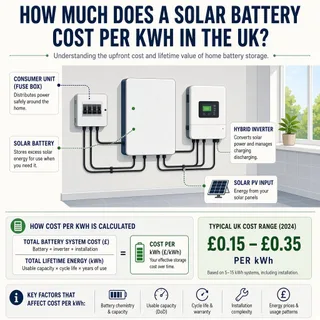
UK solar battery cost per kWh is not a national rate. Divide the surveyed installed total by usable kilowatt-hours, not nameplate or supply-only prices.
Read article
No single UK solar battery price per kWh exists. Divide matched supply-and-fit by usable kWh, not nameplate, and keep inverters and extras out.
Read article
Read article
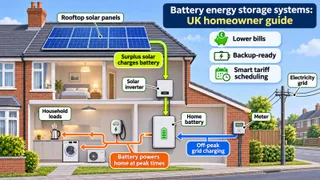
Compare battery energy storage systems for UK homes. Use your electricity readings and tariff to size a battery, estimate savings and check backup options.
Read article


Mo's Solar Mission
Mo's Mission Nominations
Garlinge Primary School and Nursery
Garlinge Primary School and Nursery is a foundation primary school on Westfield Road in Margate, Kent, for children aged 3 to 11. It is m...
St Luke's Church of England Primary SchoolSt Luke's Church of England Primary School is a voluntary controlled Church of England primary school on Jubilee Road in Formby, Merseysi...
Comberbach Nursery and Primary SchoolComberbach Nursery and Primary School is a primary academy on Mather Drive in the village of Comberbach, near Northwich in Cheshire, for...
Locations
Solar installation near you
Write for Kilowatts.uk
Got a trade and something worth saying?
Write it here under your own name. Sign in, put a profile up, and start a guide. Pay only if you want more links from your articles out to your own site.
Register
Create a Kilowatts.uk account, or sign in if you already have one.
Author profile
Put your name, photo and experience on a public author page.
Start creating
Write a guide or a blog. Free authors can put one followed link to their own site in articles each month.
FAQ
Need Help? RoboMo's Got Answers
How much does it cost to install a home battery in the UK?
The Energy Saving Trust gives around £4,600 as a guide for a 5 kWh home battery system. Your fitted price depends on the battery’s usable capacity, inverter output and the electrical work your home needs. Ask for an itemised quote after the installer has surveyed the proposed location and cable route.
What should I check when comparing home battery quotes?
Compare systems with similar usable capacity and continuous power output. Check whether each quote includes the inverter, metering, cabling, any consumer unit work, commissioning and network paperwork. Ask for the total fitted price including VAT, a list of exclusions and confirmation of who will handle the network submission.
Can I install a home battery without solar panels?
Yes. A standalone battery can charge from the grid and supply your home later. If you plan to use a time-of-use tariff, check how much the battery can charge during the cheaper window and how much higher-rate electricity it could replace.
Can I add a battery to my existing solar panels?
Often, yes. An AC-coupled battery has its own inverter, so you may be able to keep your existing solar inverter. Give the installer the make and model of your inverter and ask what wiring or metering changes are included. If you receive Feed-in Tariff payments, check with your provider before changing the metering.
Is it cheaper to install a battery at the same time as solar panels?
Installing both together can save on labour and may allow you to use one compatible hybrid inverter for the panels and battery. Ask for solar-only and solar-plus-battery quotes with the same panel layout. The difference shows how much you would pay to add storage.
How do I decide what size home battery to buy?
Use half-hourly smart meter data to see how much electricity you use during the hours you want the battery to cover. Check how much surplus solar or off-peak grid electricity you could store, including during winter. Compare usable capacity in kWh and continuous output in kW, and ask the installer to model a smaller battery using the same data.
Does it cost extra for a home battery to work during a power cut?
Backup may require extra hardware and wiring, so ask for a separate price. Confirm which circuits will stay powered, how much power they can draw at once and whether your solar panels can recharge the battery during an outage. Any charge you keep in reserve for outages reduces the energy available for everyday bill savings.
How can I estimate whether a home battery will pay for itself?
Compare the fitted price with estimated annual savings based on your usage and tariff. Allow for charging losses, the cost of off-peak electricity and any export payments you would give up by storing surplus solar. Test the estimate with a smaller difference between peak and off-peak rates or less battery use. Compare the resulting payback period with the warranty and check how much capacity the warranty guarantees over time.
Live help
Need help right now?
Talk to RoboMo™ and get instant answers.