LinkedIn profile for David Coleman David Coleman
Founder & Renewable Energy Author, kilowatts.uk


LinkedIn profile for David Coleman David Coleman
Founder & Renewable Energy Author, kilowatts.uk
Article
A reproduced US grant record highlights an Imperial-origin hydrogen-organic flow battery. Understand its older patent family and the gap to commercial storage.
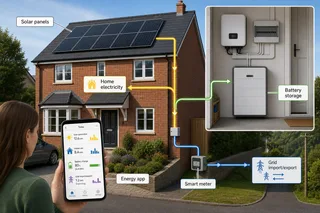
Illustration of a home energy system; it does not depict a product or installation announced in this article.
Published 5 November 2026. Patent-family information and laboratory claims are distinguished from a commercial battery product.
A US patent record lists a 3 November 2026 grant for an Imperial-origin redox flow battery design combining a hydrogen side with a liquid organic side. The date is a patent milestone, not evidence that a new grid battery has started commercial operation.
For UK readers interested in longer-duration storage, the question is how the architecture might progress from a protected invention and laboratory results to a complete operating system.
The reproduced grant record for US12,785,128 identifies IP2IPO Innovations Limited and inventors Anthony Kucernak and Javier Rubio-Garcia. The associated published application traces priority to November 2018 and an international filing in November 2019.
Those dates prevent an important misunderstanding: a newly listed grant does not mean the underlying concept was first invented in November 2026. Patent publication, grant and commercial deployment answer different questions.
The application describes a gaseous anolyte paired with an organic liquid catholyte. In simple terms, the two sides use different forms of material to carry out the reversible reactions involved in charging and discharging.
The Imperial licensing page discusses later methylene-blue work. That particular laboratory formulation should not be confused with every chemistry covered by the broader patent family.
Imperial reports laboratory performance, including testing over 30 full cycles. That is a defined experiment, not evidence of the many years of operation expected from a commercial storage installation.
Development also needs to address the complete system: storage vessels, pumps, controls, power electronics, maintenance and the handling of its materials. A cell result cannot provide the installed cost or availability of all those components together.
A patent record is not a product certification, a project finance decision, a freedom-to-operate opinion or a supply contract. It does not independently validate the economics of a future battery.
For a developer assessing the technology, useful next evidence would include independent system tests, repeated cycling under relevant conditions, measured efficiency including auxiliary loads, and a documented maintenance and safety case.
This is research and intellectual-property news, not an alternative domestic battery quotation. A homeowner should continue comparing available equipment on usable capacity, power, support and a suitable installation design.
The technology may remain worth following as a possible storage route, but a future licensing or pilot announcement should be assessed on its own evidence. Keep the patent milestone separate from claims that the design is already commercially proven.
Solar comparison
Enter your postcode to assess your roof, compare solar options and get quotes from UK installers.
Choose home, business or industrial, then enter your postcode. RoboMo maps the roof and ranks panel brands by fit.
1. Postcode Start the assessment for your property.
2. Pin the roof Mark the array on the map.
3. Compare RoboMo™ builds your options.
Battery ROI tool
Enter the day rate, off-peak rate and export rate. The calculator ranks batteries in the Kilowatts shop over 10 years. Home batteries also suit offices and small commercial sites.
Reading
Cambridge spinout Illumion has raised GBP1.7 million for battery imaging technology. What charge photometry can show, and why this is not a new home battery.
Read article
Australia is backing a pilot line for PowerNet modular batteries. See the 4 kWh concept, project timetable and why a UK launch is not established.
Read article

A typical EV battery stores several times more than a home battery - but only bidirectional cars and chargers can send that energy back into the house.
Read article
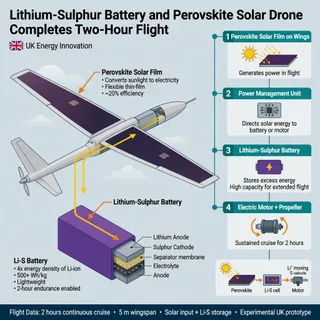
A lithium-sulphur battery drone with perovskite solar cells flew almost two hours. What the test does and does not prove for UK energy sites.
Read article
Write for Kilowatts.uk
Write it here under your own name. Sign in, put a profile up, and start a guide. Pay only if you want more links from your articles out to your own site.
Create a Kilowatts.uk account, or sign in if you already have one.
Put your name, photo and experience on a public author page.
Write a guide or a blog. Free authors can put one followed link to their own site in articles each month.
FAQ
Live help
Talk to RoboMo™ and get instant answers.
Live chat