


Rubber Tidal Turbine Blades Could Replace Pitch Control - What the Edinburgh Tests Proved
Published: 2026-11-23 18:18:28
Updated: 2026-11-23 10:19:01
In Edinburgh tank tests, rubber tidal turbine blades cut rapid load swings by up to 29%. In simulation, they nearly matched the yield of pitch control.
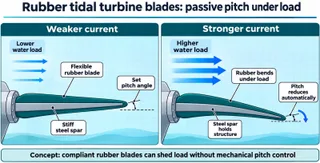
Rubber tidal turbine blades shed load in Edinburgh tank tests
Rubber tidal turbine blades reduced rapid load fluctuations on a model rotor tested by the University of Edinburgh and Michelin. The flexible trailing edges flattened in stronger currents, reducing thrust on the rotor. In a separate simulation of a tidal cycle, the flexible blades captured nearly as much energy as modelled rigid blades with active pitch control. The flexible design still used active rotor-speed control. Its performance at full scale and in open water remains unproven. Nature study
How a rubber blade responds to stronger currents
A tidal-stream turbine uses moving seawater to turn a rotor and drive a generator. Active pitch control rotates each blade about its long axis to change the angle at which it meets the flow. In the Edinburgh design, a stiff steel spar supports the leading edge while the rubber trailing edge bends under load. As the blade profile flattens, thrust falls.
The current bends the blade directly. If the trailing edge is too stiff, it sheds less load. If it is too soft, it can bend far enough to reduce power capture. A commercial turbine would still need to regulate rotor speed, brake and shut down safely. Nature study
What the reported 29% reduction means for turbine fatigue
The University of Edinburgh reported up to 29% lower rapid load fluctuations on the 1.26-metre model rotor. Figure 3 of the paper breaks down the results. At rated current speed in FloWave’s turbulent current-only tests, the standard deviation of rapid fluctuations in blade-root bending moment was about 28% lower than for the rigid reference blades at the same operating point. The standard deviation of thrust fluctuations was about 23% lower. Both figures describe how much smaller the load swings were under those test conditions. University of Edinburgh School of Engineering Nature study, Figure 3 Repeated bending can cause fatigue. In Supplementary Note 6, a preliminary calculation puts the fatigue life of a full-scale rubber blade above the study’s 20-year service benchmark for existing turbines. Establishing service life would also require evidence on how the rubber and its connection to the spar hold up under seawater exposure, abrasion and repeated flexing. Nature study and supplementary information
How much electricity could the blades generate, and at what cost?
Annual generation and installed costs are still unknown. Power, measured in kilowatts or megawatts, rises and falls with the current. Energy, measured in kilowatt-hours or megawatt-hours, adds up that output over time. The simulation compared both designs over the same tidal cycle. Estimating annual generation at a real site would require a current-speed record at rotor depth, a validated power curve and an allowance for downtime. The same distinction between rated power and energy over time applies when estimating annual solar generation.
Removing the pitch mechanism could simplify maintenance. The cost of electricity would also depend on the cost of making and inspecting the flexible blades and of repairing or replacing worn components. If an inspection requires bringing the rotor ashore, vessel hire and lost generation add to the cost, and suitable weather determines when the work can go ahead. Any savings would have to hold up across the maintenance cycle.
What a UK sea trial would need to establish
A developer would measure current speed and turbulence at rotor depth, check water depth and vessel access for installation and retrieval, and assess the route to a grid connection. The European Marine Energy Centre’s Fall of Warness site off Eday in Orkney shows how a sea trial can work. Current meters characterise tidal and wave conditions, and cabled berths allow turbines to export power. The Edinburgh tank tests took place at FloWave. European Marine Energy Centre tidal test site
A sea trial would track rotor loads and electrical output across different tides and record how the turbine behaves during shutdown. Inspections would check whether abrasion, marine growth or ageing change the blades’ shape or stiffness. Developers would also need to know which checks can be done underwater and which require bringing the rotor ashore. That affects the vessels needed and the time the turbine spends out of service.
Could tidal turbines supply a UK home, balcony or business?
The Edinburgh design is intended for marine energy projects in fast-flowing tidal channels. It needs a submerged rotor, a suitable current and access for installation and maintenance. A coastal business considering its own project would need to assess the tidal resource at a specific marine site and work out how electricity would reach the premises or the grid.
For on-site generation at a home, farm or business, a site assessment can compare options such as rooftop solar with the property’s usable roof area and electricity demand. It can estimate how much of the electricity generated could be used on site and how much would be available for export.
Homeowners can compare rooftop solar options or check whether their property has a suitable site for a small wind turbine. Farms and businesses can compare solar for their premises based on their available space and on-site electricity use.
Solar comparison
Compare solar for your property
Enter your postcode to assess your roof, compare solar options and get quotes from UK installers.
- Free postcode start
- Home, business and industrial
- RoboMo™ maps your roof
See which panels fit your roof
Choose home, business or industrial, then enter your postcode. RoboMo maps the roof and ranks panel brands by fit.
1. Postcode Start the assessment for your property.
2. Pin the roof Mark the array on the map.
3. Compare RoboMo™ builds your options.

Battery ROI tool
See what a battery saves on your bill
Enter the day rate, off-peak rate and export rate. The calculator ranks batteries in the Kilowatts shop over 10 years. Home batteries also suit offices and small commercial sites.
Reading
Sources and further reading
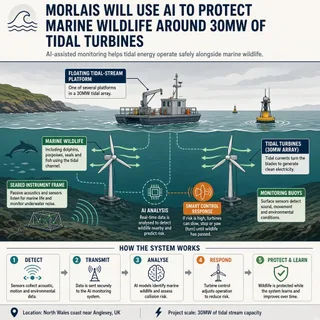
On 27 October 2026, Morlais reported that HydroWing had contracted Anglesey company Ecodetect to monitor a planned 30MW tidal-stream project.
Read article

Navien and Passiv's PEM750 package claims a 17% COP gain from smart control. It is not a guaranteed bill cut, and software cannot fix poor commissioning.
Read article

The main issues are wind quality, planning rules, structural safety, noise, grid connection, cost, turbine type, turbine size, and maintenance.
Read article

See how HyCoFlex generated power and process steam at full load on 100% renewable hydrogen, and what UK factories should check before a CHP retrofit.
Read article





Mo's Solar Mission
Mo's Mission Nominations
Garlinge Primary School and Nursery
Garlinge Primary School and Nursery is a foundation primary school on Westfield Road in Margate, Kent, for children aged 3 to 11. It is m...
St Luke's Church of England Primary SchoolSt Luke's Church of England Primary School is a voluntary controlled Church of England primary school on Jubilee Road in Formby, Merseysi...
Comberbach Nursery and Primary SchoolComberbach Nursery and Primary School is a primary academy on Mather Drive in the village of Comberbach, near Northwich in Cheshire, for...
Locations
Solar installation near you
Write for Kilowatts.uk
Got a trade and something worth saying?
Write it here under your own name. Sign in, put a profile up, and start a guide. Pay only if you want more links from your articles out to your own site.
Register
Create a Kilowatts.uk account, or sign in if you already have one.
Author profile
Put your name, photo and experience on a public author page.
Start creating
Write a guide or a blog. Free authors can put one followed link to their own site in articles each month.
FAQ
Need Help? RoboMo's Got Answers
How could flexible rubber blades replace active pitch control?
A steel spar supports the front of each blade, while the rubber trailing edge bends in stronger currents. This flattens the blade profile and reduces the force of the current pushing on the rotor. The design still used active rotor-speed control, and a commercial turbine would need to brake and shut down safely.
What did the Edinburgh tank tests show?
The team measured smaller rapid load fluctuations on a 1.26-metre model rotor fitted with flexible blades. The university reported reductions of up to 29%. At rated current speed in turbulent flow, fluctuations in bending at the blade root were about 28% smaller and thrust fluctuations about 23% smaller than with the rigid reference blades.
Could flexible blades generate as much electricity as rigid blades?
In a simulation of one tidal cycle, the flexible blades captured nearly as much energy as rigid blades with active pitch control. Estimating annual generation at a real site would require measured currents at rotor depth, a validated power curve and an allowance for downtime.
How long could a rubber tidal turbine blade last?
A preliminary calculation estimated that a full-size rubber blade could withstand repeated loading for more than the study’s 20-year benchmark. Establishing service life would also require evidence of how the rubber and its attachment to the steel spar hold up under seawater exposure, abrasion and repeated flexing.
Could flexible blades lower the cost of tidal electricity?
Removing the pitch mechanism could reduce the number of parts that need servicing. Overall costs would also depend on how much the flexible blades cost to make, inspect and replace. If maintenance requires bringing the rotor ashore, vessel hire and lost generation would affect any savings.
What would a UK sea trial need to prove?
A full-scale sea trial would need to measure rotor loads and electrical output across different tides and check how the turbine behaves during shutdown. Inspections would look for changes in blade shape or stiffness caused by wear, marine growth or ageing. The trial would also help establish which maintenance checks can be done underwater.
Could I install a tidal turbine to supply my home or business?
The Edinburgh design is intended for marine energy projects in fast-flowing tidal channels. It needs a submerged rotor, a suitable current and vessel access for installation and maintenance. A coastal business considering a project would also need a route to bring the electricity ashore. For a home, farm or business looking to generate power on site, a rooftop solar assessment can compare usable roof space with electricity demand.
Live help
Need help right now?
Talk to RoboMo™ and get instant answers.