


Can Batteries Smooth AI Power Spikes in Under a Millisecond? Inside Ampt's 800V DC Converter
Published: 2026-11-23 19:52:12
Updated: 2026-11-23 11:52:47
See how Ampt’s 80 kW battery converter could buffer GPU power spikes in UK AI data centres and when it could free up capacity within grid import limits.
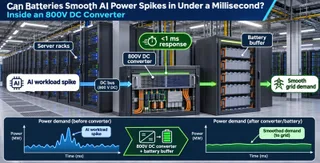
Can the Ampt 800V DC battery converter smooth AI power spikes?
Yes, a battery-backed 800 V DC system can buffer short GPU power spikes. Ampt says its rack-mounted converter can deliver full power in under one millisecond. Ampt’s public materials give no load-step size, input voltage, response criterion or allowable rack-voltage deviation for that test. No independent pilot measurements were found. Whether the system can reduce peak import at a UK data centre depends on the size, duration and frequency of the spikes and the power available for recharging. Ampt battery converter specifications
Ampt’s 11 November 2026 launch announcement reported partner pilots and set a target of the third quarter of 2027 for general availability. UK buyers should confirm delivery dates, local commissioning support and spare-module availability before relying on that timetable. Ampt launch announcement
How the battery and converter handle a GPU load swing
In Ampt’s design, an upstream power conversion system feeds a DC bus from the AC supply. The battery shares that bus, which Ampt describes as operating at 1,100–1,500 V DC in its launch configuration. The rack converter takes the variable bus voltage and supplies a regulated 800 V DC output. When GPU demand rises faster than the upstream supply is set to respond, the battery can cover the difference. As demand falls, the upstream supply can recharge the battery within the site’s import limit and the battery’s charge limits. Ampt launch announcement
Ampt rates each 2U module at 80 kW and 100 A at its 800 V DC output. Modules can run in parallel. Check how they share load at the expected bus voltages and temperatures, including with one module offline if the design relies on spare capacity. Ampt quotes peak converter efficiency of up to 99.2%. To estimate energy use and cooling demand, ask for an efficiency curve across the expected load and input-voltage range. Account separately for losses in the battery and upstream conversion. Ampt battery converter specifications
When could battery buffering free up capacity on a UK grid connection?
Battery buffering could support more compute within an existing import limit if short peaks are the constraint and the battery can recharge between them. Power in kW determines how much of a shortfall the equipment can cover at any instant. Usable energy in kWh determines how long it can cover that shortfall, given the battery’s operating limits and any reserve held for other duties. The same distinction matters when specifying commercial battery systems for site-wide peak management.
Overview
Suppose the battery has to cover a 400 kW shortfall at the racks for 30 seconds, followed by 60 seconds for recharging. Each pulse takes about 3.33 kWh at the racks (400 kW × 30 ÷ 3,600). If the site has 150 kW of spare AC import capacity throughout that minute after allowing for cooling and other loads, it can import only 2.50 kWh for charging. The battery ends each cycle with at least 0.83 kWh less usable energy. Conversion and battery losses increase the deficit.
At 150 kW, replacing 3.33 kWh takes at least 80 seconds before allowing for losses. A larger battery can cover more pulses, but continuous operation still needs more recharge headroom, longer recovery windows or less energy per pulse. Size the battery’s usable capacity for the longest expected run of pulses, allowing for losses, operating reserve and capacity decline. Check separately that the battery can deliver the required power at the lowest state of charge and temperature expected in service.
Record rack voltage and load at a resolution that captures sub-millisecond changes. Measure AC import separately at the connection point over a representative workload, including recharging and cooling demand. Use the metering basis in the site’s connection agreement to assess how much capacity the design could free up. For a site connected to the distribution network in Great Britain, give the distribution network operator (DNO) a single-line diagram, the expected import and recharge profile, and details of any equipment that can operate in parallel with the grid. Ask whether the proposal affects the connection agreement and whether G99 applies to the AC-side arrangement. For a direct transmission connection or a project in Northern Ireland, confirm the route with the relevant network operator. Energy Networks Association distributed generation connection guide
What should operators test and monitor?
Agree the transient acceptance test before procurement. Ask the supplier for time-aligned voltage and current traces that show the starting and finishing loads. Record the converter input voltage, battery state of charge and measurement points. Define when timing starts and what counts as a pass. Measure separately how long it takes to reach the requested output power and how long it takes for rack voltage to return within the rack supplier’s tolerance. Record the worst voltage dip or overshoot and the time the voltage takes to settle.
Repeat the tests for rising and falling load steps, near the battery’s operating limits. If the design relies on spare converter capacity, repeat them with one converter offline. Check how the converter and battery management system respond to faults and supply interruptions. If the design includes an uninterruptible power supply, test the handover and verify which loads stay energised and for how long.
Ampt lists a built-in web interface for local configuration and testing, plus Modbus TCP for supervisory control and data acquisition (SCADA). For integration with site energy management, specify how often telemetry must update, how quickly commands must take effect and what the system should do if communications drop. Use local instruments for the transient acceptance test. Ordinary SCADA polling may miss the voltage dip or overshoot. Ampt battery converter specifications
What will it cost to install in the UK?
Ampt’s public launch material and product page give no typical UK installed price. Ask bidders to price the full power path, including batteries, rack converters, upstream conversion, DC cabling and switchgear, protection, isolation, earthing, controls integration and commissioning. In an existing hall with AC distribution, identify which racks and circuits would need modification and whether the work requires planned outages. Ampt launch announcement
Give each bidder the same measured workload and import limit so you can compare designs. Ask for the assumed usable battery capacity over the warranty period, the number of modules needed if one has to be taken out of service, the recharge power, service arrangements and conformity documentation. If the business case depends on adding compute, set acceptance criteria for both measured import across a full workload and recharge cycle and rack-voltage performance.
If the wider project includes on-site generation, compare industrial solar proposals using the site’s measured daytime demand and model how much generation would be available during the expected recharge windows.
Which data centres are a good fit?
The best fit is an 800 V DC data hall where brief, repeatable GPU peaks limit how much compute the site can deploy and measured gaps between peaks leave enough import headroom to recharge. An AC retrofit may require wider changes to power distribution. If the site also needs storage for longer periods of peak demand, assess that duty when specifying site-wide battery storage. A site with sustained demand near its import limit will have little room to recharge. Give bidders the rack supplier’s voltage tolerance and a measured site load profile. Ask them to show how many extra racks the design can support through repeated peaks without exceeding the agreed import limit.
Solar comparison
Compare solar for your property
Enter your postcode to assess your roof, compare solar options and get quotes from UK installers.
- Free postcode start
- Home, business and industrial
- RoboMo™ maps your roof
See which panels fit your roof
Choose home, business or industrial, then enter your postcode. RoboMo maps the roof and ranks panel brands by fit.
1. Postcode Start the assessment for your property.
2. Pin the roof Mark the array on the map.
3. Compare RoboMo™ builds your options.

Battery ROI tool
See what a battery saves on your bill
Enter the day rate, off-peak rate and export rate. The calculator ranks batteries in the Kilowatts shop over 10 years. Home batteries also suit offices and small commercial sites.
Reading
Sources and further reading

See how BMW and Lumissil sent battery data over the power lines of a full Gen6 800 V pack and what UK iX3 buyers should check about home charging.
Read article
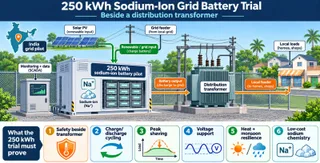
Jaipur's 250 kWh sodium-ion battery trial will test whether storage can ease peak transformer loads. See what UK battery buyers can learn about sizing.
Read article

A home battery stores daytime solar and releases it in the evening. Here's how time-shifting works, what happens when it empties, and how to size one properly.
Read article
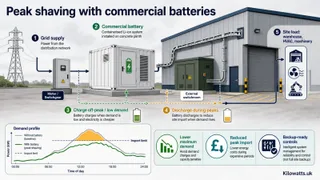
See when peak shaving with commercial batteries can cut UK capacity and excess charges, and why kVA, half-hourly data and reserve energy decide the result.
Read article


Mo's Solar Mission
Mo's Mission Nominations
Garlinge Primary School and Nursery
Garlinge Primary School and Nursery is a foundation primary school on Westfield Road in Margate, Kent, for children aged 3 to 11. It is m...
St Luke's Church of England Primary SchoolSt Luke's Church of England Primary School is a voluntary controlled Church of England primary school on Jubilee Road in Formby, Merseysi...
Comberbach Nursery and Primary SchoolComberbach Nursery and Primary School is a primary academy on Mather Drive in the village of Comberbach, near Northwich in Cheshire, for...
Locations
Solar installation near you
Write for Kilowatts.uk
Got a trade and something worth saying?
Write it here under your own name. Sign in, put a profile up, and start a guide. Pay only if you want more links from your articles out to your own site.
Register
Create a Kilowatts.uk account, or sign in if you already have one.
Author profile
Put your name, photo and experience on a public author page.
Start creating
Write a guide or a blog. Free authors can put one followed link to their own site in articles each month.
FAQ
Need Help? RoboMo's Got Answers
Can Ampt’s battery converter respond to AI power spikes in under a millisecond?
Ampt says its converter can deliver full power in under one millisecond. The published claim does not specify the size of the load step or how far the rack voltage dipped during the test. Ask for voltage and current traces that show both how quickly output power rises and how long the rack voltage takes to settle within tolerance.
Is Ampt’s 800 V DC converter suitable for home battery storage?
The converter is designed for 800 V DC data centre racks. For a home battery, check compatibility with your existing inverter or solar system, the usable capacity in kWh and the maximum output in kW. If you want backup during a power cut, confirm which circuits the proposed system can supply.
Can a battery help a UK data centre add more servers on its existing grid connection?
It may help if brief power spikes are the constraint and the site has enough spare import capacity to recharge between them. Repeated spikes can drain the battery if it cannot recover enough charge, and sustained demand above the import limit can only be covered for a finite time. Measure import at the grid connection over a representative workload, including cooling and battery recharging.
How much battery power and capacity does a data centre need to smooth AI spikes?
The power rating in kW determines how much of the demand spike the battery can cover, while usable capacity in kWh determines how long it can cover it. A 400 kW shortfall lasting 30 seconds needs about 3.33 kWh at the racks before losses. Size the system for the longest expected run of spikes, allowing for recharge time, battery reserve and capacity decline.
Does a data centre battery installation need approval from the UK network operator?
Check with the relevant network operator using the proposed electrical layout and expected import and recharge profile. For a distribution-connected site in Great Britain, ask the distribution network operator whether the design affects the connection agreement and whether G99 applies to the AC-side arrangement. For a direct transmission connection or a site in Northern Ireland, confirm the process with the relevant network operator.
Can the Ampt converter replace a data centre UPS?
Fast response to changes in rack demand does not establish how the system will perform during a power cut. If you need uninterruptible power, test the complete backup arrangement, including any UPS handover. Verify which loads stay powered and for how long.
How much does an Ampt 800 V DC system cost to install in the UK?
Ampt’s published launch materials do not give a typical UK installed price. Ask for a quote covering the batteries, rack converters, upstream conversion equipment, DC cabling and switchgear, protection, controls integration and commissioning. For an existing AC data hall, ask bidders to include any distribution changes and planned outages in their proposals.
When will Ampt’s 800 V DC converter be available in the UK?
Ampt’s launch announcement reported partner pilots and targeted general availability for the third quarter of 2027. Ask the supplier to confirm UK delivery dates, local commissioning support and spare-module availability before building the converter into your project schedule.
Live help
Need help right now?
Talk to RoboMo™ and get instant answers.