


India's First Sodium-Ion Grid Battery Will Sit Beside a Transformer - What the 250kWh Trial Must Prove
Published: 2026-11-24 12:02:32
Updated: 2026-11-24 04:03:27
Jaipur's 250 kWh sodium-ion battery trial will test whether storage can ease peak transformer loads. See what UK battery buyers can learn about sizing.
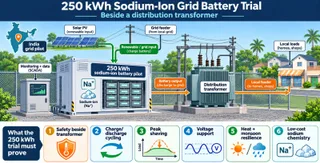
What Jaipur’s planned 250 kWh sodium-ion battery pilot must prove
Jaipur’s planned 250 kW / 250 kWh sodium-ion battery pilot will test whether storage at a local distribution transformer can cut peak loading and make better use of rooftop solar. The battery needs to deliver enough power throughout the peak, recharge without adding to the constraint and repeat the cycle through Rajasthan’s summer heat.
In its 29 October 2026 announcement, the Global Energy Alliance for People and Planet said it and Jaipur Vidyut Vitran Nigam Limited (JVVNL) had issued a joint request for proposals for the pilot at K.L. Saini Stadium. The organisers describe it as India’s first sodium-ion storage pilot at distribution-transformer level. The request for proposals is the latest publicly verified milestone. The full tender and any subsequent contract award or commissioning could not be independently verified. Global Energy Alliance pilot announcement
Why put a battery at a distribution transformer?
A distribution transformer steps down the voltage for local customers. A battery connected on its low-voltage side can charge when nearby rooftop solar generates more electricity than customers use. When demand rises, the battery can supply some of it locally, reducing the power drawn through the transformer. The same principle underlies peak shaving with a home battery.
Charging from the grid during a busy period adds to transformer loading. Discharging too early can leave too little energy for the highest part of the peak. If demand stays high for several hours, the operator needs to know how far loading must fall and how long it must stay below the target. A lower discharge rate can stretch the battery’s runtime if it still covers the excess demand throughout the peak.
What 250 kW and 250 kWh mean in practice
The 250 kW rating is the rate at which the system can deliver energy. The 250 kWh rating is its energy capacity. Dividing capacity by power gives a nominal runtime of one hour at rated output. The announcement leaves open how much capacity is usable and where the power and energy ratings are measured.
For network planning, the utility needs the continuous AC output and usable energy at the connection point under site conditions. If capacity is quoted at the battery, the utility needs to account for the permitted state-of-charge range, conversion losses and auxiliary consumption. High temperatures can also limit sustained output. The transformer’s own limits determine what to measure, such as current on each phase or apparent power where relevant. The battery’s kW rating alone cannot show how heavily each phase is loaded.
What remote control has to get right
A controller can use local measurements to identify when the transformer has spare capacity for charging and when the battery should discharge. Operators can monitor transformer loading, battery state of charge and faults. The organisers have announced performance monitoring and left the control strategy and communications arrangements open in the public release. Global Energy Alliance pilot announcement
Two commissioning tests would show how the controls handle failures. If the remote link drops while the transformer meter still provides valid readings, local control may continue within agreed limits. If readings stop or become stale, the controller loses the information it needs to judge whether charging would worsen the constraint. The commissioning record should show how the system responds in each case, when it alerts operators and what must happen before normal operation resumes.
What would count as a successful trial?
The organisers say the trial will measure peak loading, rooftop solar utilisation, efficiency and reliability on a live distribution network, including during summer heat. It will also assess thermal safety, degradation and lifecycle costs, using lithium-ion storage and conventional network reinforcement as comparators. The public release states the objectives and leaves numerical success thresholds unspecified. Global Energy Alliance pilot announcement
The results should show how much the battery reduced transformer loading, how long it kept loading below the target and how often it was available when needed. Comparing similar days with and without battery dispatch would help isolate its contribution. Weather, demand and solar generation all matter to that comparison. To show whether the battery made better use of rooftop solar, the report could measure how much surplus solar was stored and later used locally, with grid charging accounted for.
Efficiency figures should state where measurements were taken and whether they include cooling and other auxiliary loads. Hot-weather results should show whether the system sustained the required output and how often it had to reduce power. A comparison with reinforcement should use the same load forecast and account for maintenance, degradation and replacement costs. Deferring an upgrade depends on the battery covering peaks reliably as demand grows, with enough time to recharge between them.
What Jaipur can tell UK homes and businesses
The closest UK equivalent is a distribution network operator managing a constrained transformer. A battery behind a home or business meter generally serves that customer’s demand, solar generation and tariff. In either case, start with measured data and identify the periods the battery needs to cover. For homes, smart energy management can help coordinate charging with solar generation, demand and tariff windows.
Overview
For a solar battery retrofit, ask whether the installer proposes keeping the existing solar inverter and adding a battery inverter, or replacing it with a hybrid inverter. The choice affects wiring, metering and the connection assessment. On a three-phase site with uneven loads, ask how the system measures each phase and which phases it can supply. If you need backup during a power cut, ask which circuits the battery will power and what equipment the quote includes to make that possible.
In Great Britain, ask the installer to confirm the applicable G98 or G99 route with the distribution network operator, taking existing generation and storage into account. If the design relies on an import or export limit, ask how the installer will demonstrate compliance with the applicable G100 requirements and record the commissioning checks. In Northern Ireland, check the local network operator’s connection guidance. Energy Networks Association distributed generation guide
How to compare a UK sodium-ion battery quote
Jaipur’s specification illustrates why both power and energy matter when sizing a battery. Compare UK quotes against the same charge and discharge requirements. Check usable capacity, continuous AC output, efficiency under stated conditions and warranty limits on years, cycles or energy throughput. When comparing battery installation costs, include metering, electrical work, monitoring, servicing and any inverter replacement. Check who handles warranty claims and who can service the system if a component fails.
Use your import and export data to identify when you need the battery. Give each installer the same profile and ask them to show when it would charge and discharge, how much energy it would deliver and where it would fall short. If savings depend on charging at a cheaper rate, use the actual tariff windows and account for cycling losses. If you plan to store surplus solar, include the export income you would give up.
If your home has no solar, read about a plug-in sodium-ion battery being developed for that setting. If you’re considering solar alongside storage, you can arrange a free survey to discuss what would suit your home.
Solar comparison
Compare solar for your property
Enter your postcode to assess your roof, compare solar options and get quotes from UK installers.
- Free postcode start
- Home, business and industrial
- RoboMo™ maps your roof
See which panels fit your roof
Choose home, business or industrial, then enter your postcode. RoboMo maps the roof and ranks panel brands by fit.
1. Postcode Start the assessment for your property.
2. Pin the roof Mark the array on the map.
3. Compare RoboMo™ builds your options.

Battery ROI tool
See what a battery saves on your bill
Enter the day rate, off-peak rate and export rate. The calculator ranks batteries in the Kilowatts shop over 10 years. Home batteries also suit offices and small commercial sites.
Reading
Sources and further reading
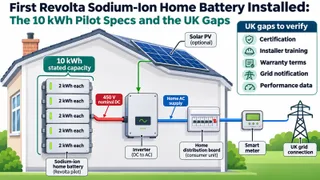
Explore Revolta’s 10 kWh sodium-ion home battery pilot in Germany and see what UK buyers still need to confirm about supply, pricing and warranty.
Read article
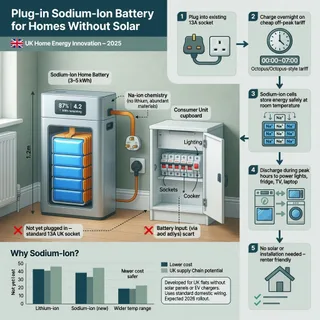
A plug-in sodium-ion battery for homes without solar is in development, not on sale. UK grid rules may still block a simple wall-socket connection.
Read article
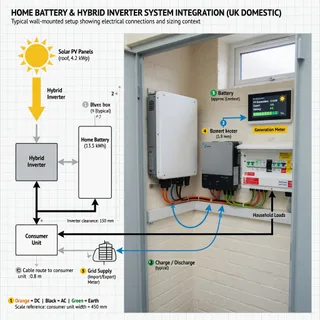
What battery do I need depends on usable kilowatt-hours you can shift, inverter power, and whether the charge window and connection can fill it.
Read article

Yes - a home battery can fill from cheap off-peak grid electricity, then run your house through the expensive peak. Here's how it works in UK homes.
Read article



Mo's Solar Mission
Mo's Mission Nominations
Garlinge Primary School and Nursery
Garlinge Primary School and Nursery is a foundation primary school on Westfield Road in Margate, Kent, for children aged 3 to 11. It is m...
St Luke's Church of England Primary SchoolSt Luke's Church of England Primary School is a voluntary controlled Church of England primary school on Jubilee Road in Formby, Merseysi...
Comberbach Nursery and Primary SchoolComberbach Nursery and Primary School is a primary academy on Mather Drive in the village of Comberbach, near Northwich in Cheshire, for...
Locations
Solar installation near you
Write for Kilowatts.uk
Got a trade and something worth saying?
Write it here under your own name. Sign in, put a profile up, and start a guide. Pay only if you want more links from your articles out to your own site.
Register
Create a Kilowatts.uk account, or sign in if you already have one.
Author profile
Put your name, photo and experience on a public author page.
Start creating
Write a guide or a blog. Free authors can put one followed link to their own site in articles each month.
FAQ
Need Help? RoboMo's Got Answers
What is Jaipur’s sodium-ion battery trial testing?
The planned trial will test whether a battery beside a local transformer can store surplus rooftop solar and release it when demand rises. Useful results would show how much it reduced peak loading, how long the reduction lasted and whether the battery could deliver that performance repeatedly in summer heat.
What is the difference between 250 kW and 250 kWh?
Kilowatts measure how quickly a battery can deliver power, while kilowatt-hours measure how much energy it can store. Jaipur’s ratings imply one hour at full output on paper. When comparing home batteries, ask for usable capacity and continuous AC output, as these determine what the battery can supply and for how long.
How should I size a battery for my home?
Use your electricity import and export data across seasons to see how much energy you could store and when you would use it. Check that the battery’s continuous output can cover the appliances you want to run together. Ask each installer to model the same usage profile so you can compare quotes on a like-for-like basis.
Can a home battery save me money without solar panels?
A battery can charge from the grid during a cheaper tariff window and supply your home when electricity costs more. The savings depend on your actual tariff, how much demand falls in the dearer hours and how much energy is lost in charging and discharging. Compare the estimated savings with the full installed cost.
Can I add a battery to my existing solar panels?
Ask whether you can keep your solar inverter and add a separate battery inverter, or whether the installer proposes replacing it with a hybrid inverter. The choice affects wiring, metering and the connection assessment. Ask the installer to confirm the applicable network connection process for the combined system.
Will a home battery keep my lights on during a power cut?
A battery can supply power during an outage if the installation is designed for backup. Ask which circuits it will power, how much power it can deliver and whether it reserves any charge for outages. Check that the quote includes the equipment and wiring needed for backup.
How should I compare sodium-ion and lithium-ion battery quotes?
Compare systems that can meet the same power and runtime requirements for your home. Check usable capacity, continuous output, round-trip efficiency and warranty limits on years, cycles or total energy delivered. Compare full installed costs and ask who will handle servicing and warranty claims.
Live help
Need help right now?
Talk to RoboMo™ and get instant answers.