


First Revolta Sodium-Ion Home Battery Installed: The 10 kWh Pilot Specs and the UK Gaps
Published: 2026-11-24 05:33:53
Updated: 2026-11-23 21:34:52
Explore Revolta’s 10 kWh sodium-ion home battery pilot in Germany and see what UK buyers still need to confirm about supply, pricing and warranty.
Revolta commissions its first customer sodium-ion home battery in Germany
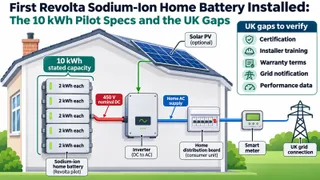
Revolta commissioned its first sodium-ion home battery at a customer site near Aschaffenburg, Germany. The installation was reported on 5 November 2026. The 10 kWh pilot pairs five 2 kWh modules with an SMA inverter. Revolta’s November 2026 availability information limits initial deliveries to Germany. UK supply, installed pricing and local warranty support remain unconfirmed. pv magazine’s commissioning report · Revolta’s availability information
The property already had about 20 kW of solar PV and a small hydroelectric plant. Hydro can charge the battery when solar output is low, so charging patterns may differ from those of a UK home with rooftop solar alone. Revolta added metering to collect operating data. Assessing seasonal performance and bill savings will take longer-term measurements. pv magazine’s commissioning report
What 10 kWh and 450 V mean in practice
Revolta’s English datasheet rates each HV-2.0 Na module at 2 kWh of usable energy, giving the five-module system 10 kWh on the battery side. The 450 V nominal DC rating describes the connection between the battery and inverter. Ask how much energy the system can deliver on the AC side after conversion losses and any backup reserve you set. Revolta’s English HV-2.0 Na module datasheet
Capacity in kWh tells you how much energy the battery can store. Power in kW tells you how quickly it can charge or discharge. Revolta gives a charge and discharge rate of 0.4 C, equivalent to about 4 kW on the battery side for five modules. The datasheet separately lists continuous DC power of 0.6 to 1.2 kW per module, depending on state of charge. If you have a heat pump, electric cooker or EV charger, compare the continuous AC output of the proposed battery and inverter with the combined demand of appliances likely to run together. Revolta’s product specifications · Revolta’s English module datasheet
What the inverter app can control
Revolta’s control unit sends battery data to the inverter, which displays it in its app. If you plan to use cheaper overnight electricity, ask the installer to demonstrate grid charging on the proposed inverter model and firmware. At handover, check that you can change charging times, set a minimum reserve and override a schedule. If your tariff’s cheap hours vary, check how the system gets updated times and whether saved schedules run when the internet drops. Make sure you have your own account access and know who can restore it. Revolta’s monitoring and operation guidance
If you need backup power, ask the installer to demonstrate it. The circuits you want to keep running need suitable wiring and an inverter that supports backup. Check which circuits stay live, how much power they can draw together and whether solar can recharge the battery while the property is disconnected from the grid. Revolta’s backup guidance
What a UK installer would need to check
Revolta’s battery connects on the DC side of a compatible hybrid or dedicated battery inverter. If you’re adding a battery to existing solar, give the installer the model and firmware version of your existing solar inverter. Ask them to check the battery’s operating voltage range and metering requirements and get written confirmation that the proposed pairing is compatible. Revolta treats support for an inverter’s communication protocol and formal approval by the inverter manufacturer separately. Ask for confirmation that covers the exact model. Revolta’s inverter and retrofit guidance
For a grid-connected installation in Great Britain, ask the installer to confirm the G98 or G99 route with the local distribution network operator (DNO). They should check the exact inverter model and variant in the Energy Networks Association’s Type Test Register and confirm that the evidence covers the proposed configuration. If the entry is missing or unclear, find out what evidence the DNO will accept before ordering equipment. The installer should account for any existing generation. If the design limits export, they should confirm the required settings, evidence and commissioning checks with the DNO. Government guidance on registering energy devices
The site survey should cover consumer unit space, cable routes, meter placement and battery location. Revolta recommends charging between 0°C and 45°C and says power falls at very low temperatures. If you plan to charge overnight in an unheated garage, ask how much energy the battery could take on during cheap hours in cold weather. Have the installer check the clearances against the installation manual. Revolta’s operating and installation guidance
What the pilot tells us about costs and savings
Revolta’s German FAQ, checked on 24 November 2026, gave an indicative hardware price of about €3,210 for five modules and the control unit before installation. It described 2026 deliveries as Germany-only. For UK context, the Energy Saving Trust gives a broad home battery cost range of £1,500 to £10,000, with an indicative cost of around £4,600 for a 5 kWh system. Compare installed quotes that include any inverter change, metering, electrical work, commissioning and backup wiring you need. Revolta’s German pricing and availability · Energy Saving Trust battery storage guide
To see whether 10 kWh suits your home, use half-hourly smart meter data across different seasons and include solar generation or export data if you have it. For solar charging, weigh the savings on later imports against the export income you would give up. For grid charging, compare the cost of off-peak electricity used to charge the battery with the cost of the peak-rate imports it would replace. Allow for energy lost in charging and discharging when you estimate your battery payback. If you regularly have too little surplus generation to fill the battery or too little demand later to use the stored energy, ask the installer to model a smaller system using the same data.
What Revolta’s warranty covers in Germany
Revolta’s factory warranty dated 7 November 2026 covers eligible modules bought through an authorised channel and installed and operated in Germany. It provides a ten-year product warranty. A separate performance warranty guarantees at least 80% of usable energy until ten years have passed or a module has discharged a cumulative 5.6 MWh, whichever comes first. Revolta’s high-voltage battery factory warranty
For a UK purchase, ask for written terms naming the warranty provider, confirming UK coverage and explaining any limit on cumulative discharge and any retained-capacity guarantee. Check what the terms cover for the modules, control unit and inverter, who diagnoses faults and who pays for labour, travel, removal and shipping. Ask who stocks replacement parts and whom to contact if the installer stops trading.
Where sodium-ion could fit in UK homes and businesses
When comparing sodium-ion with lithium iron phosphate (LFP), look at the complete systems in your quotes. Compare usable capacity, continuous AC output, round-trip efficiency measured on the same basis, and the cost and scope of warranty support. The German pilot gives Revolta a site to collect operating data. Comparing battery service life, safety or running costs across chemistries requires evidence from comparable systems and operating conditions.
For a flat with balcony solar, check equipment compatibility, where the battery could go, its exposure to weather and any building permissions. For a shop, workshop or farm, use interval meter data to see how long the load you want to cover lasts. Sustained demand can drain the battery. Short peaks can exceed the inverter’s continuous output even when the battery still has charge.
What to ask for before choosing a battery
Bring your usage data, tariff rates and existing inverter details when you book a site survey. Ask for an itemised quote that names the battery and inverter, states usable capacity and continuous AC power, and explains the charging controls, grid-connection route and who handles faults locally. If Revolta is on your shortlist, confirm UK supply and get the warranty and service terms in writing before committing to a design.
Use the Kilowatts UK comparison tools or installer directory to shortlist options, then compare quotes using the same usage and tariff assumptions.
Solar comparison
Compare solar for your property
Enter your postcode to assess your roof, compare solar options and get quotes from UK installers.
- Free postcode start
- Home, business and industrial
- RoboMo™ maps your roof
See which panels fit your roof
Choose home, business or industrial, then enter your postcode. RoboMo maps the roof and ranks panel brands by fit.
1. Postcode Start the assessment for your property.
2. Pin the roof Mark the array on the map.
3. Compare RoboMo™ builds your options.

Battery ROI tool
See what a battery saves on your bill
Enter the day rate, off-peak rate and export rate. The calculator ranks batteries in the Kilowatts shop over 10 years. Home batteries also suit offices and small commercial sites.
Reading
Sources and further reading
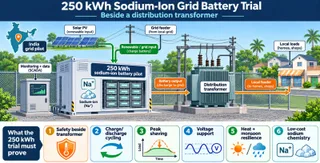
Jaipur's 250 kWh sodium-ion battery trial will test whether storage can ease peak transformer loads. See what UK battery buyers can learn about sizing.
Read article
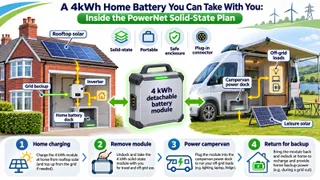
Could PowerNet’s detachable 4 kWh solid-state battery serve UK homes and campervans? See what Australia’s pilot covers and what buyers still need to know.
Read article
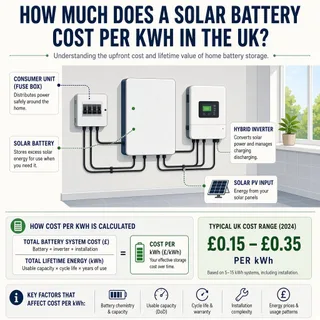
UK solar battery cost per kWh is not a national rate. Divide the surveyed installed total by usable kilowatt-hours, not nameplate or supply-only prices.
Read article
No single UK solar battery price per kWh exists. Divide matched supply-and-fit by usable kWh, not nameplate, and keep inverters and extras out.
Read article


Mo's Solar Mission
Mo's Mission Nominations
Garlinge Primary School and Nursery
Garlinge Primary School and Nursery is a foundation primary school on Westfield Road in Margate, Kent, for children aged 3 to 11. It is m...
St Luke's Church of England Primary SchoolSt Luke's Church of England Primary School is a voluntary controlled Church of England primary school on Jubilee Road in Formby, Merseysi...
Comberbach Nursery and Primary SchoolComberbach Nursery and Primary School is a primary academy on Mather Drive in the village of Comberbach, near Northwich in Cheshire, for...
Locations
Solar installation near you
Write for Kilowatts.uk
Got a trade and something worth saying?
Write it here under your own name. Sign in, put a profile up, and start a guide. Pay only if you want more links from your articles out to your own site.
Register
Create a Kilowatts.uk account, or sign in if you already have one.
Author profile
Put your name, photo and experience on a public author page.
Start creating
Write a guide or a blog. Free authors can put one followed link to their own site in articles each month.
FAQ
Need Help? RoboMo's Got Answers
Can I buy the Revolta sodium-ion home battery in the UK?
Revolta’s November 2026 availability information limited initial deliveries to Germany. UK supply, installed pricing and local warranty support were unconfirmed. If an installer offers the battery, ask for an itemised quote and written confirmation of UK warranty coverage and local servicing.
What do 10 kWh and 450 V mean for my home?
The five modules provide 10 kWh of usable energy on the battery side. The nominal 450 V DC rating describes the connection between the battery and inverter. Ask how much energy you can use after inverter losses and any backup reserve, and check the continuous AC output in kW to see which appliances can run together.
Can I add the Revolta battery to my existing solar panels?
A retrofit may be possible with a compatible hybrid or dedicated battery inverter. Give your installer the model and firmware version of your existing inverter and ask for written confirmation that the inverter manufacturer approves the proposed pairing. In Great Britain, ask the installer to confirm the grid-connection route with your local distribution network operator, including how it accounts for your existing solar.
Can the battery charge on a cheap overnight tariff?
Ask the installer to demonstrate scheduled grid charging on the exact inverter model and firmware in your quote. If your cheap hours vary, check how the system updates its schedule and whether saved schedules run if the internet drops. For an unheated garage, ask how much energy the battery can take on during a cold night’s cheap-rate window.
Will the Revolta battery keep my home running during a power cut?
Backup depends on the inverter and how your home is wired. Ask the installer to demonstrate which circuits stay live, how much power they can draw together and whether your solar panels can recharge the battery during the cut.
How can I tell whether a 10 kWh battery will save me money?
Use half-hourly smart meter data from different seasons to estimate how much stored energy you could use. Factor in charging losses, the export income you would give up by storing surplus solar and, if charging from the grid, the difference between off-peak and peak rates. The German pilot also had a small hydroelectric plant, so its charging patterns may differ from those of a UK home with rooftop solar alone. Ask for a smaller battery to be modelled using the same data.
Would Revolta’s ten-year warranty cover a UK installation?
The published factory warranty applies to eligible modules installed and operated in Germany. Its separate performance warranty guarantees at least 80% of usable energy for up to ten years or until a module has discharged 5.6 MWh in total, whichever comes first. For a UK quote, ask who provides the warranty and get written confirmation of UK coverage, capacity and discharge limits, and who pays for labour and shipping.
How should I compare Revolta with a lithium iron phosphate (LFP) battery?
Compare complete installed systems on usable capacity, continuous AC output, round-trip efficiency measured on the same basis and warranty support. Ask for evidence from similar systems and operating conditions before drawing conclusions about service life, safety or running costs.
Live help
Need help right now?
Talk to RoboMo™ and get instant answers.