


Microsoft Patent Could Route AI Workloads to Where Wind and Solar Power Are Available
Published: 2026-11-23 22:40:28
Updated: 2026-11-23 14:41:16
See how Microsoft’s patent application would use wind and solar forecasts to route AI inference, and what UK trials would need to measure to prove savings.
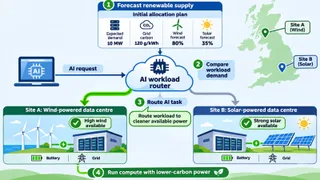
Microsoft patent application proposes routing AI workloads to where wind and solar power are available
Microsoft’s US patent application describes how an AI service could send requests to computing sites forecast to have more wind or solar power. The receiving site would still need suitable processors, spare capacity and a network connection fast enough to meet the response deadline. UK cost and emissions savings remain unquantified. They would depend on where the requests would otherwise run, how each site gets its electricity and what would otherwise happen to the renewable output.
The proposal focuses on AI inference, the work a trained model does to generate an answer or prediction. The request travels over a data network, and the chosen site uses the electricity available to it. The US Patent and Trademark Office published application US20260349824A1 on 5 November 2026. A patent grant and a live UK deployment would each require separate confirmation. Published US patent application US20260349824A1
How power forecasts change where AI requests run
A longer-range plan uses expected request volumes and power availability to decide how much work each site should handle and how to configure its processors. A second planning stage uses a fresher forecast to revise the allocation and adjust processor speeds. When a request arrives, the scheduler chooses a site based on the revised plan and the request’s requirements.
If cloud lowers the solar forecast at one site while wind output is expected to hold up at another, the scheduler could send more new requests to the wind-powered site. That site still needs to be able to run the model. Even with spare power, a long queue or a slow network connection could make it unsuitable for an interactive request.
When routing could cut electricity costs or emissions
Routing is most promising when compatible sites have different generation patterns and enough spare computing capacity to take on extra requests. The financial case depends in part on whether the electricity would otherwise be curtailed or sold to the grid. Operators would also need to account for the cost of keeping processors ready at several sites and maintaining service when forecasts are wrong.
A UK trial would need to compare forecast-based routing with the operator’s usual routing using the same mix of requests. It should record electricity use at each site, grid imports and exports, and how much generation would otherwise be curtailed. The comparison should also state the electricity prices and emissions assumptions used. Response times and the share of requests delayed or dropped would show whether any savings came at the expense of service quality.
Microsoft Research’s XWind project routes requests using live signals from computing sites, including inference latency, how much of the model’s cache is in use and how many requests are queued. The patent application’s scheduler uses a plan updated with a power forecast. XWind ran on real computing hardware configured to emulate wind-powered sites, so its results apply to that test setup and routing method. Microsoft Research’s XWind evaluation
What Great Britain’s grid carbon forecast can tell you
The National Energy System Operator’s regional carbon-intensity forecast estimates the emissions associated with a kilowatt-hour of grid electricity in different parts of Great Britain. It can help a business choose when to run flexible work on grid power. To estimate on-site renewable surplus, a business needs local generation and demand readings for the same intervals. NESO regional carbon-intensity forecast
Even when rooftop solar is generating well, refrigeration, machinery or charging an on-site battery may use most of the output. Spare power, measured in kilowatts (kW), tells a controller how much extra load it can support at that moment. The energy available over time, measured in kilowatt-hours (kWh), helps determine whether the job can finish by its deadline. A brief spell of sunshine may be enough to start charging an EV, but reaching the required charge by departure may still need a grid top-up.
What homes, farms and businesses can apply today
At a single property, the same principle can help decide when to run a flexible load. A household could schedule its EV charging for times when it expects to export solar power. A farm or small business could check whether battery charging or a flexible process can run when machinery draws less power. A business with several computing sites would also need to check whether the receiving site can meet the workload’s response-time and data-handling requirements.
Compare interval readings for grid imports and exports with on-site generation data, where available, to see when surplus occurs and how long it lasts. If you are weighing up solar for your home or comparing solar for your business, ask the installer to model how roof orientation and shading affect generation during the hours you can use it. Ask what the energy management system measures at the grid connection, which loads take priority when output falls and what happens if it loses contact with the meter. For EV charging, check whether you can set a departure deadline and whether the controller can draw on the grid to reach your target charge in time.
Solar comparison
Compare solar for your property
Enter your postcode to assess your roof, compare solar options and get quotes from UK installers.
- Free postcode start
- Home, business and industrial
- RoboMo™ maps your roof
See which panels fit your roof
Choose home, business or industrial, then enter your postcode. RoboMo maps the roof and ranks panel brands by fit.
1. Postcode Start the assessment for your property.
2. Pin the roof Mark the array on the map.
3. Compare RoboMo™ builds your options.

Battery ROI tool
See what a battery saves on your bill
Enter the day rate, off-peak rate and export rate. The calculator ranks batteries in the Kilowatts shop over 10 years. Home batteries also suit offices and small commercial sites.
Reading
Sources and further reading
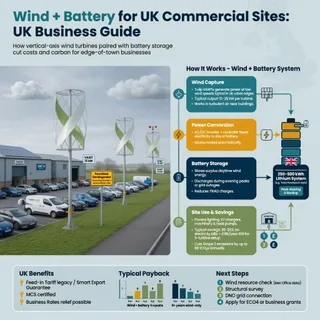
Wind plus battery is credible for a UK commercial site only with usable rotor-height wind, planning and a connection. Storage cannot make wind firm power.
Read article
Learn how UK homeowners can combine solar panels with a small wind turbine, stay SEG-eligible, and lower energy bills with the right inverter setup.
Read article

For most UK businesses, solar is the more practical starting point. Wind is worth serious consideration only on exposed sites with enough land.
Read article
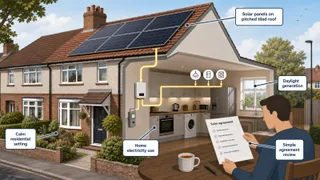
A power purchase agreement solar deal is a long-term contract where a third party funds, owns and usually maintains solar panels on your roof.
Read article



Mo's Solar Mission
Mo's Mission Nominations
Garlinge Primary School and Nursery
Garlinge Primary School and Nursery is a foundation primary school on Westfield Road in Margate, Kent, for children aged 3 to 11. It is m...
St Luke's Church of England Primary SchoolSt Luke's Church of England Primary School is a voluntary controlled Church of England primary school on Jubilee Road in Formby, Merseysi...
Comberbach Nursery and Primary SchoolComberbach Nursery and Primary School is a primary academy on Mather Drive in the village of Comberbach, near Northwich in Cheshire, for...
Locations
Solar installation near you
Write for Kilowatts.uk
Got a trade and something worth saying?
Write it here under your own name. Sign in, put a profile up, and start a guide. Pay only if you want more links from your articles out to your own site.
Register
Create a Kilowatts.uk account, or sign in if you already have one.
Author profile
Put your name, photo and experience on a public author page.
Start creating
Write a guide or a blog. Free authors can put one followed link to their own site in articles each month.
FAQ
Need Help? RoboMo's Got Answers
What does Microsoft’s patent application propose?
It describes using wind and solar forecasts to decide which computing site should handle an AI request. The chosen site still needs suitable processors, spare capacity and a fast enough network connection. The approach focuses on AI inference, which is the work a trained model does to generate an answer or prediction.
Is Microsoft using this system in the UK?
The published US patent application sets out the proposed system. A patent grant and a live UK deployment would each need separate confirmation.
Could routing AI requests this way lower emissions or electricity costs?
It could help if the receiving site can use wind or solar output that would otherwise go unused. The savings depend on where the request would otherwise run, how both sites get their electricity and what they pay for it. UK savings have yet to be quantified.
Can I use Great Britain’s grid carbon forecast to tell when I have spare solar power?
The forecast estimates the emissions associated with grid electricity by region and time. To find out when your home has spare solar power, compare grid import and export readings with solar generation data for the same periods, where available. If you have a battery, check when it charges, as it may absorb some of the surplus.
Can I charge my electric car when my solar panels have spare power?
A compatible EV charger can use readings at the grid connection to adjust charging as your solar surplus changes. A short sunny spell may start a charge, but reaching your target by departure depends on how much surplus is available over time. If you need the car ready by a set time, check whether the charger can use grid electricity to top it up.
What should I ask an installer when comparing home solar quotes?
Ask how your roof’s orientation and shading will affect output during the hours you can use it. If the quote includes a battery or EV charger, ask which gets priority when there is spare solar power and what happens when output drops. Check what the controller measures at the grid connection and how it behaves if it loses contact with the meter.
Live help
Need help right now?
Talk to RoboMo™ and get instant answers.