


Battery storage for power outages
Published: 2026-11-26 01:59:37
Updated: 2026-11-25 18:00:27
Plan battery storage for UK power cuts. Decide which circuits to keep live, estimate runtime without solar and see what to ask for in an installer quote.
Will battery storage work during a power cut?
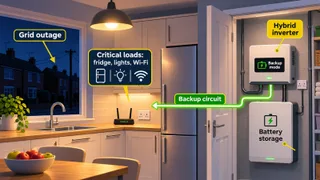
Yes. Battery storage can keep appliances and circuits running during a power cut if the system is designed and wired for backup. Even a fully charged battery fitted for solar storage or tariff savings may shut down when the grid fails. How long backup lasts depends on the charge when the cut starts, which circuits it supplies, how much power they draw and whether your solar panels can recharge the battery during the outage.
Start by deciding what needs to stay on and for how long. Keeping a fridge, router and a few lights running overnight calls for a different setup from starting a heat pump or keeping a business’s cold storage running.
How does a battery keep supplying power when the grid goes down?
Changeover equipment disconnects the backed-up circuits from the public network. The inverter then creates a local supply for those circuits. This is called island mode. The installer must design the earthing and electrical protection to work safely in island mode and during normal grid operation.
If you already have a battery, check the handover documents for details of the emergency power supply (EPS) outlet, gateway or changeover device, and the schedule of backed-up circuits. The inverter datasheet gives the EPS rating. The handover documents show whether backup was wired in and which sockets or appliances it supplies. If the paperwork is unclear, ask the installer to confirm the setup and demonstrate it.
Which circuits should you back up?
Choose the simplest setup that covers what you need to keep running. A dedicated socket can serve a few plug-in devices. Selected-circuit backup can keep fixed lighting and specific sockets live. Whole-property backup covers more circuits, within the inverter’s output and subject to any controls that switch off larger loads.
Overview
An electric shower or EV charger can make whole-property backup harder to size. Fridge compressors and pumps can draw substantially more power at start-up than while running. Ask what the inverter can supply continuously in island mode, what its surge rating is and how long it can sustain that surge.
Automatic changeover can briefly interrupt power. If a server or control system must stay online during the switch, check whether it can tolerate the specified transfer time. A dedicated uninterruptible power supply (UPS) can bridge the gap where needed.
How long will battery backup last?
Kilowatt-hours (kWh) measure the energy available to run your equipment. Kilowatts (kW) measure how much power the inverter can supply at once. Use energy consumption to estimate runtime. Check peak demand separately to see whether the inverter can start and run your equipment.
If 5 kWh is available to the backed-up circuits at the start of the cut, a steady 0.5 kW load could run for about ten hours, or a steady 1 kW load for about five hours, without solar recharge. If you base your estimate on the battery’s quoted usable capacity at full charge, account for its actual charge when the cut starts, the inverter’s own consumption and conversion losses.
Suppose a plug-in meter records a fridge using 0.32 kWh over eight hours as its compressor cycles. In the same period, a router drawing 10 W continuously uses 0.08 kWh, and 30 W of LED lighting used for four hours adds 0.12 kWh. Together, they use 0.52 kWh over eight hours, averaging 65 W. These figures are illustrative. Measure your fridge over several cycles and estimate how many hours you would use the lights during a cut. To check continuous output, add the fridge’s running demand to the 40 W drawn by the router and lights when both are on. Then check the compressor’s start-up demand against the inverter’s surge rating and how long it can sustain that output. A meter can record energy use in kWh across several cycles and still miss the brief start-up peak. Ask the installer to check the appliance’s start-up specifications or measure the peak where needed. Ask for a runtime estimate for an overnight or winter cut with no solar input. A higher backup reserve can leave more energy available when the cut starts, with less capacity available for everyday tariff savings.
Can solar panels recharge the battery during an outage?
Yes, if the installation can use solar generation in island mode. A conventional grid-connected solar inverter shuts down when it loses its grid reference. A compatible backup setup lets the panels supply loads or recharge the battery during a cut. For a retrofit, ask the installer to confirm that this works with your exact inverter model and the proposed wiring.
Ask whether the system can restart from solar after the battery reaches its shutdown threshold and what conditions it needs to do so. Roof orientation, shading and short winter days all affect how much solar energy is available during a cut. Base your minimum backup requirement on what the battery can supply for the time you need to cover.
When does battery backup make sense for a business or farm?
When assessing storage for a business, decide what must keep running, what can wait and what needs a controlled shutdown. A shop may need tills, networking and some lighting. A cold store may need compressors to restart in sequence, while a farm may need a pump to restart automatically. Sites with similar daily electricity use can have very different backup requirements.
Check which phase supplies each essential load. On a three-phase supply, a single-phase backup system may support selected circuits on one phase. Three-phase motors and other three-phase equipment need a system designed to supply them. Ask the installer to check starting current and what happens if several pieces of equipment try to restart at once. If cuts could last days, compare battery-only and generator-backed designs against the runtime you need, fuel arrangements and the order in which equipment must restart.
What should a UK battery backup quote include?
Give each installer the same brief. Include the circuits or appliances you need to keep running, the target runtime, any equipment that needs uninterrupted power and details of existing solar or storage. During the survey, the installer should check the supply phases, space at the consumer unit or distribution board, cable routes and how much rewiring is needed to group essential circuits.
Ask for an itemised quote covering changeover equipment, circuit alterations, earthing and commissioning. It should state the continuous and surge output in backup mode, the estimated energy available at the agreed reserve setting and whether solar charging works during an outage. For a retrofit, check whether you can keep the existing inverter and whether the quote covers all the equipment and wiring changes needed for backup.
Ask the installer which notification or application route applies for your distribution network operator (DNO), who will submit the paperwork and whether anything needs to be agreed before installation. The Energy Networks Association’s *Distributed Generation Connection Guide for G98 and G99* explains the routes in Great Britain. In Northern Ireland, check NIE Networks’ generation connection guidance. The installer should assess the proposed system alongside any existing generation, storage and export limit. Agree a simulated power cut at handover. Ask the installer to show which circuits stay live, demonstrate that representative loads start and run, and show how the system returns to grid operation. Get the backed-up circuit schedule and reserve settings in writing so you can check them later. If cuts are rare and you only need a few plug-in devices, get a quote for a dedicated backup outlet before paying for wider wiring changes. Use the Kilowatts.uk installer directory to find local battery installers. Give each the same circuit list and target runtime so you can compare their quotes. If you’re planning backup for your home, you can also arrange a free energy survey.
Solar comparison
Compare solar for your property
Enter your postcode to assess your roof, compare solar options and get quotes from UK installers.
- Free postcode start
- Home, business and industrial
- RoboMo™ maps your roof
See which panels fit your roof
Choose home, business or industrial, then enter your postcode. RoboMo maps the roof and ranks panel brands by fit.
1. Postcode Start the assessment for your property.
2. Pin the roof Mark the array on the map.
3. Compare RoboMo™ builds your options.

Battery ROI tool
See what a battery saves on your bill
Enter the day rate, off-peak rate and export rate. The calculator ranks batteries in the Kilowatts shop over 10 years. Home batteries also suit offices and small commercial sites.
Reading
Sources and further reading
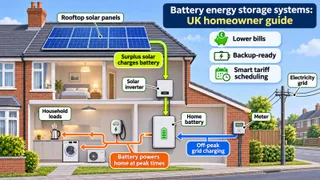
Compare battery energy storage systems for UK homes. Use your electricity readings and tariff to size a battery, estimate savings and check backup options.
Read article
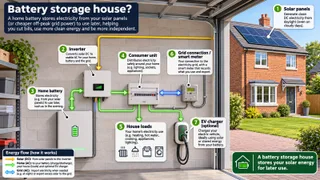
Find the right battery storage for your UK home. Use your tariff and electricity use to weigh up new solar, a battery retrofit or grid charging.
Read article
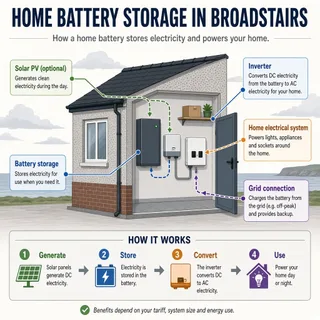
Home battery storage in Broadstairs depends on usable kWh, salt-air siting and UK Power Networks paperwork. Backup is not automatic in a power cut.
Read article
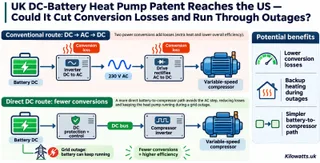
See how Digital Heat’s DC battery heat pump design could cut conversion losses and what would keep a UK home warm during a winter power cut.
Read article


Mo's Solar Mission
Mo's Mission Nominations
Garlinge Primary School and Nursery
Garlinge Primary School and Nursery is a foundation primary school on Westfield Road in Margate, Kent, for children aged 3 to 11. It is m...
St Luke's Church of England Primary SchoolSt Luke's Church of England Primary School is a voluntary controlled Church of England primary school on Jubilee Road in Formby, Merseysi...
Comberbach Nursery and Primary SchoolComberbach Nursery and Primary School is a primary academy on Mather Drive in the village of Comberbach, near Northwich in Cheshire, for...
Locations
Solar installation near you
Write for Kilowatts.uk
Got a trade and something worth saying?
Write it here under your own name. Sign in, put a profile up, and start a guide. Pay only if you want more links from your articles out to your own site.
Register
Create a Kilowatts.uk account, or sign in if you already have one.
Author profile
Put your name, photo and experience on a public author page.
Start creating
Write a guide or a blog. Free authors can put one followed link to their own site in articles each month.
FAQ
Need Help? RoboMo's Got Answers
Will my home battery work during a power cut?
It will if the system is designed and wired to provide backup power. A battery installed for solar storage or cheaper electricity may shut down when the grid fails, even if it is fully charged. Check your handover documents for a dedicated backup socket or a list of circuits that stay live.
Can a battery power my whole house during a power cut?
Some systems can back up the whole house, but the inverter limits how much you can run at once. High-power appliances such as an electric shower or EV charger may need to stay off. Backing up selected circuits can cover essentials such as the fridge, router and lights.
How long will a home battery last during a power cut?
Divide the energy available at the start of the cut in kilowatt-hours by the average power drawn in kilowatts. If 5 kWh is available to your appliances and they draw an average of 0.5 kW, that gives about ten hours without solar charging. If you start with the battery’s quoted usable capacity, allow for its actual charge, inverter consumption and conversion losses.
Can my solar panels recharge the battery during a power cut?
Yes, if your solar and battery system is set up to use solar power while disconnected from the grid. Ask your installer whether your inverter supports this and whether the system can restart from solar after the battery shuts down. For an overnight or winter outage, ask for a runtime estimate with no solar input.
Will battery backup switch on automatically during a power cut?
Some systems switch over automatically, while a dedicated backup socket may need to be activated manually. Even an automatic switch can briefly interrupt power and cause a router or computer to restart. If a device needs continuous power, check the changeover time and consider a suitable uninterruptible power supply.
Can I add power-cut backup to an existing solar or battery system?
It depends on your inverter, battery and wiring. Ask an installer to check the exact models and confirm whether you can keep your existing equipment. The quote should cover any changeover equipment and wiring needed to supply your chosen circuits.
Can a home battery run a heat pump during a power cut?
It can if the heat pump is on a backed-up circuit and the inverter can meet its running and start-up demands. Ask the installer to check those demands alongside any other appliances that might be running or starting at the same time. A heat pump can also shorten backup runtime, so include it in your runtime estimate.
What should I ask an installer to include in a battery backup quote?
Ask for an itemised quote that lists the backed-up circuits, continuous and surge power in backup mode, and estimated runtime at the agreed reserve setting. Check whether solar charging works during a cut and who will handle any required paperwork with your local network operator. Agree a simulated power cut at handover so you can see which sockets and appliances work.
Live help
Need help right now?
Talk to RoboMo™ and get instant answers.