


UK DC-Battery Heat Pump Patent Reaches the US - Could It Cut Conversion Losses and Run Through Outages?
Published: 2026-11-24 01:25:58
Updated: 2026-11-23 17:26:55
See how Digital Heat’s DC battery heat pump design could cut conversion losses and what would keep a UK home warm during a winter power cut.
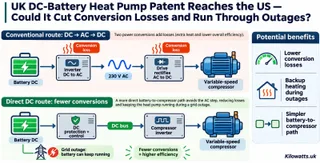
Digital Heat’s DC battery heat pump design explained in published US patent application
Digital Heat’s DC battery heat pump design could cut conversion losses when the compressor runs on stored electricity. It could also keep the heating on during a power cut if the battery can supply the compressor, pumps, controls and other equipment needed to deliver heat. US patent application US 2026/0348600 A1 was published on 5 November 2026 and claims priority from UK application 2306592.3, filed on 4 May 2023. UK product availability, measured savings and winter backup runtime remain unconfirmed. Published US patent application
Where direct DC could save electricity
A conventional battery stores electricity as direct current (DC). When it powers a standard AC-fed heat pump, the battery inverter converts DC to alternating current (AC). In many variable-speed heat pumps, the compressor drive converts that AC back to DC before producing the supply the motor needs. Digital Heat’s design feeds the battery into the DC side of the drive, bypassing the DC-to-AC-to-DC conversion. The motor still needs drive electronics, and the design can use a DC-to-DC converter to match voltages. US application, figures 3 and 4
The saving depends on how efficiently each power path operates at the heat pump’s working loads and how often the compressor draws from the battery. A fair comparison measures how much electricity each system uses to deliver the same amount of heat at the same outdoor and heating-water temperatures. It should cover a full charge and discharge cycle and account for circulation pumps, fans and defrost. Seasonal electricity use depends on how the whole system runs over the heating season. For context on household storage, see how AC and DC coupling affect the path electricity takes through a battery system.
What would keep the heating on in a power cut?
Home battery backup has to reach every component needed to deliver heat. Depending on the installation, that can include the compressor, controls, outdoor fan, circulation pumps and motorised valves. Ask whether the heat pump can complete a defrost cycle on backup and whether any electric boost heater is enabled, limited or disabled in that mode. The application also describes optional interfaces for powering other appliances. Each extra load leaves less energy and power for heating. US application, claims 10 and 11 and operating modes
If backup supplies any fixed wiring, ask the installer which circuits stay live and how the system isolates them from the public grid. Ask what provides the earth reference when the system runs independently in island mode. The installer should also explain how they will verify that protective devices disconnect the supply within the required time if a fault occurs. The Institution of Engineering and Technology’s guidance explains why protection must be assessed while the backup source is supplying the circuits. IET guidance on automatic disconnection in island mode
Available battery energy, measured in kilowatt-hours (kWh), and average electrical draw determine runtime. Discharge power, measured in kilowatts (kW), determines what can run at the same time. Take a hypothetical 10 kWh battery that starts at 80% charge and stops discharging at 20%, with both percentages based on the same 10 kWh capacity. That leaves 6 kWh before discharge losses. If 5.4 kWh reaches the equipment and the compressor, fan, pumps and controls average 1.8 kW on a cold day, including defrost, the estimated runtime is three hours. Check peak demand against both the continuous and short-duration ratings of the battery and its power electronics. A defrost cycle, an enabled boost heater or another backed-up load switching on can push demand above the system’s limit even when the battery has energy left. Ask how a lower starting charge affects runtime and how the temperature at the battery’s installed location affects available energy and power.
How solar charging and remote controls could work
The application describes optional solar charging and controls that could schedule battery use around weather forecasts or expected heating demand. Ask whether you can change the charge schedule and backup reserve, and which controls still work if the internet goes down. US application, claims 20 to 22 For a broader look at scheduling and coordinating household equipment, see how smart energy controls manage when equipment uses electricity.
If the design includes solar, ask the installer to show whether it can recharge the battery with the mains off and whether the system can restart after a low-charge shutdown. A simulated power cut at commissioning can also show which circuits stay live and how the system returns to normal when mains power comes back.
Estimate winter solar generation using the roof’s orientation, shading and the available daylight. If most winter charging would come from the grid, compare your actual peak and off-peak rates and account for storage losses. Keeping a larger reserve for outages leaves less capacity for shifting electricity use to cheaper hours.
What do we know about heat output and cost?
Rated heat output, measured seasonal performance and installed price for a UK product remain unknown. One claim specifies a battery capacity of at least 1.5 kWh. To size a system, ask for the heat output and electrical input at your property’s winter design conditions, along with the usable battery energy and discharge power available in backup mode. US application, claim 2
Energy Saving Trust provides indicative costs for conventional home battery storage. Those figures cover the battery installation. A quote for heating and backup may also include backup switching, consumer unit work and changes to the heat pump or radiators. Ask for these costs separately so you can compare quotes on the same basis. Energy Saving Trust battery storage guidance See what affects battery installation prices when reviewing the storage part of a quote.
Where could the design suit UK properties?
For a house, start with room-by-room heat loss and the water temperature the radiators or underfloor heating need on a cold day. Use those conditions to estimate the heat pump’s electrical demand before sizing the battery. A battery sized for a short interruption may run out well before morning. If you already have a heat pump, check whether its manufacturer supports the proposed battery and backup arrangement before paying for a retrofit design.
For a flat, a balcony survey should cover airflow, vibration, noise near neighbours’ windows, drainage for defrost water and access for servicing. Confirm permissions with the building owner or manager and check the applicable local planning requirements. Check the battery location against the manufacturer’s requirements for temperature, access and clearances.
For a small business, decide which areas need heat and which other circuits need power during an outage. Refrigeration starting while the heat pump is running can raise peak demand even if the average load looks manageable. Ask the installer to review the electrical supply, space in the distribution board and loads that could run at the same time. They should also confirm the applicable connection process for the proposed equipment with the local distribution network operator.
What to ask for if you are buying now
Give each installer the same brief. State which rooms need heat, which other circuits must stay live and how long you want the system to run on a cold day. Ask for a written estimate that specifies the starting charge, discharge cut-off, average electrical draw and peak load. If you need solar charging during an outage, include it in the commissioning tests.
Ask installers to use the same backup reserve when estimating tariff savings and outage runtime. That shows how much capacity is available for everyday savings once you’ve set aside energy for a power cut. If you’re just starting to assess your home’s options, you can book a home survey and bring the same brief.
Solar comparison
Compare solar for your property
Enter your postcode to assess your roof, compare solar options and get quotes from UK installers.
- Free postcode start
- Home, business and industrial
- RoboMo™ maps your roof
See which panels fit your roof
Choose home, business or industrial, then enter your postcode. RoboMo maps the roof and ranks panel brands by fit.
1. Postcode Start the assessment for your property.
2. Pin the roof Mark the array on the map.
3. Compare RoboMo™ builds your options.

Battery ROI tool
See what a battery saves on your bill
Enter the day rate, off-peak rate and export rate. The calculator ranks batteries in the Kilowatts shop over 10 years. Home batteries also suit offices and small commercial sites.
Reading
Sources and further reading
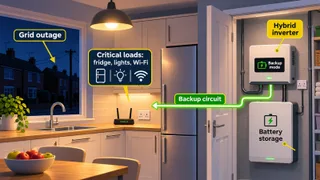
Plan battery storage for UK power cuts. Decide which circuits to keep live, estimate runtime without solar and see what to ask for in an installer quote.
Read article
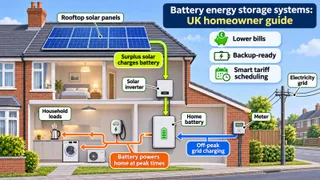
Compare battery energy storage systems for UK homes. Use your electricity readings and tariff to size a battery, estimate savings and check backup options.
Read article
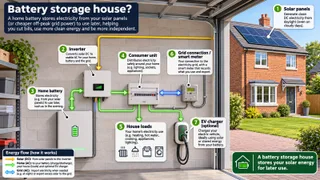
Find the right battery storage for your UK home. Use your tariff and electricity use to weigh up new solar, a battery retrofit or grid charging.
Read article

Heat pump demand peaks when UK solar output collapses. Here is how the two curves actually interact, where summer surplus goes, and what to plan for.
Read article


Mo's Solar Mission
Mo's Mission Nominations
Garlinge Primary School and Nursery
Garlinge Primary School and Nursery is a foundation primary school on Westfield Road in Margate, Kent, for children aged 3 to 11. It is m...
St Luke's Church of England Primary SchoolSt Luke's Church of England Primary School is a voluntary controlled Church of England primary school on Jubilee Road in Formby, Merseysi...
Comberbach Nursery and Primary SchoolComberbach Nursery and Primary School is a primary academy on Mather Drive in the village of Comberbach, near Northwich in Cheshire, for...
Locations
Solar installation near you
Write for Kilowatts.uk
Got a trade and something worth saying?
Write it here under your own name. Sign in, put a profile up, and start a guide. Pay only if you want more links from your articles out to your own site.
Register
Create a Kilowatts.uk account, or sign in if you already have one.
Author profile
Put your name, photo and experience on a public author page.
Start creating
Write a guide or a blog. Free authors can put one followed link to their own site in articles each month.
FAQ
Need Help? RoboMo's Got Answers
Can I buy Digital Heat’s DC battery heat pump in the UK?
UK availability, installed price and measured seasonal performance remain unconfirmed. The published US patent application describes the design and its possible features. It gives no timetable for a UK launch.
Would a direct DC battery heat pump use less electricity?
It could use less electricity when the compressor runs from the battery by avoiding the conversion from DC to AC and back to DC. The saving depends on how often the heat pump uses stored electricity and how efficient the electronics are at typical loads. Ask for a comparison that measures electricity use for the same heat output and includes battery charging losses, pumps, fans and defrost.
Will the heat pump keep my home warm during a power cut?
It could keep heating if the backup system can power the compressor, fan, controls, circulation pumps and any valves needed to deliver heat. Ask which circuits stay live, how the installer will isolate them from the grid and whether the heat pump can complete a defrost cycle on backup. Check whether any electric boost heater can run in that mode, as it can substantially increase demand.
How long could the battery run my heat pump in winter?
Divide the usable energy the battery can deliver during the outage, in kWh, by the average electrical draw of the heating equipment, in kW. For example, 5.4 kWh delivered to equipment drawing an average of 1.8 kW would give about three hours. Ask for a cold-day estimate that specifies starting charge, the minimum charge setting and the effect of battery temperature. Check that the system can also meet peak demand, including during defrost.
Can solar panels recharge the battery during a power cut?
That depends on whether the installed system can use solar power while disconnected from the grid. Ask the installer to demonstrate solar charging during a simulated power cut and confirm whether the system can restart after the battery shuts down at low charge. Winter output will depend on daylight, shading and roof orientation.
Can I add direct DC battery backup to my existing heat pump?
Compatibility depends on the heat pump model and the proposed backup system. Ask the heat pump manufacturer which arrangements it supports before paying for a retrofit design. If your priority is heating during outages, ask whether a compatible AC battery backup can supply the full heating system, including its peak electrical demand.
What should I ask installers to include in a quote?
Ask for heat output and electrical demand at your home’s winter design conditions, based on room-by-room heat loss and the water temperature your radiators or underfloor heating need. Tell each installer which circuits must stay live and how long you need backup on a cold day. Ask for itemised costs for the heat pump, battery, backup switching and any electrical or radiator work. Have each installer use the same battery reserve when estimating outage runtime and tariff savings.
Live help
Need help right now?
Talk to RoboMo™ and get instant answers.