


Compare ppa uk
Published: 2026-11-26 02:20:51
Updated: 2026-11-25 18:21:46
Compare UK business PPA quotes on a like-for-like basis. See how billable volumes, grid top-ups and buyout terms affect the full cost of each deal.
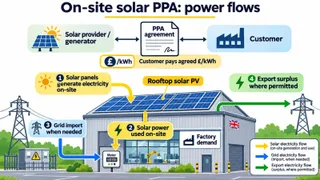
How to Compare UK Power Purchase Agreements: A Guide for Business Buyers
To compare UK power purchase agreements (PPAs), check which units you pay for, how the rate changes, what you still owe your electricity supplier and what it costs to exit. For on-site solar, compare the full cost of a PPA with buying the system outright and staying on grid supply. Use the same demand profile and grid price assumptions for all three options, and the same generation forecast for both solar options. For sleeved and virtual PPAs, compare the generator contract and your electricity supply costs together. Annual price increases, fees and charges for unused electricity can outweigh a low opening rate.
A PPA sets out how a buyer pays for electricity from a generator or, under a virtual PPA, settles payments against a market price. Under a typical on-site solar PPA, a third party funds and owns the panels. Your business pays for electricity as set out in the agreement, and your grid supplier covers any shortfall. The case for on-site solar is stronger if you have steady daytime demand, suitable roof space or land and control of the site for the contract term.
Which type of PPA fits your business?
An on-site solar PPA is worth pricing if you have room for panels and regularly use electricity during daylight hours. A private-wire PPA can connect a nearby generator directly to your premises if there is a viable cable route, the necessary access rights and a suitable backup supply. An off-site sleeved PPA can serve buyers with limited space or multiple sites. A supplier handles delivery and settlement through the public network. Ask which sites and meters the supplier can include and what happens if you add or close a site.
A virtual PPA is a financial agreement tied to generation. You arrange your electricity supply separately. Payments depend on the difference between the contract price and a market reference price, applied to the volume specified in the agreement. A payment you receive under the PPA may cover only part of an increase in your supply bill if the prices, periods or volumes used to calculate the two payments differ. Model both cash flows under the same scenarios. If your business already owns a generator and wants to sell surplus electricity, compare export PPA quotes on the price paid for exported units and the terms attached.
What does a UK solar PPA cost?
Ask each bidder for a dated, site-specific rate in pence per kilowatt-hour, the contract term and a sample invoice. If the rate is index-linked, check which index applies, when the first adjustment takes effect, how often the price changes and how any cap or floor works. Compare all options over the same period. Include replacement grid purchases after a shorter deal expires. For outright ownership, account for any remaining asset value or removal costs. Start with a forecast for grid supply alone. For each unit of solar power used on site, count the import charge it would avoid at the time it is generated. Include charges you will still pay, such as standing charges. For outright ownership, include installation, any financing costs, maintenance and expected component replacement. Use the same demand, grid price and inflation assumptions for each option when reviewing long-term solar savings projections.
Which electricity does an on-site solar PPA bill for?
Rooftop panels can supply a factory during daylight hours. The grid covers any shortfall and can take surplus electricity where export is permitted. The generation meter records solar output, while the grid metering records imports and exports. Ask the bidder to mark the meters on the site diagram and show which readings determine the bill. If there is a battery or more than one supply point, ask how the calculation assigns units to each source and accounts for charging and discharging.
On a sunny weekend when the factory is shut, the panels can still generate electricity while the building uses very little. A contract based on on-site consumption may charge for the small amount the factory uses. A gross-generation contract can also charge for power that goes to the grid. A minimum purchase commitment can trigger a separate payment if usage falls below the agreed threshold. Ask for a worked invoice for a shutdown weekend and check how it changes if an export limit forces the system to reduce output. Check whether the contract allows billing for estimated generation during a shutdown, outage or export restriction.
How to compare sleeved and virtual PPA quotes
For a sleeved PPA, ask the supplier to model a period when the generator produces less than your sites need and one when it produces more. Check what you pay for market top-ups, how the supplier credits or charges for surplus power and whether the sleeve price includes imbalance and administration fees. Ask who pays when generation or demand differs from the contract assumptions. If the supply contract ends before the PPA, check who can take over the sleeve and what it would cost to switch.
For a virtual PPA, ask for cash-flow examples that use the proposed settlement formula and your expected supply bill. Test what happens when the reference price is above or below the strike price, when output is low and when the reference price diverges from what you pay for electricity. Check the terms for negative prices, curtailment, collateral and early termination. Look at how large the payments could be and when they fall due, even if the central forecast looks favourable.
If you need the PPA for renewable electricity reporting, ask which Renewable Energy Guarantees of Origin (REGOs) are included, the generation periods they cover and who receives them. Check Ofgem’s REGO guidance and the rules of the reporting framework your business uses. Ask for evidence of certificate allocation or retirement where applicable, and confirm who can claim the associated generation. Put these terms in the agreement so you can verify them after delivery.
Can your site use the solar output?
Give each bidder the same half-hourly demand data where available and flag planned changes to shifts, machinery or opening hours. Ask how much solar output the site will use, how much it will export and how much generation it will lose to curtailment. A factory running weekday shifts and a grain store that uses most of its electricity around harvest can have similar annual consumption and very different solar savings. If you plan to add EV charging or electrify heating, tell bidders when you expect to use the extra electricity and ask for forecasts with and without it.
A site survey should cover roof condition, structural capacity, shading, usable area, cable routes and the proposed connection point in the building’s electrical installation. Ask who will check solar planning requirements and handle the application with the local distribution network operator. Consult the operator’s published guidance on generation connections and export limits. Ask the bidder what export limit the forecast assumes and get written confirmation of the permitted limit when available. If the site faces export restrictions, ask when the system is likely to reduce output and who bears the cost.
If a bidder includes a battery, ask to see the same forecast for solar alone. Check who controls charging and discharging, who pays for electricity used to charge the battery from the grid and how battery losses and operating limits affect the bill. An upcoming roof replacement, a short lease or a planned move may matter more than a small difference in the opening PPA rate.
How to choose a PPA provider and installer
Ask each bidder who owns the system, who installs it and who maintains it. When assessing commercial solar installers, request examples of comparable commercial installations, a layout and generation forecast for your site, and a schedule showing any shutdowns needed to connect the system. Check who handles faults, inverter replacement, insurance and maintenance access. If you expect roof work during the term, confirm who pays to remove and refit the panels and how billing works while the system is out of service.
Read the draft agreement alongside the financial model. Ask how the provider calculates the buyout price, what conditions apply if you need to transfer the agreement when you sell or move, and who is responsible for removing the equipment or reinstating the roof at the end of the term. Check landlord and lender consents early so bidders can account for them in the design and agreement.
Use Kilowatts.uk to compare solar for your business and shortlist providers with relevant commercial experience. Give each bidder the same site information and electricity data. Ask for a funded PPA quote and an outright purchase quote where available. Rerun the comparison with lower daytime demand and different grid prices. Before signing, check which assumptions would change your choice and whether the contract assigns those risks as described in the quote.
Solar comparison
Compare solar for your property
Enter your postcode to assess your roof, compare solar options and get quotes from UK installers.
- Free postcode start
- Home, business and industrial
- RoboMo™ maps your roof
See which panels fit your roof
Choose home, business or industrial, then enter your postcode. RoboMo maps the roof and ranks panel brands by fit.
1. Postcode Start the assessment for your property.
2. Pin the roof Mark the array on the map.
3. Compare RoboMo™ builds your options.

Battery ROI tool
See what a battery saves on your bill
Enter the day rate, off-peak rate and export rate. The calculator ranks batteries in the Kilowatts shop over 10 years. Home batteries also suit offices and small commercial sites.
Reading
Sources and further reading
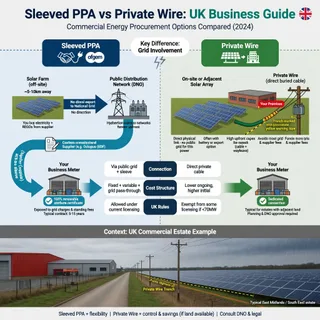
A sleeved PPA needs a UK supplier that will sleeve volume on the public network. A private wire needs an adjacent cable, land rights and a lawful supply.
Read article
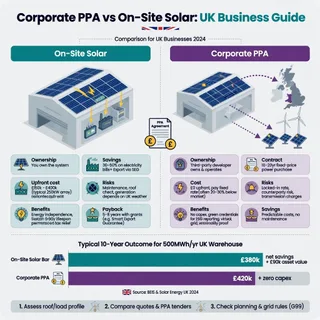
A corporate PPA is a multi-year contract for volume you still buy. On-site solar cuts import at one UK meter when generation and load coincide.
Read article
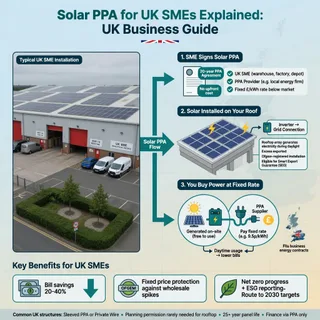
A solar PPA for UK SMEs is a contract to buy on-site generation from a funder that owns the plant. Weigh daytime load, roof rights and how long you stay.
Read article
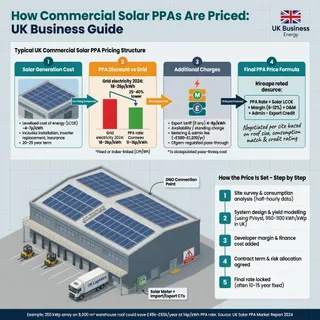
Commercial solar PPAs are priced from capital, yield, daytime load, credit and term, not a UK-wide tariff. Export is priced separately from on-site use.
Read article


Mo's Solar Mission
Mo's Mission Nominations
Garlinge Primary School and Nursery
Garlinge Primary School and Nursery is a foundation primary school on Westfield Road in Margate, Kent, for children aged 3 to 11. It is m...
St Luke's Church of England Primary SchoolSt Luke's Church of England Primary School is a voluntary controlled Church of England primary school on Jubilee Road in Formby, Merseysi...
Comberbach Nursery and Primary SchoolComberbach Nursery and Primary School is a primary academy on Mather Drive in the village of Comberbach, near Northwich in Cheshire, for...
Locations
Solar installation near you
Write for Kilowatts.uk
Got a trade and something worth saying?
Write it here under your own name. Sign in, put a profile up, and start a guide. Pay only if you want more links from your articles out to your own site.
Register
Create a Kilowatts.uk account, or sign in if you already have one.
Author profile
Put your name, photo and experience on a public author page.
Start creating
Write a guide or a blog. Free authors can put one followed link to their own site in articles each month.
FAQ
Need Help? RoboMo's Got Answers
What is a power purchase agreement and who is it suitable for?
A power purchase agreement (PPA) sets out how a buyer pays for electricity from a generator or settles payments linked to its output. Under a typical on-site solar PPA, a provider funds and owns the panels, and you pay for electricity as agreed in the contract. This can suit a business with regular daytime demand, a suitable site and control of the premises for the contract term.
How do I compare a solar PPA with buying panels or staying on grid supply?
Compare total costs over the same period using the same electricity demand and grid price assumptions. Use the same solar generation forecast for the PPA and purchase options. Include PPA rate increases, any fees and remaining grid charges, and factor in installation, maintenance and component replacement for outright ownership. Test how the results change if daytime demand falls or grid prices rise more slowly than expected.
Will I pay for solar electricity I do not use?
That depends on how the contract defines billable electricity. Some PPAs charge for electricity used on site, while others charge for all generation or impose a minimum purchase commitment. Ask for a worked invoice for a sunny day when the site is closed, and check who receives any export income.
How can I tell whether my site will use enough solar power?
Give each bidder the same half-hourly electricity data if available and flag any planned changes to opening hours, equipment or EV charging. Ask how much generation you would use on site, how much would be exported and how often an export limit could force the system to reduce output. Have the provider check the roof condition and shading before relying on the forecast.
How do I compare sleeved and virtual PPAs?
With a sleeved PPA, a supplier handles delivery through the public network, so compare the generator price alongside supplier fees and charges for shortfalls or surplus. With a virtual PPA, you arrange electricity supply separately and make or receive payments based on a market reference price. Model the PPA payments and supply bill together under several price and generation scenarios.
What happens if I sell the property, move out or need roof repairs?
Check whether the agreement can transfer to a new owner or occupier, whose consent is needed and how any early buyout is calculated. Ask who pays to remove and refit the panels for roof work and how billing works while the system is out of service. Confirm who handles removal and roof reinstatement at the end of the term.
Does a PPA include renewable electricity certificates?
Check whether the agreement includes Renewable Energy Guarantees of Origin (REGOs), which generation periods they cover and who receives them. If you need them for renewable electricity reporting, ask for evidence of allocation or retirement where applicable. Check the requirements of the reporting framework you use before relying on the certificates.
Live help
Need help right now?
Talk to RoboMo™ and get instant answers.